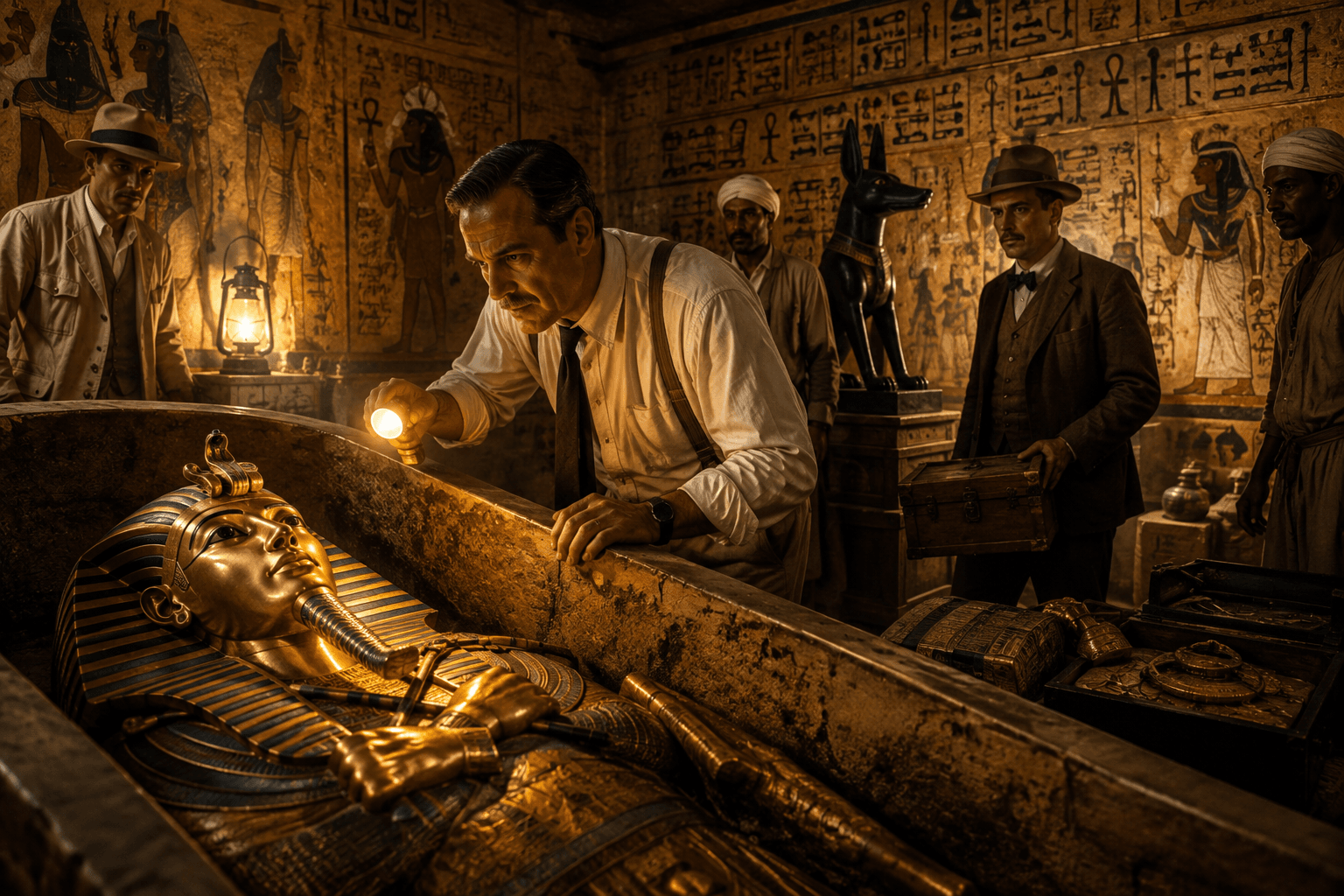

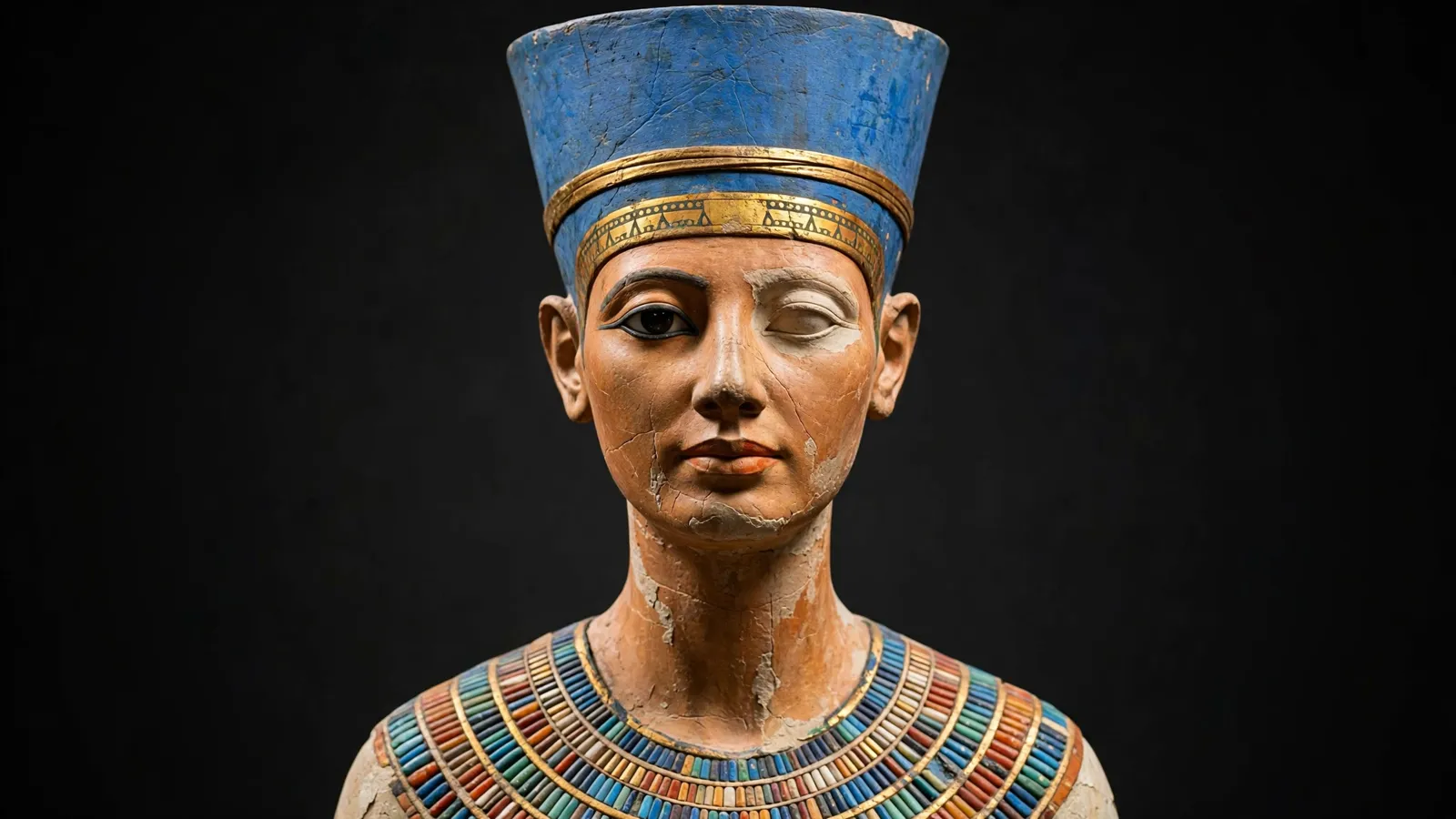
In 2015 the Egyptologist Nicholas Reeves proposed that Nefertiti lay behind a wall in Tutankhamun’s tomb. Radar surveys followed. The first seemed promising. Later, better surveys found nothing.
In 2023 Zahi Hawass said an announcement about her burial was four months away. In December 2024 he said he was fairly certain it would come in 2025.
Nothing came.
Nefertiti is the most recognisable face from ancient Egypt and one of the least documented people who wore it. We do not know where she was buried, how she died, or with certainty what happened in the last years of her life.
In brief: Nefertiti was the principal wife of the pharaoh Akhenaten, who ruled Egypt around 1353 to 1336 BC. She held unusual prominence in art and religion, and may have ruled as pharaoh herself after his death. Her tomb and her mummy have never been identified.
Myth Versus Evidence
| What is usually said | What the evidence shows |
|---|---|
| The Younger Lady mummy is Nefertiti | DNA published in 2010 identifies her as a daughter of Amenhotep III and Queen Tiye — Akhenaten’s sister. Nefertiti was never titled King’s Daughter |
| She is buried behind a wall in Tutankhamun’s tomb | An early radar scan looked promising. Two later, more rigorous surveys found no void |
| Her tomb is about to be announced | Announcements have been promised repeatedly since 2015. Nothing has been published where other Egyptologists can examine it |
| The Berlin bust is a portrait of her | It was found in a sculptor’s workshop and appears to be a master model for copying. One eye was never inlaid |
The Bust Is Not the Woman
Almost everything the public knows about Nefertiti comes from one object: a painted limestone bust found at Amarna in 1912 by a German expedition, now in the Neues Museum in Berlin.
It is worth knowing what that object actually is. It was found in the workshop of the sculptor Thutmose, and it appears to be a master model — a reference piece kept in the studio so other artists could copy the official likeness. Not a portrait made to be displayed.
One eye was never finished. The left socket has no inlay, which supports the workshop-model reading rather than the romantic explanations sometimes offered.
So the face everyone recognises is an idealised official image, produced to a standard, in a period when Egyptian art was deliberately breaking its own conventions.
What She Actually Did
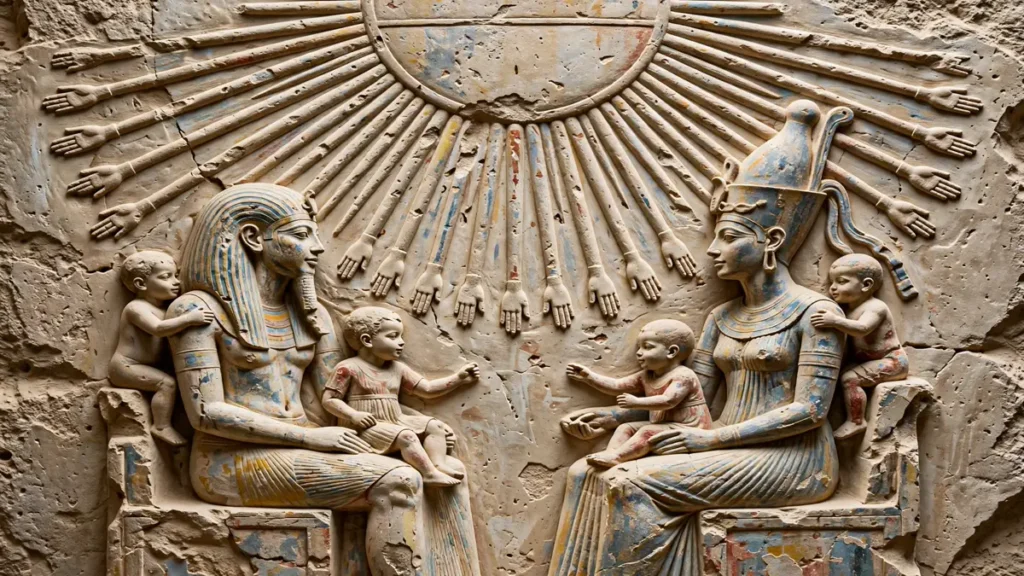
Nefertiti was the Great Royal Wife of Amenhotep IV, the pharaoh who renamed himself Akhenaten, abandoned Egypt’s traditional gods in favour of the Aten, and built a new capital in the desert.
That religious upheaval is described in our guide to the ancient Egyptian gods. What matters here is Nefertiti’s place in it.
She is not a background figure in the art of the period. She appears constantly, and in ways Egyptian queens did not usually appear.
- Shown making offerings directly to the Aten, a priestly act normally reserved for the king
- Depicted at the same scale as Akhenaten rather than smaller, as convention required
- Shown driving a chariot
- Depicted in the classic pose of a pharaoh striking a captive — an image otherwise exclusive to kings
Reliefs at Amarna show the royal family in domestic scenes that have no earlier parallel: Nefertiti and Akhenaten with their six daughters, sitting, holding them, under the rays of the Aten ending in small hands.
Whether this reflects genuine political power or an unusual religious role is debated. What is not debated is that it was irregular.
Did She Rule as Pharaoh?
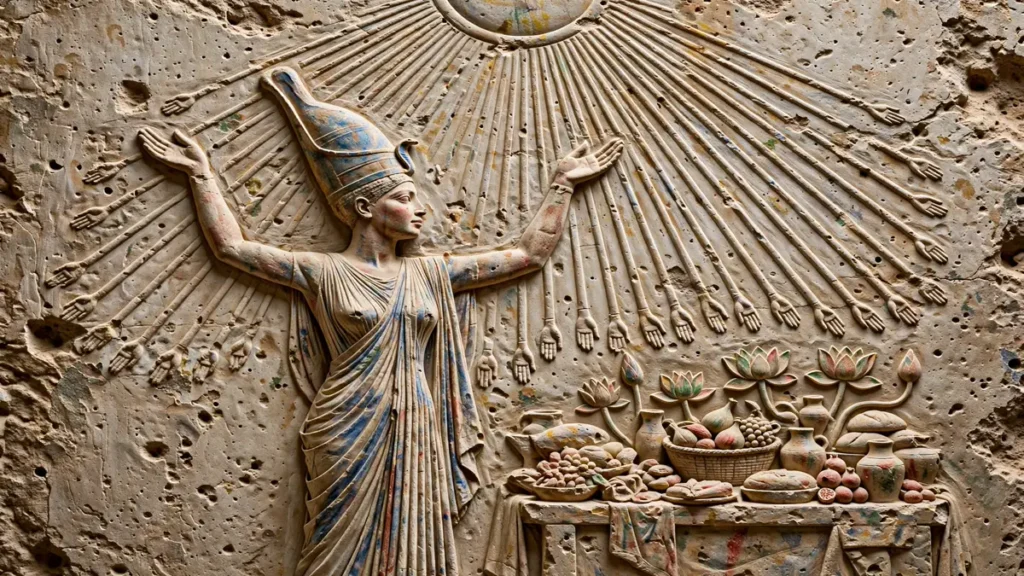
Around year 12 of Akhenaten’s reign, Nefertiti disappears from the record. For a long time this was read as her death or fall from favour.
The current leading interpretation is different, though not settled.
A figure named Neferneferuaten appears as co-regent and then as pharaoh in the closing years of the Amarna period. Several Egyptologists identify this ruler as Nefertiti under a new throne name — pointing to feminine grammatical endings in some of the inscriptions, and to epithets that echo hers.
Others identify Neferneferuaten as Meritaten, Nefertiti’s eldest daughter, or as a different figure entirely. The evidence is fragmentary and the debate is active.
If the Nefertiti identification is right, she would have ruled Egypt in her own name shortly before Tutankhamun took the throne — which would place her in the small group of women who held the office outright, alongside Hatshepsut and later Cleopatra.
The Search for Her Tomb
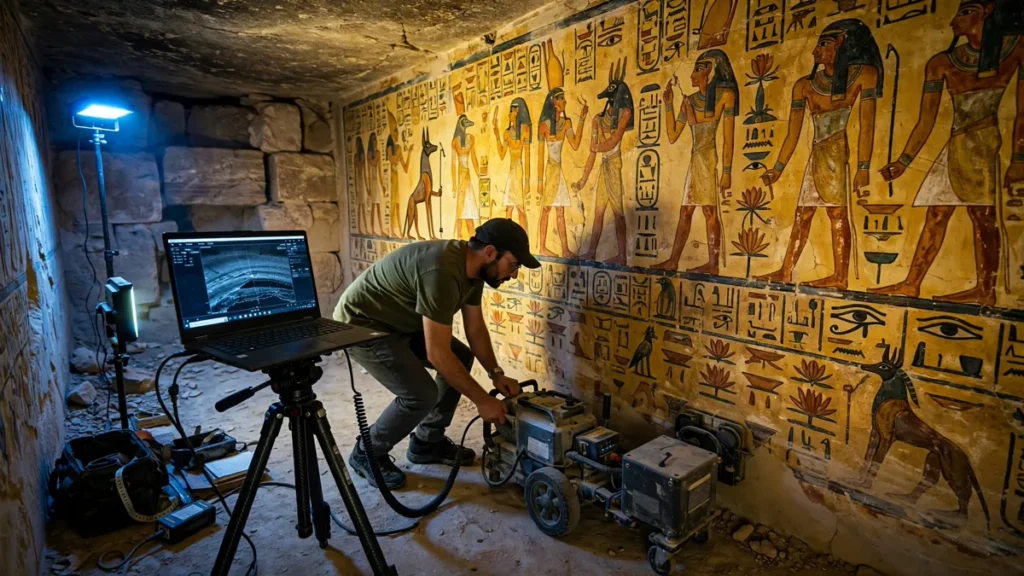
Nefertiti’s burial has never been found. Several candidates have been proposed and none has held up.
The candidates at a glance
| Candidate | Proposed by | Current status |
|---|---|---|
| Younger Lady, KV35 | Joann Fletcher, 2003 | Ruled out by published DNA |
| Hidden chamber, KV62 | Nicholas Reeves, 2015 | Not confirmed — later radar found nothing |
| KV21B | Various | Open but weak — age fits, nothing else does |
| Unlocated tomb at Amarna | — | Never found |
The Younger Lady — ruled out
In 2003 Joann Fletcher proposed that a mummy from tomb KV35, known as the Younger Lady, was Nefertiti. The claim received enormous coverage.
DNA testing published in JAMA in 2010 undermined it. The Younger Lady is the mother of Tutankhamun and a daughter of Amenhotep III and Queen Tiye — which makes her a sister of Akhenaten. Nefertiti never carried the title King’s Daughter, and no evidence places her in that family line.
The Egyptologist Marc Gabolde has challenged the interpretation of that DNA, arguing the genetic overlap could result from cousin marriage rather than sibling parentage. It remains a minority position.
The hidden chamber — not confirmed
Nicholas Reeves argued in 2015 that Tutankhamun’s tomb was originally cut for a woman and contains sealed doorways in its north and west walls.
An initial radar scan appeared to support it. A second, conducted with different equipment, did not. A third, more rigorous survey also found no evidence of a void.
Most specialists now consider the hypothesis unsupported. The wider excavation history of the area is covered in our article on the Valley of the Kings.
KV21B — open, and weak
Two female mummies from tomb KV21 have been suggested. One, KV21B, is estimated at around forty-five years old at death, which would fit.
But an age estimate is not an identification. The same body could be Mutnodjmet, Nefertiti’s sister, or any number of royal women whose burials were disturbed and moved in antiquity. No inscription connects it to her.
The Pattern of Announcements
This is worth naming directly, because it shapes what readers encounter online.
Claims that Nefertiti’s tomb is about to be revealed have appeared repeatedly over the past decade. In 2023, Zahi Hawass told media that an announcement was roughly four months away. In late 2024 he expressed confidence that it would come in 2025.
No such announcement has been published in a peer-reviewed venue, and no identified burial has been presented.
This is not an accusation of bad faith. Excavation genuinely is slow and results genuinely are uncertain. But a pattern of imminent announcements that do not arrive is a reason to treat the next one carefully rather than as news.
A useful test: has anything been published where other Egyptologists can examine the evidence? If not, it is a statement, not a finding.
The hidden-chamber proposal sits alongside several other widely repeated claims about ancient Egypt that did not survive careful measurement. We keep a running record of them in Ancient Egypt claims, checked, with what was announced set against what the evidence supports.
Why the Record Is So Thin
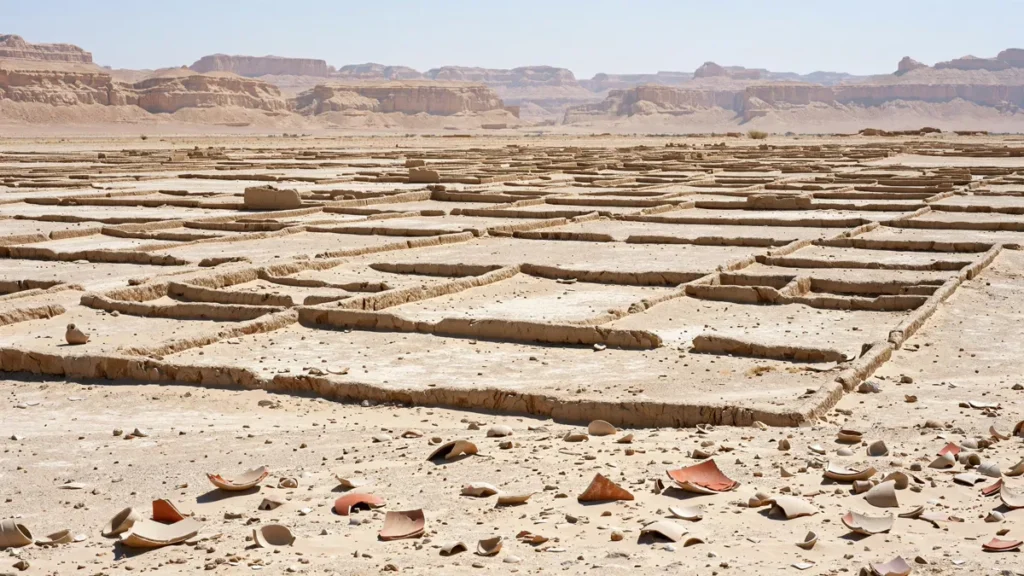
The gaps are not accidental.
After Akhenaten’s death, Egypt reversed his religious programme. The old gods were restored, the new capital at Amarna was abandoned within a generation, and the entire episode was treated as something to be undone.
Akhenaten’s monuments were dismantled and the blocks reused inside other structures. His name was struck from king lists. Later records refer to him, when they refer to him at all, as the enemy or the criminal of Akhetaten.
Nefertiti was erased alongside him — not for anything she did, but because the whole period was being removed. The practice of destroying a name to destroy a person is described in our article on Egyptian hieroglyphs.
Ironically, this is why the bust survives. It was left in a workshop at an abandoned site that nobody thought worth looting.
What We Know and What We Don’t
Established by evidence
- She was Great Royal Wife of Akhenaten, c. 1353–1336 BC
- She and Akhenaten had six daughters
- She appears in art performing acts normally restricted to the pharaoh
- She disappears from the record around year 12 of the reign
- The Berlin bust was found in the sculptor Thutmose’s workshop at Amarna in 1912
- The Younger Lady mummy is not her, according to published DNA work
- No radar survey has confirmed a hidden chamber in Tutankhamun’s tomb
Still unresolved
- Where she was buried
- Whether she ruled as the pharaoh Neferneferuaten
- How and when she died
- Whether she was Tutankhamun’s mother or his stepmother
- Her parentage, which is nowhere stated
Frequently Asked Questions
Who was Nefertiti?
The principal wife of the pharaoh Akhenaten, who ruled Egypt around 1353 to 1336 BC. She held unusual prominence in the art and religion of his reign and may have ruled as pharaoh in her own right after his death.
Has Nefertiti’s tomb been found?
No. Several candidates have been proposed, including a hidden chamber in Tutankhamun’s tomb and mummies from KV35 and KV21, but none has been confirmed. Repeated announcements that a discovery is imminent have not produced published evidence.
Is the Younger Lady mummy Nefertiti?
Almost certainly not. DNA published in 2010 indicates the Younger Lady was a daughter of Amenhotep III and Queen Tiye, making her Akhenaten’s sister and Tutankhamun’s mother. Nefertiti is never given the title King’s Daughter.
Was Nefertiti a pharaoh?
Possibly. A ruler named Neferneferuaten held the throne late in the Amarna period, and several Egyptologists identify this figure as Nefertiti under a new name, partly on the basis of feminine grammatical forms in some inscriptions. Others identify Neferneferuaten as her daughter Meritaten.
Where is the Nefertiti bust?
In the Neues Museum in Berlin. It was excavated at Amarna in 1912 by a German expedition and appears to have been a sculptor’s master model rather than a finished display piece — one eye was never inlaid.
Was Nefertiti Tutankhamun’s mother?
The published DNA evidence points to the Younger Lady as his mother, and she is identified as a sister of Akhenaten rather than as Nefertiti. Some researchers, notably Marc Gabolde, dispute that reading. On current evidence Nefertiti was most likely his stepmother.
Conclusion
Nefertiti is famous for a face, and the face is a workshop model with one eye missing.
What survives of her otherwise is a set of reliefs showing a queen doing things queens did not do, a disappearance from the record halfway through a reign, and a possible second identity as a ruling pharaoh that scholars have been arguing about for decades.
Her tomb may still be found. It has been about to be found for ten years.
Related
Hatshepsut: the woman who ruled as pharaoh →
Tutankhamun’s treasures
The gods of ancient Egypt, including the Aten
Cleopatra, the last pharaoh
Ancient Egypt claims, checked
Sources and Further Reading
- Neues Museum, Berlin — holder of the Nefertiti bust and its excavation record.
- Hawass, Z. et al. (2010). “Ancestry and Pathology in King Tutankhamun’s Family.” JAMA — the DNA study identifying the Younger Lady.
- Reeves, N. (2015). “The Burial of Nefertiti?” — the hidden chamber proposal, and the radar surveys that followed.
- Dodson, A., Amarna Sunset — standard treatment of the end of the Amarna period and the Neferneferuaten question.