
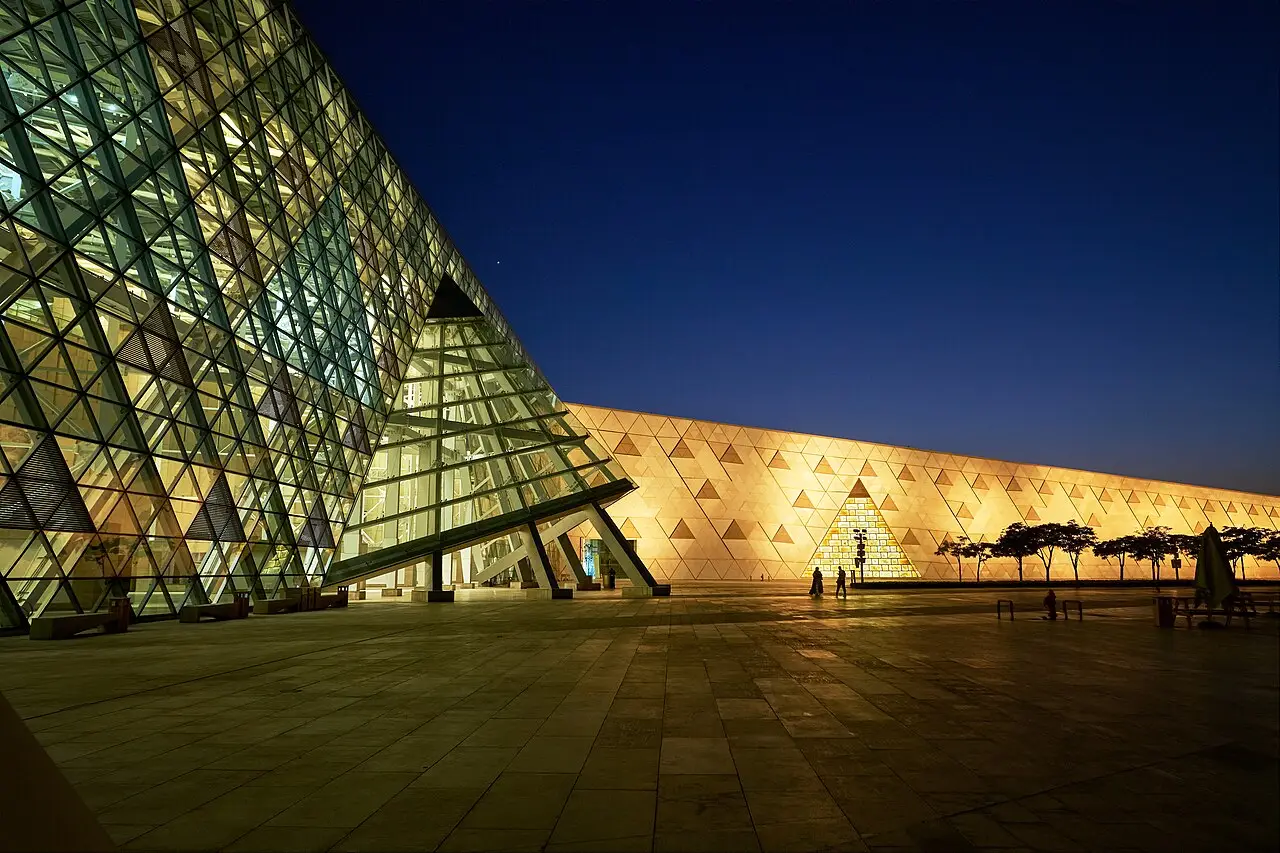
For more than a century, anyone who wanted to see Tutankhamun’s gold mask had to squeeze into a crowded, dimly lit hall in downtown Cairo. That changed on November 1, 2025, when Egypt officially opened the Grand Egyptian Museum, a vast stone-and-glass building at the edge of the Giza plateau, about 2 km (just over a mile) from the Great Pyramid.
It is the largest museum in the world devoted to a single civilization. Its collection runs to more than 100,000 objects, and for the first time since Howard Carter opened the boy king’s tomb in 1922, every one of Tutankhamun’s treasures is displayed in one place. Here is what is inside, what not to miss, what a visit costs, and why archaeologists see it as more than just a new home for old things.
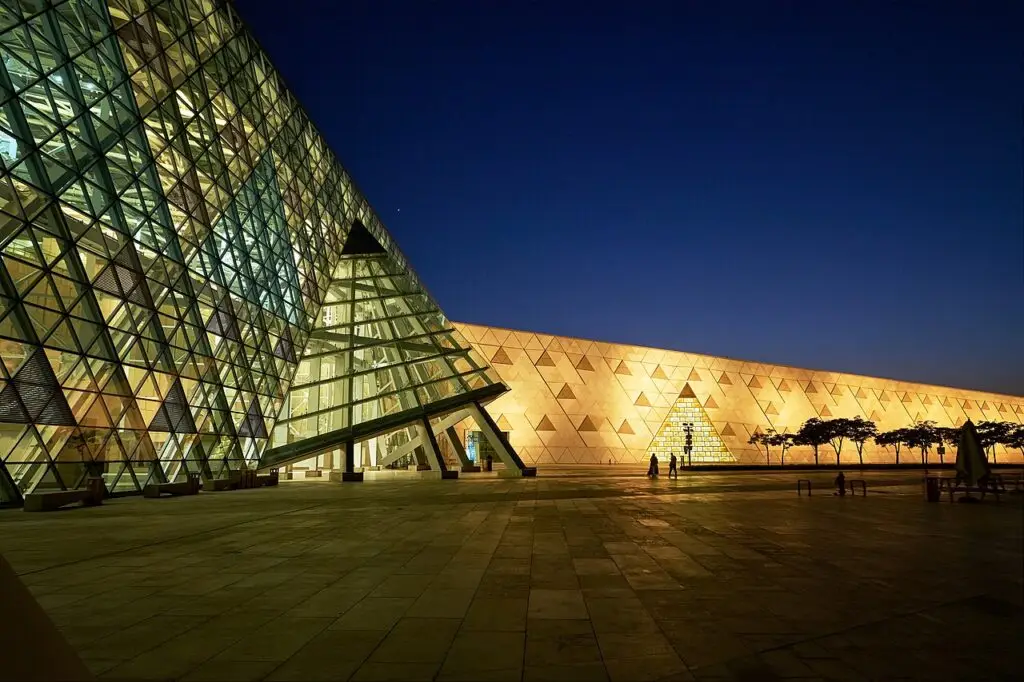
The Grand Egyptian Museum at a Glance
- Official opening: November 1, 2025 (open to the public from November 4, 2025). Some galleries had been open for limited tours since 2023–2024.
- Location: Giza, on the Cairo–Alexandria desert road, about 2 km from the Pyramids of Giza.
- Architects: Heneghan Peng Architects of Dublin, winners of an international competition. Construction began in 2005.
- Size: a site of roughly 120 acres (50 hectares), with 12 main exhibition galleries.
- Collection: more than 100,000 artifacts, tens of thousands of them on display.
- Star exhibits: the complete Tutankhamun collection (over 5,000 objects), the colossal statue of Ramesses II, the Grand Staircase, the hanging obelisk and Khufu’s 4,500-year-old boat.
- Also called: GEM, or the Giza Museum.
Why Egypt Built a New Museum
The old Egyptian Museum on Tahrir Square opened in 1902. It was built for a few thousand objects and ended up holding well over 100,000, many of them stacked in basements or displayed with typed labels that had not changed in decades. There was little room for proper climate control, conservation or modern displays, and Tutankhamun’s treasures were split between several rooms.
Planning for a new museum near the pyramids began in the 1990s. Egypt held an international design competition in 2002, and the Irish firm Heneghan Peng won with a building shaped like a wedge cut into the desert edge, its lines pointing toward the pyramids. Work started in 2005, but the project was slowed by the 2011 revolution, funding problems and the COVID-19 pandemic. The final cost is usually put at more than $1 billion, much of it financed by loans from Japan.
The Grand Hall and the Statue of Ramesses II
You enter into a huge, sunlit atrium. Standing in the middle is a colossal granite statue of Ramesses II, Egypt’s most famous warrior king. It is about 11 meters (36 feet) tall, weighs around 83 tons and is roughly 3,200 years old.
The statue has had a long journey. It was found broken in pieces near ancient Memphis in 1820, reassembled, and in 1955 placed in front of Cairo’s main railway station, in a square that took the name Ramses Square. Decades of traffic fumes and vibration were damaging it, so in 2006 it was moved to the Giza site, and in January 2018 it was carried into the museum’s atrium on a specially built platform.

The Grand Staircase
From the hall, a six-story Grand Staircase climbs toward the galleries. It is lined with dozens of large statues of kings, queens and gods, arranged roughly by theme: royal images, the gods, and the king’s role as servant of the gods. Walking up it feels like climbing through Egyptian history.
At the top, a wall of glass frames the Pyramids of Giza. The view was planned from the start: the building’s main lines all point toward the Great Pyramid of Khufu.

Tutankhamun’s Galleries: The Main Event
For most visitors, the reason to come is the boy king. When Howard Carter emptied Tutankhamun’s tomb between 1922 and 1932, he recorded more than 5,000 objects. Only part of them ever went on show in the old museum; many sat in storage for 100 years. At the GEM, the whole collection is displayed together across two large galleries.
Highlights include:
- The gold mask. Made of about 10 kg (22 lb) of gold inlaid with glass and semi-precious stones, it covered the head of Tutankhamun’s mummy. It moved from Tahrir Square to Giza for the full opening.
- The coffins. Tutankhamun was buried in three nested coffins. The innermost is solid gold and weighs about 110 kg (243 lb).
- The golden throne, showing the king and his queen, Ankhesenamun, under the rays of the sun disk.
- Chariots, beds, shrines, weapons, clothing, games and even the king’s sandals and walking sticks.
- Everyday objects such as food boxes, jars of wine and the silver and bronze trumpets that were famously played on BBC radio in 1939.
One thing you will not see is the king himself. Tutankhamun’s mummy still lies in his tomb, KV62, in the Valley of the Kings at Luxor. If you want the full story of the objects, see our guide to Tutankhamun’s treasures and the truth behind the curse of Tutankhamun.
The 12 Main Galleries
Above the staircase, 12 main galleries tell the story of ancient Egypt from prehistoric times to the Roman period, about 7,000 years of history. They are arranged both by period and by three big themes: society, kingship and beliefs. Expect early pottery and tools, Old Kingdom statues from the pyramid age, Middle Kingdom jewelry, New Kingdom royal art, coffins and mummy masks, and Greek and Roman portraits from Egypt’s last centuries.
Many of these objects came from the Tahrir museum, but others were brought from storerooms and regional museums across Egypt, and some have never been displayed before.
The Hanging Obelisk
Before you even reach the doors, look up. In the entrance plaza stands an obelisk of Ramesses II, brought from the ancient city of Tanis in the Nile Delta. Instead of resting on the ground, it is lifted on supports so you can walk underneath and see the king’s cartouche carved on its base, a part of an obelisk that is normally hidden forever. It is billed as the world’s first hanging obelisk.

Khufu’s Boat
Next to the main building is a separate gallery for one of the oldest and best-preserved ships in the world. In 1954, archaeologist Kamal el-Mallakh found a sealed pit beside the Great Pyramid containing a dismantled cedar boat, buried for Khufu around 2500 BC. Restorer Hag Ahmed Youssef spent years putting its 1,224 pieces back together. The finished boat is about 43.6 meters (143 feet) long.
For decades it sat in a small museum beside the pyramid. In August 2021 it was moved, in one piece, to the GEM on a remote-controlled vehicle, a delicate overnight journey. A second boat from a neighboring pit is being restored at the museum, and visitors can watch the work.

How the GEM Is Changing Egyptology
The museum is not only a showroom. Behind the galleries sits one of the largest conservation centers in the Middle East, with laboratories for wood, stone, textiles, organic remains and metal. Many of Tutankhamun’s objects were cleaned, studied and stabilized there before going on display, and researchers have used the move to re-examine pieces that had not been looked at closely since Carter’s time.
Keeping the whole Tutankhamun collection together also matters for scholars. Seeing every object from one tomb side by side helps archaeologists understand how a royal burial was planned, packed and in some cases rushed. The GEM has also renewed debate about famous Egyptian objects held abroad, such as the Rosetta Stone in London and the bust of Nefertiti in Berlin. Some Egyptian archaeologists have called for their return, while the museums that hold them argue they were acquired legally under the rules of the time.
Visiting the Grand Egyptian Museum: Tickets and Tips
Prices and hours change, so check the official ticket site, visit-gem.com, before you go. At the full opening in November 2025:
| Ticket (foreign visitors) | Price at opening |
|---|---|
| Adult, main galleries, unguided | 1,450 Egyptian pounds (about $30) |
| Child or student, unguided | 730 Egyptian pounds |
| Adult, guided tour | 1,950 Egyptian pounds |
| Children under 6 | Free |
- Hours: galleries were open 9 a.m. to 6 p.m. on most days, with late opening until 9 p.m. on Wednesdays and Saturdays.
- Time needed: allow at least three to four hours. Tutankhamun’s galleries alone can take over an hour.
- Book ahead: tickets are sold online for timed entry and are non-refundable.
- Photos: allowed for personal use, but no flash, tripods or selfie sticks.
- Combine it with the pyramids: the two sites are a short taxi ride apart, and many tours visit both in one day.
The old Egyptian Museum on Tahrir Square remains open with thousands of objects, while the royal mummies, including Ramesses II, moved in 2021 to the National Museum of Egyptian Civilization in Fustat.
Frequently Asked Questions
When did the Grand Egyptian Museum open?
The Grand Egyptian Museum officially opened on November 1, 2025, with a ceremony attended by world leaders, and opened to the public on November 4, 2025. Parts of the museum had been open for limited visits since 2023.
Is Tutankhamun’s mask in the Grand Egyptian Museum?
Yes. Tutankhamun’s gold mask, his gold coffins and the rest of his treasures were moved to the Grand Egyptian Museum. His mummy, however, remains in his tomb in the Valley of the Kings.
How far is the Grand Egyptian Museum from the pyramids?
About 2 km, or just over a mile. On a clear day you can see the pyramids from the top of the Grand Staircase.
Is the Grand Egyptian Museum the biggest museum in the world?
It is the largest museum in the world dedicated to a single civilization. Museums such as the Louvre are bigger overall but cover many cultures.
How long do you need at the Grand Egyptian Museum?
Plan at least three to four hours to see the Grand Staircase, Tutankhamun’s galleries and a few of the main galleries. A full day is not too much if you love ancient Egypt.
The Bottom Line
The Grand Egyptian Museum gives ancient Egypt the setting it deserves: the pyramids through the window, Ramesses II in the hall and Tutankhamun’s complete treasure shown together for the first time in a century. If you are planning a trip to Egypt, it now ranks alongside the pyramids and the Valley of the Kings as a must-see. If you are not, start with our list of Egyptian pharaohs to meet the kings whose treasures fill its halls.
Sources
- Encyclopaedia Britannica: Grand Egyptian Museum
- National Geographic: The Grand Egyptian Museum is opening in full
- Khaleej Times: Grand Egyptian Museum visitor guide (tickets and hours)
- Grand Egyptian Museum: official ticketing website
- Griffith Institute, University of Oxford: Tutankhamun, Anatomy of an Excavation