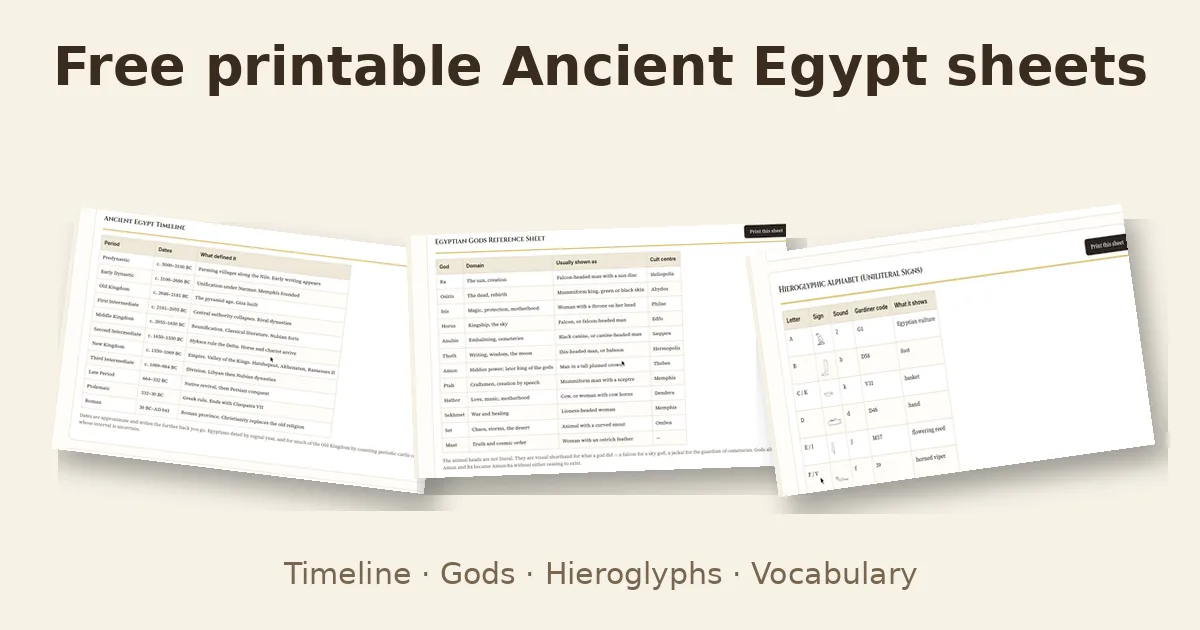
Five reference sheets for teaching ancient Egypt, each formatted to print cleanly on a single page. No sign-up, no download, no watermark — press the button on any sheet and your browser prints just that one, with the site credit at the foot.
They are written to be accurate rather than simplified. Where something is uncertain, the note under the table says so.
Ancient Egypt Timeline
| Period | Dates | What defined it |
|---|---|---|
| Predynastic | c. 5000–3100 BC | Farming villages along the Nile. Early writing appears |
| Early Dynastic | c. 3100–2686 BC | Unification under Narmer. Memphis founded |
| Old Kingdom | c. 2686–2181 BC | The pyramid age. Giza built |
| First Intermediate | c. 2181–2055 BC | Central authority collapses. Rival dynasties |
| Middle Kingdom | c. 2055–1650 BC | Reunification. Classical literature. Nubian forts |
| Second Intermediate | c. 1650–1550 BC | Hyksos rule the Delta. Horse and chariot arrive |
| New Kingdom | c. 1550–1069 BC | Empire. Valley of the Kings. Hatshepsut, Akhenaten, Ramesses II |
| Third Intermediate | c. 1069–664 BC | Division. Libyan then Nubian dynasties |
| Late Period | 664–332 BC | Native revival, then Persian conquest |
| Ptolemaic | 332–30 BC | Greek rule. Ends with Cleopatra VII |
| Roman | 30 BC–AD 641 | Roman province. Christianity replaces the old religion |
Dates are approximate and widen the further back you go. Egyptians dated by regnal year, and for much of the Old Kingdom by counting periodic cattle censuses whose interval is uncertain.
The Three Egyptian Seasons
| Season | Roughly | The river | The work |
|---|---|---|---|
| Akhet — Inundation | June – September | Flood covers the floodplain | No farming. Labour moved to state building projects |
| Peret — Emergence | October – February | Water recedes, leaving wet silt | Ploughing and sowing into the fresh deposit |
| Shemu — Low water | March – May | River at its lowest | Harvest, threshing, grain into state granaries |
Egypt had three seasons, not four, and all three were defined by the Nile rather than by weather. The flood came from the summer monsoon over the Ethiopian highlands, two thousand kilometres upstream.
Egyptian Gods Reference Sheet
| God | Domain | Usually shown as | Cult centre |
|---|---|---|---|
| Ra | The sun, creation | Falcon-headed man with a sun disc | Heliopolis |
| Osiris | The dead, rebirth | Mummiform king, green or black skin | Abydos |
| Isis | Magic, protection, motherhood | Woman with a throne on her head | Philae |
| Horus | Kingship, the sky | Falcon, or falcon-headed man | Edfu |
| Anubis | Embalming, cemeteries | Black canine, or canine-headed man | Saqqara |
| Thoth | Writing, wisdom, the moon | Ibis-headed man, or baboon | Hermopolis |
| Amun | Hidden power; later king of the gods | Man in a tall plumed crown | Thebes |
| Ptah | Craftsmen, creation by speech | Mummiform man with a sceptre | Memphis |
| Hathor | Love, music, motherhood | Cow, or woman with cow horns | Dendera |
| Sekhmet | War and healing | Lioness-headed woman | Memphis |
| Set | Chaos, storms, the desert | Animal with a curved snout | Ombos |
| Maat | Truth and cosmic order | Woman with an ostrich feather | — |
The animal heads are not literal. They are visual shorthand for what a god did — a falcon for a sky god, a jackal for the guardian of cemeteries. Gods also merged: Amun and Ra became Amun-Ra without either ceasing to exist.
Hieroglyphic Alphabet (Uniliteral Signs)
| Letter | Sign | Sound | Gardiner code | What it shows |
|---|---|---|---|---|
| A | 𓄿 | ʔ | G1 | Egyptian vulture |
| B | 𓃀 | b | D58 | foot |
| C / K | 𓎡 | k | V31 | basket |
| D | 𓂧 | d | D46 | hand |
| E / I | 𓇋 | j | M17 | flowering reed |
| F / V | 𓆑 | f | I9 | horned viper |
| G | 𓎼 | g | W11 | jar stand |
| H | 𓉔 | h | O4 | reed shelter |
| J | 𓆓 | ḏ | I10 | cobra |
| L | 𓃭 | l | E23 | recumbent lion |
| M | 𓅓 | m | G17 | owl |
| N | 𓈖 | n | N35 | water |
| O / U / W | 𓅱 | w | G43 | quail chick |
| P | 𓊪 | p | Q3 | stool |
| Q | 𓈎 | q | N29 | hill slope |
| R | 𓂋 | r | D21 | mouth |
| S | 𓋴 | s | S29 | folded cloth |
| T | 𓏏 | t | X1 | bread loaf |
| Y | 𓇌 | y | Z4 | double reed |
| Z | 𓊃 | z | O34 | door bolt |
| SH | 𓈙 | š | N37 | pool |
| CH / KH | 𓐍 | ḫ | Aa1 | placenta |
| AA | 𓂝 | ʿ | D36 | forearm |
These 23 single-consonant signs are what Egyptians used to spell foreign names. Egyptian wrote no vowels, so several English letters share one sign. Students can spell their own names with our online tool at egyptiansecrets.online.
Key Vocabulary
| Term | Meaning |
|---|---|
| Akhet | The inundation season, when the Nile flooded the fields |
| Ankh | Sign meaning life, carried by gods in art |
| Book of the Dead | Collection of funerary spells buried with the dead. Egyptian name: Coming Forth by Day |
| Canopic jars | Four jars holding the lungs, liver, stomach and intestines. The heart stayed in the body |
| Cartouche | Oval rope loop enclosing a royal name, believed to protect it |
| Cataract | Stretch of rapids on the Nile. The First Cataract at Aswan was Egypt’s southern frontier |
| Deshret | The red land — the desert either side of the floodplain |
| Determinative | Silent hieroglyph showing which meaning of a word is intended |
| Dynasty | Sequence of rulers grouped by the historian Manetho. Not always by family |
| Hieratic | Cursive script scribes used for everyday writing |
| Hieroglyph | Formal Egyptian writing sign. Can stand for a sound, a word, or act as a silent marker |
| Kemet | The black land — Egypt’s own name for itself, after the colour of Nile silt |
| Maat | Cosmic order, truth and balance. The king’s duty was to maintain it |
| Mastaba | Flat-roofed rectangular tomb, the form pyramids developed from |
| Natron | Naturally occurring salt used to dry the body during mummification |
| Nilometer | Graduated shaft or staircase for measuring flood height, used to set taxes |
| Nome | Administrative province. Egypt had 42, each under a governor called a nomarch |
| Papyrus | Writing material made from reed strips pressed into sheets |
| Pharaoh | From per-aa, meaning great house. Originally the palace, later the ruler |
| Sarcophagus | Outer stone coffin containing the nested inner coffins |
| Scribe | Literate official. Perhaps one per cent of Egyptians could read |
| Shabti | Small figurine buried with the dead to perform labour on their behalf |
| Stele | Upright inscribed stone slab, used for decrees, boundaries and tombs |
| Vizier | Head of the administration, reporting only to the king |
Terms are given in the spellings most common in English-language sources. Egyptian words are transliterations, so you will see variants — shabti and ushabti, for instance, are the same thing.
Using These in Class
The sheets map onto the ancient civilisations units taught in most middle-school curricula. A few suggestions on how they fit together.
Start with the seasons, not the pyramids
The three-season sheet explains almost everything else. Once students understand that the flood made farming impossible for three months a year, the availability of pyramid labour stops being mysterious, and so does the tax system.
The timeline handles the scale problem
Students routinely picture Cleopatra and the pyramid builders as contemporaries. They are separated by about 2,500 years — a longer gap than between Cleopatra and the present day. Putting the periods side by side on one page makes that visible.
The alphabet sheet is the one they will use
Spelling their own names is the activity that tends to land. Worth saying explicitly that Egyptian wrote no vowels, which is why C and K share a sign and why the result is an approximation rather than a translation. Our online name tool does the same thing and shows the sign breakdown.
For assessment, the ten-question quiz targets the misconceptions most textbooks repeat, and every answer comes with an explanation of the evidence.
Permissions
These sheets may be printed and distributed freely for classroom use. Please leave the site credit at the foot of each sheet in place. If you find an error, tell us and it will be corrected.
Frequently Asked Questions
Are these free to use in class?
Yes. Print and distribute them freely for teaching. There is no sign-up and no download. The only request is that the site credit at the foot of each sheet stays in place.
How do I print just one sheet?
Press the Print this sheet button on that sheet. Your browser’s print dialogue opens with only that sheet on the page — navigation, menus and the other sheets are hidden automatically.
What age group are these for?
They suit middle-school ancient civilisations units and upper primary, and the vocabulary sheet is useful at secondary level too. The content is accurate rather than simplified, so it does not need correcting later.
Why are the dates marked approximate?
Because Egyptian chronology is reconstructed rather than recorded. Old Kingdom dates rest on cattle-count records whose interval is uncertain, so estimates vary by decades between sources. Later periods can be cross-checked and are much firmer.