Ancient Egypt had no fixed pantheon. Different cities taught different accounts of how the world began, and a god who was minor in one place could be the creator in another. The table below covers 36 gods and goddesses you are most likely to meet, with what each one governed, how to recognise them, their family, and where they were worshipped.
| God | Domain | Shown as | Family | Main cult centre |
|---|---|---|---|---|
| AtumTem | The first god, and the setting sun | Man in the double crown; sometimes a serpent or a scarab | Self-created from Nun. Father of Shu and Tefnut | Heliopolis |
| Shu | Air, light and the space between earth and sky | Man with an ostrich feather on his head, arms raised | Son of Atum. Consort of Tefnut. Father of Geb and Nut | Heliopolis |
| TefnutTefenet | Moisture and dew | Lioness, or lioness-headed woman | Daughter of Atum. Consort of Shu. Mother of Geb and Nut | Heliopolis |
| GebSeb | The earth | Man lying beneath the arched sky, often with green skin | Son of Shu and Tefnut. Consort of Nut. Father of Osiris, Isis, Set and Nephthys | Heliopolis |
| NutNuit | The sky | Woman arched over the earth, her body covered in stars | Daughter of Shu and Tefnut. Consort of Geb | Heliopolis |
| OsirisUsir, Wesir | King of the dead, and of resurrection | Mummiform man with green or black skin, crook and flail, atef crown | Son of Geb and Nut. Consort of Isis. Father of Horus | Abydos |
| IsisAset, Iset | Magic, kingship and motherhood | Woman with the throne hieroglyph on her head; later with cow horns and sun disc | Daughter of Geb and Nut. Consort of Osiris. Mother of Horus | Philae; Behbeit el-Hagar |
| SetSeth, Sutekh | Storms, the desert, disorder and foreign lands | The “Set animal” — a creature no one has identified: curved snout, square ears, forked tail | Son of Geb and Nut. Consort of Nephthys | Ombos; Avaris |
| NephthysNebet-het | Mourning, and protection of the dead | Woman wearing her name sign: a basket above a house | Daughter of Geb and Nut. Consort of Set. Sister of Isis | Heliopolis; worshipped with Isis |
| Ptah | Creation by thought and speech; craftsmen | Mummiform man with a straight beard, holding was, djed and ankh | Consort of Sekhmet. Father of Nefertem | Memphis |
| AmunAmon, Amen | The hidden one; later king of the gods | Man in a tall double-plumed crown, or ram-headed | One of the Ogdoad with Amaunet. Later consort of Mut, father of Khonsu | Thebes (Karnak) |
| KhnumKhnemu | Shaping human beings; the Nile’s source | Ram-headed man, often at a potter’s wheel | Consort of Satet and Anuket at Elephantine | Elephantine; Esna |
| NeithNet | War, weaving and creation | Woman in the red crown, with crossed arrows and a shield | Sometimes called the mother of Ra or of Sobek | Sais |
| RaRe, Ra-Horakhty | The sun, and the order of the cosmos | Falcon-headed man crowned with the sun disc and a cobra | Father of Shu and Tefnut in some traditions; merged with Atum and later Amun | Heliopolis |
| HorusHeru, Hor | The sky, and kingship itself | Falcon, or falcon-headed man in the double crown | Two distinct gods share the name. Horus the Elder is an ancient sky god; Horus son of Osiris and Isis avenged his father | Edfu; Hierakonpolis |
| KhonsuChons | The moon, and healing | Youth in a side-lock with a lunar disc and crescent | Son of Amun and Mut | Thebes (Karnak) |
| AtenAton | The visible disc of the sun | The disc alone, its rays ending in human hands | No family. Akhenaten made it the sole god and closed other temples | Akhetaten (Amarna) |
| AnubisAnpu, Inpu | Embalming, and guarding the necropolis | Canine-headed man, or a recumbent black canine — jackal or African wolf, still debated | Parentage changed over time: son of Ra in early texts, of Hesat or Bastet in the Coffin Texts, and of Osiris and Nephthys only in later Greek-period sources | Cynopolis |
| ThothDjehuty | Writing, knowledge, the moon and the verdict | Ibis-headed man, or a seated baboon | Sometimes called self-created; consort of Seshat or Maat in different traditions | Hermopolis |
| MaatMa’at | Truth, balance and cosmic order | Woman with a single ostrich feather on her head | Called a daughter of Ra. Also a principle rather than only a person | No major temple of her own |
| SokarSeker | The Memphite necropolis and its workshops | Falcon-headed mummiform man, often on a funerary barque | Later merged into the single figure Ptah-Sokar-Osiris | Memphis (Saqqara) |
| WepwawetUpuaut | “Opener of the ways” — the road ahead, in war and in death | Standing canine on a standard, usually grey or white | Often confused with Anubis; a separate god with his own cult | Asyut |
| AmmitAmmut | Devourer of hearts that failed the weighing | Crocodile head, lion forepart, hippopotamus hindquarters | Never worshipped and had no temple. She was a consequence, not a deity to pray to | None |
| BastetBast | The home, women, and protection | Cat, or cat-headed woman; in earlier periods a lioness | Called a daughter of Ra | Bubastis |
| TaweretTaurt, Thoeris | Pregnancy and childbirth | Upright hippopotamus with a lion’s limbs and a crocodile’s back | No fixed family. Worshipped in houses rather than temples | Household shrines across Egypt |
| Bes | The household, childbirth and sleep | Dwarf with a lion’s mane and features, tongue out, often with a tambourine | No mythology of his own, which is unusual for so popular a god | Household shrines across Egypt |
| WadjetUto, Buto | Protector of Lower Egypt and of the king | Rearing cobra — the uraeus worn on the royal brow | With Nekhbet forms “the Two Ladies” of the royal titulary | Buto |
| Nekhbet | Protector of Upper Egypt and of the king | Vulture, often with wings spread above the king | With Wadjet forms “the Two Ladies” | Nekheb (El Kab) |
| SekhmetSakhmet | War, plague, and the cure for both | Lioness-headed woman with a sun disc | Consort of Ptah. Mother of Nefertem | Memphis |
| HathorHet-Heru | Love, music, motherhood; and the welcome of the dead | Cow, or woman with cow’s horns and a sun disc between them | Called mother, wife or daughter of Horus depending on the period | Dendera |
| Mut | Motherhood and queenship | Woman in a vulture headdress and the double crown | Consort of Amun. Mother of Khonsu | Thebes (Karnak) |
| NefertemNefertum | The lotus, and the first sunrise | Youth with a lotus blossom on his head | Son of Ptah and Sekhmet | Memphis |
| SobekSuchos | The crocodile; royal power and fertile water | Crocodile, or crocodile-headed man | Sometimes called a son of Neith | Kom Ombo; the Faiyum |
| HapiHapy | The inundation — not the Nile river itself | Man with a heavy belly and breasts, blue or green, carrying offerings | No settled family. Often shown as a pair, binding Upper and Lower Egypt together | Aswan; Gebel el-Silsila |
| Min | Fertility, the harvest, and the eastern desert roads | Standing man with one arm raised holding a flail, ithyphallic | Later identified with Amun as Amun-Min | Coptos; Akhmim |
| ApepApophis, Apofis | Chaos, and the enemy of the sun | Enormous serpent | Had no family and no worship. Rituals existed only to destroy him nightly | None — the opposite of a cult |
Groupings are for navigating the table, not Egyptian doctrine. Most of these gods overlapped, merged and changed roles across three thousand years.
Why there is no single family tree
Four cities taught four different creation stories, and all four were current at the same time. Egyptians did not treat this as a contradiction to be resolved.
| City | Creator | How creation happens |
|---|---|---|
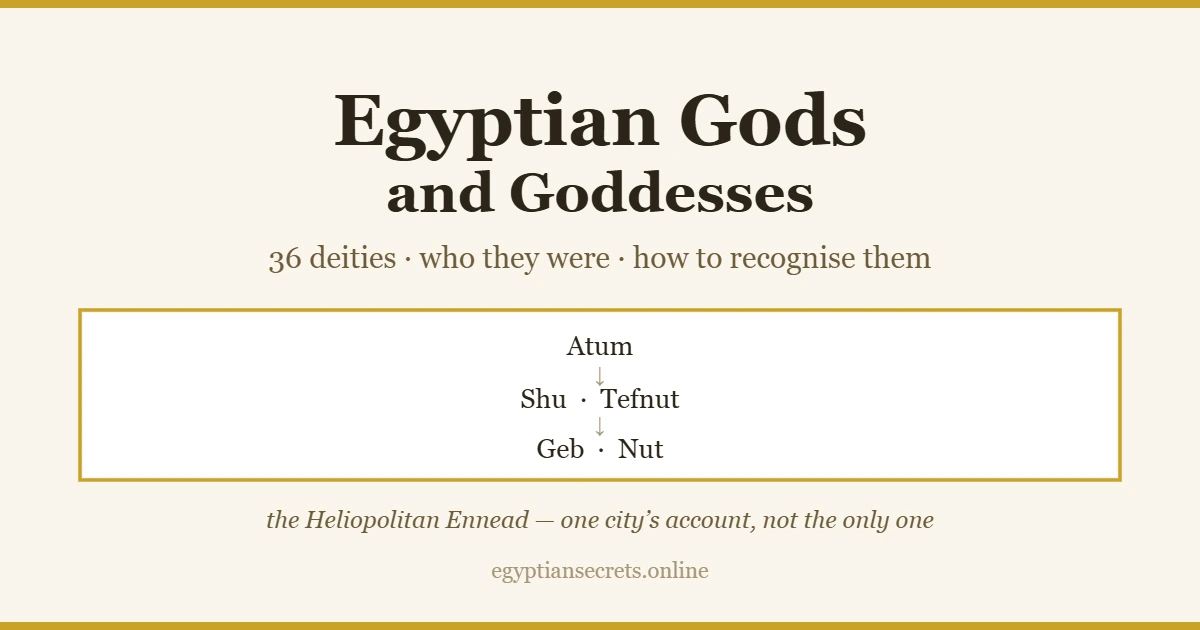
| Heliopolis | Atum | Atum emerges from the waters of Nun and brings forth Shu and Tefnut from his own body. Their descendants form the Ennead. |
| Hermopolis | The Ogdoad | Eight gods in four pairs — Nu and Naunet, Huh and Hauhet, Kek and Kauket, Amun and Amaunet — embody the qualities of the primeval water. The males are frogs, the females snakes. |
| Memphis | Ptah | Ptah thinks the world in his heart and speaks it with his tongue. Creation by mind and word rather than by body. |
| Thebes | Amun | Amun is the hidden force behind everything, including the other creators. One account has creation begin with the call of a goose across the still water. |
The Memphite priesthood did not deny the Ennead. They said Ptah’s thought caused Atum and the Ennead to exist — absorbing the older story rather than replacing it. Amun’s priesthood at Thebes later did the same thing to everyone else.
So when you see a single neat Egyptian family tree, it is almost always the Heliopolitan one, presented as though it were the only one.
Six things usually stated wrongly
Horus is not one of the nine. The Ennead is Atum, Shu, Tefnut, Geb, Nut, Osiris, Isis, Set and Nephthys. Horus, son of Osiris and Isis, is attached to the tradition but is not a member. Most published family trees add him as a tenth.
Anubis’s parents changed. “Son of Osiris and Nephthys” is stated everywhere as fact. It is a late tradition, reported by Plutarch in the Greek period. Early Egyptian sources call Anubis a son of Ra; the Coffin Texts make him the son of the cow goddess Hesat, or of Bastet. The Osirian parentage looks like a later attempt to fit an older, independent god into the Osiris story.
Hapi is the flood, not the river. He is the god of the annual inundation — the event, not the water. Calling him “god of the Nile” misses what the Egyptians were actually anxious about, which was whether the flood would come high enough.
Set is not the Egyptian devil. He murders Osiris, and in later periods he was genuinely demonised. But for most of Egyptian history he also stood in the bow of Ra’s boat each night and speared Apep, the serpent of chaos. Two pharaohs were named after him. The flattening of Set into pure evil is largely a Late Period development.
Bastet was a lioness first. The gentle cat goddess is the later form. In earlier periods she was a lioness, closer to Sekhmet, and the softening happened over centuries.
Ammit was never worshipped. She has no temple, no priesthood and no prayers, because she was not that kind of figure. She sat beside the scales as a consequence: if the heart failed, she ate it.
How to recognise a god you do not know
Egyptian art is a labelling system, not a portrait gallery. Four things identify almost any figure.
The head. An animal head names the god: ibis is Thoth, jackal is Anubis, falcon is Horus or Ra, ram is Khnum or Amun, lioness is Sekhmet or Tefnut, crocodile is Sobek.
What sits on the head. A throne is Isis. A sun disc between cow’s horns is Hathor, or Isis in later art. An ostrich feather is Maat. A lotus is Nefertem. Tall double plumes are Amun.
What the figure holds. A crook and flail mean kingship, usually Osiris. A was sceptre means power; an ankh means life. Ptah holds all three at once.
The body shape. A mummiform body means the dead or the buried — Osiris, Ptah, Sokar. Where a god is shown as a dwarf, it is Bes.
Frequently Asked Questions
How many Egyptian gods were there?
There is no complete count. Scholars have catalogued well over a thousand names, but many are local forms of the same god, or names that appear once in a single text. The 36 in the table above are the ones with substantial cults, surviving temples or major roles in the myths.
Who was the most important Egyptian god?
It depends on when you ask. Ra dominated the Old Kingdom, Osiris rose through the Middle Kingdom, Amun-Ra ruled the New Kingdom, and for about twenty years under Akhenaten the Aten displaced all of them. No single god held the position for three thousand years.
What is the Ennead?
The nine gods of Heliopolis: Atum, his children Shu and Tefnut, their children Geb and Nut, and their four children Osiris, Isis, Set and Nephthys. It is the best-known Egyptian genealogy, but it is one city’s account, not a national creed.
Are Ra and Amun the same god?
They began as separate gods and were merged. As Thebes gained power its local god Amun was combined with the older sun god Ra to form Amun-Ra. Egyptian religion did this often: gods were fused rather than replaced, and both names survived.
Why do Egyptian gods have animal heads?
The animal names the quality, not the appearance. A falcon head marks a god who sees and strikes from above; a jackal head marks the animal that haunted the desert cemeteries. Egyptians did not believe their gods literally looked like this — the images are written statements about what the god is.
Which Egyptian god judged the dead?
Osiris presided, Anubis performed the weighing, Thoth recorded the result, and Maat’s feather sat in the other pan. Ammit waited beside the scales for a heart that failed.
Related
Ancient Egyptian gods: the fuller story →
Religion of ancient Egypt
Anubis
The Book of the Dead
Ancient Egypt claims, checked