
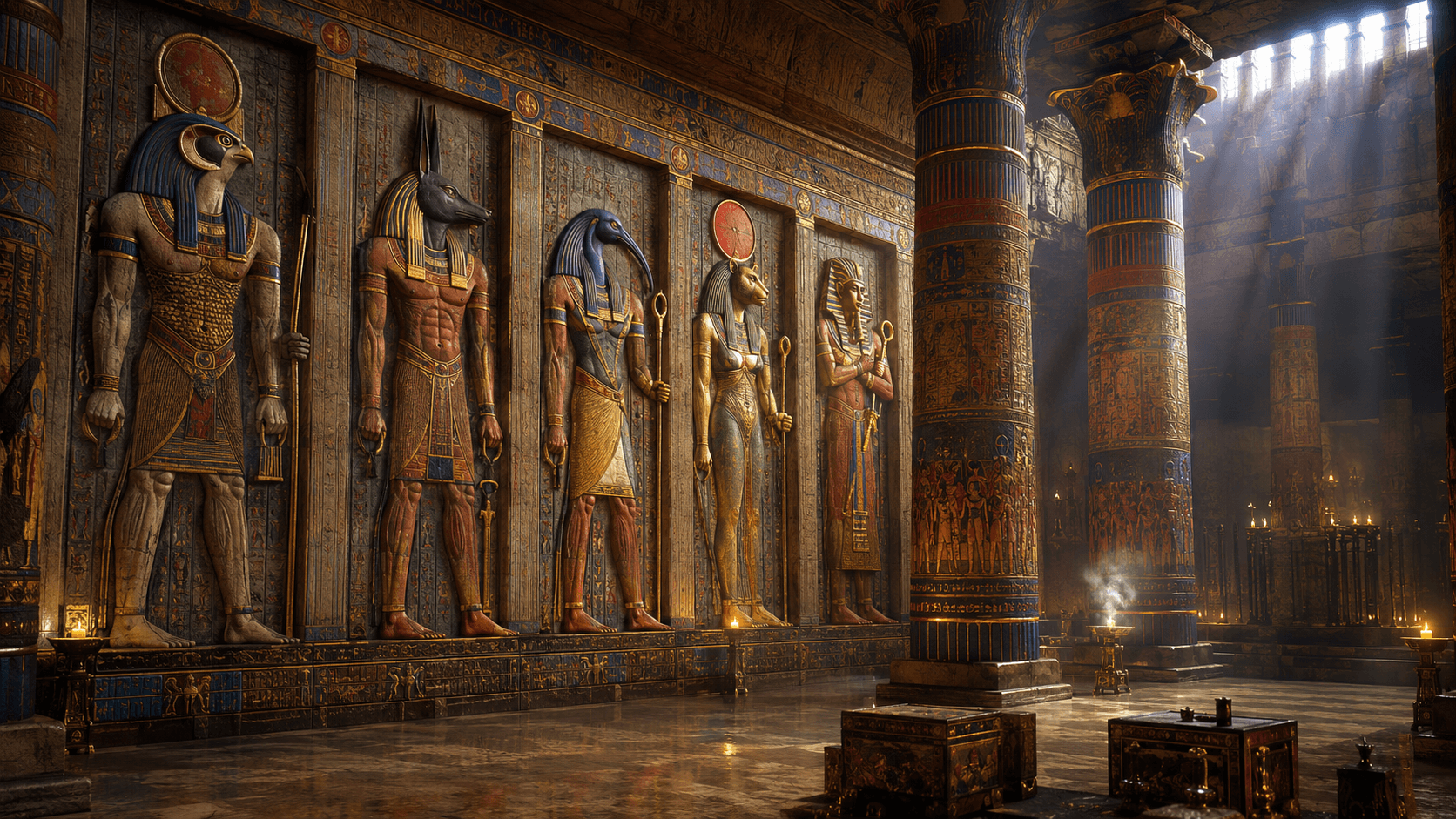
Egyptologists have catalogued well over a thousand named ancient Egyptian gods. Some presided over the sun and the cosmos. Others watched over a single village, a particular illness, or the doorway of a house.
No Egyptian ever worshipped all of them, and no Egyptian could have listed them all. This was not a tidy system with a fixed hierarchy. It was three thousand years of accumulated belief, absorbing local traditions, merging deities, and letting old gods fade while new ones rose.
This guide covers the gods who mattered most, the stories that connected them, and the ideas underneath the whole system.
What “God” Actually Meant in Egypt
Before the names, one point that changes everything.
The Egyptian word usually translated as “god” is netjer. It did not mean what the word means in Judaism, Christianity, or Islam. As Oxford Egyptologist John Baines puts it, netjer covered a far wider range of beings than the deities of monotheistic religions — including entities we might now call demons or spirits.
Egyptian gods were powerful but not infinite. They lived inside the cosmos rather than outside it, They could grow old, be wounded, be tricked, and in some accounts die. They needed offerings. Their statues were washed, dressed, and fed daily.
They also merged freely. Amun and Ra became Amun-Ra. Ptah, Sokar and Osiris became a single funerary deity. This was not confusion — it was a way of saying two gods shared an aspect, without either ceasing to exist separately.
The Ennead: Egypt’s First Family
The best-known grouping is the Great Ennead of Heliopolis — nine deities whose relationships carry both the creation of the world and the founding drama of Egyptian religion. It is attested as early as the Pyramid Texts of the Old Kingdom.
At its head is Atum, the creator, who brought himself into being from the primordial waters and then produced the first pair of gods alone. Atum was frequently identified with the sun god Ra, appearing as Atum-Ra or Ra-Atum — some sources head the Ennead with Ra for that reason.
From Atum came:
- Shu (air) and Tefnut (moisture)
- Their children Geb (earth) and Nut (sky)
- And their children: Osiris, Isis, Set, and Nephthys
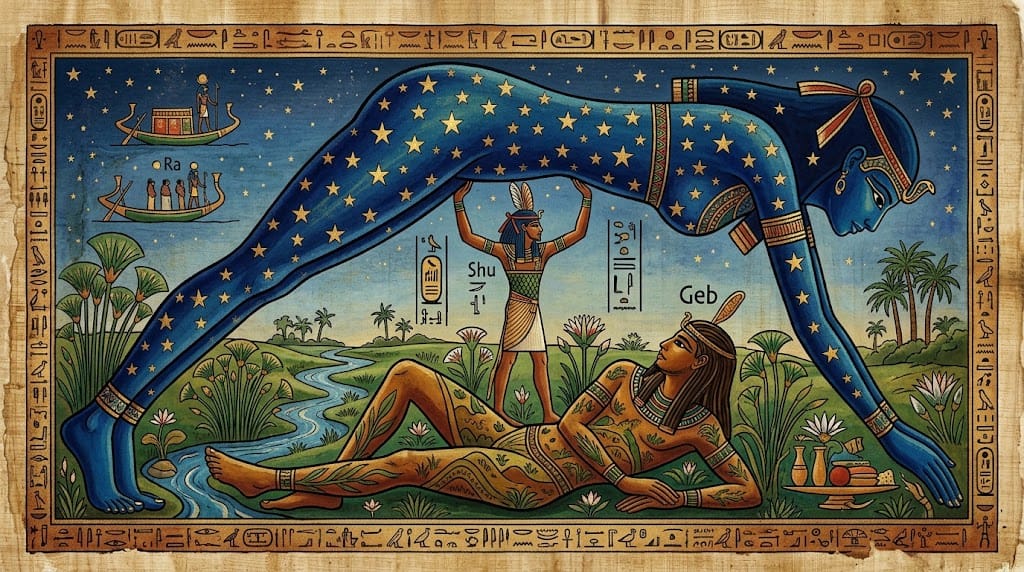
Egyptian art shows this literally. Geb lies below as the land; Nut arches overhead as the star-covered sky; Shu stands between them, holding them apart. Air separating earth from sky is not a metaphor here — it is the shape of the world.
One oddity: the Ennead excludes Horus, who is essential to the Osiris story it sets up. Baines suggests the grouping was somewhat arbitrary, assembled to fit the significant number nine rather than built from the theology outward.
It wasn’t the only creation story
Different cities told it differently, and Egypt saw no need to choose.
At Hermopolis, eight primordial deities — the Ogdoad — embodied the formless state before creation: water, darkness, infinity, and hiddenness, each as a male-female pair.
At Memphis, the craftsman god Ptah created not by physical act but by conceiving things in his heart and speaking their names. Creation by thought and word, roughly two thousand years before any comparable idea appears elsewhere.
The Osiris Myth: The Story That Held It Together
If Egyptian religion has a central narrative, this is it.
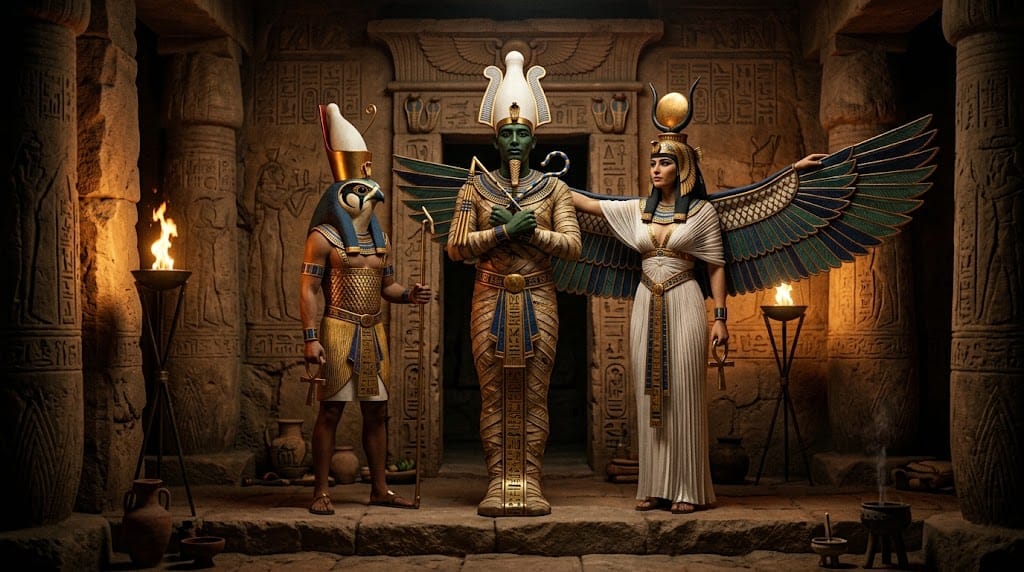
Osiris ruled Egypt as a good king. His brother Set, jealous, murdered him and scattered his body. Isis, Osiris’s wife and sister, searched Egypt, gathered the pieces, and used her magic to restore him long enough to conceive a son.
Osiris did not return to the living. He became ruler of the dead. Their son Horus grew up in hiding, then contested the throne against Set in a long legal and physical struggle, and eventually won.
Three things follow from this story, and they run through everything else:
- Death can be survived. What happened to Osiris could happen to anyone properly prepared — which is the logic behind Egyptian mummification.
- Kingship is divine and inherited. Every living pharaoh was Horus; every dead one became Osiris.
- Order defeats chaos, but never permanently. Set is not destroyed. He is contained, and must be contained again.
The Major Gods
Of the many ancient Egyptian gods attested in temple texts and tomb inscriptions, a smaller group appears again and again across the whole span of Egyptian history. These are the ones worth knowing first.
Ra — the sun
Ra sailed across the sky by day and through the underworld by night, where he fought the serpent Apophis before rising again at dawn. Sunrise was not automatic. It was a victory, won nightly.
Amun — the hidden one
A minor Theban god who rose with Thebes itself to become, as Amun-Ra, the supreme state deity of the New Kingdom. His priesthood at Karnak grew wealthy enough to rival the throne — a shift traced in our guide to ancient Egypt’s government.
Osiris — lord of the dead
Shown as a mummified king with green or black skin — the colours of vegetation and of Nile silt. Both mean the same thing: life returning from apparent death.
Isis — magic and protection
The most capable figure in the Osiris story. She restored her husband, hid and protected her son, and outwitted Ra himself to learn his secret name. Her worship eventually spread across the Roman Empire, far beyond Egypt. Cleopatra presented herself publicly as Isis made flesh.
Horus — kingship
Falcon-headed god of the sky and rightful ruler. He lost an eye fighting Set; it was healed and became the wedjat, the Eye of Horus, one of Egypt’s most common protective amulets.
Set — chaos and the desert
Murderer of Osiris, but not simply a villain. Set also stood at the prow of Ra’s boat each night, spearing Apophis. Egypt understood that the force that threatens order is also the force that defends it.
Anubis — embalming and the dead
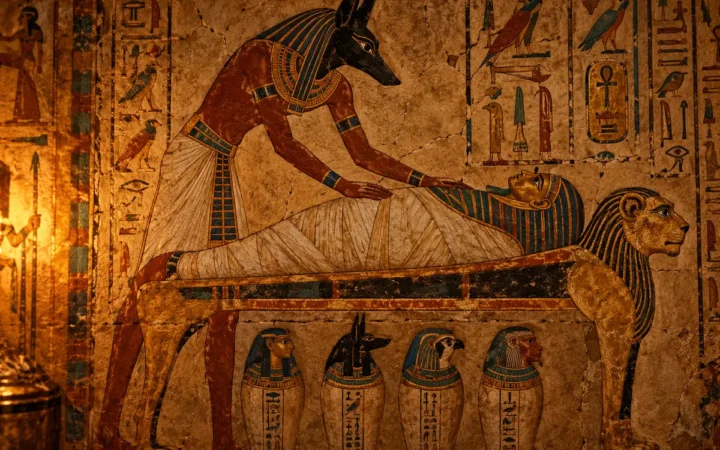
Jackal-headed guardian of the necropolis, patron of embalmers, and the god who leads the dead to judgement and operates the scales. Jackals scavenged around desert cemeteries — Egypt made the animal a protector rather than a threat. The organs he oversaw were stored in canopic jars guarded by the Four Sons of Horus.
Thoth — writing and wisdom
Ibis-headed god of scribes, mathematics, and the moon. He records the verdict at the judgement of the dead. Egypt’s scribes, who ran the state’s census and land registers, worked under his patronage.
Hathor — love, music, and the sky
Cow-horned goddess of joy, music, motherhood, and beauty, who also welcomed the dead into the afterlife. One of the most widely worshipped deities in Egypt.
Sekhmet — war and healing
Lion-headed and terrifying. In one myth Ra sends her to punish humanity and she cannot be stopped until she is tricked into drinking beer dyed red. The same goddess who brought plague was invoked to cure it.
Bastet — cats and protection
A gentler counterpart to Sekhmet, associated with cats, childbirth, and protection of the home. Her cult centre at Bubastis drew enormous festivals.
Ptah — craftsmen and creation
Patron of artisans and creator god of Memphis, who made the world by thought and speech. The Greek name Aigyptos, from which “Egypt” derives, traces back to a name for his temple.
The British Museum maintains a browsable list of thirty-five Egyptian gods and goddesses for readers who want to go further.
Maat: The Idea Underneath Everything
Behind all the ancient Egyptian gods sat a single organising principle.
Maat is both a goddess and a concept, and the concept matters more.
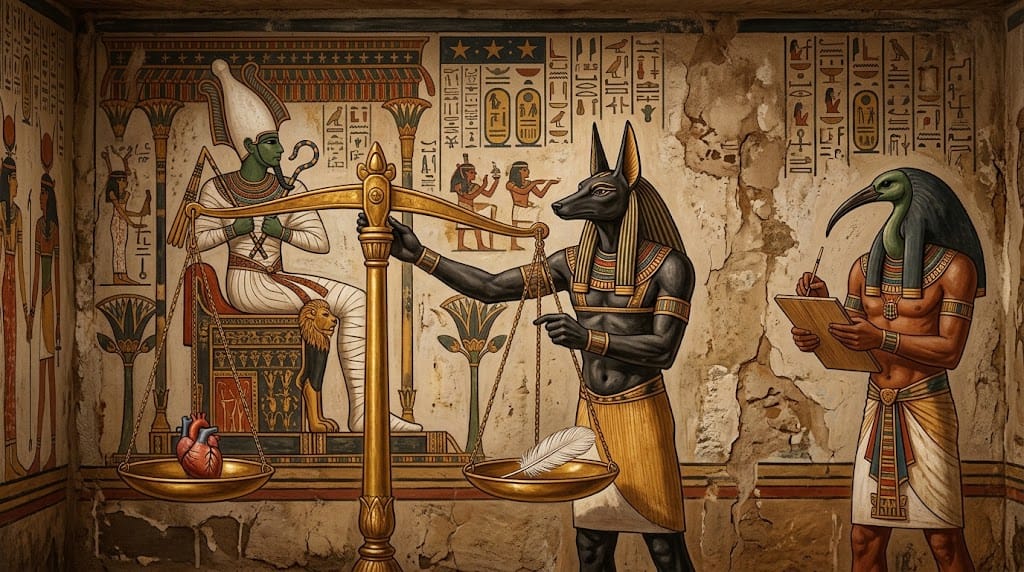
It means truth, balance, justice, and cosmic order — the correct state of things. The pharaoh’s fundamental job was to uphold maat against isfet, disorder. Every temple ritual, every legal judgement, every properly run harvest was maat being maintained.
At death it became personal. The heart of the deceased was weighed against the feather of Maat. Anubis worked the scales, Thoth recorded the result, and a creature called Ammit waited to devour anyone who failed. Pass, and you entered Osiris’s realm.
Egyptian morality was not a list of commandments from a god. It was alignment with the order of the universe itself.
Why the Animal Heads?
This is the most misunderstood feature of Egyptian religion, and the thing that most often gets the ancient Egyptian gods described wrongly.
Egyptians did not worship animals, and they did not believe their gods literally had animal heads. The animal form was a visual language for expressing what a god was like. The World History Encyclopedia keeps a useful gallery of Egyptian gods and goddesses showing how widely these forms varied.
A falcon sees everything from above — so Horus, god of kingship and sky, wears a falcon’s head. A jackal haunts the desert cemeteries — so Anubis, who guards the dead, wears a jackal’s. A lioness is the most dangerous predator Egyptians knew — so Sekhmet is lion-headed.
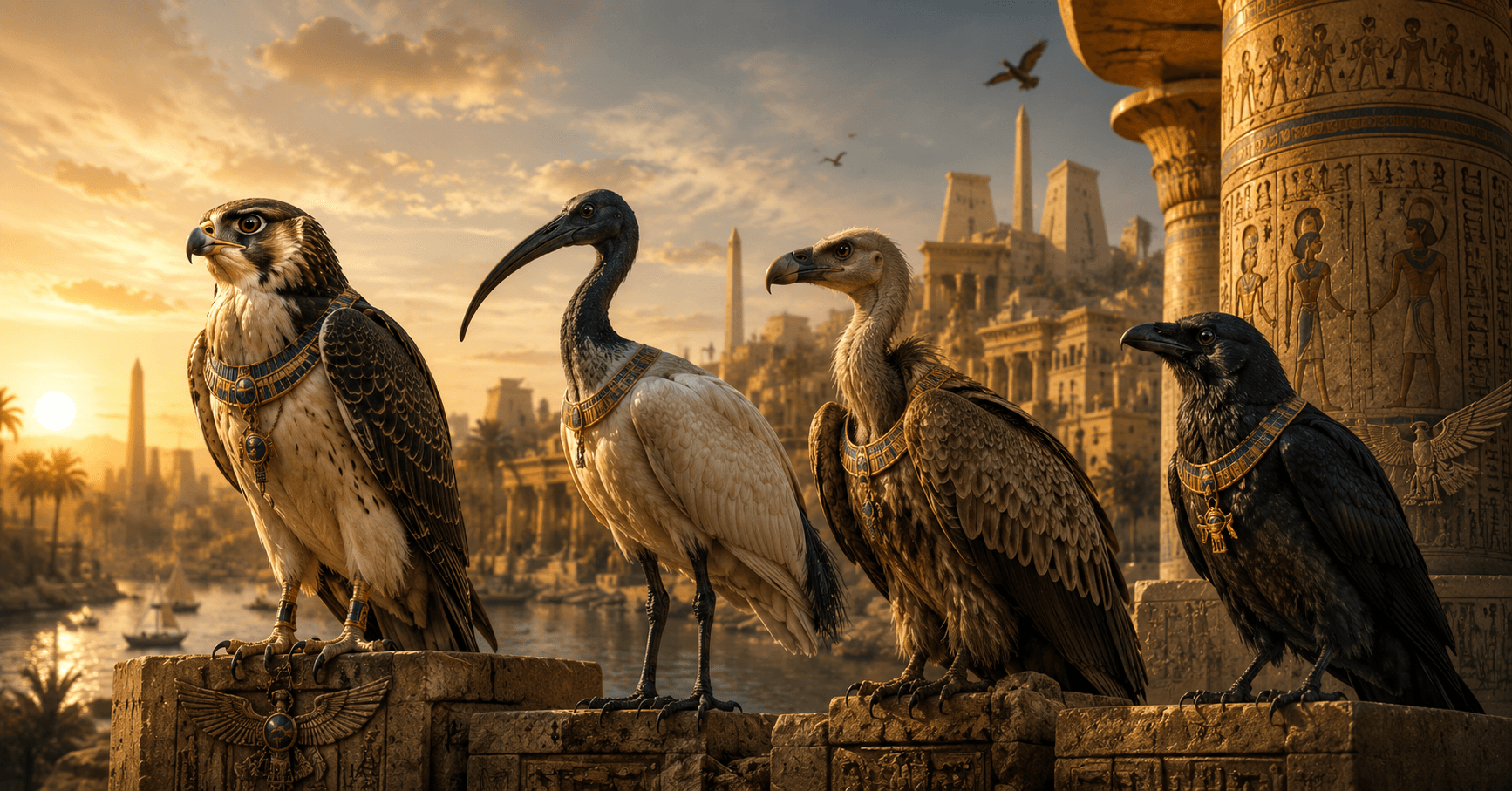
The same god could be shown differently in different contexts: fully human, fully animal, or a hybrid. These were not competing claims about appearance. They were different statements about function. Our article on the sacred birds of ancient Egypt looks at how this worked with specific species.
The Gods Ordinary People Actually Lived With
Not all of the ancient Egyptian gods were state deities. Most Egyptians never entered the inner sanctuary of a great temple. Those were run by priests on the state’s behalf, and access was restricted.
Household religion looked different. It centred on small, approachable deities concerned with immediate problems:
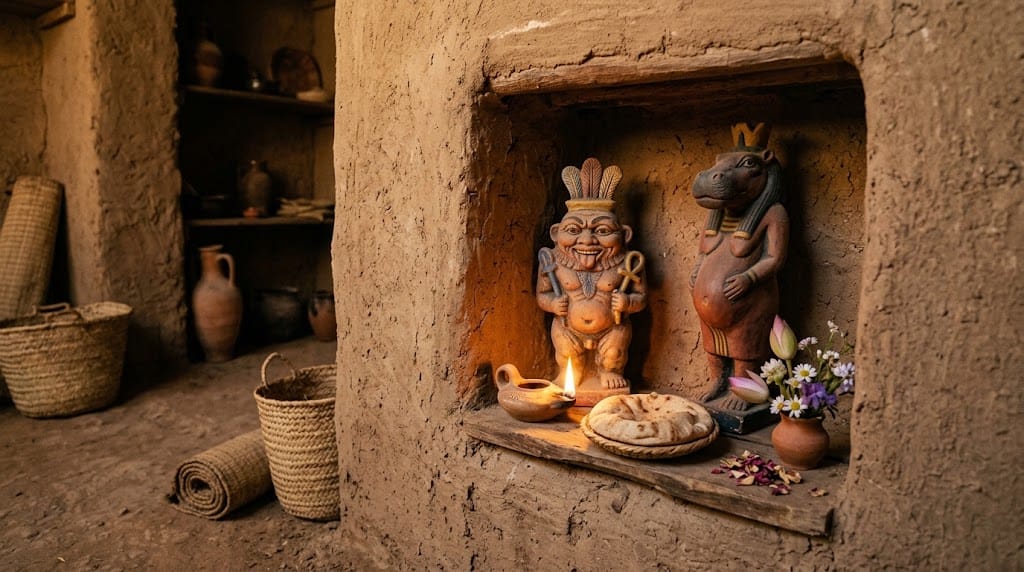
- Bes — a dwarf god with a lion’s mane and a fierce expression, who protected households and especially women in childbirth
- Taweret — a hippopotamus goddess, also a protector of pregnancy and birth
- Ancestors, local shrine gods, and protective amulets worn daily
Bes and Taweret appear in ordinary homes far more often than Amun or Ra. State religion and lived religion overlapped, but they were not the same thing.
The One Time It Nearly Broke
Once in three thousand years, a pharaoh tried to set the ancient Egyptian gods aside altogether.
In the fourteenth century BCE, the pharaoh Akhenaten did something without precedent. He elevated the Aten — the visible sun disc — above all other gods, closed temples, and moved his capital to a new city built from nothing.
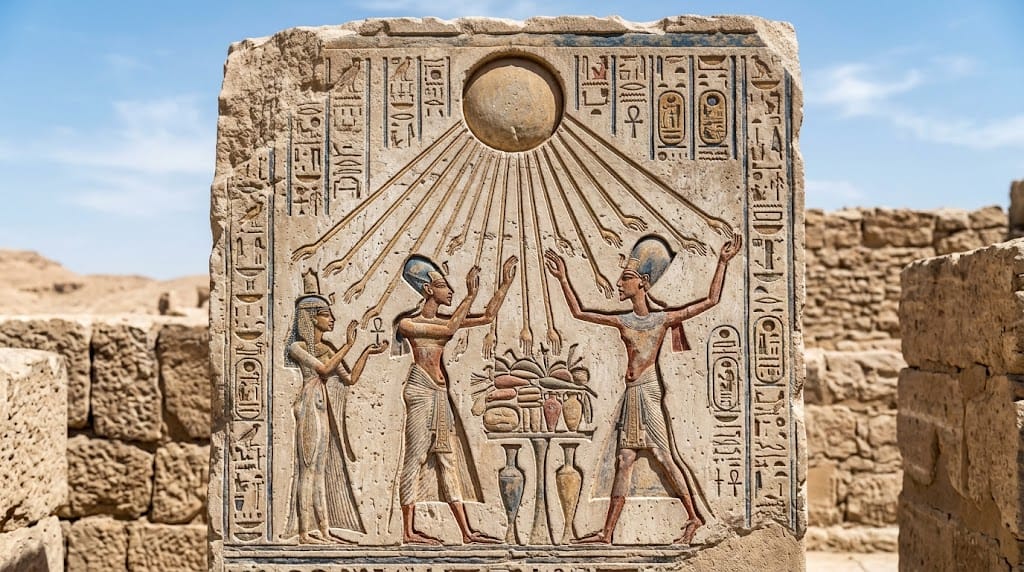
Whether this counts as genuine monotheism is debated. Akhenaten and his family still appear as intermediaries, and some other deities were not entirely suppressed.
What is clear is that it did not survive him. Within a few years of his death the old gods were restored, the new capital abandoned, and Akhenaten’s name struck from king lists. His son — born Tutankhaten, renamed Tutankhamun — marks the restoration in his own name.
Frequently Asked Questions
How many ancient Egyptian gods were there?
Over a thousand names are known, though no single list was ever authoritative. Many were purely local, and the number grew across three thousand years as regional deities were absorbed and merged.
Who was the most important Egyptian god?
It depended on when and where. Ra dominated the Old Kingdom, Amun-Ra the New Kingdom, Ptah at Memphis. Osiris and Isis were widely worshipped across almost all periods.
What is the Ennead?
A group of nine deities from Heliopolis: Atum, Shu, Tefnut, Geb, Nut, Osiris, Isis, Set, and Nephthys. It combines a creation account with the beginning of the Osiris myth, and is attested from the Old Kingdom Pyramid Texts onward.
Did Egyptians worship animals?
No. The ancient Egyptian gods were not animals themselves; animal features expressed a god’s character and function. A falcon head signalled sky and vision, a jackal head the desert cemetery. The same deity could be depicted human, animal, or hybrid depending on context.
Why do Egyptian gods have overlapping roles?
Because the system grew by accumulation rather than design. Local gods with similar functions were merged, producing combined deities such as Amun-Ra and Ptah-Sokar-Osiris without either original god disappearing.
What is Maat?
Both a goddess and the principle of truth, balance, and cosmic order. Upholding maat was the pharaoh’s central duty, and at death each person’s heart was weighed against Maat’s feather.
Conclusion
The ancient Egyptian gods were never governed by a fixed doctrine. It was a working system that absorbed contradiction without strain — several creation stories, gods who merged and separated, a sun that had to be rescued every night.
Underneath the thousand names sat one idea: the universe has a correct order, that order is fragile, and keeping it takes continuous effort from gods and people alike.
Three thousand years of temples, rituals, and tombs were built on that conviction. The ancient Egyptian gods were not a fixed cast of characters but a living vocabulary for describing a world people depended on and could not control.
For a closer look at how these beliefs shaped daily worship and temple practice, see our overview of the religion of ancient Egypt.
7 Comments