Ancient Egypt generates more confident headlines than almost any other subject in archaeology, and a lot of them do not survive contact with the evidence. This page takes ten claims that circulate widely and says, for each one, what was actually found and what it does and does not show.
Tutankhamun’s dagger was made from a meteorite
True, and chemically demonstrated.
What the evidence actually shows
The blade was analysed by X-ray fluorescence and contains about 11% nickel and 0.6% cobalt. Iron smelted on Earth before the nineteenth century never exceeds about 4% nickel, and the nickel-to-cobalt ratio matches iron meteorites. The composition sits within the median of 76 known iron meteorites.
This one is usually reported accurately. It matters because it shows Egyptians were working iron centuries before the Iron Age reached Egypt — not by smelting it, but by using metal that fell from the sky.
There is a large hidden space inside the Great Pyramid
The space is real. Calling it a “chamber” is the headline’s word, not the scientists’.
What the evidence actually shows
Three independent physics teams, using muon detection from different positions, found a void at least 30 metres long above the Grand Gallery. It was published in Nature on 2 November 2017. A second find, the North Face Corridor, was published in March 2023 and later inspected with an endoscope.
What nobody has established is what the space is for. It may be a construction feature that relieved weight, not a room. Zahi Hawass first said the 2017 paper “offers nothing to Egyptology”, then called it a major discovery after the corridor was inspected. Treat any article that says “secret chamber” or “hidden room” as having added that itself.
The pyramids were built by paid workers, not slaves
True, and it is one of the best-evidenced facts in Egyptology.
What the evidence actually shows
Excavation at Giza uncovered the workers’ settlement: bakeries, breweries, and the quantities of bread, beer and meat issued as rations. The workers were buried in their own tombs beside the pyramid — slaves do not get tombs in sight of the king’s. The diary of the inspector Merer, the oldest inscribed papyri from Egypt, records a crew of about two hundred men hauling limestone, with their deliveries logged.
The slave story comes from Herodotus writing two thousand years after the fact, and was repeated for centuries because nobody had dug up the alternative. Now we have.
A vast underground city lies beneath the Giza pyramids
No credible evidence. It was never peer reviewed.
What the evidence actually shows
In 2025 a team claimed that satellite radar had revealed shafts and a huge complex under the plateau. The work was announced to the press rather than published in a reviewed journal. Radar specialists pointed out that the technique used cannot resolve structures at the depths claimed — the signal simply does not reach that far.
This is the clearest example of why the format of an announcement matters as much as its content. A press release is not a result. The claim keeps returning every few months; the evidence has not changed.
Nefertiti is buried behind a wall in Tutankhamun’s tomb
Tested three times. The last and best survey found nothing.
What the evidence actually shows
Nicholas Reeves proposed in 2015 that lines in the tomb wall marked blocked doorways. A 2016 radar survey was announced as showing a chamber with “90% certainty”. A more careful survey in 2018, using three independent radar systems, found no void and no wall boundary of any kind behind the painted surface.
Worth noticing how the confident number came first and the careful measurement came later. Nefertiti’s burial place is still genuinely unknown — that part of the mystery is real.
There is a curse on those who opened Tutankhamun’s tomb
Someone actually measured this. There is no effect.
What the evidence actually shows
A cohort study published in the BMJ in 2002 identified 44 Westerners who were in Egypt at the time, 25 of whom were present at the opening of the tomb or the sarcophagus. It compared how long each group lived afterwards. Mean age at death was 70 for the exposed group and 75 for the unexposed, and the difference was not statistically significant (P=0.95).
Lord Carnarvon did die shortly afterwards, of blood poisoning from an infected mosquito bite. Howard Carter, who opened the tomb himself and spent ten years inside it, lived until 1939.
The Sphinx is thousands of years older than Khafre, because it was eroded by rain
A real geological argument, but it does not survive the rest of the evidence.
What the evidence actually shows
John Anthony West raised the idea in 1979 and geologist Robert Schoch developed it from 1991, dating the Sphinx as early as 9700 BC. The weathering is better explained by salt crystallisation in poor-quality Giza limestone, by pre-existing fractures in the bedrock, and by rainfall that continued in Egypt until around 2200 BC — well within dynastic times.
The archaeology is the harder problem for the theory. The Sphinx Temple reuses the Valley Temple’s wall, luminescence dating places both in the later third millennium BC, blocks quarried from the Sphinx enclosure were used in neighbouring buildings, and no society capable of the work existed in Egypt at the earlier date. Mark Lehner puts the idea at “a very, very low level of probability”.
Cleopatra’s tomb is at Taposiris Magna
Possible, unproven, and searched for over twenty years.
What the evidence actually shows
Kathleen Martínez has excavated the temple west of Alexandria for two decades. The dig has produced coins bearing Cleopatra’s image, carvings, mummies in rock-cut tombs, a 1,300-metre tunnel found in 2022, and a sunken harbour reported in 2025. None of that is a tomb, and none of it is Cleopatra.
The ancient sources place her burial near Alexandria, beside a temple of Isis, in a mausoleum Octavian finished. Martínez’s answer is that priests moved the bodies later. Zahi Hawass rejects the theory on the grounds that Egyptians never buried inside temples — though that reason is itself contradicted by known temple burials. The honest position is that the tomb has not been found, here or anywhere.
We know what the void inside the Great Pyramid was for
We do not. This is a real unanswered question.
What the evidence actually shows
The void’s existence is settled. Its purpose is not. Candidate explanations include a relieving space built to take weight off the Grand Gallery, a construction ramp left inside the structure, or a space with a function nobody has guessed. No instrument so far has produced an image of the inside.
This is worth separating from the pseudo-mysteries. It is a genuine open question about the best-studied building in the ancient world, and it is more interesting than the invented ones.
Egypt will announce a discovery that “rewrites history”
An announcement about an announcement. Nothing has been published.
What the evidence actually shows
Statements of this kind appear regularly, usually ahead of a press event or a broadcast. There is no paper, no data, and no way for anyone outside the team to assess anything.
A useful habit: when a discovery is announced, look for what you can actually read. A journal article, a preprint, an excavation report, or a site notice. If there is none, the correct response is not disbelief — it is simply waiting.
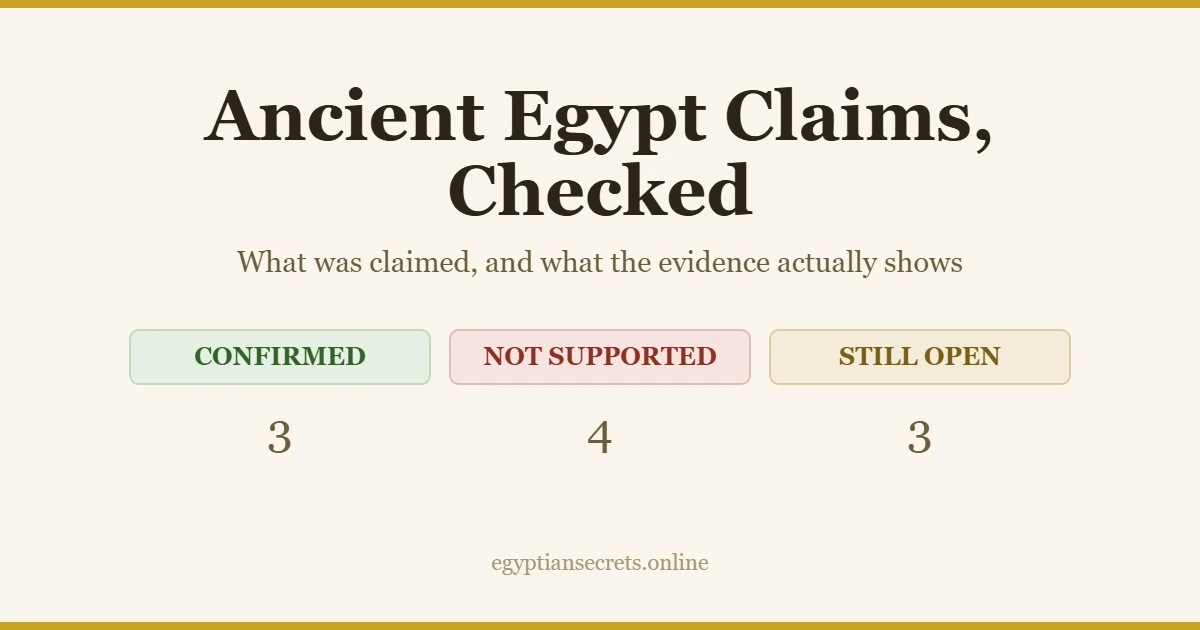
Three of these are true. Four are not supported. Three are genuinely open — and those are the ones worth your attention, because an unanswered question about the Great Pyramid is more interesting than an invented one.
How each claim is judged
The test is not whether a claim sounds far-fetched. Some true things about Egypt sound far-fetched: a dagger made from a meteorite, a thirty-metre cavity nobody has entered. The test is what you can actually read.
For each claim the questions are the same. Was the work published somewhere it could be checked, or announced to the press? Did independent teams reach the same result? Does the physical method used actually work at the scale claimed? And when careful measurement came later, did it agree with the first confident number?
That last question does a lot of work. The pattern repeats: a striking claim arrives with a percentage attached, and the careful survey that follows finds nothing. It happened with the chamber behind Tutankhamun’s wall. It happens every time a radar result is announced by press release.
Why the headlines drift
Most exaggeration is not invented by anyone. It accumulates in the retelling.
A physics team writes “void” because that is what their data supports — an absence of stone, shape and purpose unknown. A press office writes “cavity”. A news desk writes “hidden chamber”. An aggregator writes “secret room”. By the fourth retelling the article describes a room, and no single step in that chain was dishonest.
Knowing this makes a claim easy to check yourself: find the earliest version you can and read the researchers’ own words. The gap between what they wrote and what you were told is usually the whole story.
Checking a claim yourself
You do not need to be an Egyptologist to do this. Four habits cover most cases.
Look for something you can read. A journal article, a preprint, an excavation report. If a discovery exists only as a press statement or a documentary, that is worth knowing before you form a view.
Check whether the method works at that scale. Satellite radar cannot see hundreds of metres into rock. Ground-penetrating radar cannot see through unlimited thicknesses of stone. Many claims fail on physics alone, before any archaeology is needed.
Notice who is not being quoted. If a claim about Giza appears without a response from anyone who has excavated at Giza, that absence is information.
Separate the finding from the interpretation. “There is a void” and “there is a hidden chamber” are not the same sentence. The first is a measurement. The second is a guess about what the measurement means.
What is genuinely unknown
Rejecting the invented mysteries does not leave a tidy subject. Egyptology has real gaps, and they are larger than most popular accounts admit.
Nobody knows exactly how the heaviest blocks were raised. Nobody knows what the void above the Grand Gallery was for. Nefertiti’s burial has never been found, and neither has Cleopatra’s. The sound values of a few hieroglyphs are reconstructions rather than recordings, and for at least one sign we cannot even identify the object it depicts.
These are better questions than the ones the headlines offer, and they have the advantage of being real.
Frequently Asked Questions
Is there really a hidden chamber in the Great Pyramid?
There is a large void, at least thirty metres long, confirmed by three independent teams and published in Nature in 2017. Whether it is a chamber is unknown — it may be a construction feature that relieved weight above the Grand Gallery. “Chamber” and “secret room” are terms added by later reporting, not by the researchers.
Was there really a curse on Tutankhamun’s tomb?
No. A study in the BMJ in 2002 compared how long the people present at the opening lived afterwards against those who were in Egypt but not present. The difference was not statistically significant. Howard Carter, who spent ten years working inside the tomb, lived until 1939.
Is there a city under the pyramids?
No credible evidence supports it. The 2025 claim was announced to the press rather than published for review, and the radar technique cited cannot resolve structures at the depths described.
Did slaves build the pyramids?
No. The workers’ settlement at Giza has been excavated, along with their bakeries, their ration records and their own tombs beside the pyramid. The diary of the inspector Merer records a crew of about two hundred men hauling stone, with deliveries logged.
How old is the Sphinx?
The evidence points to the reign of Khafre, around 2500 BC. The claim that water erosion shows a much earlier date is not accepted by mainstream geologists or Egyptologists; salt crystallisation, poor-quality limestone and rainfall continuing to around 2200 BC account for the weathering.
Has Cleopatra’s tomb been found?
No. The excavation at Taposiris Magna has run for two decades and produced coins, carvings, tombs and a long tunnel, but no tomb of Cleopatra. Ancient sources place her burial near Alexandria.
How do you decide what counts as confirmed here?
Published where it can be checked, reproduced or corroborated independently, and consistent with the physical limits of the method used. Where those conditions are met the claim is marked confirmed; where careful measurement has contradicted it, not supported; where the question is real and unanswered, still open.
Related
Inside the Great Pyramid →
How were the pyramids built?
The curse of Tutankhamun
The Great Sphinx of Giza