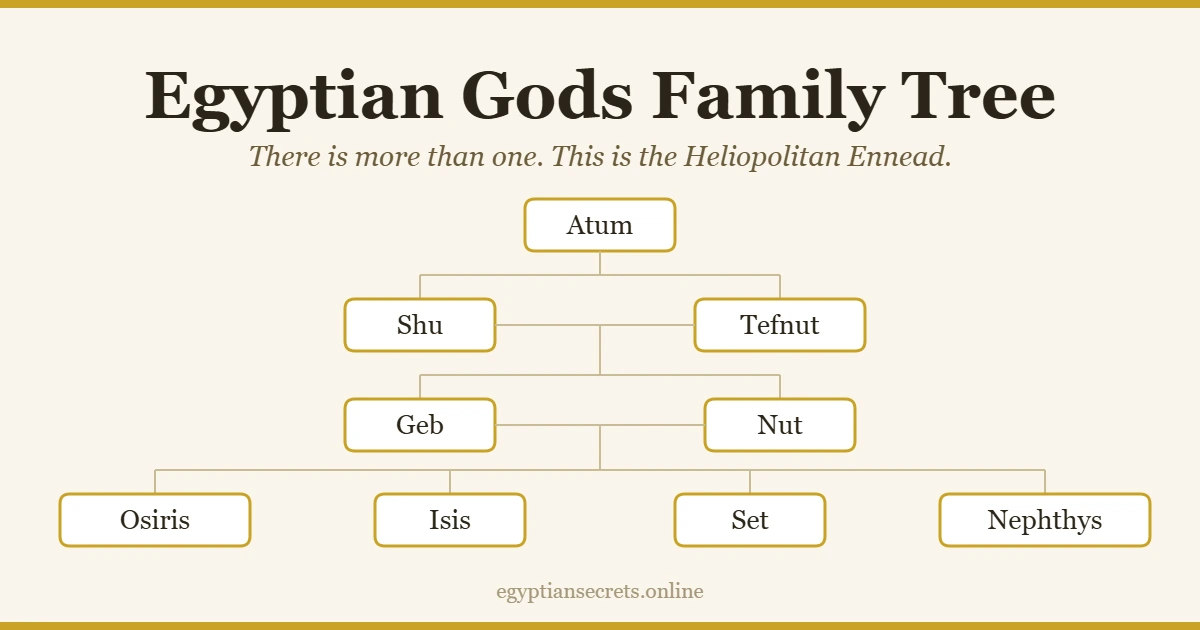
There is no single Egyptian family tree, and any chart that shows you one has quietly picked a side. What follows is the genealogy taught at Heliopolis — the best known of them — and beside it the Ogdoad of Hermopolis, which is not a family at all. Both were current at the same time.
One of the groupAttached, but not counted
Tap any name for who they were. Horizontal lines join consorts; vertical lines run parent to child.
Why Horus is drawn differently
The Ennead means “the Nine”, and the nine are Atum, Shu, Tefnut, Geb, Nut, Osiris, Isis, Set and Nephthys. Horus is not among them. He belongs to the story that follows — the murder of Osiris and the contest for the throne — but the group was counted before he entered it.
There is a second complication. Two gods share the name. Horus the Elder is an ancient falcon sky god who existed long before the Osiris story, and in some versions he is counted among the Nine in place of another. Horus son of Osiris and Isis is the child who avenges his father. Later Egyptians did not always separate them, and neither do most modern charts.
That is why he sits below the line here, in a dashed box: attached to the family, not counted in it.
The Ogdoad is not a generation
At Hermopolis the account is different in kind, not just in detail. Eight gods in four male-and-female pairs stand for the qualities of the water that existed before creation: Nu and Naunet for the still water, Huh and Hauhet for endlessness, Kek and Kauket for darkness, Amun and Amaunet for what is hidden.
The males were shown as frogs and the females as snakes. They are not anyone’s parents and nobody’s children. They converge, the mound of earth rises out of the water, and the sun appears above it.
So the Ogdoad cannot be plugged into the Ennead as an earlier generation, however tempting that is. They are two separate answers to the same question.
Two more traditions that do not fit on a chart
Memphis. Ptah creates by thinking and then speaking — the world forms because he says it. This is not a genealogy at all, and the Memphite priests did not deny the Ennead. They said Ptah’s thought was what caused Atum and the Nine to exist. The older story was absorbed rather than contradicted.
Thebes. Amun, one of the eight at Hermopolis, rose with his city until he was the hidden force behind every other creator, including the ones who had made him. One account has creation begin with the call of a goose across the silent water.
Both are theological claims stacked on top of existing stories, and neither adds a rung to any family tree.
How Egyptians lived with the contradiction
They do not appear to have found it a problem. A priest at Memphis and a priest at Heliopolis could each hold that his god came first, and both could be recorded in the same reign without anyone reconciling them.
Part of the reason is that these are not competing histories of a single event. They are accounts of what creation is — emergence from water, separation of earth and sky, the power of speech, the presence of something hidden. A temple could teach one without denying another.
The other reason is political. When a city gained power its god gained rank, usually by merging with an established one rather than displacing him: Amun with Ra to make Amun-Ra, Ptah with Sokar and Osiris to make a single funerary god. Egyptian religion grew by addition. Almost nothing was ever thrown away, which is exactly why no clean tree exists.
Frequently Asked Questions
Who is the father of all Egyptian gods?
At Heliopolis, Atum — who was self-created and had no father. At Hermopolis there is no father at all, only eight gods embodying the pre-creation water. At Memphis it is Ptah, and at Thebes, Amun. The answer depends on which city you ask.
Is Horus the son of Ra or of Osiris?
Both answers are attested, because there are two gods called Horus. Horus the Elder is an ancient falcon sky god closely linked with Ra. Horus son of Osiris and Isis is the child of the Osiris story. Over time they merged in popular use.
Are Isis and Osiris brother and sister?
Yes, and also husband and wife. Both are children of Geb and Nut, as are Set and Nephthys, who are likewise siblings and consorts. Sibling marriage among the gods mirrored royal practice, which used it to keep the succession within one line.
Who came first, Ra or Atum?
They are largely the same god seen at different hours. Atum is the sun at evening and Ra the sun at midday, and by the Old Kingdom they were already being written as one figure, Atum-Ra. Asking which came first assumes a separation the Egyptians had stopped making.
Why do the Egyptian gods marry their siblings?
The Ennead has only one generation to draw from at each step, so pairings inside it are unavoidable. It also reflected how Egyptian kingship worked: royal sibling marriage kept the throne within a single family, and the gods were described in the terms the court already used.
Is the Ennead the complete list of Egyptian gods?
No. It is the divine family of one city. Thoth, Ptah, Hathor, Anubis, Bastet, Sobek and hundreds of others sit outside it entirely, with their own cults and their own relationships.
Related
All 36 gods, searchable →
Ancient Egyptian gods: the fuller story
Religion of ancient Egypt
The Book of the Dead