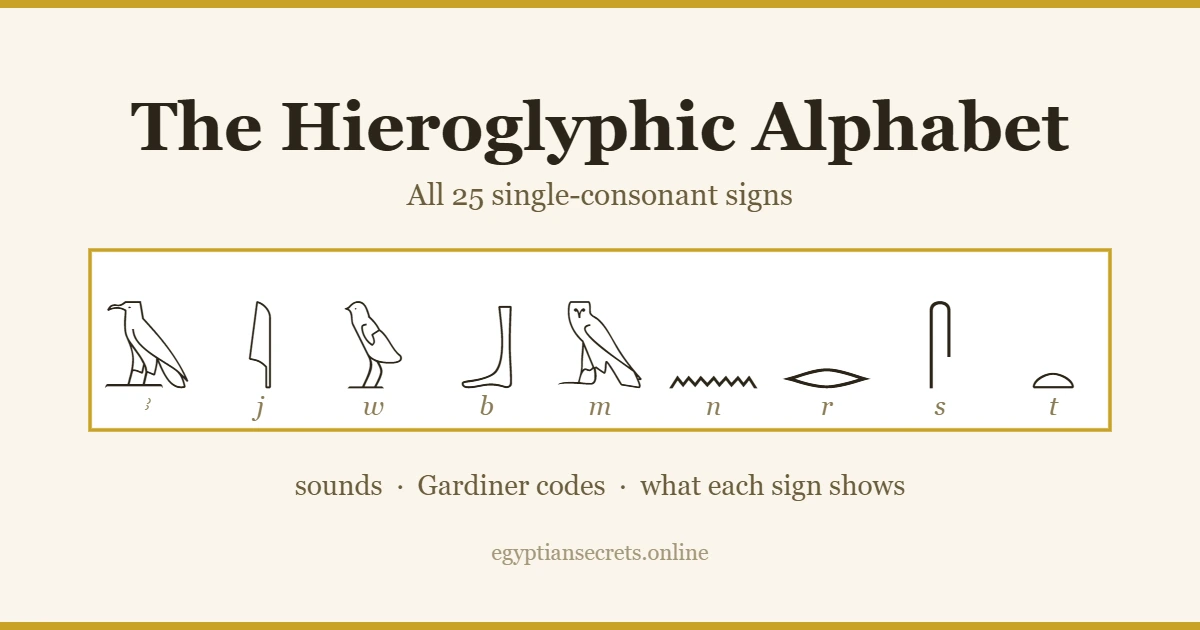
There are 25 hieroglyphs that stand for a single consonant each. Egyptologists call them uniliterals, and together they are the closest thing ancient Egyptian had to an alphabet. Every one of them is in the table below, with the sound it carried, the object it depicts, and its code in Gardiner’s sign list.
| Sign | Translit. | English | What it shows | Sound | Gardiner |
|---|---|---|---|---|---|
| 𓄿 | ꜣ | A | Egyptian vulture | A glottal stop, like the catch in 'uh-oh'. Conventionally read as 'ah'. | G1U+1313F |
| 𓇋 | j | I, E, Y | flowering reed | A 'y' or 'ee' sound. Older books write this as i. | M17U+131CB |
| 𓇌 | y | Y | double reed | A firm 'y' as in 'yes'. Sometimes written with two strokes instead. | M17AU+131CC |
| 𓂝 | ꜥ | A | forearm | A tightened sound made deep in the throat. No English equivalent. | D36U+1309D |
| 𓅱 | w | W, U, O | quail chick | A 'w' or 'oo' sound. | G43U+13171 |
| 𓃀 | b | B | foot | 'b' as in 'boat'. | D58U+130C0 |
| 𓊪 | p | P | reed mat or stool | 'p' as in 'pot'. | Q3U+132AA |
| 𓆑 | f | F, V | horned viper | 'f' as in 'foot'. | I9U+13191 |
| 𓅓 | m | M | owl | 'm' as in 'moon'. | G17U+13153 |
| 𓈖 | n | N | ripple of water | 'n' as in 'noon'. | N35U+13216 |
| 𓂋 | r | R | mouth | 'r', probably tapped rather than rolled. | D21U+1308B |
| 𓉔 | h | H | reed shelter | 'h' as in 'house'. | O4U+13254 |
| 𓎛 | ḥ | H | wick of twisted flax | A heavier 'h', made further back in the throat. | V28U+1339B |
| 𓐍 | ḫ | KH | placenta (uncertain) | 'ch' as in Scottish 'loch'. | Aa1U+1340D |
| 𓄡 | ẖ | KH | animal's belly with tail | A softer 'ch', closer to German 'ich'. | F32U+13121 |
| 𓊃 | z | Z, S | door bolt | 'z', though by the Middle Kingdom it sounded the same as s. | O34U+13283 |
| 𓋴 | s | S | folded cloth | 's' as in 'sit'. | S29U+132F4 |
| 𓈙 | š | SH | pool or garden basin | 'sh' as in 'ship'. | N37U+13219 |
| 𓈎 | q | Q | hill slope | A 'k' made far back in the throat, deeper than k. | N29U+1320E |
| 𓎡 | k | K, C | basket with handle | 'k' as in 'kite'. | V31U+133A1 |
| 𓎼 | g | G | jar stand | 'g' as in 'good'. | W11U+133BC |
| 𓏏 | t | T | bread loaf | 't' as in 'top'. | X1U+133CF |
| 𓍿 | ṯ | CH | tethering rope | 'tj', drifting toward 'ch' over time. | V13U+1337F |
| 𓂧 | d | D | hand | 'd' as in 'door'. | D46U+130A7 |
| 𓆓 | ḏ | J, DJ | cobra at rest | 'dj' as in 'judge'. | I10U+13193 |
If any sign shows as an empty box, your device has no hieroglyph font installed. The Gardiner code and codepoint still identify the sign exactly.
They are not an alphabet in the way English is, and the Egyptians never used them on their own to write their language. That difference is the reason most name-in-hieroglyphs results look convincing but are not quite what an Egyptian scribe would have written — explained further down.
How to read this table
Sign is the hieroglyph itself. Translit. is the transliteration character Egyptologists write in place of the sign — the letters with dots and bars underneath are not typos, they mark sounds English has no letter for. English shows which of our letters the sign is usually matched to when writing a modern name. Gardiner is the sign’s catalogue number from Alan Gardiner’s 1927 sign list, still the standard reference, followed by its Unicode codepoint.
The filters group the signs the way a linguist would: semi-vowels are the weak, vowel-like consonants; stops are made by blocking the air completely; fricatives by forcing it through a narrow gap.
Why this is not really an alphabet
An alphabet is a complete system: every sound in the language has a letter, and you write words by stringing those letters together. The 25 uniliterals never worked that way.
Egyptian writing used three kinds of sign at the same time. Uniliterals carried one consonant, like the ones in the table. Biliterals and triliterals carried two or three consonants in a single sign — the sign 𓄤 nfr is one sign for three consonants, not three signs. And determinatives carried no sound at all; they sat silently at the end of a word to tell you which word was meant.
A normal Egyptian word mixed all three. The uniliterals mostly appeared as helpers: spelling out the ending of a word, clarifying a sign that could be read two ways, or writing foreign names the system had no signs for. A text written only in uniliterals would have looked as strange to a scribe as writing English entirely in phonetic symbols looks to us.
Why there are no vowels
Look down the transliteration column and you will not find a, e, i, o or u as we use them. Egyptian belonged to the Afro-Asiatic family, like Arabic and Hebrew, and those languages build words from a skeleton of consonants. The vowels changed depending on grammar, and the writing system simply left them out.
This is why Egyptian names have no single correct spelling in English. The consonant skeleton of the famous boy king is twt-ʿnḫ-imn. Whether you write Tutankhamun, Tutankhamen or Tutankhamon depends on which vowels a modern scholar chose to insert. None of them is the pronunciation an Egyptian would have recognised, because nobody wrote it down.
The signs for ᵃ, j, y and w in the table are the nearest thing to vowels, and even they are consonants doing double duty — closer to the y and w in “yes” and “wet” than to true vowel letters.
The letters that do not exist: L, V and X
This is the part most name generators quietly skip. Classical Egyptian of the pyramid age had no letter L, no V and no X.
There was no separate sign for L because the sound was not distinct in the language of the Old and Middle Kingdoms; where later speakers had an l, earlier writing used the signs for r or n. A lion sign is often pressed into service for l on modern name charts, and there is some historical basis for it — scribes did use it that way much later, in the Late and Ptolemaic periods, precisely when they needed to write Greek and other foreign names. But for most of Egyptian history, l had no letter of its own.
V and X never existed at all. Name charts hand V to the horned viper, the f sign, and split X into k plus s. Both are modern conveniences, not Egyptian practice.
C is handled the same way: it is given either the k sign or the s sign depending on how the name sounds. That is why Carol and Karol come out identically, and why Cynthia begins with the folded cloth rather than the basket.
Beyond single sounds
Once you know the 25, the rest of the system opens up. Biliteral signs are extremely common — there are around eighty in regular use — and scribes often wrote them followed by uniliterals that repeated part of the same sound, a habit called phonetic complementing. It looks redundant until you realise it was doing the job of a spelling check, ruling out the other ways a sign might be read.
Direction mattered too. Hieroglyphs could run right to left, left to right, or top to bottom. The rule is simple: the human and animal signs face the beginning of the line, so if the vulture and the owl are looking to the left, you read from left to right. In practice most monumental inscriptions run right to left.
How certain are these sounds?
Less certain than a neat table suggests. Nobody has heard spoken ancient Egyptian. The sound values come from three overlapping sources: Coptic, the last stage of the language, which was written in Greek letters and survived in Christian liturgy; Greek and Akkadian transcriptions of Egyptian names, which show how foreigners heard them; and internal patterns in the writing itself.
For most consonants those sources agree. For a few they do not. The sign catalogued as Aa1, given as ḫ here, is the clearest case — even the object it depicts is uncertain, which is why Gardiner filed it under “unclassified”. It is usually called a placenta, and that is a guess. The distinction between z and s had already collapsed by the Middle Kingdom, which is why some reference lists count 24 uniliterals instead of 25.
None of this makes the table wrong. It means the sounds are careful reconstructions rather than recordings, and honest sources say so.
Writing your own name
If you want to see your name in these signs, the tool on this site applies the standard letter-to-sign matching, wraps the result in a cartouche and shows you which sign is doing what — including where it is making one of the compromises described above.
Write your name in hieroglyphs →
For the wider story of how the script worked and how it was finally read again after fourteen centuries, see Egyptian hieroglyphs explained.
Frequently Asked Questions
How many letters are in the Egyptian alphabet?
There are 25 single-consonant signs, though some reference lists give 24 because the signs for z and s came to represent the same sound. They are not a true alphabet: Egyptian also used signs for two and three consonants at once, and silent signs that indicated meaning rather than sound.
Did hieroglyphs have vowels?
No. Egyptian wrote consonants only, in common with other Afro-Asiatic languages such as Arabic and Hebrew. The vowels were supplied by the reader. This is why modern spellings of Egyptian names vary so much — the vowels in Tutankhamun are a modern addition.
Is there a hieroglyph for L?
Not in classical Egyptian. The sound was written with the r or n signs in earlier periods. A lion sign was used for l much later, in the Late and Ptolemaic periods, mainly for writing foreign names, and modern name charts borrow it.
What are the dots and lines under the transliteration letters?
They mark sounds English has no letter for. A dot under h shows a heavier h made deeper in the throat; a line under it shows a “ch” sound. They are standard Egyptological notation, not typographical errors.
What is a Gardiner code?
It is the catalogue number for a hieroglyph from Alan Gardiner’s 1927 sign list, which sorted signs into groups by what they depict — G for birds, D for parts of the body, N for sky, earth and water, and so on. G1 is the first bird in the list, the Egyptian vulture. Egyptologists still cite these codes.
Which way do you read hieroglyphs?
Whichever way the people and animals are facing. The signs look toward the start of the line, so if they face left you read left to right. Texts could also be written in vertical columns.