
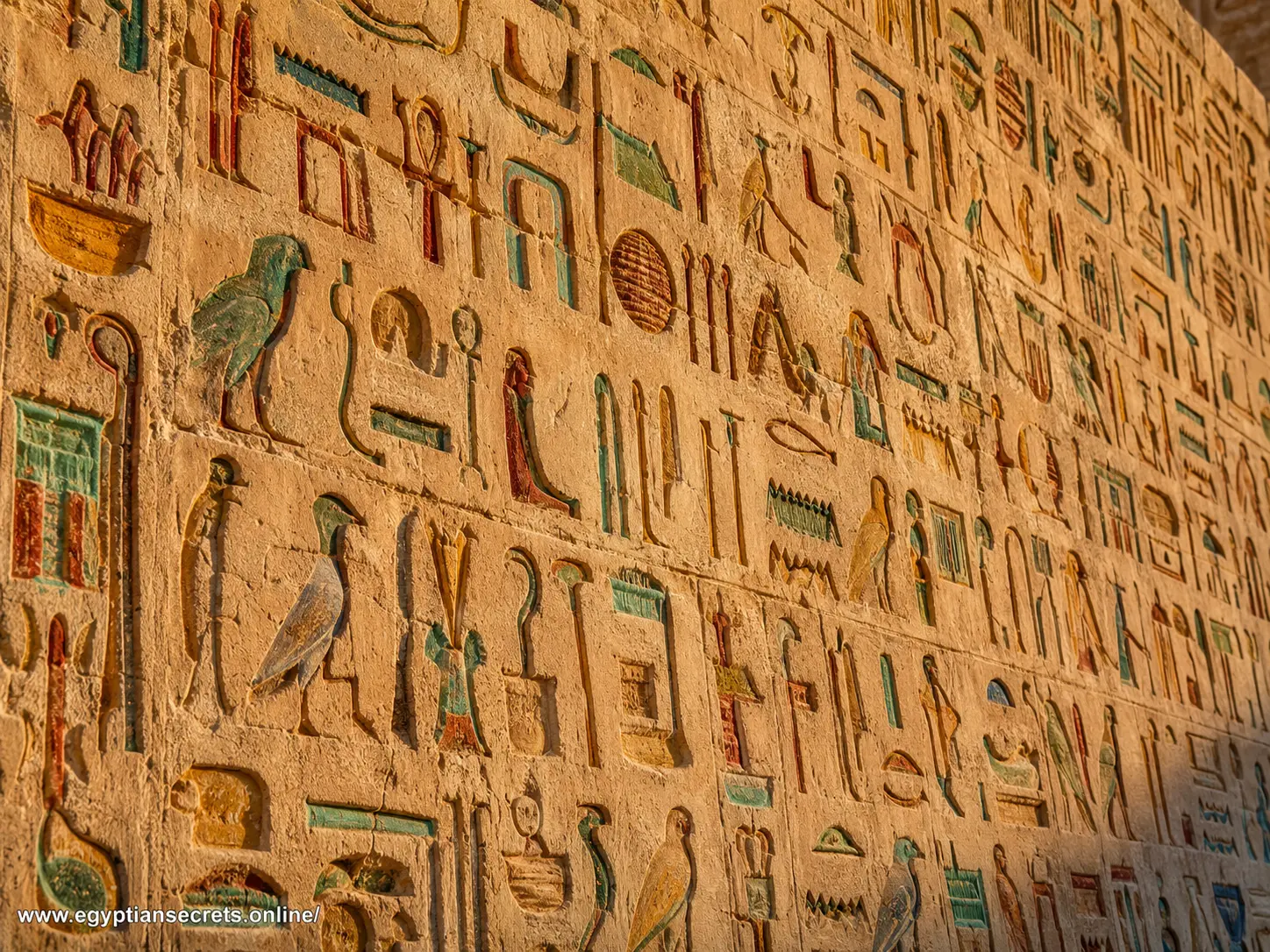
Sometime in the summer of AD 394, a priest at the temple of Philae carved a short message into the stone. It was a small thing — the kind of graffito priests had been leaving for centuries.
Nobody carved another one. That inscription is the last dated hieroglyphic text we have, and within a generation or two, nobody left alive could read it.
The script stayed unreadable for the next fourteen centuries.
That gap is the strangest thing about Egyptian hieroglyphs. This was not some obscure regional script. It had been in continuous use for roughly three and a half thousand years, carved across every temple and tomb Egypt ever built. And then the knowledge simply stopped, mid-sentence, and stayed stopped until 1822.
What Hieroglyphs Actually Are
Here is the misconception that ruins most people’s understanding before they start: hieroglyphs are not picture-writing. A drawing of an owl does not mean “owl.”
It usually means the sound m.
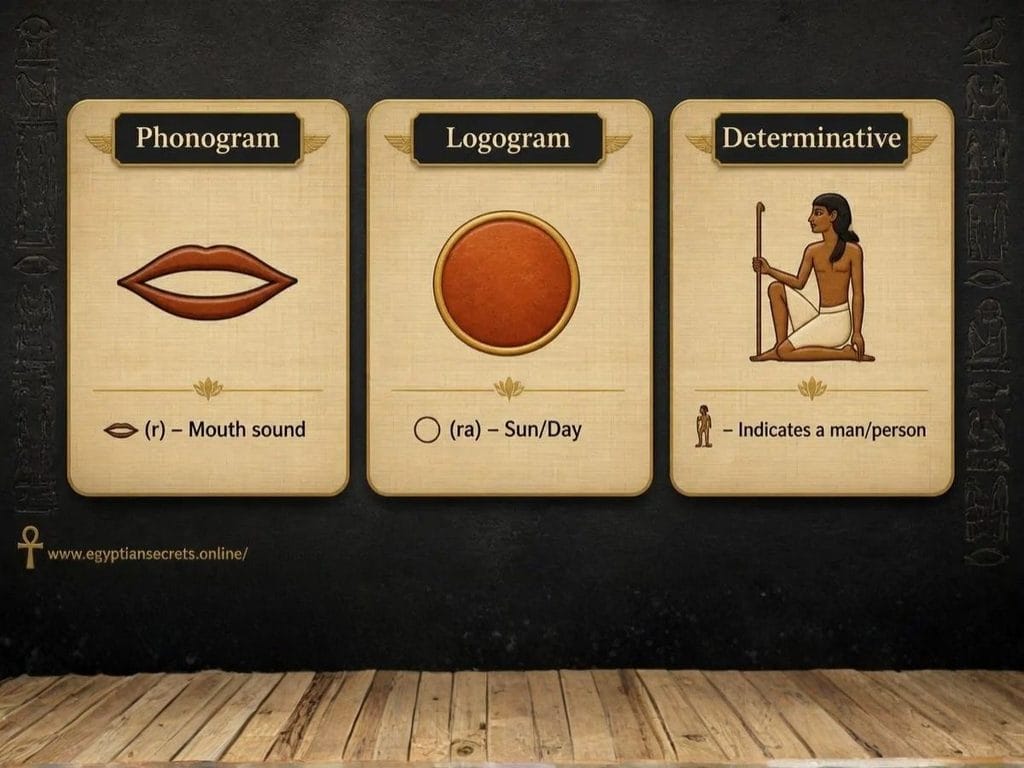
Egyptian hieroglyphs work as a mixed system, and individual signs do three different jobs depending on where they sit:
- Phonograms — signs that stand for sounds, exactly like letters. Some represent one consonant, others two or three.
- Logograms — signs that do mean the thing they depict. A sun disc genuinely can mean “sun.”
- Determinatives — silent signs added at the end of a word to tell you what category it belongs to. They are never pronounced.
That third category is the clever one. Egyptian wrote no vowels, so words that sounded alike looked identical on the page. A determinative resolved the ambiguity — a pair of walking legs after a word told you it was about motion; a seated man told you it was a person.
English does something similar when we write “read” and rely on context to tell you which pronunciation is meant. Egyptian just made the context explicit and put it on the page.
How many signs were there?
Around 750 in Middle Egyptian, the classical stage of the language. By the Greco-Roman period the inventory had swollen past several thousand, as priests invented elaborate new spellings that only a shrinking circle of specialists could follow.
That inflation is part of why the script died. It became a closed professional code at exactly the moment Egypt’s temple culture was collapsing.
Reading Direction, and the Trick Nobody Tells You
Hieroglyphs can be written left to right, right to left, or in vertical columns. Egyptians chose whichever suited the surface and the symmetry of the design.
So how do you know which way to read?
Look at the faces. Any sign with a face — a bird, an animal, a seated figure — looks toward the beginning of the line. If the owls face left, you read left to right. If they face right, start on the right.
It takes about ten seconds to learn and it works on almost every inscription in Egypt.
How the Script Was Cracked
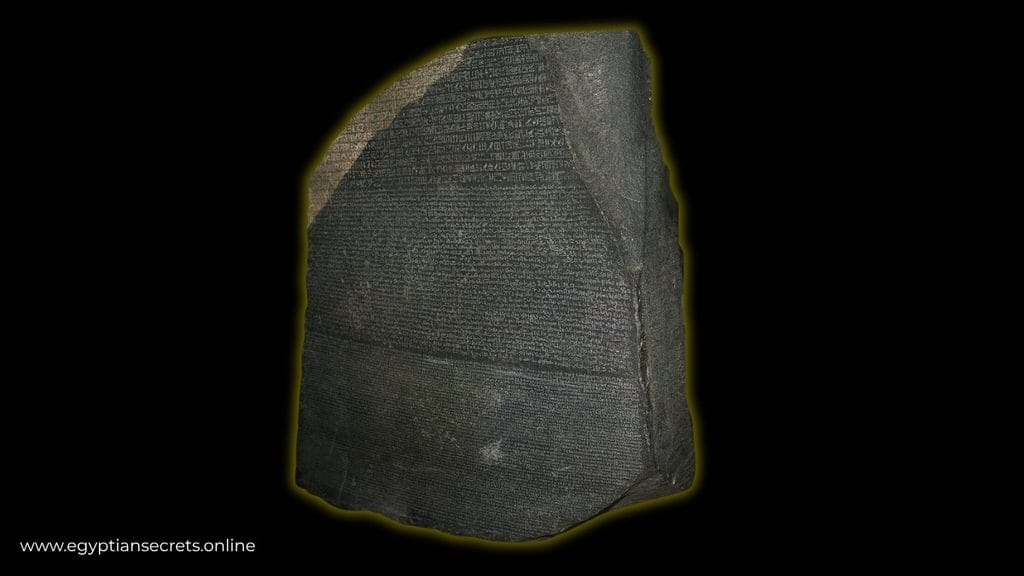
The decipherment story usually gets compressed into one object and one man. Rosetta Stone, Champollion, done.
It was messier than that, and more interesting.
French soldiers found the Rosetta Stone in 1799 while rebuilding a fort near Rashid. It carried the same priestly decree, issued for Ptolemy V in 196 BC, in three scripts: hieroglyphs, demotic, and Greek. Scholars could read the Greek. That gave them a crib.
But the crib alone solved nothing for twenty years, because everyone was working from a false assumption — that hieroglyphs were symbolic, a philosophical picture-code rather than a writing system that recorded speech.
Progress came in pieces. The Swedish diplomat Johan David Åkerblad picked out proper names in the demotic text within a couple of months. The English physicist Thomas Young — better known for proving light behaves as a wave — worked out that demotic derived from hieroglyphs and correctly identified several single-consonant signs. Then he took a wrong turn and stalled.
Jean-François Champollion had an advantage nobody else did: he could read Coptic, the last descendant of the Egyptian language, still used liturgically by Egyptian Christians. When he started sounding out royal names in cartouches, the results came out as recognisable Coptic words.
His letter announcing the system was read publicly on 27 September 1822 — 1,428 years after that priest at Philae put down his chisel. The British Museum has published a detailed timeline of the whole decipherment if you want the full sequence.
One correction worth making: the Rosetta Stone was never the only bilingual key. The Decree of Canopus, found at Tanis in 1866, carried more hieroglyphic signs than the Rosetta Stone and mattered enormously to nineteenth-century scholarship. It sits in the Egyptian Museum in Cairo and gets a fraction of the attention.
What Recent Discoveries Have Changed
Two finds in particular have shifted things in the last few years.
The Elkab inscriptions: writing was never just bookkeeping
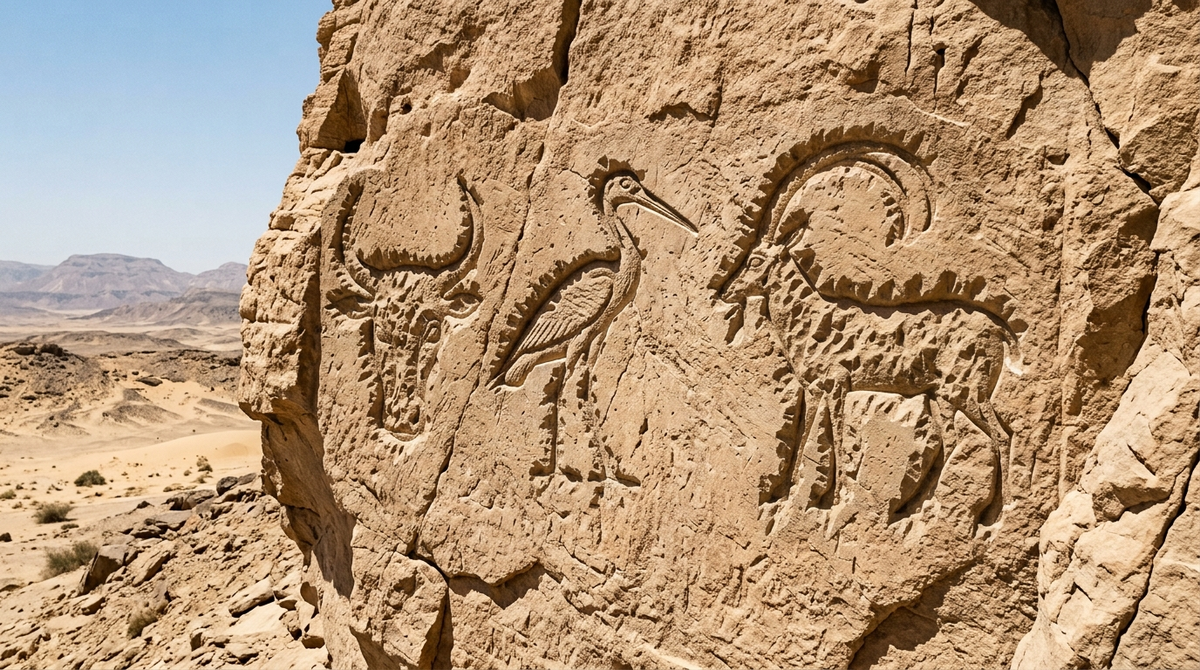
A joint expedition from Yale and the Royal Museums of Art and History in Brussels, led by Egyptologist John Darnell, documented rock inscriptions in the desert north of Elkab in Upper Egypt. They date to roughly 3200 BC — around 5,200 years old — which makes them among the earliest monumental hieroglyphs known.
The scale is the point. Previously known signs from this period measure one or two centimetres. These are over half a metre tall. Darnell’s comparison was that it is like going from small text on a screen to the same text on a billboard.
Why it matters: the standard account held that Egyptian writing began as a narrow administrative tool — tags, labels, accounting — and only later expanded into monumental and religious use. Darnell argues these inscriptions undercut that. Writing appears to have been geographically widespread and used for varied purposes from very close to its beginning.
The team found them by mapping ancient road networks rather than digging at random. Egyptian rock inscriptions are rarely placed casually — they cluster along routes, positioned to be seen.
A seventh Canopus Decree — and it breaks the pattern
In 2025 Egypt’s Ministry of Tourism and Antiquities announced a newly discovered version of the Decree of Canopus — a sandstone stela roughly four feet tall, in good condition, carved with a winged sun disc flanked by two cobras.
What makes it unusual: the six previously known copies are multilingual. This one carries hieroglyphs only.
Egyptologist Stefan Pfeiffer has suggested the blank space below the carved decoration indicates the stela was never finished. Researchers are still comparing it against the other versions, so what it eventually tells us is genuinely open.
Can AI Read Hieroglyphs Now?
Partly, and not in the way the headlines suggest.
There is real work happening. Machine learning has become genuinely useful for sign recognition — photographing a wall and having software identify which glyphs are present, segment them, and match them against sign lists. That is tedious work that used to eat weeks of a specialist’s time, and automating it is a real gain.
Translation is a different problem, and much harder. Egyptian is a dead language with no living speakers, limited training data, no written vowels, and grammar that shifted substantially across three thousand years. Context does most of the work, and context is exactly what these systems handle worst.
So when you see a video claiming AI has decoded a hidden message in an Egyptian carving — a prophecy, a warning, a date — it is invented. Those videos exist because they perform well, not because anything was decoded.
A useful test: real decipherment work names the site, names the researchers, and gets published somewhere you can check. Claims that skip all three are entertainment.
Who Could Actually Read Them?
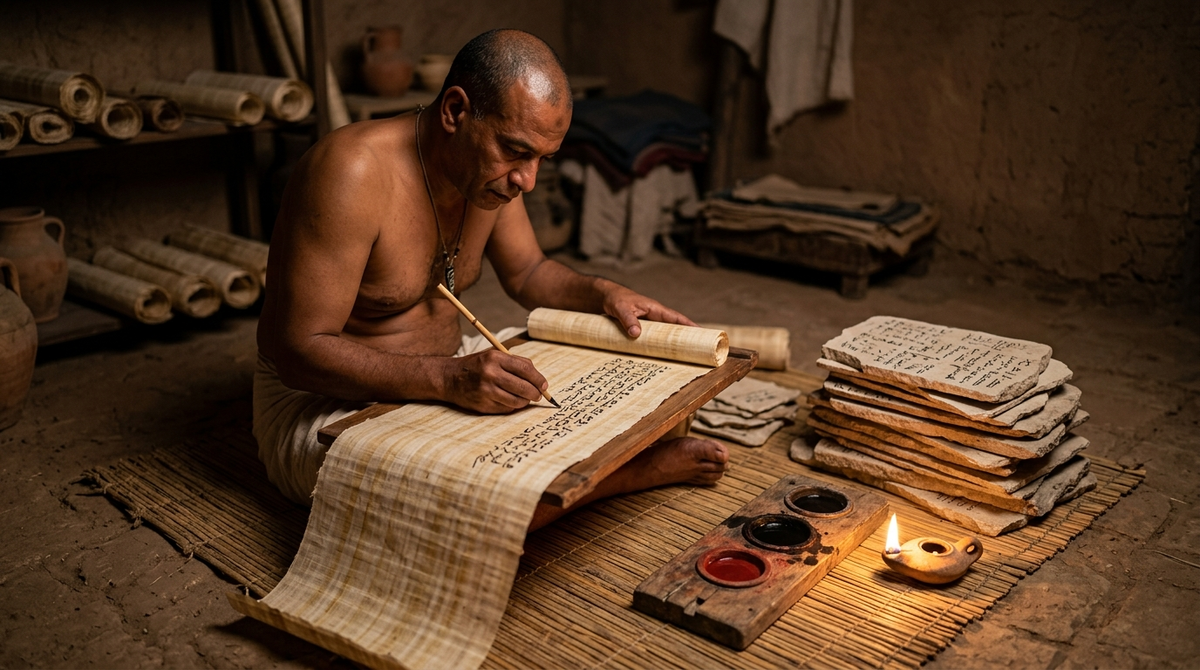
Very few people. Literacy estimates for ancient Egypt generally sit in the low single digits as a percentage of the population, and full hieroglyphic literacy was rarer still.
Most writing that got done day to day was not in hieroglyphs at all. Scribes used hieratic, a cursive shorthand written with a reed brush on papyrus and ostraca. Hieroglyphs were the formal, carved, monumental version — reserved for temples, tombs, and royal display.
Think of it as the difference between a stone-carved inscription over a courthouse door and the handwriting in the files inside.
That scribal class ran the country. The land surveys, tax assessments and household registers described in our article on the ancient Egypt census were all produced by these men, and Egypt’s government existed largely to process what they wrote down.
Thoth, the ibis-headed god of writing, was their patron — one of the ancient Egyptian gods whose cult had a direct professional constituency.
Writing Was Considered Dangerous
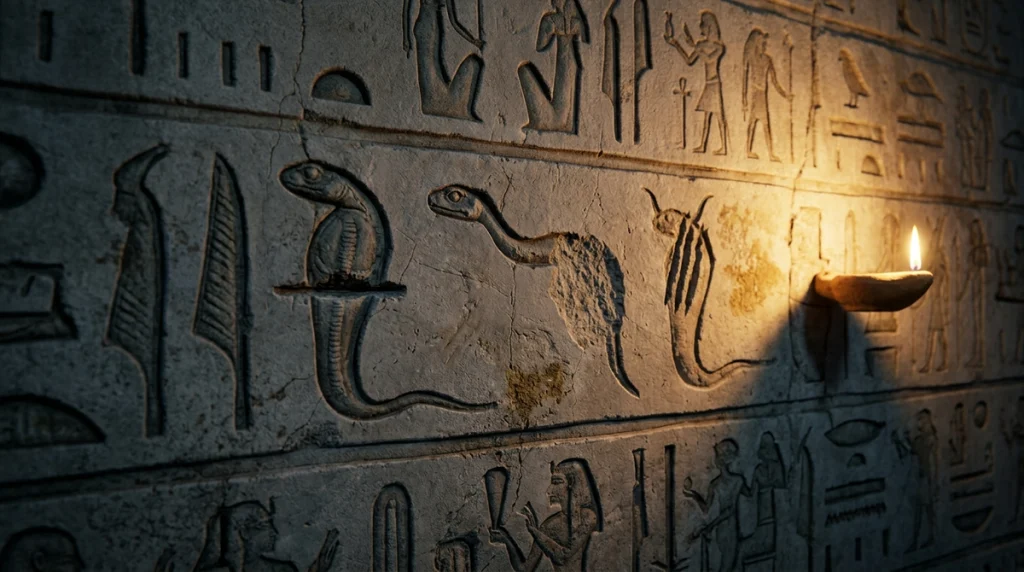
This is my favourite detail about the whole script, and it tells you something no grammar book will.
Egyptians believed written words had power. A name written down preserved the person; a name erased destroyed them. That belief had practical consequences carved into the walls.
In some burial chambers, signs depicting dangerous creatures — snakes, scorpions, lions — were deliberately mutilated. Carved without legs. Cut in half. Speared with a knife glyph.
The reasoning: a snake sign sealed inside a tomb with a defenceless corpse might act like a snake. So the scribes disabled it.
The same logic ran in reverse for enemies. Erasing a name from a monument was not vandalism — it was an attempt to end someone’s existence in the afterlife. It happened to Akhenaten. It happened to Hatshepsut. It happened to anyone whose successors wanted them gone permanently.
A script people were frightened of is not decoration.
Frequently Asked Questions
Are Egyptian hieroglyphs a picture language?
No. Most signs represent sounds rather than the objects they depict. An owl sign usually stands for the consonant m. The system mixes phonetic signs, word signs, and silent classifying signs called determinatives.
When were Egyptian hieroglyphs deciphered?
Jean-François Champollion’s breakthrough was announced publicly on 27 September 1822. Earlier partial progress came from Johan David Åkerblad and Thomas Young, but Champollion’s knowledge of Coptic let him confirm the script recorded spoken Egyptian.
What is the last hieroglyphic inscription?
A graffito carved by a priest at the temple of Philae, dated to AD 394. No later dated hieroglyphic text is known, and the ability to read the script was lost soon afterwards.
How many hieroglyphic signs are there?
Roughly 750 in Middle Egyptian, the classical stage of the language. The inventory expanded to several thousand during the Greco-Roman period as temple scribes developed increasingly elaborate spellings.
Which direction do you read hieroglyphs?
Left to right, right to left, or top to bottom, depending on the layout. Signs with faces look toward the start of the line, so the direction the birds and animals face tells you where to begin.
Can artificial intelligence translate hieroglyphs?
Machine learning is useful for identifying and cataloguing individual signs, which speeds up a genuinely tedious part of the work. Full translation remains a research problem, and viral claims about AI decoding hidden messages in Egyptian carvings are not real.
Conclusion
Egyptian hieroglyphs get treated as ornament — the thing you photograph on a temple wall and never think about again.
They were a working technology. People used them to run an economy, bury their dead, curse their enemies, and argue with the gods. They were feared enough that scribes cut the legs off snake signs before sealing a tomb.
And for fourteen centuries, nobody on earth could read a word of it.