
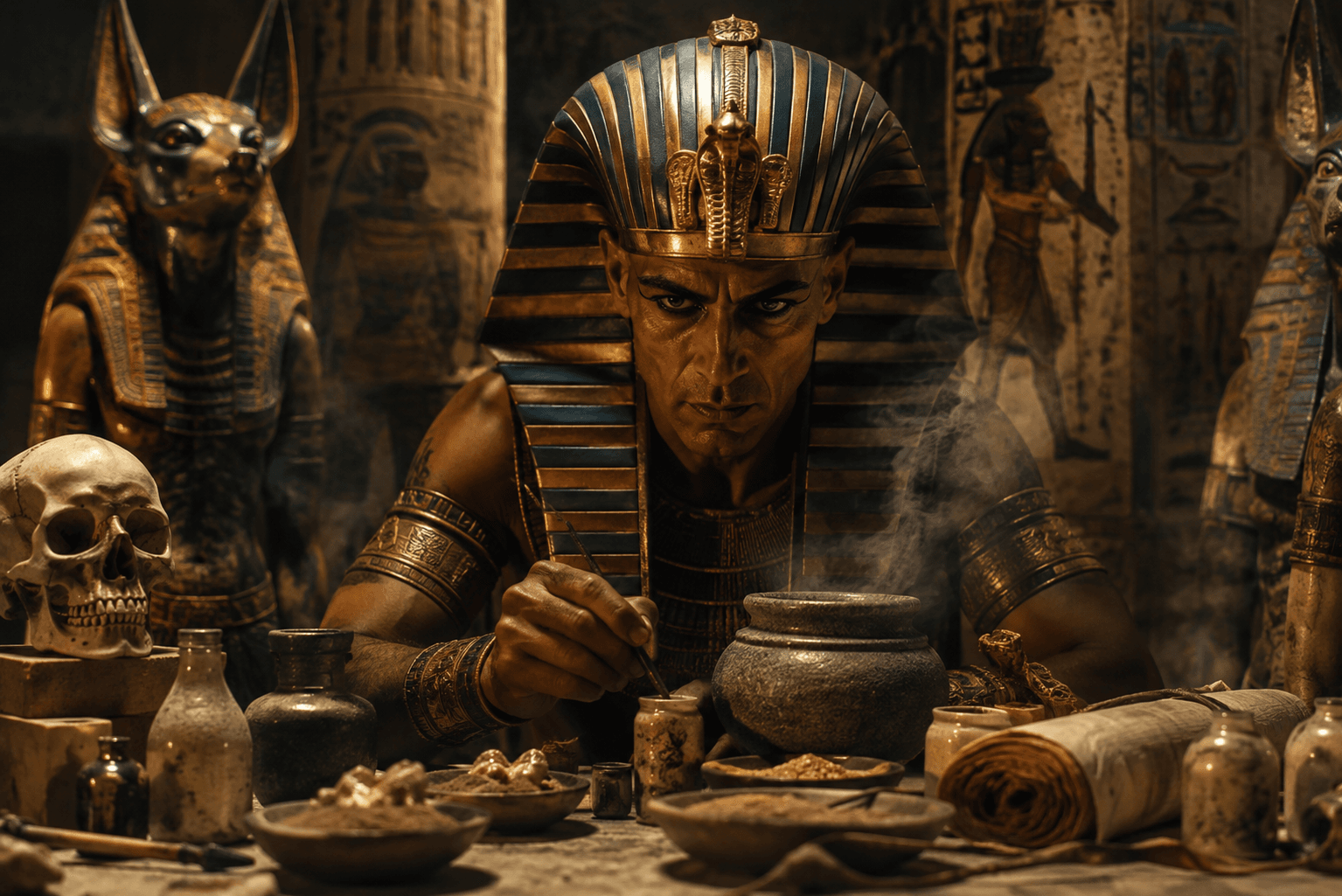
Discover what ancient Egyptians actually invented. From papyrus to toothpaste to the first antibiotics, explore 15 innovations that shaped human civilization. Papyrus made possible the record-keeping described in our article on the ancient Egypt census.
Introduction
Here’s something interesting: when you ask someone “What did ancient Egyptians invent?” most people draw a blank. Or they say “pyramids” (which is architecture, not really an invention). Or they say “mummies” (which is a technique, not an invention in the modern sense).
But the truth is, ancient Egyptians invented a remarkable number of things we take for granted today. Things we use every single day. Things that shaped how human civilization developed.
And honestly? Once you start looking into ancient Egypt inventions, you realize how innovative this civilization actually was. They weren’t just building big monuments. They were solving practical problems. They were asking “how can we do this better?” They were experimenting. They were developing techniques and technologies that are still in use thousands of years later. Our article on how the pyramids were built covers the engineering side.
Some of their inventions were objects. Some were techniques. Some were systems for organizing society or storing knowledge. But all of them mattered. All of them changed how humans lived.
Let me walk you through what ancient Egyptians actually invented. Some will surprise you. Some you probably use today without even knowing an Egyptian came up with it thousands of years ago.
Papyrus: The Paper That Changed Writing

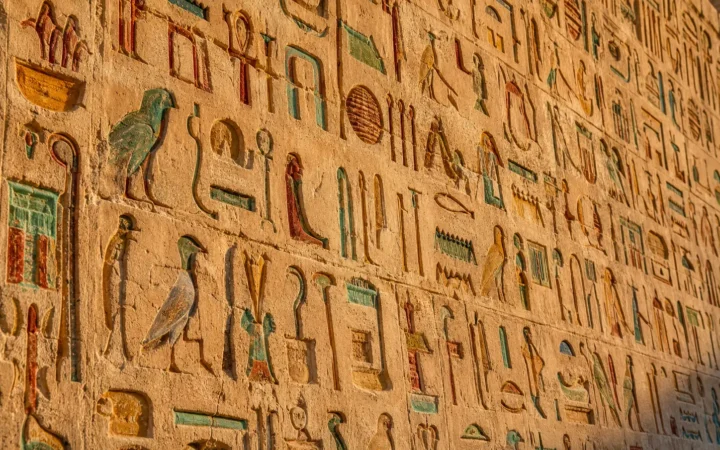
The most obvious ancient Egypt invention is papyrus. Not the plant itself—papyrus plants grew naturally in the Nile Delta. The invention was the idea to process the plant into a writing surface.
Here’s how it worked: the papyrus plant had a core that Egyptians would cut into thin strips. They’d lay these strips side by side, then lay another layer perpendicular on top. Then they’d soak the whole thing in water and pound it. The fibers would bond together naturally, creating a smooth surface you could write on.
It sounds simple. It wasn’t. Creating papyrus required understanding the plant’s properties, understanding how fibers could bond, understanding what would create a writing surface smooth enough for text but durable enough to last. It required experimentation.
Papyrus was revolutionary because it was light, portable, and reusable in ways that clay tablets (the writing medium used in Mesopotamia) weren’t. You could carry papyrus easily. You could roll it into scrolls for storage. You could transport written documents.
This meant that writing wasn’t limited to monumental records carved into stone. It could be portable. It could be personal. It could be business documents, letters, administrative records, religious texts. Papyrus democratized writing in a way that changed civilization.
We still use paper today—essentially the same concept Egyptians developed. The word “paper” comes from “papyrus.” This is an invention that lasted 3,000+ years.
The Toothbrush and Dental Care
Ancient Egyptians are credited with inventing the toothbrush. Not the bristle toothbrush you use today, but the basic concept.
They’d take a small stick—often from the miswak tree—and chew on one end until the fibers separated, creating brush-like bristles. They’d use this to clean their teeth, often with a mixture of mint, salt, and other ingredients.
This wasn’t just convenience. Egyptians clearly valued dental health. Archaeological examination of mummies shows evidence of dental care. They seemed to understand that maintaining teeth was important for health.
The invention here is the realization that your teeth need active cleaning, and the development of tools and techniques to do that. Modern toothbrushes are essentially the same concept they developed—a handle with bristles, used for cleaning teeth.
The First Toothpaste
Related to toothbrush invention is toothpaste. Egyptians created mixtures specifically for cleaning teeth. Archaeological evidence suggests they used combinations of:
- Mint
- Salt
- Crushed rock or chalk
- Water
These were ground into pastes or powders and applied to teeth. This is the ancestor of modern toothpaste.
The innovation here is understanding that some substances help clean teeth better than just water and a brush. Understanding that mint and salt have beneficial properties. Understanding how to create a consistent paste.
Modern toothpaste is more sophisticated (we add fluoride, use more refined abrasives, add ingredients for whitening). But the basic concept—a paste applied to teeth for cleaning—that’s an ancient Egyptian invention.
Antibiotics: The Moldy Bread Discovery
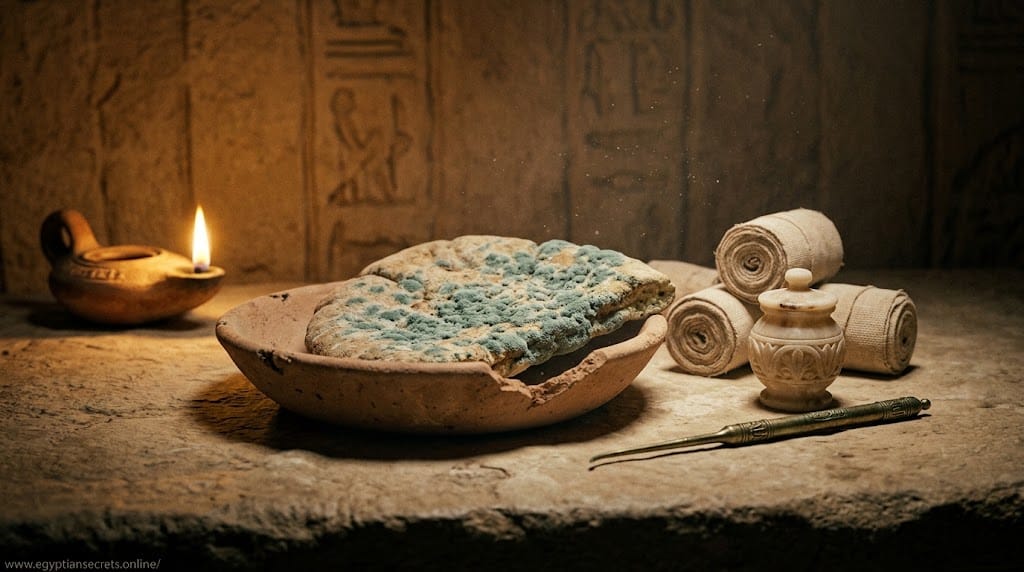
This one will blow your mind. Ancient Egyptians apparently discovered antibiotics thousands of years before Fleming discovered penicillin.
Historical evidence suggests that Egyptians noticed that certain molds prevented infection. Specifically, they observed that certain molds growing on bread seemed to prevent wounds from becoming infected. So they deliberately applied moldy bread to wounds.
This is essentially empirical discovery of antibiotics. They didn’t understand bacteria or fungal biology. They just noticed: “Moldy bread = wounds don’t get infected as badly.” So they used it.
Modern science eventually identified that these molds produce compounds (like penicillin) that actually kill bacteria. Egyptians stumbled onto this through observation and experimentation, thousands of years before we had microscopes or understood microbiology.
Medicine and Medicinal Substances
Building on their empirical medical knowledge (like the moldy bread antibiotic), Egyptians developed extensive medicinal practices. They created treatments using:
- Plant extracts
- Animal products
- Mineral compounds
- Careful preparation techniques
The Edwin Smith Papyrus and Ebers Papyrus document Egyptian medical knowledge. They describe treatments for wounds, digestive issues, eye diseases, and more. Some of these treatments actually work (we’ve confirmed this through modern scientific analysis).
The invention here is the idea that specific substances can treat specific ailments. That medicine can be systematic and documented. That medical knowledge can be passed down and improved over time. Egyptian kohl eyeliner is a good example of empirical medicine.
The Process of Mummification (Advanced Preservation Technique)
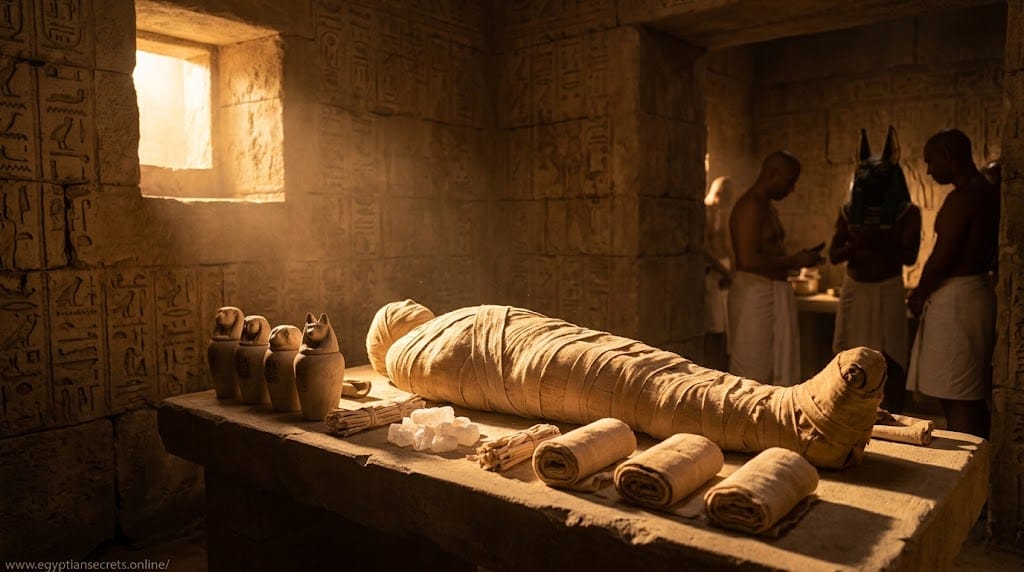
Mummification might not seem like an invention, but it’s actually a remarkable preservation technology. The Egyptians developed techniques to preserve bodies for thousands of years.
They discovered that certain materials—specifically natron (a mineral salt)—could desiccate a body and prevent decomposition. They developed careful procedures for organ removal, tissue treatment, and wrapping. They created conditions (sealed tombs, specific environments) that allowed preservation to continue indefinitely.
This was experimentation and innovation applied to a spiritual/religious goal. But the preservation techniques they developed were genuinely sophisticated and effective.
Modern scientists still study Egyptian mummification because it was so effective. The invention here is understanding preservation chemistry and creating a reproducible process.
The 365-Day Calendar
The Egyptians invented the 365-day calendar. They observed that the year—the time for the Nile to flood and return to normal—took approximately 365 days. They divided this into 12 months of 30 days each, plus 5 extra days for religious celebrations.
This wasn’t perfect (the actual year is 365.25 days, so they lost about a quarter day annually), but it was functional and systematic. It allowed planning. It allowed prediction of the flood season.
This calendar system is the ancestor of the modern calendar we use today. The concept of dividing the year into months, into weeks, into days—that comes from Egyptian innovation.
Advanced Construction Techniques
Egyptian construction techniques—for pyramids, temples, and monuments—were innovative for their time. They developed:
- Methods for quarrying and moving massive stone blocks
- Ramp systems for raising blocks to height
- Surveying techniques for precise alignment
- Engineering techniques for creating structures that would last thousands of years
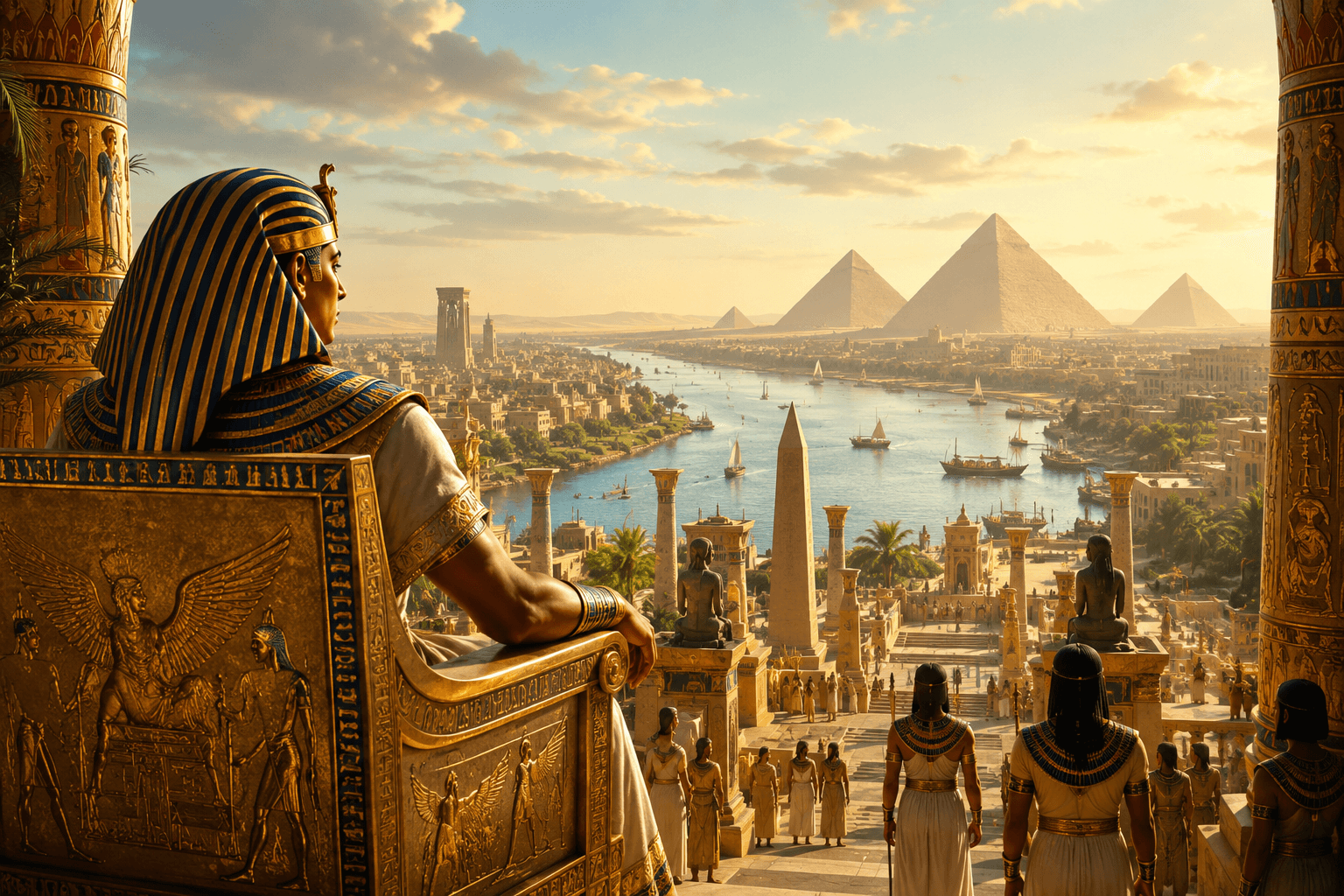
The Great Pyramid is built with such precision that some angles and measurements are accurate to fractions of an inch. This required sophisticated understanding of mathematics, geometry, engineering, and logistics.
Were these techniques perfect? No. Did Egyptians have to revise approaches? Yes (early pyramids failed or collapsed—this is documented). But they kept innovating, kept improving, kept solving problems. That’s what inventive societies do.
The Sundial and Shadow Clock
To measure time during the day, Egyptians developed the shadow clock (later called a sundial). This was a simple device that used the shadow cast by the sun to indicate time periods.
The innovation here is understanding that the sun’s position can be used to measure time. Creating a tool that translates this understanding into practical time measurement. Understanding enough astronomy to make this work reliably.
Cosmetics and Personal Care Products
Ancient Egyptians developed sophisticated cosmetics, including:
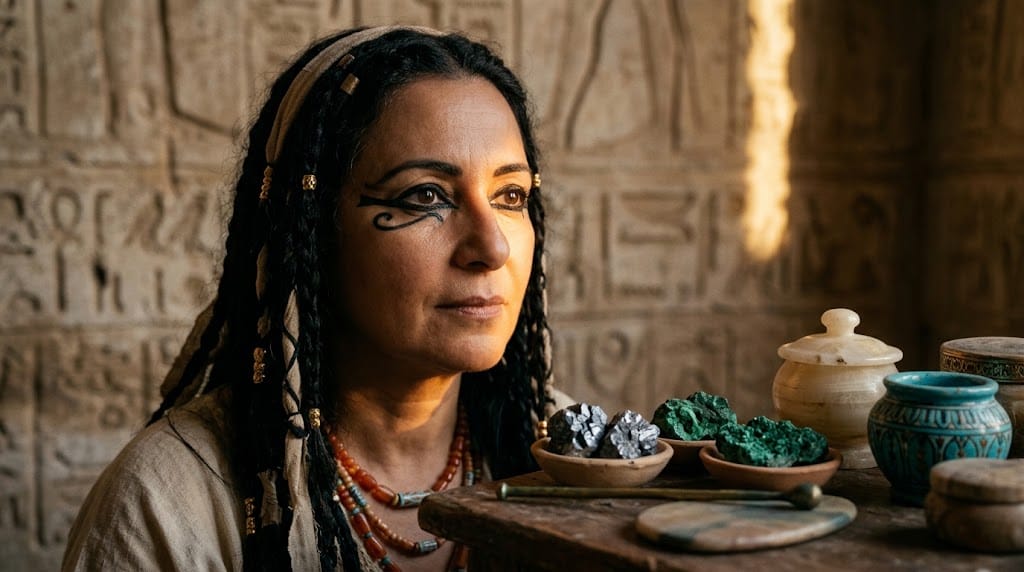
- Kohl eyeliner (which, as we discussed in our earlier article, actually had immune-boosting properties)
- Eye makeup in various colors
- Creams and oils for skin care
- Perfumes and scented oils
- Hair products
They created production techniques for creating these products consistently. They developed understanding of which substances worked for different purposes. They created distribution and trade systems for luxury cosmetics.
The innovation here is understanding chemistry, understanding what works for different skin types and purposes, creating reproducible formulas.
Beer Brewing and Fermentation
Egyptians didn’t invent beer (there’s evidence of beer brewing in Mesopotamia too), but they did develop sophisticated brewing techniques. Beer was a staple of Egyptian diet—safer than water, nutritious, widely available.
Egyptians understood fermentation enough to produce consistent, reliable beer. They had quality control methods. They had storage and distribution systems. They understood which conditions produced better beer.
Understanding fermentation was essentially understanding microbiology at an empirical level. This knowledge was applied to bread-making as well—they understood how yeast worked, even without understanding that yeast was a living organism.
Glass Manufacturing
Egyptians were among the first to develop glass manufacturing. They created small glass vessels starting around 1500 BCE. This required understanding:
- High-temperature melting
- Glass composition and how different materials affected properties
- Forming techniques
- Cooling procedures
Early Egyptian glass was expensive and rare—only for the wealthy. But over time, techniques improved and glass became more common. This innovation eventually led to widespread glass production that transformed human civilization.
Faience: The First Synthetic Material
Faience is a ceramic material that Egyptians developed and perfected. It’s made from crushed quartz, mixed with binders and water, formed into shape, dried, and then fired at high temperature. The result is a glazed, durable material that’s often blue-green in color.
Faience was used for decorative objects, amulets, tiles, and vessels. The innovation here is understanding how to create a synthetic material with specific desired properties. This is essentially the predecessor to modern ceramics and synthetic materials.
It represents a major innovation: the ability to create new materials rather than just using naturally occurring ones.
Concrete and Waterproof Plaster
Egyptian builders developed waterproof plasters and concretes for use in construction and waterproofing. These materials helped structures withstand exposure to water and time.
They used combinations of materials—lime, gypsum, various aggregates—mixed and applied in specific ways to create durable, waterproof surfaces. Modern analysis of ancient structures shows these materials held up remarkably well.
This represents innovation in materials science, understanding how to combine substances to create desired properties.
The Weighing Scale and Early Measurement Systems
Egyptians developed sophisticated systems for measuring and weighing goods. They created weighing scales precise enough for trade and for creating consistent quality products.
They developed standardized units of measurement—for weight, for length, for volume. This allowed:
- Fair trade
- Quality control in manufacturing
- Reproducible results in crafts and construction
- Taxation and economic systems based on measurable quantities
These systems were foundational to developing a complex economic civilization.
Frequently Asked Questions (FAQ)
Q: What is the most important ancient Egypt invention?
A: Papyrus is probably the most impactful. It revolutionized writing and information storage. But mummification, the calendar, and construction techniques are also monumentally important.
Q: Did ancient Egyptians invent the pyramid?
A: Pyramids are architecture, not really an invention. But the engineering techniques to build them were innovative. And Egyptians did develop the pyramid design over time, improving from step pyramids to smooth-sided pyramids.
Q: Did Egyptians invent mathematics?
A: Not exactly, though they developed sophisticated mathematical systems. They understood geometry well enough to build pyramids with incredible precision.
Q: How did ancient Egyptians discover antibiotics?
A: They observed that moldy bread prevented infection. We now know certain molds produce antibiotics. This was empirical discovery—noticing something works, then using it—rather than scientific discovery.
Q: Are Egyptian inventions still used today?
A: Yes, many. Papyrus led to paper. The calendar is still used. Cosmetics and personal care products are still used. Construction techniques are still relevant.
Q: Did other civilizations invent similar things?
A: Sometimes. Mesopotamia also had writing and mathematics. But Egyptians developed many innovations independently or improved on earlier ideas.
Q: What ancient Egypt invention surprises people most?
A: Probably antibiotics. Most people don’t realize Egyptians discovered that moldy materials could prevent infection.
Q: How did Egyptians come up with these inventions?
A: Mostly through observation and experimentation. They noticed something worked, then refined the technique. Over time, accumulated knowledge led to sophisticated innovations.
Conclusion: Innovation as the Foundation of Civilization
Looking at ancient Egypt inventions, what becomes clear is this: civilization requires innovation. You can’t build pyramids without developing engineering techniques. You can’t maintain complex society without writing systems. You can’t have healthy populations without medical innovations.
Egyptians weren’t geniuses who suddenly came up with all these ideas. They were practical people solving real problems. They noticed things. They experimented. They shared knowledge. They improved techniques over generations.
That process of observation, experimentation, refinement, and knowledge-sharing is essentially what innovation is. And ancient Egypt was remarkably good at it.
3 Comments