How this works, and how accurate it is
How Accurate Is This?
It is an approximation. So is every tool like it, including the ones that do not say so.
The reason is simple: Egyptian did not write vowels. A name like “Sarah” has no fixed hieroglyphic spelling because the script records consonants and leaves the reader to supply the rest.
What this tool does is genuine as far as it goes. The signs above are uniliterals — single-consonant signs. Egyptians used exactly these to spell foreign names and words that did not exist in their own vocabulary, sounding them out one consonant at a time. The method is real; the result is an approximation of your name’s consonants, not a translation.
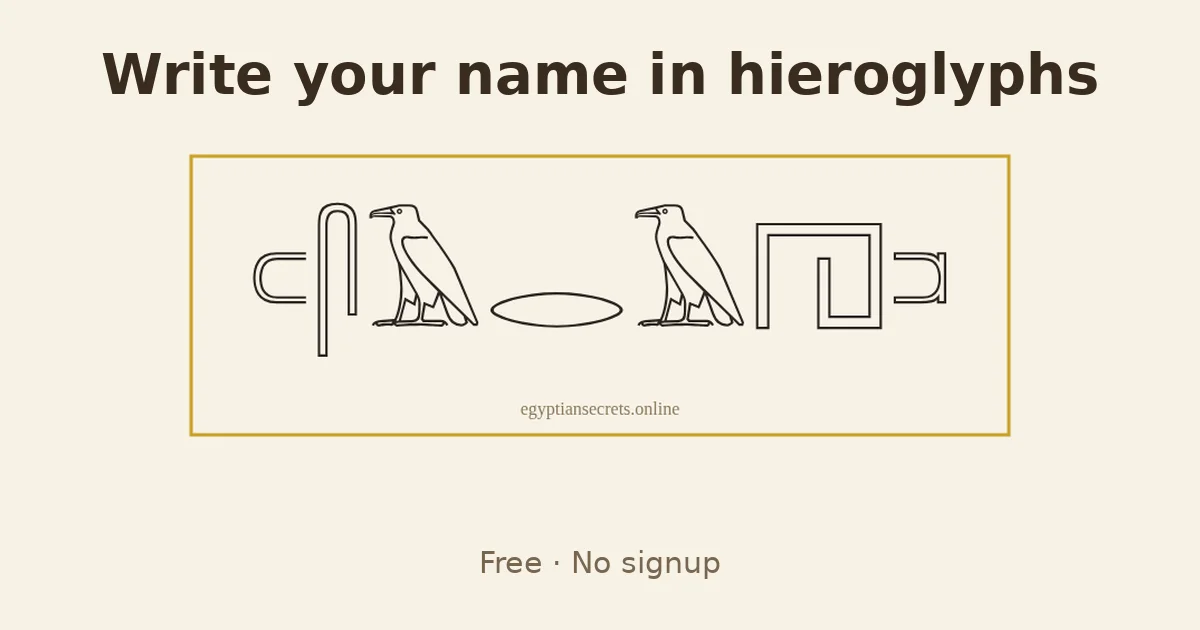
What the cartouche is
The oval ring enclosing the signs is a cartouche. It is a loop of rope with the ends tied, and it surrounded the names of kings and queens.
Egyptians believed a written name held the person’s identity, and the cartouche protected it. That belief had a dark side — erasing a name from a monument was an attempt to end someone’s existence in the afterlife, as happened to Hatshepsut.
Why some letters share a sign
Several English letters map to the same hieroglyph because Egyptian had no separate sound for them. C and K both become the basket sign. U, O and W all become the quail chick. V is written with the horned viper used for F.
This is not a flaw in the tool. It reflects the actual sound inventory of the language.
Want the full set of signs rather than just your name? The hieroglyphic alphabet lists all 25 single-consonant signs with their sounds, Gardiner codes and what each one depicts — including why there is no sign for L, V or X.
Frequently Asked Questions
Is this my name in real hieroglyphics?
The signs are real and the method is one Egyptians used for foreign names. But because Egyptian wrote no vowels, there is no single correct hieroglyphic spelling of a modern name. Treat it as a close phonetic approximation.
Why do C and K give the same sign?
Egyptian had one sound where English has two letters. Both are written with the basket sign, Gardiner code V31. The same applies to U, O and W, which all use the quail chick.
What does the oval around the name mean?
It is a cartouche — a loop of knotted rope that enclosed royal names. Egyptians believed it protected the name, and therefore the person, written inside it.
Why are the signs showing as empty boxes?
Your device does not have a hieroglyphic font installed. The signs use the Unicode Egyptian Hieroglyphs block, which most modern phones support but some older devices do not. The downloaded image will still work.
Did Egyptians write left to right?
Either direction, and vertically. Signs with faces look toward the beginning of the line, so the direction the birds face tells you where to start reading.
For how the writing system actually worked — the three kinds of sign, how it was deciphered, and what recent excavations have changed — see our full guide to Egyptian hieroglyphs.