

First, here are 13 ancient Egyptian names and their commonly cited meanings, from Khufu to Ramesses.
However, most examples below are royal names, not a complete list of names used by ordinary Egyptians. Ancient Egyptian writing usually recorded consonants rather than all the vowels we use in English. As a result, modern spellings and translations can vary.

Ancient Egyptian names and meanings
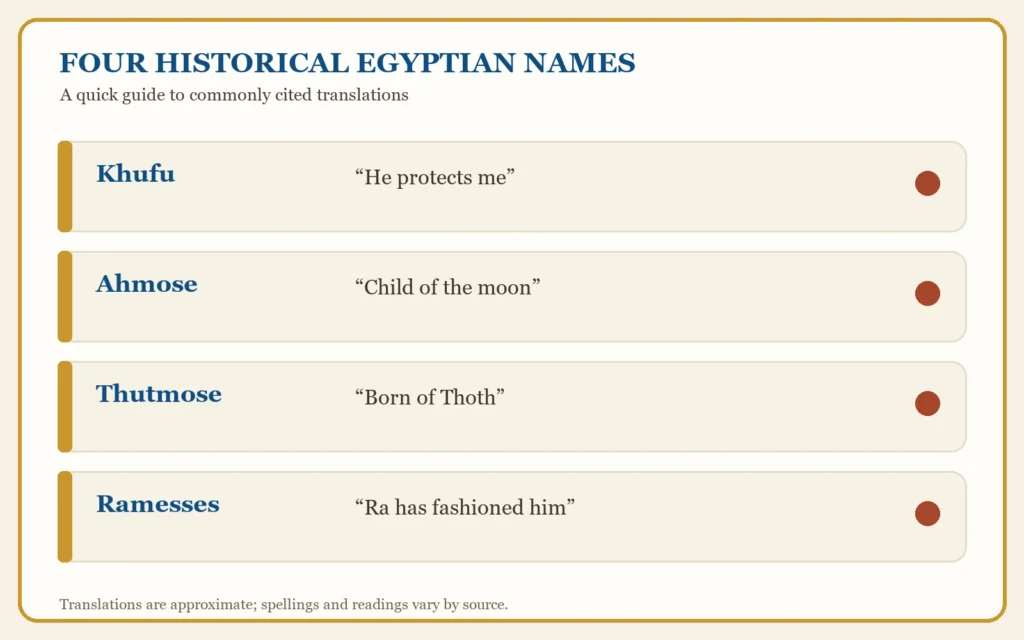
For quick reference, the table pairs each name with a commonly cited meaning and a historical connection. The Bibliotheca Alexandrina’s Learn Hieroglyphs guide provides the name readings behind these translations. Still, other references may use different spellings or wording.
| Name | Meaning commonly given | Historical connection |
|---|---|---|
| Sneferu | “Who beautifies me” | He founded Egypt’s Fourth Dynasty. |
| Khufu | “Who protects me” | Historical sources link him to the Great Pyramid at Giza. |
| Khafra | “Shines like Ra” | He commissioned a major pyramid at Giza. |
| Menkaure | “May the kas of Ra remain” | He commissioned the third major pyramid at Giza. |
| Montuhotep | “Montu is satisfied” | Several Egyptian rulers used this name. |
| Amenemhat | “Amun is in the front” | Several Twelfth Dynasty kings used this name. |
| Ahmose | “Son of the moon” | He founded the Eighteenth Dynasty. |
| Amenhotep | “Amun is satisfied” | Several New Kingdom kings used this name. |
| Thutmose | “Born of the god Thoth” | Several Eighteenth Dynasty rulers used this name. |
| Hatshepsut | “Joined with Amun, foremost of noble ladies” | She ruled Egypt as a pharaoh in the Eighteenth Dynasty. |
| Akhenaten | “Living spirit of Aten” | He elevated Aten during his reign. |
| Tutankhamun | “Living image of Amun” | Howard Carter’s team found his tomb largely intact in 1922. |
| Ramesses | “The one whom Ra created” | Several pharaohs used this name, including Ramesses II. |
Why do many Egyptian names mention a god?
Moreover, Egyptian names often referred to a god, a king, a family member, or a hope for a child’s future. For example, Oxford Egyptologist Maren Schentuleit discusses Merisekhmet, “Loved by Sekhmet,” and Peteosiris, “He who was given by the god Osiris.” Similarly, these examples show how a name could express religious devotion or a relationship with a deity. Read Oxford’s overview of Egyptian naming traditions.
How do scholars work out a name’s meaning?
To interpret a name, researchers compare its spelling, grammar, date, place, and the object or document where it appears. Meanwhile, naming customs could change from one community or period to another. Therefore, some readings are clear, while others remain debated.
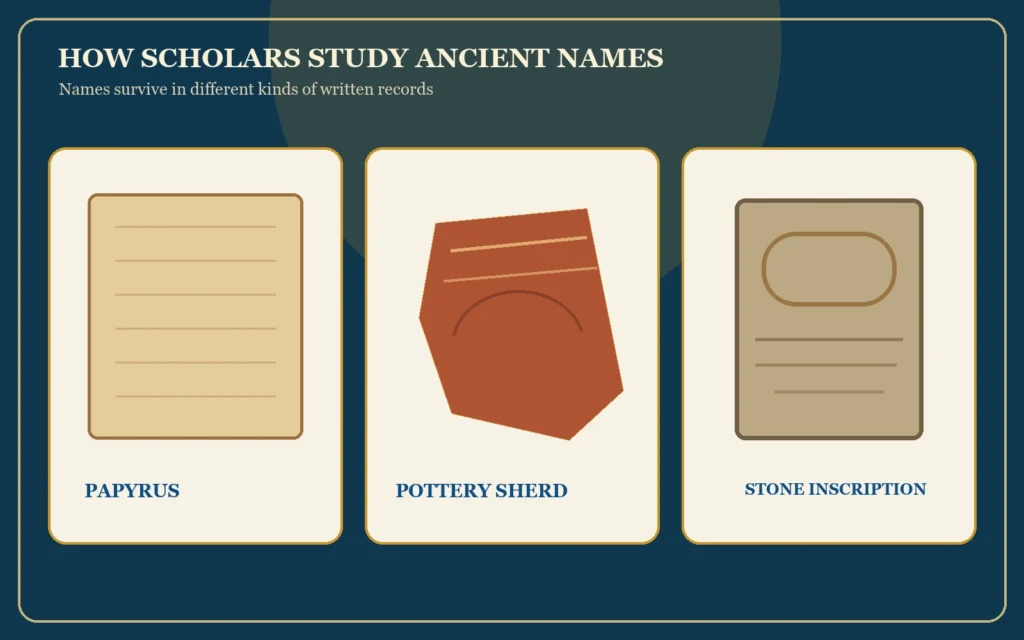
The French Institute of Oriental Archaeology’s AGÉA project on Egyptian names explains how scholars revise readings as they study new evidence. Because of that ongoing work, responsible writers identify the source for a translation instead of presenting every meaning as certain.
Does writing a name in hieroglyphs translate its meaning?
At first glance, a hieroglyphic rendering may look like a translation. However, a sound-based rendering represents the sounds of a modern name; it does not prove that the name was an ancient Egyptian word or give it an ancient Egyptian meaning. Our Write Your Name in Hieroglyphics tool demonstrates that sound-based approach.

The short answer
In short, ancient Egyptian names could express devotion, family ties, royal identity, or a hope for the future. Names such as Ahmose, Amenhotep, Thutmose, and Ramesses offer well-known historical examples. Finally, treat their meanings as useful clues, while keeping the evidence and possible translation differences in mind.