
A 4,300-Year-Old “Keeper of Secrets” Walks Out of the Sand
Some headlines do their own advertising. When Egypt’s Ministry of Tourism and Antiquities announced the find in early September 2026, you could practically hear the whole internet lean forward. A tomb. Saqqara. An official called the “Keeper of the Secrets of Royal Decrees.” Within days, searches for “egypt tomb discovery” were spiking, and social media was busy turning an Old Kingdom civil servant into an ancient spymaster.
The real story is better. This newly discovered keeper of secrets tomb doesn’t hide a man of mystery at all. It holds a man of paperwork — and that paperwork reveals how a 4,300-year-old superpower ran itself. Two false doors standing where mourners left them. Alabaster ritual vessels untouched for millennia. A wooden falcon, 100-plus ushabti figurines, and three sealed stone sarcophagi. Let’s walk through it properly.
✍️ Write YOUR Name in Real Hieroglyphics
See how the ancient Egyptians would have written your name — free interactive tool.
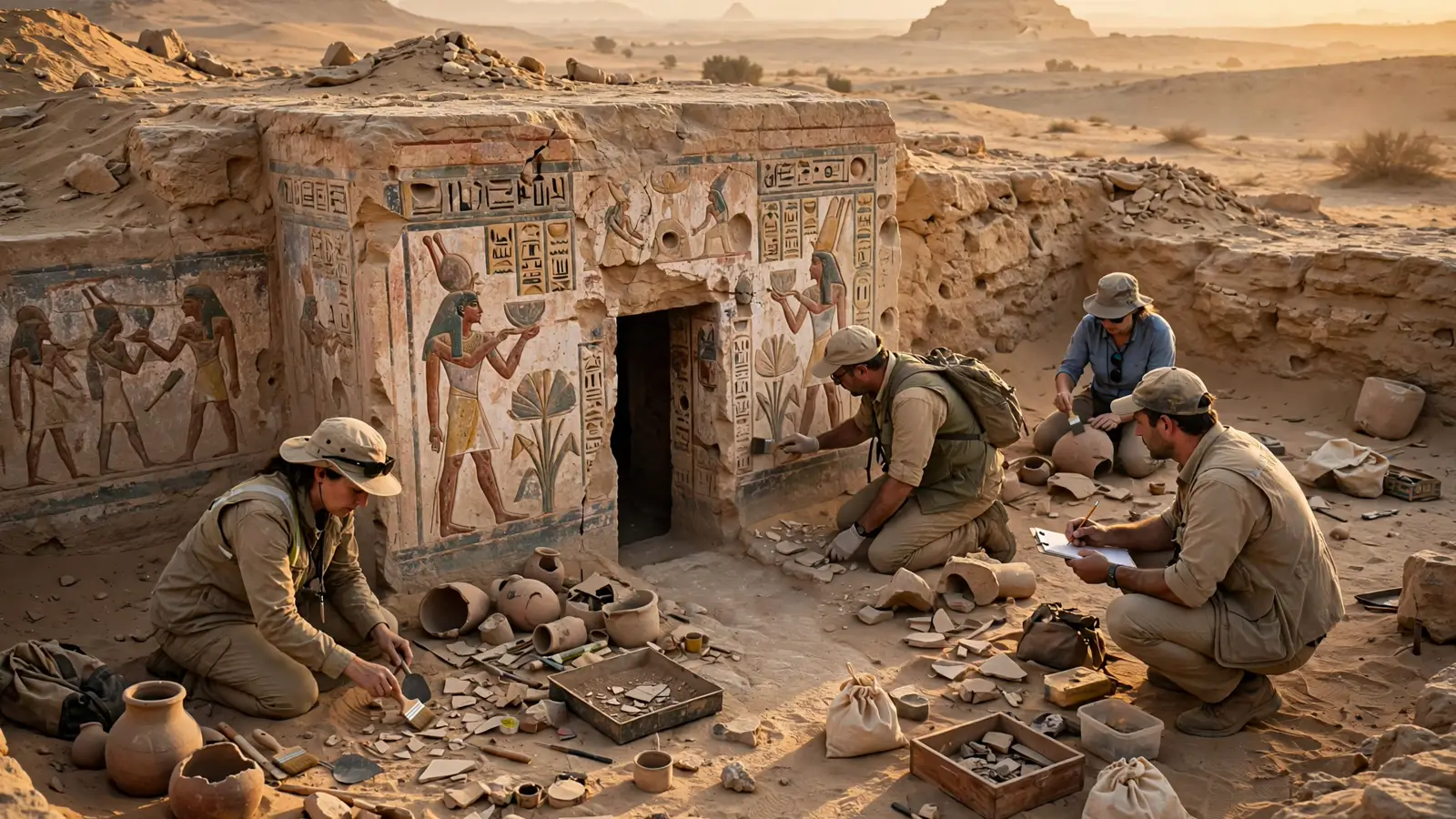
The Keeper-of-Secrets Tomb at a Glance
- Who: Sekhentio-Ptah (also transliterated Sekhentiu-Ptah or Sakhnetio-Btah), an Old Kingdom official with a string of senior titles.
- When: Late 5th or early 6th Dynasty — roughly 4,300 to 4,350 years ago, in Egypt’s Old Kingdom (2649–2150 BCE).
- Where: Sector A, a previously unexplored area west of the Bubasteion necropolis at Saqqara, about 20 miles south of Cairo.
- The signature title: “Keeper of the Secrets of Royal Decrees” — plus royal chamberlain, overseer of all the king’s works, overseer of royal documents, priest of the goddess Maat, and overseer of scribes.
- Key finds: A funerary chapel with two false doors; a complete alabaster ritual set (offering table and disk, purification basin, jug, basin) in original position; painted cartonnage; a wooden falcon statue; 100-plus faience ushabti figurines; three stone sarcophagi found sealed and intact.
- The twist: The tomb and its shafts were reused across later periods — and ancient tomb robbers got there first in places. Sekhentio-Ptah’s mummy has not been identified.
Who Was Sekhentio-Ptah, Really?
Same man, slightly different name tags — the inscriptions read like a framed résumé: royal chamberlain, overseer of all the king’s works, overseer of royal documents, priest of the goddess Maat, overseer of scribes — and the showstopper, keeper of the secrets of royal decrees. A man close to the pharaoh.
Which pharaoh? Still unanswered. The false-door style places the tomb in the late Fifth or early Sixth Dynasty, but that leaves several possible kings, and the team is continuing comparative analysis with plans to publish in peer-reviewed journals.
What “Keeper of Secrets” Actually Meant (Spoiler: Not a Spy)
So — “Keeper of the Secrets of Royal Decrees.” It sounds like a job description from a thriller novel: secret meetings, sealed scrolls, torchlit corridors. That’s why it exploded online — and why Egyptologists immediately said: not so fast.
Ann Macy Roth, a clinical professor of Egyptology at New York University, explained that the title was a “common title among royal scribes,” and “probably merely means that as someone in charge of royal documents and the people who write them, he has access to confidential information.” He wasn’t guarding mystical secrets. He was guarding the filing cabinet.
In a kingdom where everything from grain taxes to pyramid logistics moved on papyrus, the man in charge of royal documents was one of the most powerful people in the country. “Overseer of scribes” made him boss of the entire writing bureaucracy; “priest of Maat” — the goddess of truth, justice, and cosmic order — gave that authority a moral, almost cosmic weight.
That’s the great reveal of the keeper of secrets tomb: the most powerful “secret-keeper” of the Old Kingdom was essentially the pharaoh’s chief of staff. Less James Bond, more indispensable — and honestly, that tells us more about how ancient Egypt really worked than any spy story could.
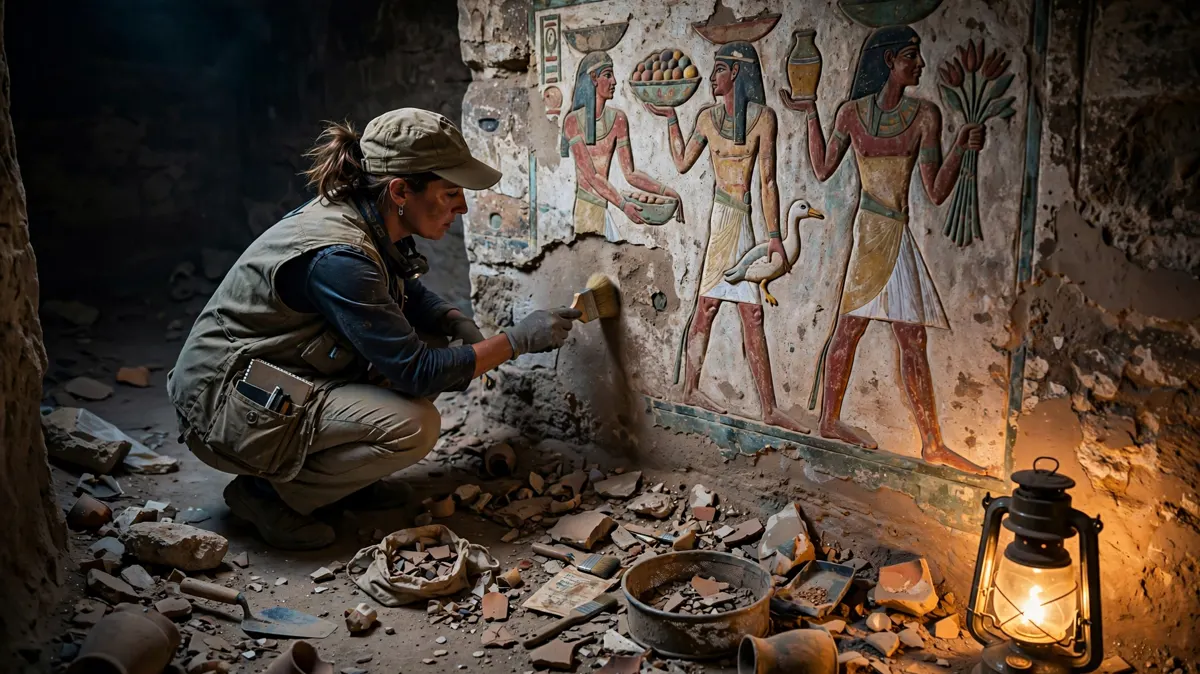
The False Doors: Portals Between Two Worlds
Here’s my favorite detail. Inside the remains of Sekhentio-Ptah’s funerary chapel, archaeologists found two false doors — carved stone slabs shaped like doors, complete with frames and panels — still standing in their original positions. To an ancient Egyptian, these weren’t decorations. They were literal thresholds between the world of the living and the world of the dead: portals through which the deceased’s spirit, the ka, could pass to receive food and drink offerings from relatives and priests. The offerings kept the deceased sustained in the afterlife; the door made the arrangement work.
And here’s the delicious part: the false doors are precisely what date the tomb. Their style points squarely to the late Fifth or early Sixth Dynasty — roughly 4,350 years ago. A religious necessity that doubled, millennia later, as a time stamp. You couldn’t plan that if you tried.
What the Excavators Found Inside the Keeper-of-Secrets Tomb
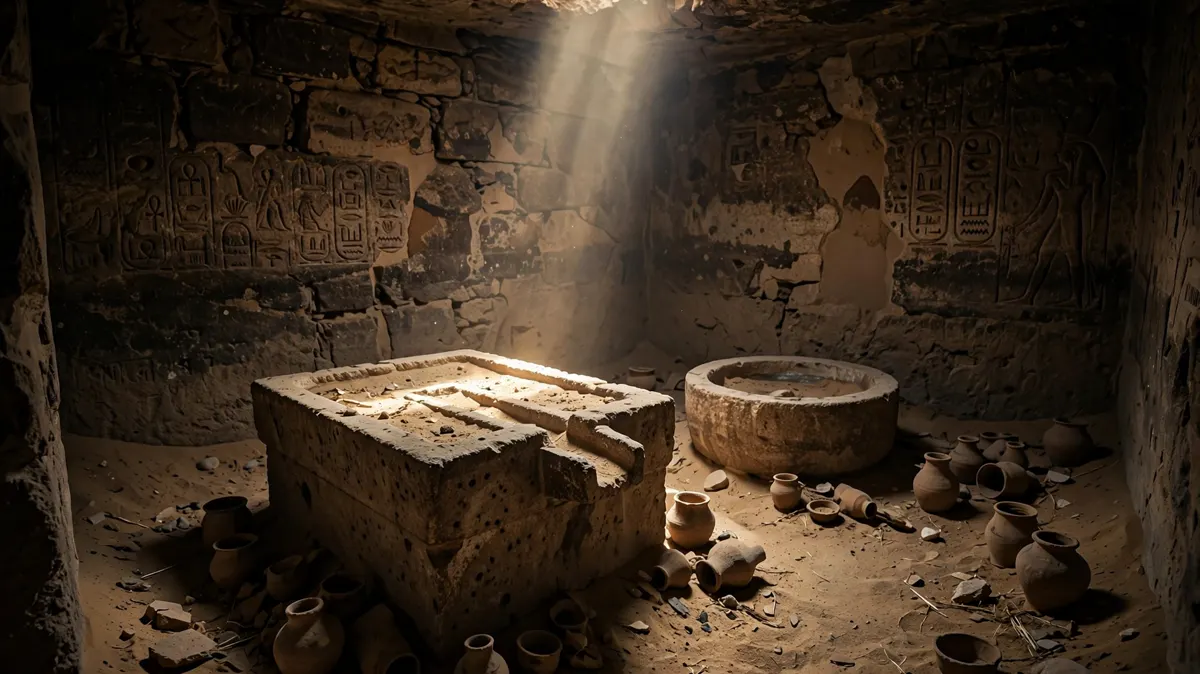
Picture this: you step into a chapel untouched for 4,300 years, and directly in front of the false door sits a complete set of alabaster ritual objects — offering table and disk, purification basin, jug, another basin — exactly where ancient hands arranged them. Finding a full ritual set in situ is vanishingly rare; most tomb equipment has been scattered, looted, or yanked out of context. Mohamed Abdel-Badie, head of Egypt’s Antiquities Sector, called it a key window into Old Kingdom funerary rituals. Every vessel carries hieroglyphic inscriptions naming Sekhentio-Ptah and listing his titles. Ritual equipment and résumé, carved in stone.
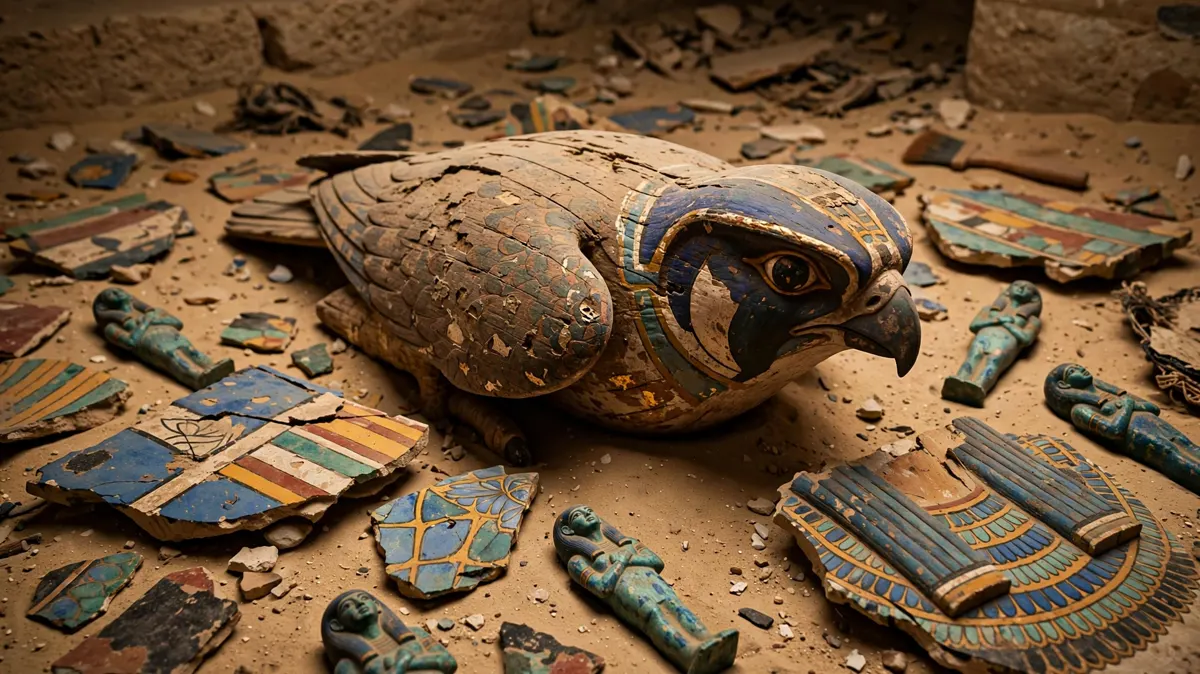
The surrounding shafts produced their own haul. Three stone sarcophagi were found sealed in their original positions — still unopened, a discovery for another season. More than a hundred faience ushabti figurines turned up: the little worker figures meant to do labor for the deceased in the afterlife. Painted funerary cartonnage — the layered linen-and-plaster casings that once covered mummies — survived in striking condition. And there’s a wooden falcon statue, likely linked to Horus, the falcon-headed god of kingship; its exact context still needs study.
One honest caveat: not everything in the keeper of secrets tomb complex belonged to Sekhentio-Ptah. The ushabtis and cartonnage probably came from later burials. Which brings us to the strangest chapter of this story.
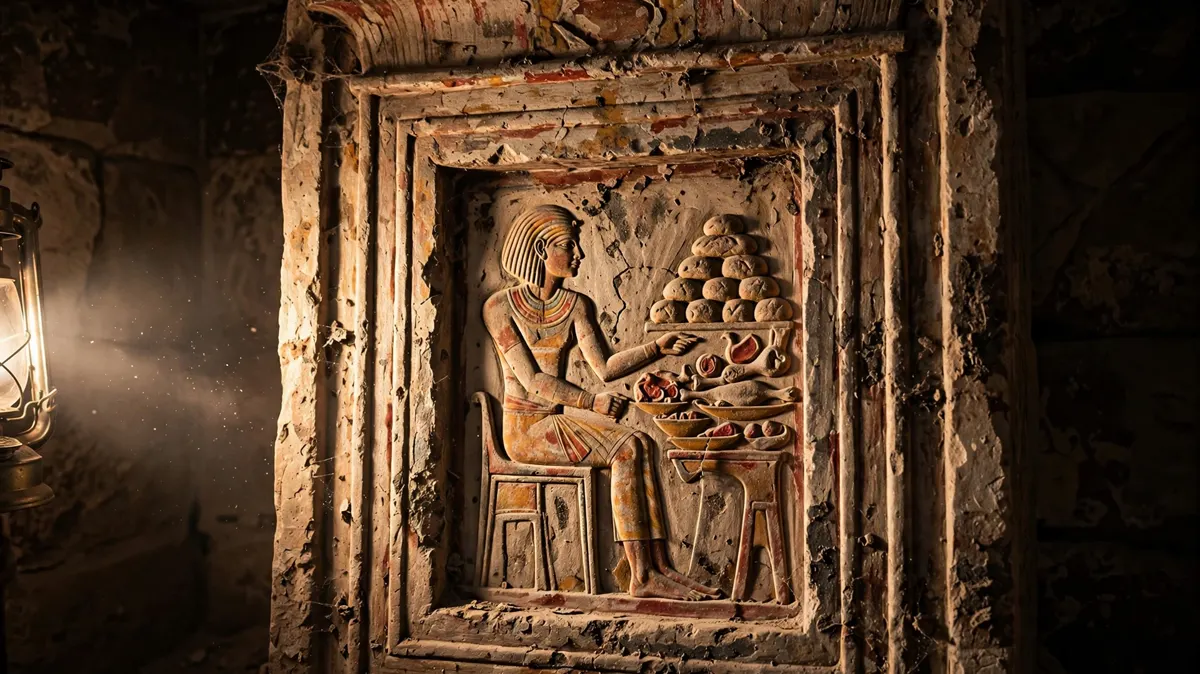
A Cemetery Built on a Cemetery
Same ground, new tenants: the keeper-of-secrets tomb complex is a textbook case of a cemetery layered on top of a cemetery. The tomb itself is Old Kingdom, but the burial shafts around it hold material from much later periods — including the Late Period, over a thousand years after Sekhentio-Ptah’s funeral.
Not everyone who came later came with respect. Tomb robbers tunneled between the chambers, cutting openings as they hunted for valuables — and all that activity explains the discovery’s biggest unsolved mystery. Despite Sekhentio-Ptah’s name appearing all over the chapel, his mummy has never been identified: destroyed by robbers, displaced during reuse, or simply not yet found. The sealed sarcophagi could hold answers, or completely different people from completely different centuries. In Saqqara, every answer arrives with two new questions.
Why Saqqara Keeps Producing Tombs Like the Keeper-of-Secrets Tomb
If this feels like the tenth Saqqara headline this year, that’s because it’s close to the truth. Just weeks earlier, Egyptian authorities unveiled three New Kingdom rock-cut tombs from another part of the Bubasteion necropolis. Saqqara doesn’t run out. It just keeps giving.
Why? Geography and longevity. Saqqara was the necropolis of Memphis — one of ancient Egypt’s greatest cities — and it stayed in active use for some three thousand years. As Egyptologist Magdy Shaker has observed, beyond the royal monuments, it’s densely packed with officials’ tombs from nearly every era, many decorated and inscribed to a very high standard.
And this dig sits in Sector A, west of the Bubasteion — an area that had simply never been excavated. The Bubasteion is best known for the cat goddess Bastet and the huge numbers of later-period cat burials found there. But Sekhentio-Ptah’s corner predates all of that by millennia. An untouched sector beside one of Egypt’s richest sites? Of course there were tombs under the sand — and the first season barely scratched the surface.
What the Keeper-of-Secrets Tomb Tells Us About the Old Kingdom
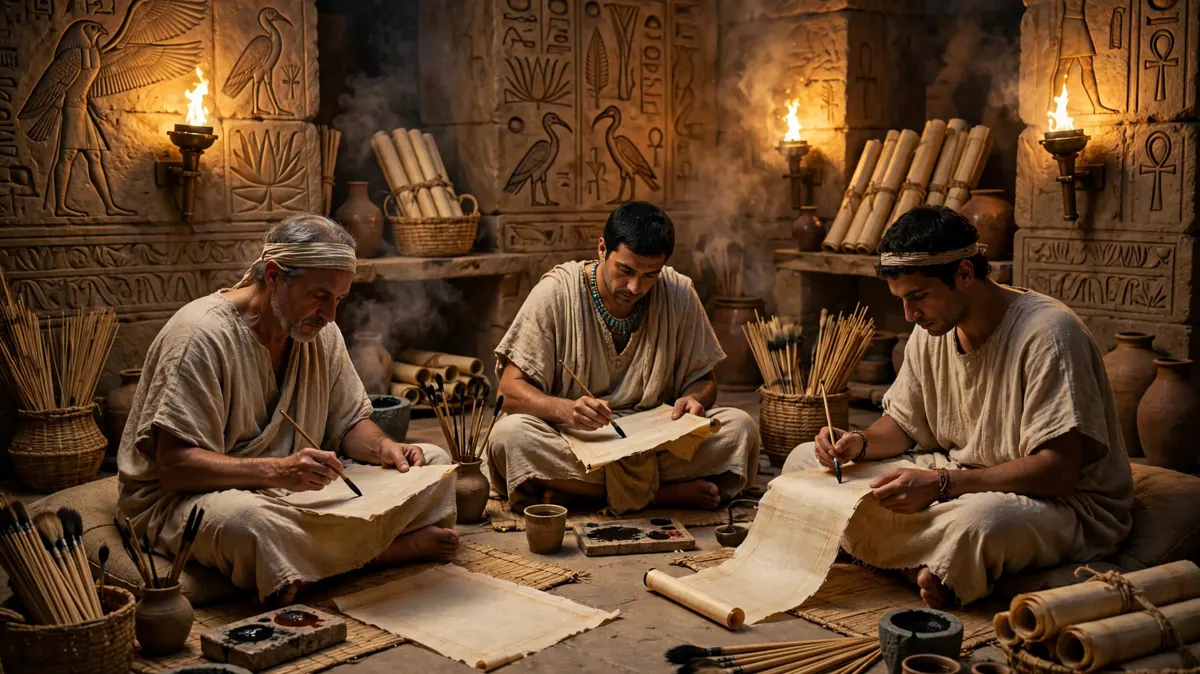
Sekhentio-Ptah’s title string is a case study in how that machine worked. He supervised the king’s works and the king’s documents and the scribes who wrote them. In a state where writing was a rare, jealously guarded skill, controlling the scribes meant controlling information itself. His priesthood of Maat — divine order made goddess — tied that authority to cosmic legitimacy. The Old Kingdom didn’t just build in stone. It built in hierarchy.
He was the man the pharaoh trusted with his words — and his tomb gives us back a piece of the oldest bureaucracy on Earth.
Frequently Asked Questions
Was Sekhentio-Ptah really a spy?
No. “Keeper of the Secrets of Royal Decrees” was a common title among royal scribes, and NYU’s Ann Macy Roth explains it meant he was in charge of royal documents and their writers, with access to confidential information. A chief of staff, not a secret agent.
Where exactly is Saqqara?
About 20 miles south of Cairo. It was the burial ground of Memphis, one of ancient Egypt’s most important cities, with monuments spanning some 3,000 years — including the famous Step Pyramid of Djoser.
What is a false door in an Egyptian tomb?
A carved stone slab shaped like a door in a chapel wall — a threshold between the worlds of the living and the dead, through which the deceased’s spirit received offerings. Their style helped date this tomb to about 4,350 years ago.
What’s actually inside the keeper of secrets tomb?
The chapel holds two false doors and a complete set of alabaster ritual objects in their original positions. The shafts yielded painted cartonnage, a wooden falcon statue, pottery, 100-plus faience ushabti figurines, and three stone sarcophagi still sealed shut — much of it likely from later burials, when the site was reused.
How old is the tomb?
About 4,300 to 4,350 years old — late 5th or early 6th Dynasty, in the Old Kingdom (roughly 2649 to 2150 BCE), the era that produced the pyramids of Giza.
Who found it, and what’s next?
An Egyptian archaeological mission under the Ministry of Tourism and Antiquities, during their first excavation season in Sector A, west of the Bubasteion at Saqqara. Excavation director Dr. Amr El-Tayebi’s team is continuing excavation and analysis, with plans to publish in peer-reviewed journals.
Keep Exploring Ancient Egypt
The keeper of secrets tomb is a reminder that Egypt’s greatest stories aren’t always about pharaohs — sometimes they’re about the people who made the pharaohs’ world work. Keep going:
- Curious what those ushabti figurines and painted cartonnage were actually for? Our guide to ancient Egyptian mummification walks through the full funerary toolkit, from embalming to the afterlife.
- Want another tomb complex with layers of history? The Valley of the Kings is where New Kingdom pharaohs — Tutankhamun included — built their afterlife journeys, tomb robbery and all.
- Fascinated by what the sealed sarcophagi might hold? Then you’ll love the search for Cleopatra’s tomb — the hunt for Egypt’s most elusive burial.
Saqqara isn’t finished with us. The team is still digging in Sector A.