
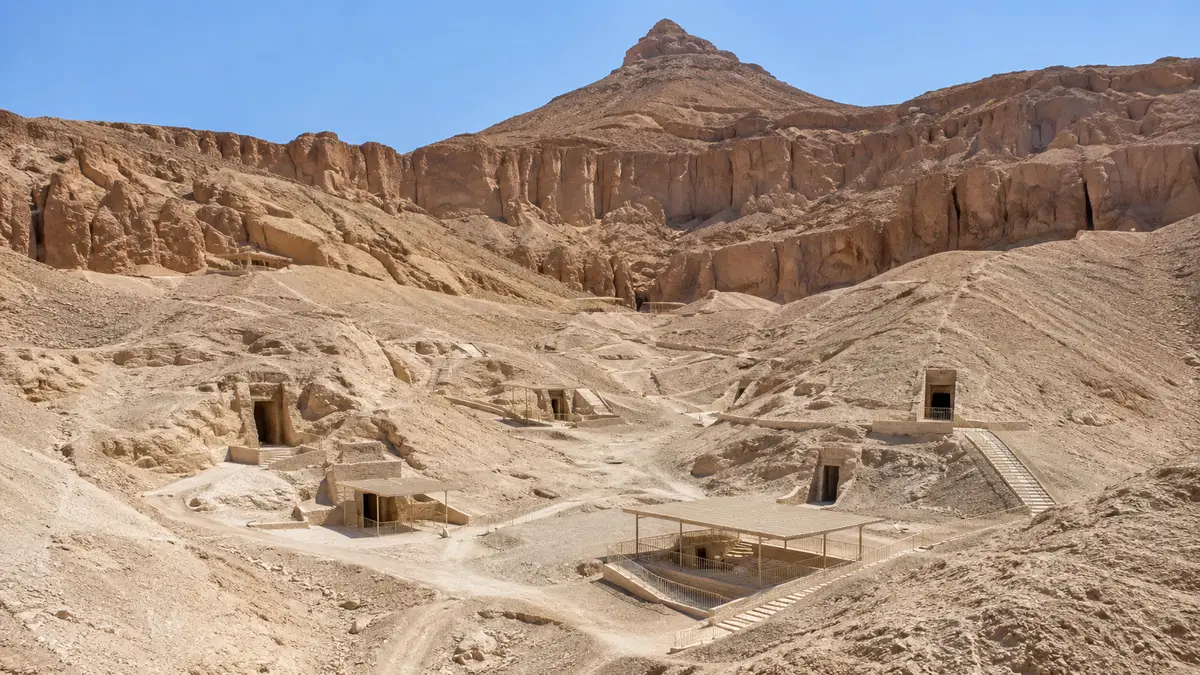
In 2022, a British-Egyptian team working in the desert wadis west of Luxor found a staircase and a blocked doorway. The assumption was that it belonged to a royal wife. The location was wrong for a king — too far out, in the wrong valley.
It took three more years of clearing rubble to establish otherwise. Inside were walls painted with the Amduat, a funerary text reserved for pharaohs, and fragments of a blue ceiling scattered with yellow stars. Broken alabaster jars carried an inscription naming their owner.
In February 2025 Egypt announced the find: the tomb of Thutmose II — the first royal tomb located since Howard Carter opened Tutankhamun’s in 1922.
It was empty. Ancient flooding had wrecked it, and the burial had been moved out in antiquity.
In brief: The Valley of the Kings is a desert valley near Luxor where Egyptian pharaohs were buried for roughly 500 years, from about 1550 to 1070 BC. It holds over 60 known tombs. Egypt moved here from pyramid burial because pyramids advertised their contents to robbers — and hidden rock-cut tombs did not.
Why Egypt Stopped Building Pyramids
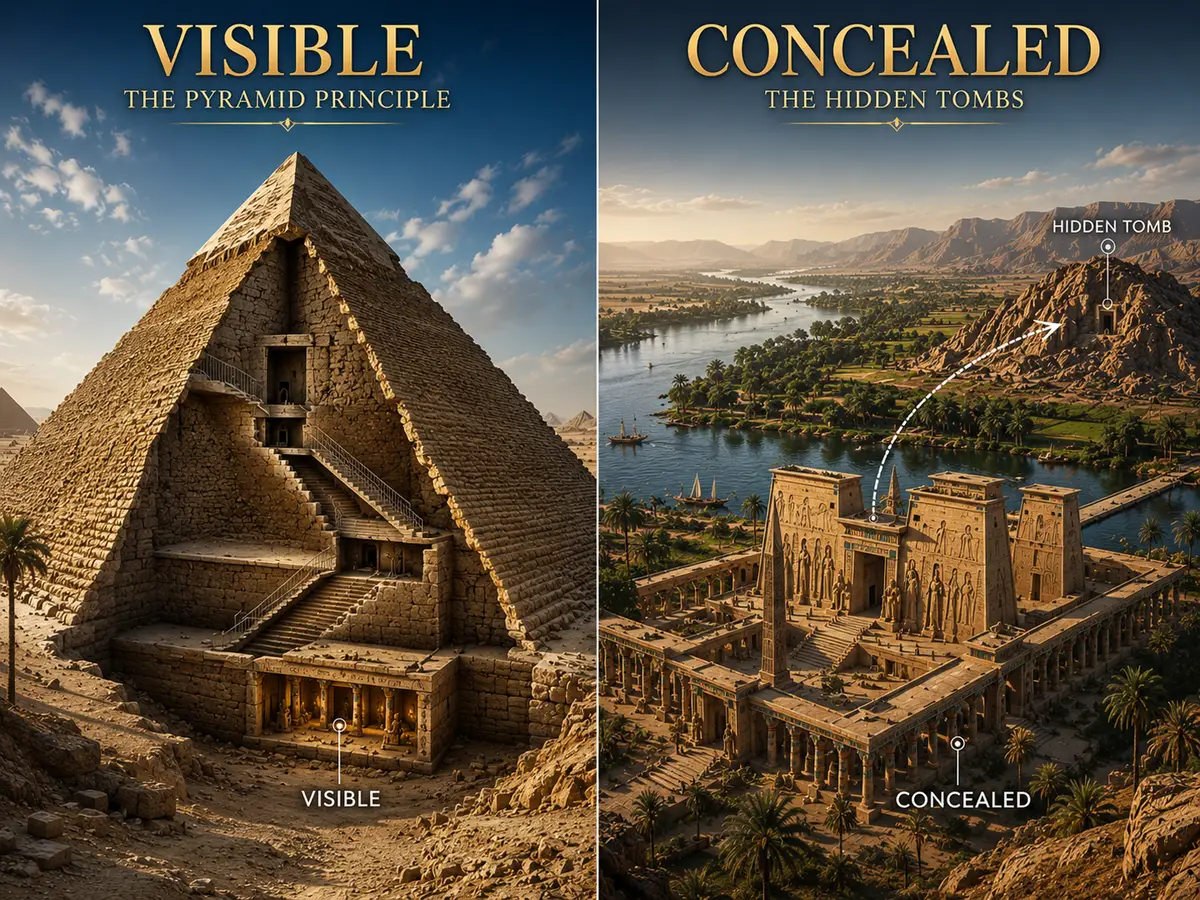
A pyramid is a sign. It says: a king is buried here, with everything he owned.
That worked while the Egyptian state was strong enough to guard them. When central authority weakened, it stopped working. Every Old Kingdom pyramid was robbed — including the Great Pyramid, whose construction had consumed two decades of national effort.
By the New Kingdom, around 1550 BC, Egypt had drawn the obvious conclusion. Thutmose I appears to have been the first to try the alternative: separate the tomb from the monument entirely.
The mortuary temple where a dead king was worshipped stayed public, on the floodplain. The body went somewhere else — cut into rock, in a remote valley, concealed.
The autobiography of Ineni, Thutmose I’s architect, describes the arrangement in a line that has been quoted ever since: he supervised the cutting of the king’s cliff-tomb alone, with no one seeing and no one hearing.
The valley was chosen carefully
The Valley of the Kings sits on the west bank of the Nile opposite Thebes, modern Luxor. West was the direction of the setting sun and, in Egyptian thought, of death.
The valley is dominated by a natural pyramid-shaped peak, el-Qurn, which may have satisfied the symbolic requirement a built pyramid previously served. It has one main entrance, which is easy to watch. The limestone cuts cleanly.
The site was also close enough to Thebes for the priesthood and the workmen’s village at Deir el-Medina to service it, but far enough into the desert to be defensible.
How the Tombs Are Organised
Every tomb in the Valley of the Kings has a KV number — Kings’ Valley 1, 2, 3 and so on. The numbering is not chronological; it reflects the order of discovery.
KV1 to KV21 were known by 1827, when John Gardner Wilkinson painted the numbers onto the entrances. Everything after that was added as it was found. Tutankhamun’s tomb, opened in 1922, is KV62. Tombs in the separate Western Valley carry a WV prefix.
More than sixty tombs are catalogued, but the number is misleading. Not all belong to kings — some held royal family members, some held favoured officials, and several were storage chambers or unfinished commencements that never received a burial.
What a royal tomb looked like inside
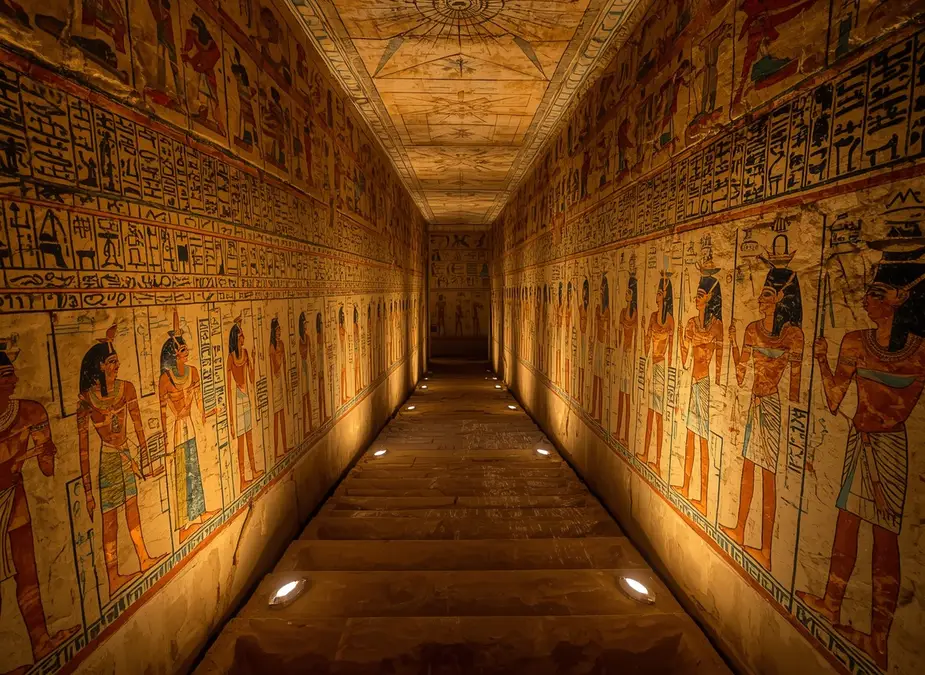
The layout evolved but the logic held: a descending corridor, one or more pillared halls, and a burial chamber at the end, often with side rooms for equipment.
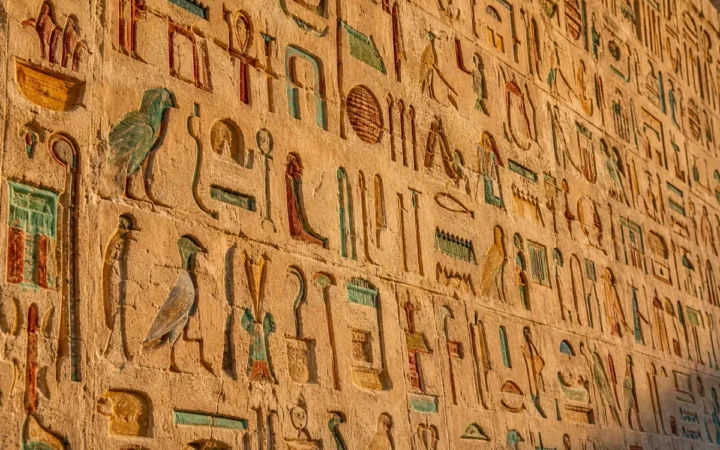
Walls carried funerary texts — the Amduat, the Book of Gates, the Litany of Re — which mapped the sun god’s night journey through the underworld. The dead king was meant to travel that route with him and be reborn at dawn. These beliefs are set out more fully in our guide to the ancient Egyptian gods.
Some tombs include a deep vertical shaft partway along the corridor. Its purpose is debated — a barrier against robbers, drainage against flash flooding, or a symbolic feature. It may have served more than one.
The Concealment Failed
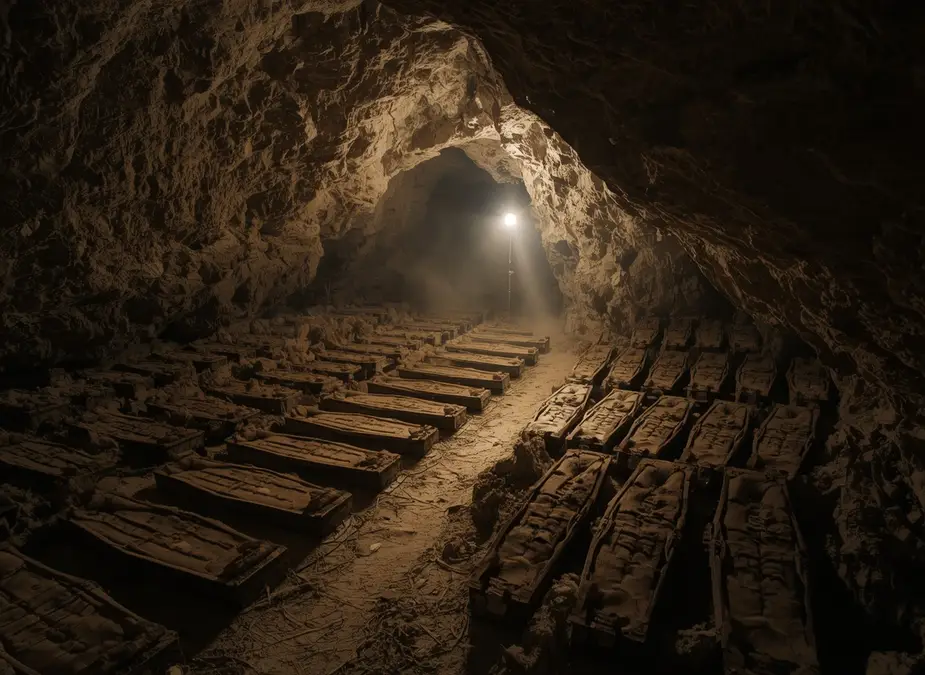
Here is the part usually left out of the story. The Valley of the Kings did not work.
Nearly every tomb in it was robbed, most of them within a few generations of the burial. Papyri from the late New Kingdom record actual tomb-robbery trials — investigations, confessions extracted under beating, and lists of what was taken.
The robbers were frequently the people who built the tombs, or their descendants. They knew the layouts. Concealment is a poor defence against your own workforce.
By around 1070 BC the priesthood gave up on the valley entirely. They gathered the surviving royal mummies, stripped what remained of value, rewrapped the bodies, and hid them in bulk — most famously in a cliff cache at Deir el-Bahari, found in 1881, which held more than fifty individuals including Ramesses II and Seti I.
The preservation techniques that let those bodies survive that treatment are covered in our article on ancient Egyptian mummification.
Why Tutankhamun survived
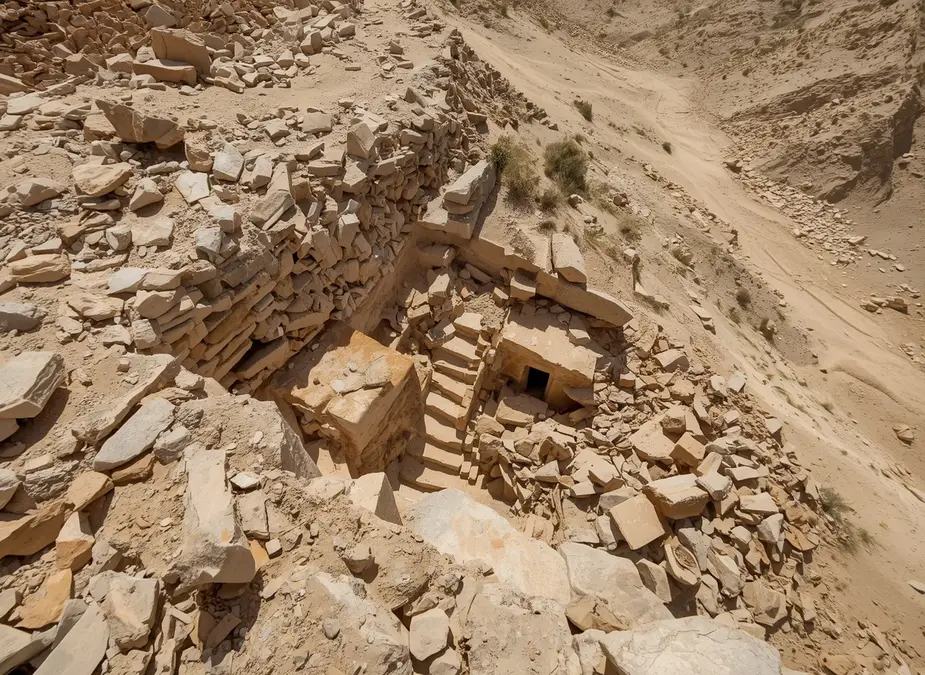
KV62 is famous because it is the exception, and the reasons are mostly accidental.
Tutankhamun was a minor king who died young, and his tomb is correspondingly small — possibly not built for him at all. It was entered by robbers at least twice shortly after burial, but they were interrupted and the tomb was resealed.
Then debris from the cutting of Ramesses VI’s tomb above buried the entrance, and workmen’s huts were built on top of the rubble. The tomb disappeared from the record for three thousand years.
What Carter found in 1922 was not a typical royal burial. It was a modest one that happened to survive — which is why the loss of the others is so hard to picture. Our article on the curse of Tutankhamun looks at the story that grew around the discovery.
The Thutmose II Discovery
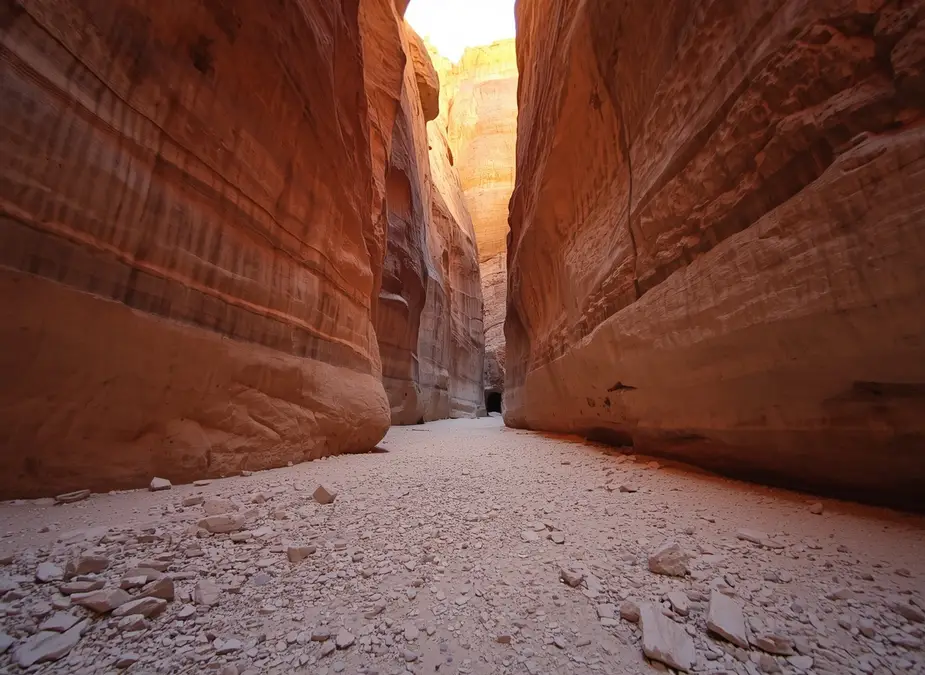
The 2025 announcement was the most significant find at the site in a century, and it is worth being precise about what was and was not found.
The excavation was a joint effort between Egypt’s Supreme Council of Antiquities and the New Kingdom Research Foundation, led by the Cambridge archaeologist Piers Litherland. The entrance was located in 2022 in the Western Wadis, some distance from the main valley.
Three things identified it as royal: Amduat texts on the walls, a blue star-painted ceiling, and inscribed alabaster vessels naming Thutmose II. The Amduat and the star ceiling were not used in non-royal burials.
What the tomb did not contain
No mummy. No sarcophagus. No gold.
The tomb had flooded badly in antiquity, and the burial appears to have been removed deliberately rather than looted. Litherland has suggested the grave goods were reburied in a second tomb nearby — which, if correct, means there is another chamber still to find.
Thutmose II’s mummy was already known. It was among those recovered from the Deir el-Bahari cache in 1881, so its absence from the tomb was expected.
One qualification worth making: the phrase “first royal tomb since Tutankhamun” circulated widely, and National Geographic later amended its coverage to note a lesser-known royal tomb identified in 2014. The Thutmose II find is genuinely major, but that headline was tidier than the record.
What it does demonstrate is that the area is not exhausted. Two centuries of excavation had produced a working assumption that the royal tombs were all accounted for. They were not.
The Nefertiti Chamber Question
In 2015 the Egyptologist Nicholas Reeves proposed that Tutankhamun’s tomb contains concealed doorways behind its painted north and west walls, and that Nefertiti might lie beyond them.
The argument rested on features in high-resolution scans of the wall surfaces that Reeves read as blocked openings, plus the observation that KV62 is oddly small and oddly shaped for a royal tomb.
Several radar surveys followed. The first appeared to support the idea. Later, more rigorous surveys did not, and the consensus moved against it.
The honest position today is that no hidden chamber has been demonstrated, and most specialists do not expect one. The question is not formally closed, but it is not open in the way popular coverage often implies.
Nefertiti’s burial has never been identified.
What We Know and What We Don’t
Established by evidence
- Pharaohs were buried here for roughly 500 years, c. 1550–1070 BC
- Over 60 tombs are catalogued, not all of them royal
- Tombs are rock-cut and were deliberately concealed, unlike pyramids
- Nearly all were robbed, most within a few generations
- Priests removed surviving mummies and hid them in caches around 1070 BC
- The Deir el-Bahari cache, found 1881, held more than fifty individuals
- The tomb of Thutmose II was identified in 2025, empty and flood-damaged
Still unresolved
- Whether a second tomb holds Thutmose II’s removed burial equipment
- Where Nefertiti was buried
- How many undiscovered tombs remain in the wider Theban necropolis
- The exact function of the deep shafts inside the tombs
- Whether some unattributed tombs belong to known kings
Frequently Asked Questions
Where is the Valley of the Kings?
On the west bank of the Nile opposite Luxor in southern Egypt, ancient Thebes. It lies in the desert hills behind the floodplain, beneath a natural pyramid-shaped peak called el-Qurn.
Why did Egyptians stop building pyramids and use the Valley of the Kings instead?
Pyramids advertised the location of a rich burial and were robbed once central authority weakened. From about 1550 BC, pharaohs separated the tomb from the monument: a public mortuary temple on the floodplain, and a concealed rock-cut tomb in the desert valley.
How many tombs are in the Valley of the Kings?
Over 60 are catalogued with KV numbers. Not all are royal — some belonged to family members or officials, and several are unfinished or were used for storage.
What was found in the Valley of the Kings in 2025?
The tomb of Thutmose II, identified by a joint Egyptian-British team led by Piers Litherland. It was found in the Western Wadis, had flooded in antiquity, and contained no burial — the contents appear to have been moved out deliberately.
Why was Tutankhamun’s tomb not robbed?
It was, twice, shortly after burial — but the robbers were interrupted and it was resealed. Debris from cutting the tomb of Ramesses VI above later buried the entrance, hiding it until 1922.
Is Nefertiti buried behind Tutankhamun’s tomb?
Probably not. Nicholas Reeves proposed this in 2015 and an early radar survey seemed supportive, but later and more rigorous surveys did not confirm any hidden chamber. Nefertiti’s burial place remains unknown.
Conclusion
The Valley of the Kings was a solution to a problem, and it did not solve it. Egypt spent five centuries hiding its kings, and the hiding failed almost every time.
What survived was not the gold. It was the walls — corridors of funerary text describing what Egyptians believed happened after death, preserved precisely because nobody could carry them away.
And the valley is still producing. A tomb sat unidentified in the Western Wadis until 2022, and its contents may still be somewhere nearby.
Sources and Further Reading
- National Geographic — detailed reporting on the Thutmose II tomb, including Piers Litherland’s assessment and the correction regarding earlier royal tomb finds.
- Dr Chris Naunton — Egyptologist’s analysis of the discovery and its implications for royal burial practice in the Western Wadis.
- Reporting on the official announcement by Egypt’s Ministry of Tourism and Antiquities, February 2025.
- Reeves, N. — published proposal regarding concealed chambers in KV62, and the radar surveys that followed.
1 Comment