
Howard Carter’s team catalogued 5,398 objects from Tutankhamun’s tomb. It took them ten years.
Hold that number against what we know about the king. Tutankhamun ruled for about nine years, died at nineteen, and was buried in a tomb so small it was probably not built for him. He was, by the standards of Egyptian kingship, a minor figure.
If that was a modest burial, the tombs of Ramesses II or Amenhotep III — both of them emptied in antiquity — are almost impossible to imagine.
Since November 2025 the entire collection has been displayed together for the first time since 1922, at the Grand Egyptian Museum outside Cairo. This is what is actually in it.
In brief: Tutankhamun’s tomb contained 5,398 catalogued objects, including a solid gold inner coffin, an 11-kilogram gold mask, six dismantled chariots, three funeral beds, a throne, board games, sandals, linen underwear and jars of wine labelled by vintage. One dagger was made from meteoritic iron — metal that fell from the sky.
Myth Versus Evidence
| What is usually said | What the evidence shows |
|---|---|
| Tutankhamun was a great pharaoh | He ruled about nine years and died at nineteen. He is famous because his tomb survived, not because his reign mattered |
| The tomb was untouched | Robbers entered at least twice shortly after burial. They were interrupted and the tomb was resealed |
| It was the richest royal burial | It was a small, hurried burial. Its significance is that it is the only near-complete one we have |
| Everything in it was gold | Most of the 5,398 objects are ordinary — food, linen, oils, walking sticks, board games |
| The mask is solid gold throughout | It is gold, but inlaid with lapis lazuli, quartz, obsidian, carnelian and coloured glass |
The Objects Everyone Knows
The gold mask
Eleven kilograms of gold, placed directly over the head and shoulders of the mummy. The eyes are quartz and obsidian, the eyebrows and eyeliner lapis lazuli, the broad collar inlaid with carnelian, feldspar and coloured glass.
On the shoulders and back, in hieroglyphs, is a spell from the funerary literature naming each part of the face and placing it under the protection of a god. The mask was not a portrait. It was equipment — it made the face function in the afterlife.
Its plaited beard was knocked off during cleaning in 2014 and hastily reattached with epoxy. A German-Egyptian team removed the glue and restored it properly the following year.
Three coffins, four shrines, one sarcophagus
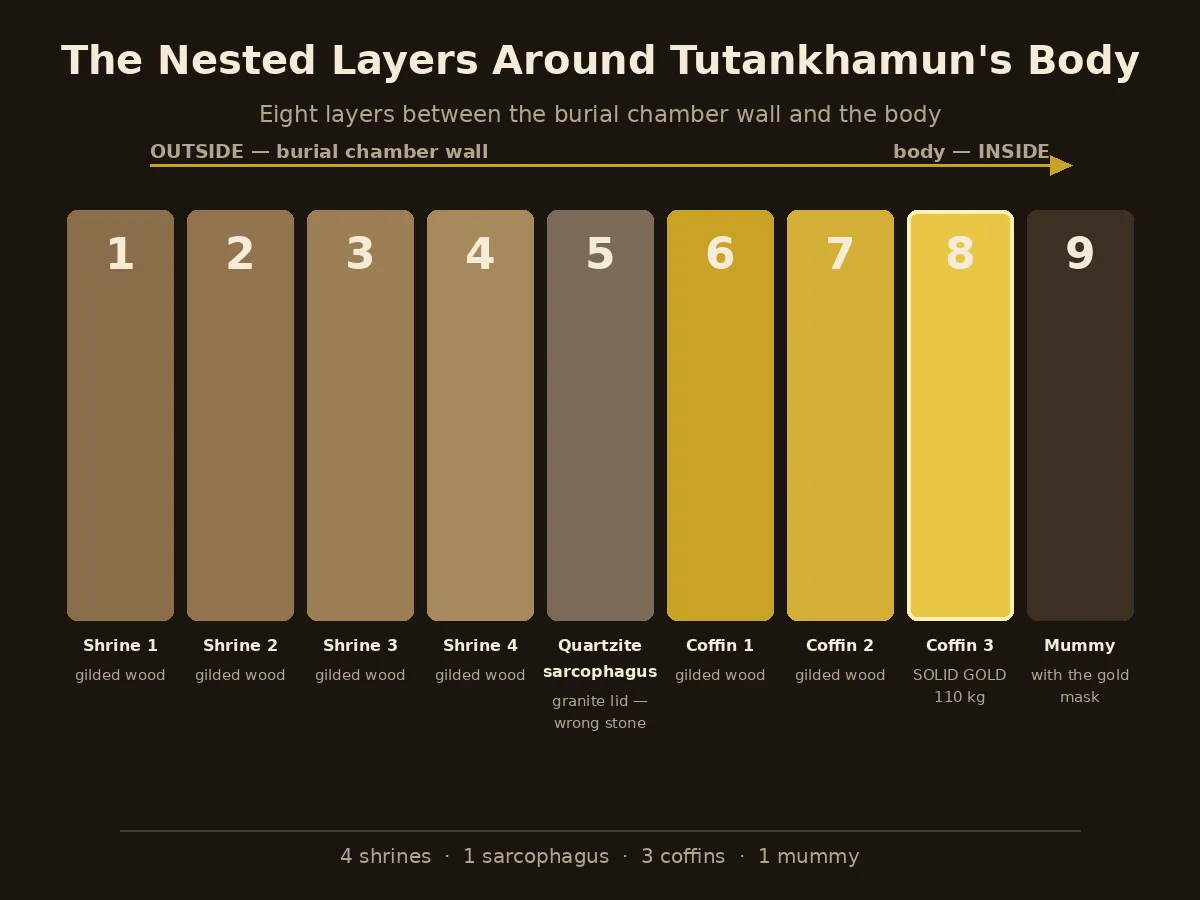
The body sat inside a nest of containers, each enclosing the next like a set of boxes.
- Four gilded wooden shrines, the outermost nearly filling the burial chamber
- A quartzite sarcophagus with a granite lid — the wrong stone, suggesting a substitution made in a hurry
- Two gilded wooden coffins
- An innermost coffin of solid gold, weighing over 110 kilograms
The outer shrines had to be dismantled to reach the body. Carter’s team needed 84 days for that stage alone.
The golden throne
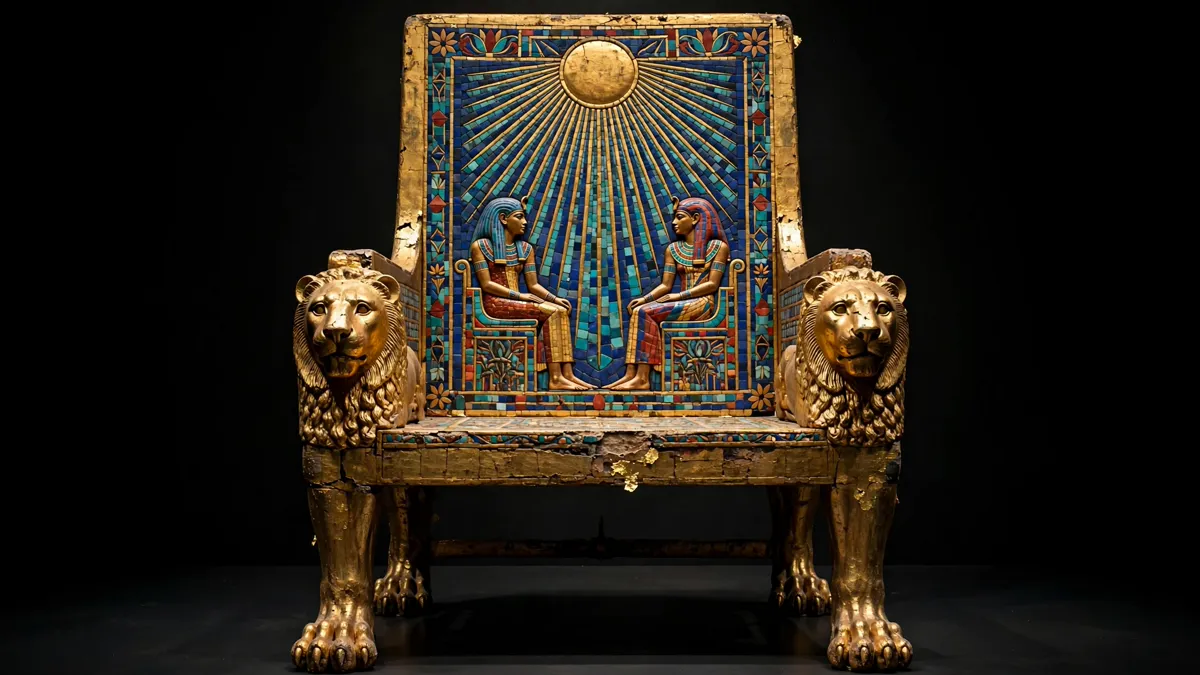
A wooden chair covered in gold and silver, inlaid with glass, faience and semi-precious stone. The back panel shows Tutankhamun seated while his wife Ankhesenamun anoints him, both under the rays of the Aten.
That detail matters. The Aten was the god of Akhenaten’s abandoned religion, and Tutankhamun’s reign was the one that reversed it. The throne carries both the old names and the new — an object caught mid-reversal.
The Dagger That Fell From the Sky
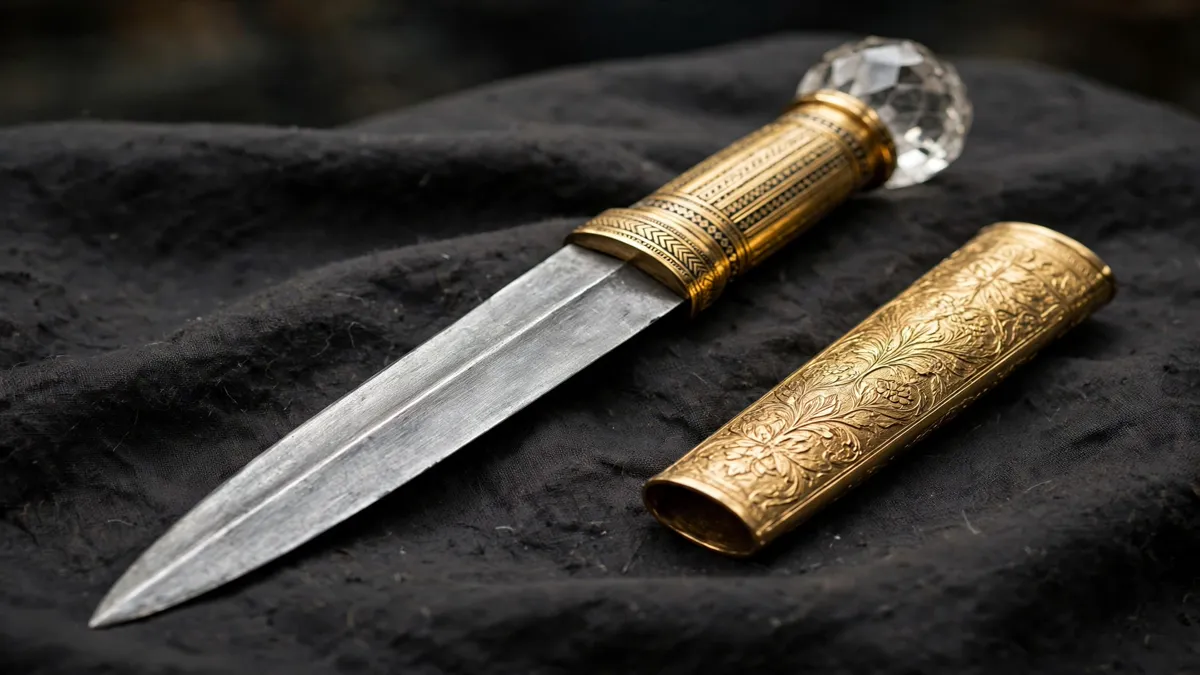
In 1925, unwrapping the mummy, Carter found two daggers tucked into the linen. One had a gold blade. The other was iron, lying against the king’s right thigh.
That second dagger should not exist.
Tutankhamun died around 1324 BC. Iron smelting did not reach Egypt in any meaningful way for roughly another six hundred years. An iron blade in a fourteenth-century BC Egyptian burial is an object out of its own time.
How the question was settled
An examination in 1994 using X-ray fluorescence suggested the metal did not match known meteorites, and the matter sat unresolved for two decades.
In 2016 a team led by Daniela Comelli of the Polytechnic University of Milan re-tested the blade with a more precise instrument. The result was decisive.
Iron from terrestrial ore, worked before the nineteenth century, contains under 4 per cent nickel. The dagger measured over 10 per cent. That composition belongs to meteoritic iron and nothing else.
The blade has not rusted. Egyptian tombs are dry enough that a piece of iron survived three thousand years in near-pristine condition, which is why the test could be done without cutting into it.
Where it probably came from
Nineteen iron objects were found in the tomb. Most are crude. The dagger is not — it has a gold hilt worked with cloisonné and granulation, a rock crystal pommel, and a gold sheath decorated with lilies on one face and feathers on the other, ending in a jackal’s head.
The quality suggests it was not made in Egypt. The Amarna letters — diplomatic correspondence from the period — record Tushratta, king of Mitanni, sending iron objects to Amenhotep III, Tutankhamun’s probable grandfather. A royal gift is the most likely explanation.
There is one more detail worth knowing. In the dynasty after Tutankhamun’s, Egyptian began using a new term for iron that translates literally as iron of the sky.
They appear to have known where it came from.
The Ordinary Things
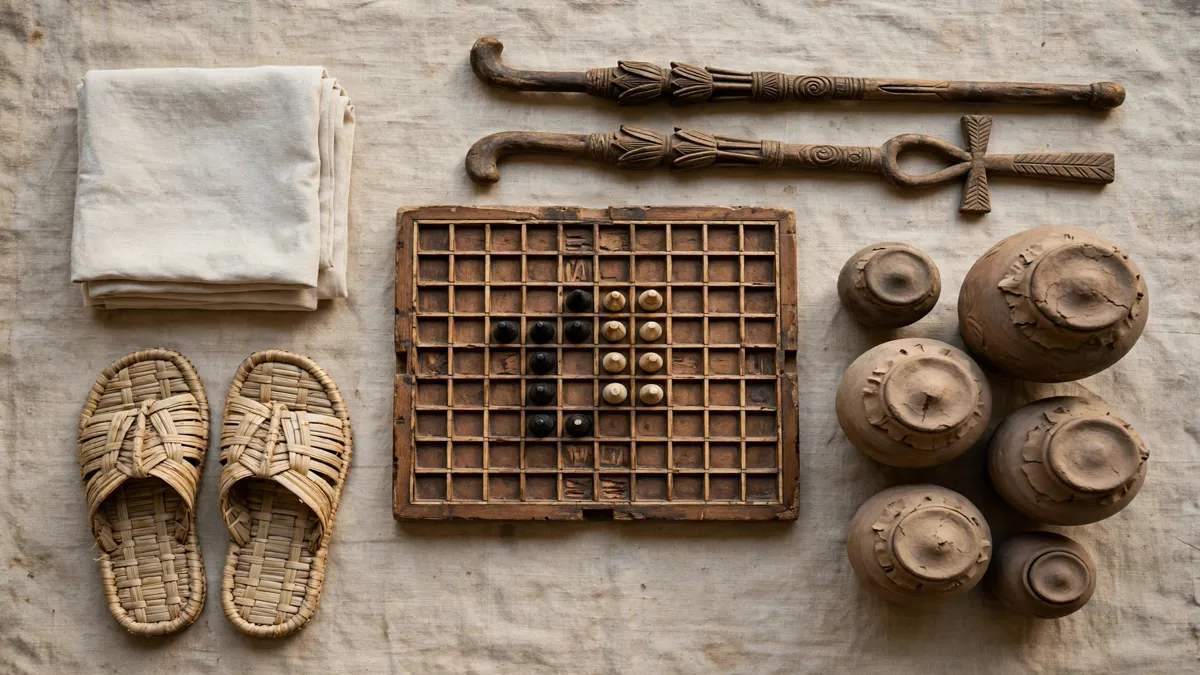
The gold gets the attention. The rest of the tomb is more revealing.
| Object | What it tells us |
|---|---|
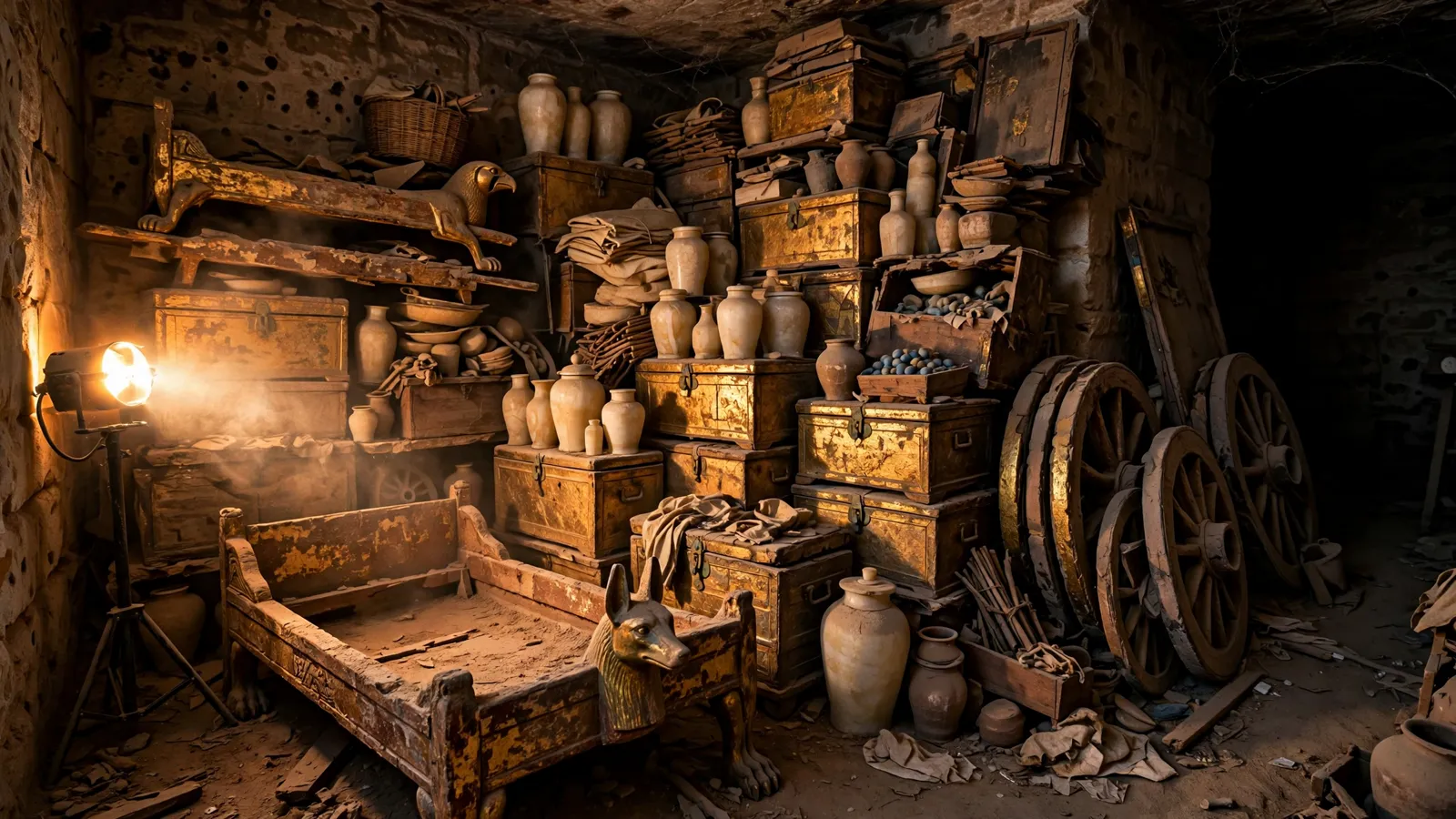
| Six chariots, dismantled | Taken apart to fit through the corridor. Some show wear — these were used, not ceremonial |
| Three funeral beds | Carved as a lion, a cow and a hippopotamus. Ritual furniture, not for sleeping |
| Wine jars | Labelled with year, vineyard and the name of the chief vintner — the ancient equivalent of a wine label |
| Food | Bread, dried meat, fruit, spices. Provisions for a journey |
| Linen underwear | Folded and packed. He was expected to need clothes |
| Board games | Several senet sets. The afterlife was assumed to involve leisure |
| Walking sticks | Around 130 of them. His mummy shows a deformed left foot, so some were likely used |
| Shabti figures | 413 of them, to perform labour on his behalf — a practice explained in our article on the Book of the Dead |
This is the part that tends to land with people. The Egyptians were not packing symbols. They were packing luggage — the specific things a teenage king would want, including his underwear and his games.
Why This Tomb Survived
Nearly every royal burial in the Valley of the Kings was robbed, most within a few generations. KV62 was entered too — twice, shortly after the funeral — but the robbers were interrupted, and the tomb was resealed by necropolis officials.
Then the accident happened. Workmen cutting the tomb of Ramesses VI directly above dumped their debris down the slope, burying the entrance. Huts were built on top of the rubble. KV62 disappeared from the record for three thousand years.
The preservation of the body itself followed a process described in our guide to ancient Egyptian mummification, and the story that grew around the discovery is covered in our article on the curse of Tutankhamun.
Where the Collection Is Now
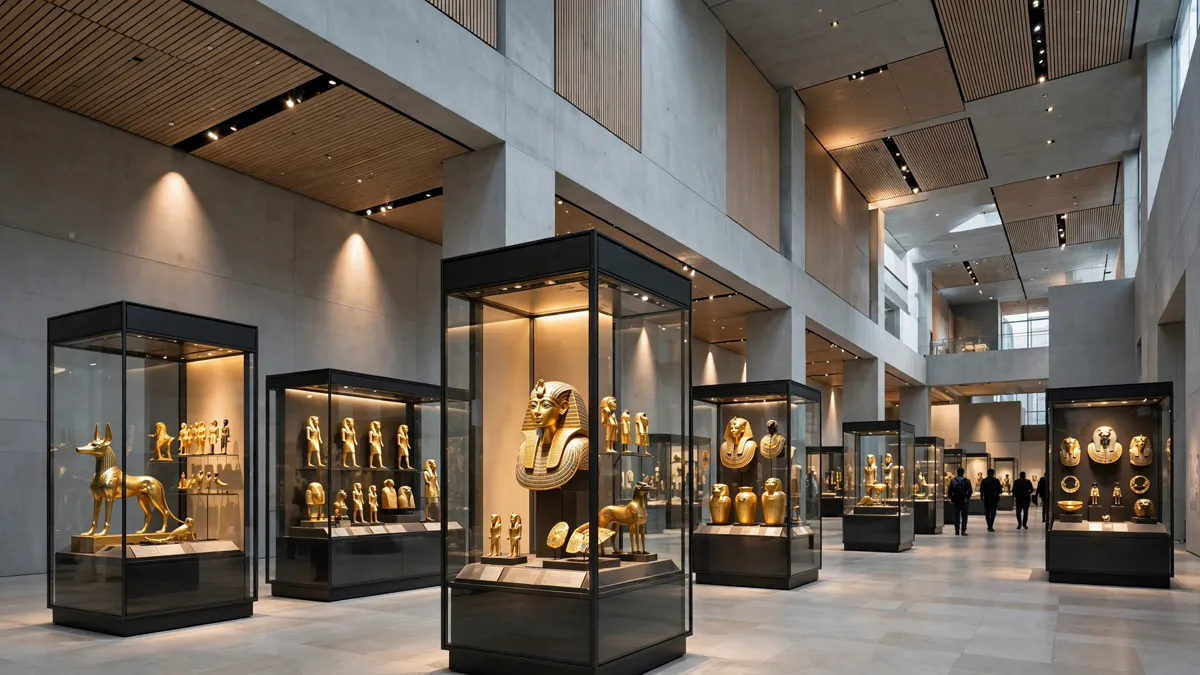
For most of the past century the treasures were split between storage and the old Egyptian Museum in Tahrir Square, which never had room to show them together.
The Grand Egyptian Museum, on the Giza plateau within sight of the pyramids, opened to the public in November 2025 after roughly two decades of construction. It holds more than 100,000 objects in total, and for the first time since Carter emptied the tomb, the complete Tutankhamun collection is displayed in one place — across two galleries covering around 7,000 square metres.
Reports from the opening week put visitor numbers at close to 19,000 a day. Tickets moved to online-only booking from December 2025.
What We Know and What We Don’t
Established by evidence
- 5,398 objects were catalogued; clearing the tomb took about ten years
- The innermost coffin is solid gold and weighs over 110 kg
- The mask weighs roughly 11 kg and is inlaid with stone and glass
- One dagger blade is meteoritic iron, confirmed by nickel content above 10 per cent
- Nineteen iron objects were present, most of them crude
- The tomb was robbed twice shortly after burial and resealed
- Debris from cutting the tomb of Ramesses VI buried the entrance
Still unresolved
- Whether the tomb was originally cut for Tutankhamun at all
- Why the sarcophagus lid is granite when the box is quartzite
- Where the meteoritic dagger was made, and by whom
- How he died — several explanations remain in contention
- Whether some objects were reused from an earlier burial
Frequently Asked Questions
How many objects were found in Tutankhamun’s tomb?
5,398 were catalogued by Howard Carter’s team. Clearing and recording them took about ten years, from 1922 to 1932.
How much does Tutankhamun’s gold mask weigh?
Around 11 kilograms, or 24 pounds. It is gold inlaid with lapis lazuli, quartz, obsidian, carnelian, feldspar and coloured glass, and carries a protective spell in hieroglyphs across the shoulders and back.
Was King Tut’s dagger really made from a meteorite?
Yes. A 2016 study led by Daniela Comelli found the blade contains over 10 per cent nickel. Iron worked from terrestrial ore before the nineteenth century contains under 4 per cent, so the composition points to meteoritic iron.
Where can you see Tutankhamun’s treasures?
At the Grand Egyptian Museum near the Giza pyramids, which opened to the public in November 2025. It is the first time the complete collection has been displayed together since the tomb was cleared.
Was Tutankhamun’s tomb really untouched?
No. Robbers entered at least twice shortly after the burial, but they were interrupted and the tomb was resealed. It then stayed hidden because debris from cutting the tomb of Ramesses VI covered the entrance.
Why is Tutankhamun so famous if he was a minor king?
Because his burial is the only near-complete royal one ever recovered. He ruled roughly nine years and died at nineteen. His fame rests on an accident of preservation rather than on anything he achieved.
Conclusion
The collection is usually presented as the greatest treasure ever found. It is better understood as the only one that survived.
Tutankhamun was a boy who reigned briefly and was buried quickly, in a tomb that may not have been his, with a sarcophagus lid of the wrong stone. Everything about the burial suggests haste. And it still produced 5,398 objects, a solid gold coffin, and a blade made from metal that fell out of the sky.
The uncomfortable implication is what we lost. Every other royal tomb in Egypt was emptied — and those kings ruled for decades.
Sources and Further Reading
- Comelli, D. et al. (2016). “The meteoritic origin of Tutankhamun’s iron dagger blade.” Meteoritics and Planetary Science. Summarised by Eos.
- HeritageDaily — on the nineteen iron objects in the tomb and the Mitanni gift hypothesis.
- The Griffith Institute, University of Oxford — Howard Carter’s complete excavation records, object cards and photographs.
- Reporting on the Grand Egyptian Museum opening, November 2025, including visitor figures and gallery details.