
Introduction
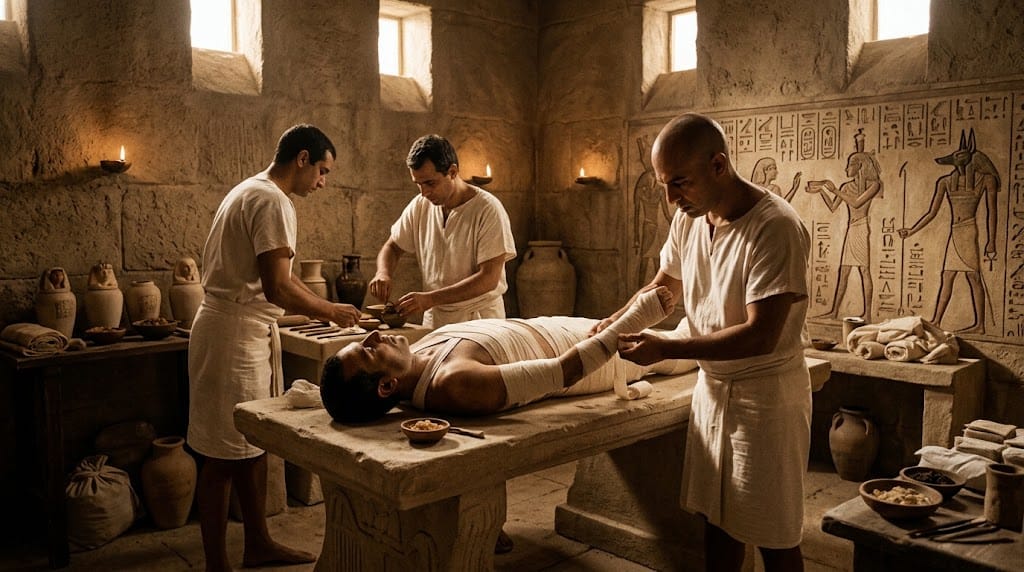
Imagine you’re an embalmer in Egypt three thousand years ago. A body has just been delivered to your workshop on the west bank of the Nile. You have seventy days.
Seventy days to turn a human body into something that will last forever.
You aren’t a doctor, and you aren’t quite a priest. You’re a specialist in a trade that Egypt treated as sacred, secretive, and absolutely essential — because in Egyptian belief, the soul needed a recognizable body to return to. Let the body decay and the person was truly gone.
Ancient Egyptian mummification is one of the most recognizable practices in human history, and also one of the most misunderstood. It wasn’t a single fixed ritual. It evolved over three thousand years, varied enormously by wealth, and involved a chemistry so sophisticated that researchers only recently worked out what was actually in the jars.
Here’s how it really worked.
It Started by Accident
The earliest Egyptian mummies weren’t made by anyone.
In the Predynastic period, before pyramids and before pharaohs, Egyptians buried their dead directly in shallow desert pits. The sand did the rest. Hot, dry, and salty, it pulled moisture out of bodies quickly enough that decay never fully set in. Bodies emerged naturally preserved — skin, hair, and all.
Egyptians noticed. When burial practices grew more elaborate and bodies were placed in coffins and built tombs, the natural preservation stopped. Sealed away from the sand, remains decayed.
So Egyptians set out to reproduce artificially what the desert had done for free. Nearly every technique that followed was an attempt to solve one problem: remove the water.
The Seventy Days
Ancient sources and archaeological evidence both point to a process lasting roughly seventy days, though the exact schedule varied by period and by how much the family could pay.
The Greek historian Herodotus, writing in the fifth century BCE, described three tiers of service — an expensive version, a middle option, and a basic treatment for the poor. Modern Egyptologists treat his account with some caution, since he was a foreign visitor writing centuries after the technique’s peak. But the general principle holds: mummification was a commercial service with a price list.
Here is the broad sequence.
Washing and purification. The body was cleansed, often with water from the Nile and a solution of palm wine.
Removal of the internal organs. Moisture is concentrated in the soft internal organs, so these were removed through a small incision in the left side of the abdomen. The lungs, liver, stomach, and intestines were taken out and treated separately. The kidneys were usually left in place.
The heart stayed. Egyptians considered the heart the seat of thought, memory, and personality — not the brain. It had to remain with the body for the judgment of the dead, where it would be weighed against the feather of truth. Removing it would have been catastrophic.
The brain was usually removed. Egyptian embalmers extracted it through the nasal passage using a long hooked instrument, and it was discarded. Egyptians attached no particular importance to it. Some mummies, however, have been found with the brain still in place, so practice was not universal.
Drying in natron. This was the step that actually preserved the body, and it took the longest.
Natron: The Salt That Made It Possible
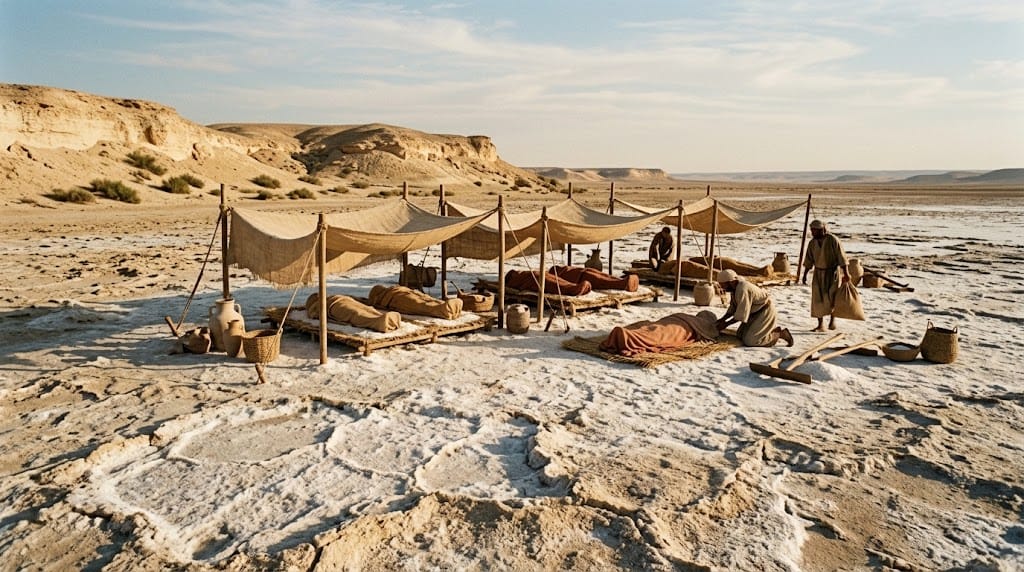
Natron is a naturally occurring mineral salt — mostly sodium carbonate and sodium bicarbonate — that collected in dry lake beds, particularly at Wadi Natrun northwest of Cairo. Egypt had it in abundance.
Its properties were close to perfect for the job. It draws water out of tissue aggressively, it inhibits bacteria, and it neutralizes odor.
The body was packed with natron and covered in it, then left for around forty days. The organs removed earlier were dried the same way. By the end, the body had lost most of its water content and was substantially lighter — dry, stable, and no longer able to support decay.
This is the entire secret. Everything else in mummification — the resins, the wrapping, the ritual — was refinement layered on top of one simple principle: a dry body does not rot.
Restoring the Body
A body dried in natron looks nothing like a living person. It’s shrunken and hollow. Egyptian embalmers went to considerable effort to reverse that.
The abdominal cavity was packed with linen, sawdust, or resin-soaked material to restore the body’s shape. In some periods, particularly the Third Intermediate Period, embalmers pushed packing material under the skin itself to plump the limbs and face — a technique that produced some of the most lifelike mummies ever made.
Artificial eyes of stone or glass were sometimes inserted. Skin was treated with oils and resins to make it supple. Cosmetics were applied. In some cases, false hair was added.
The intent wasn’t decoration. The body had to be recognizable, because Egyptian belief held that the deceased’s spirit needed to identify and re-enter it. The same logic underlies Egypt’s tomb portraits and statues, which you can read more about in our overview of the religion of ancient Egypt.
What Was Actually in the Jars
For a long time, the specific substances used in embalming were largely guesswork. Egyptian texts named them — words like antiu and sefet appear repeatedly — but nobody knew with confidence what those words referred to.
That changed with the excavation of an embalming workshop at Saqqara, discovered in 2016 a short distance from the pyramid of Unas and dating to roughly the seventh to sixth century BCE.
The site contained something unprecedented: ceramic vessels labelled with both their contents and their intended use. Some carried practical instructions indicating which part of the body a mixture was meant for.
A German–Egyptian research team analysed the residues in thirty-one of these vessels using gas chromatography–mass spectrometry, and published their results in Nature in 2023. The findings reshaped how scholars understand the practice.
The vessels contained animal fats, beeswax, bitumen, plant oils, and resins from juniper, cypress, cedar, and pistacia trees. Specific mixtures were matched to specific tasks — certain combinations were reserved for treating the head, others for preparing the linen wrappings.
Most striking were two substances that don’t come from Egypt at all: elemi and dammar resin. Dammar comes from trees that grow in the tropical forests of Southeast Asia. Elemi has a similar distribution.
The implication is significant. Egyptian embalmers were sourcing materials across thousands of kilometres, sustaining long-distance trade networks to obtain them. The researchers argue that demand for embalming substances may have helped drive the emergence of early international trade. Mummification, in other words, wasn’t just a religious practice — it was an economic engine.
The chemistry also appears deliberate rather than traditional. Several of the substances identified have genuine antibacterial and antifungal properties. The embalmers seem to have understood, at a practical level, what they were doing.
Canopic Jars and the Four Sons of Horus
The organs removed at the start weren’t discarded. They were dried, wrapped, and stored in four containers known today as canopic jars.
Each jar was associated with a protective deity — the Four Sons of Horus — and, from the New Kingdom onward, each carried a distinctive lid:
- Imsety, human-headed, guarded the liver
- Hapy, baboon-headed, guarded the lungs
- Duamutef, jackal-headed, guarded the stomach
- Qebehsenuef, falcon-headed, guarded the intestines
Earlier canopic jars had plain or human-headed lids across the set; the four-animal scheme became standard later. In some later periods the organs were treated, wrapped, and returned to the body cavity instead, with jars included in the tomb as symbolic objects only.
We’ve covered these vessels and what archaeologists have found inside them in detail in our article on ancient Egyptian funerary jars.
The Wrapping
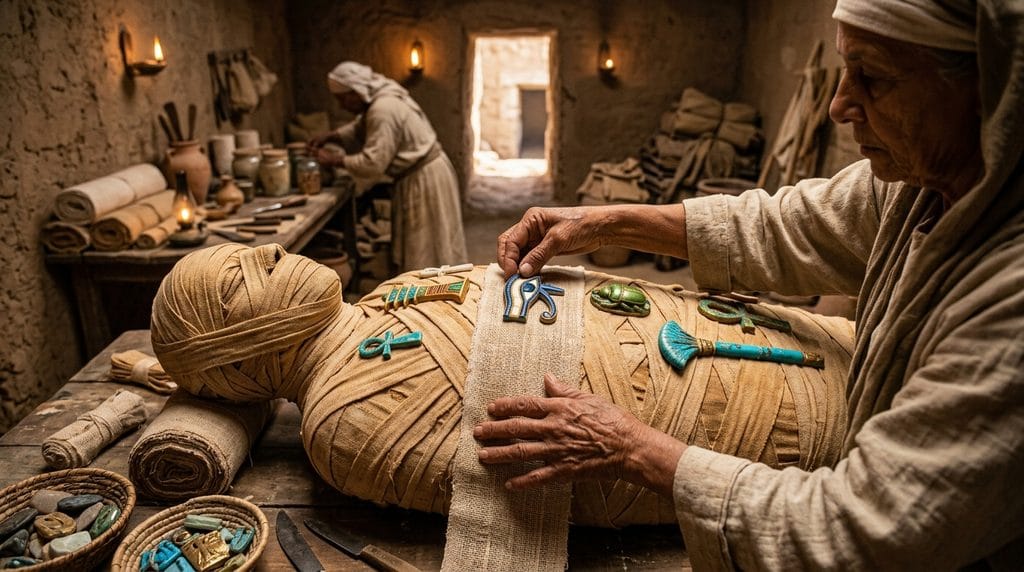
Wrapping took days and used an enormous quantity of linen — hundreds of metres for a single body, often including household linens donated by the family.
The process was methodical. Fingers and toes were wrapped individually, then hands, arms, and legs, then the torso, then the whole body in successive layers. Warm resin was brushed between layers, which hardened into a rigid protective shell.
Amulets were placed within the wrappings, each at a specific position, each with a specific protective function. A scarab was commonly placed over the heart. Priests recited prescribed formulas as the wrapping proceeded, so the physical and ritual work happened simultaneously.
A funerary mask was placed over the head. For royalty this could be gold; for ordinary people, painted cartonnage — layered linen and plaster.
The Opening of the Mouth
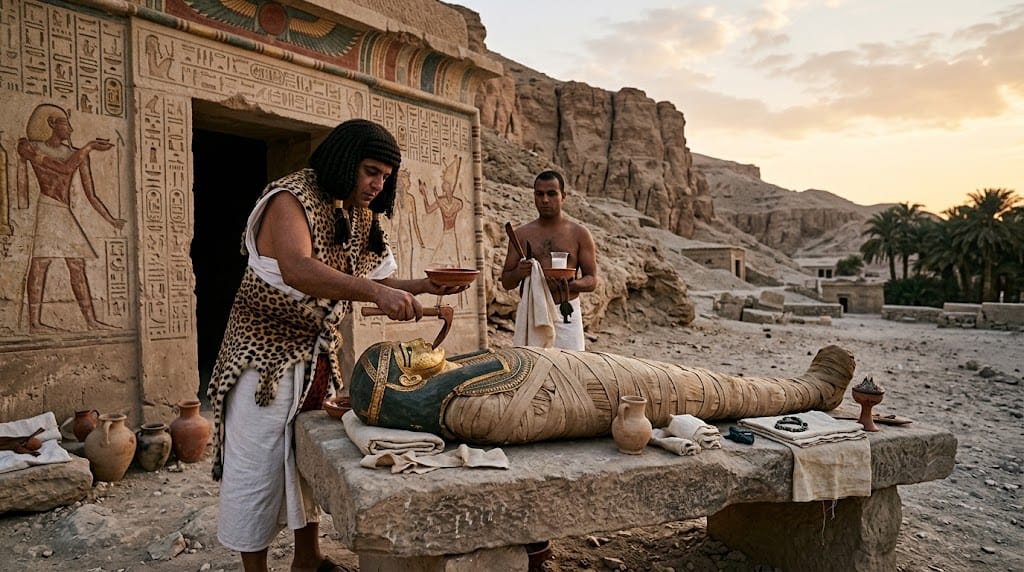
The final ritual took place at the tomb entrance, in front of the family.
In the Opening of the Mouth ceremony, a priest touched the mummy’s face with ritual implements, symbolically restoring the deceased’s ability to speak, eat, breathe, and see in the afterlife. Without it, the preserved body was just a body.
Only then was the mummy placed in its coffin and sealed into the tomb, along with food, furniture, tools, jewellery, and everything else the deceased was expected to need.
Not Just for Pharaohs
The popular image of mummification is a golden pharaoh in an ornate tomb. The reality was much broader.
By the later periods of Egyptian history, mummification was available at multiple price points. A basic treatment — minimal organ removal, natron drying, simple wrapping — was within reach of a reasonably prosperous household. The result was less durable, but the principle was the same.
Egyptians also mummified animals, on an enormous scale. Cats, ibises, falcons, crocodiles, bulls, and dogs were preserved and deposited at temple sites, most often as votive offerings to the associated deity. Some catacombs contain animal mummies in the millions. Our piece on the sacred birds of ancient Egypt covers the species involved and what they meant.
Why It Eventually Stopped
Mummification declined gradually rather than ending abruptly.
Technique peaked in quality during the New Kingdom and Third Intermediate Period. In the Ptolemaic and Roman eras, the external presentation grew more elaborate — including the striking painted mummy portraits from the Fayum region — while the internal preservation work often became noticeably poorer. Wrapping got fancier; the body underneath got less careful treatment.
As Christianity spread through Egypt in the early centuries CE, the theological foundation disappeared. Christian belief in bodily resurrection didn’t require artificial preservation, and the practice faded. By the fifth century it had largely ended.
Frequently Asked Questions
How long did ancient Egyptian mummification take?
Roughly seventy days in total. About forty of those were spent drying the body in natron salt, with the remaining time given to organ removal, treatment, wrapping, and ritual.
Why did Egyptians remove organs during mummification?
The internal organs hold most of the body’s moisture and decay fastest. Removing them was essential to preserving the body. The lungs, liver, stomach, and intestines were dried and stored separately in canopic jars.
Why was the heart left inside the body?
Egyptians believed the heart, not the brain, held a person’s intelligence, memory, and character. It was needed for the judgment of the dead, where it was weighed against the feather of Maat.
What is natron and why was it used?
Natron is a naturally occurring salt mixture of sodium carbonate and bicarbonate, gathered from dry lake beds such as Wadi Natrun. It draws moisture out of tissue and inhibits bacteria, making it the core preserving agent in Egyptian mummification.
What did modern science discover about embalming ingredients?
Analysis of labelled vessels from an embalming workshop at Saqqara, published in 2023, identified beeswax, animal fats, bitumen, and resins from juniper, cypress, cedar, and pistacia. It also found elemi and dammar resin, which originate in Southeast Asia — evidence that mummification drove long-distance trade.
Was mummification only for pharaohs?
No. It was available at several price levels, and simpler treatments were accessible to ordinary households in later periods. Egyptians also mummified animals in vast numbers as temple offerings.
Conclusion
Strip away the gold masks and the mystique, and ancient Egyptian mummification comes down to a single practical insight: water causes decay, so remove the water.
Everything else — the natron, the imported resins, the amulets, the seventy-day calendar, the priests reciting formulas over each layer of linen — was built on top of that one observation, refined across three thousand years by people who took the problem extremely seriously.
They were solving for eternity. Judging by the fact that we’re still studying their work, they came remarkably close.
6 Comments