
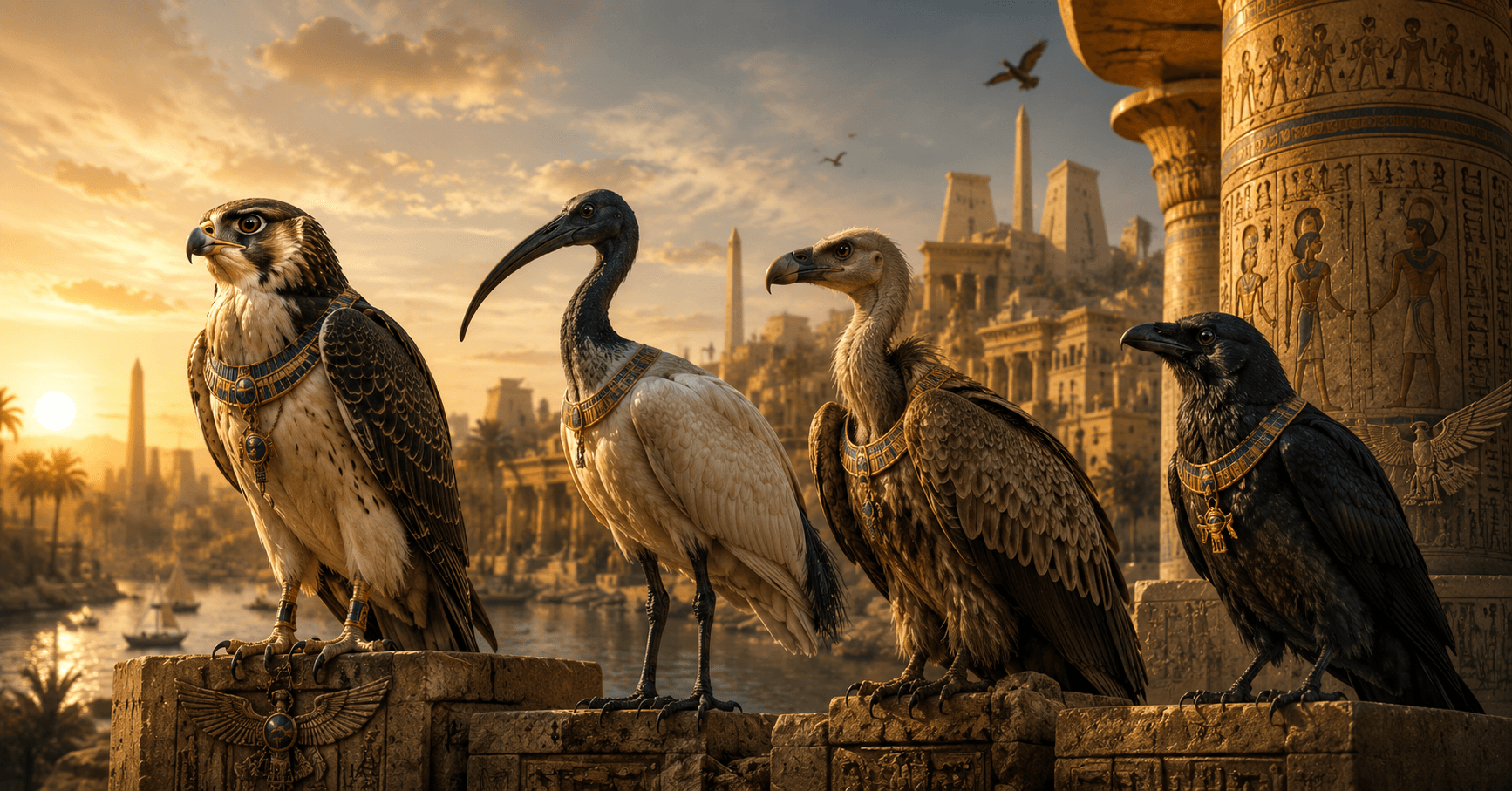
Discover sacred birds of ancient Egypt: falcons, ibis, vultures, and ravens. Learn their symbolism, connection to gods, and spiritual significance in Egyptian culture.
Introduction
Imagine walking through an ancient Egyptian temple. The walls are covered in hieroglyphics and carved images. And everywhere—on ceilings, on walls, in statues, in paintings—you see birds. Specifically, sacred birds. The wider belief system is set out in our overview of the religion of ancient Egypt.
Falcons with piercing eyes. Ibis birds with long curved beaks. Vultures with spread wings. Ravens perched watchfully. These weren’t just decorative elements. They were religious symbols. They represented gods. They carried spiritual meaning that Egyptians understood deeply.
Sacred birds weren’t just animals in ancient Egypt. They were pathways to the divine. They were symbols of power, protection, resurrection, and spiritual connection. Egyptians revered them, protected them, incorporated them into religious rituals, and honored them in art and architecture.
What’s fascinating is that these weren’t random choices. Egyptians observed birds. They noticed their behaviors. They connected what they saw in nature to spiritual concepts. A falcon’s hunting prowess became a symbol of divine power. An ibis’s connection to water became tied to rebirth and renewal.
Understanding sacred birds of ancient Egypt opens a window into how Egyptians saw the world, what they valued spiritually, and how they built meaning into everyday observation of nature.
Let me walk you through the birds that mattered most in ancient Egyptian spirituality and what they meant.
The Falcon: Symbol of Divine Power and Protection
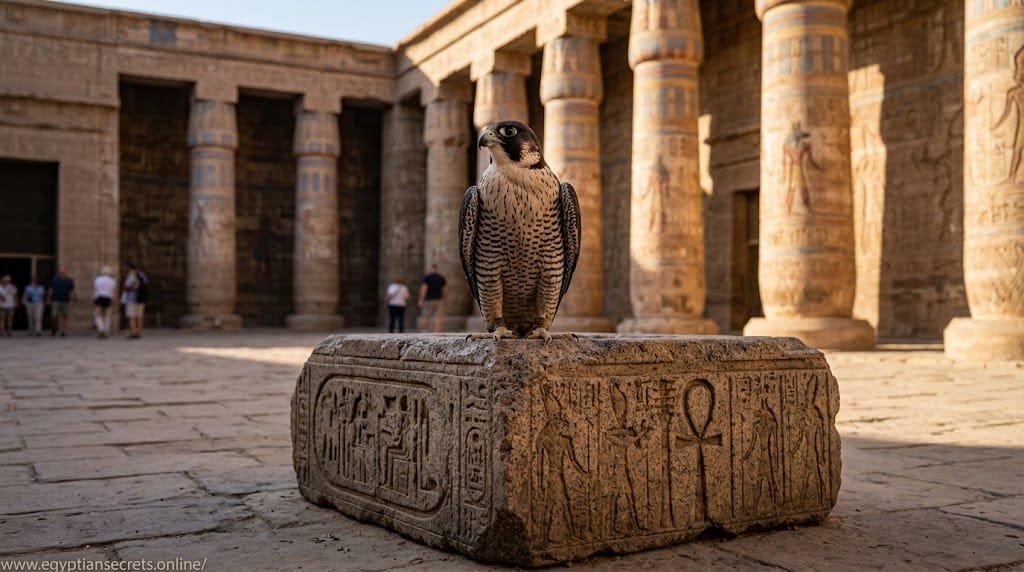
The falcon is probably the most iconic sacred bird of ancient Egypt. And for good reason.
Falcons are hunters. They dive from the sky at incredible speeds. They’re powerful, focused, deadly accurate. An ancient Egyptian watching a falcon hunt would see something extraordinary—a creature with perfect vision, perfect control, perfect deadly precision.
To Egyptians, this meant power. Divine power. The power of the sun, the power of kings, the power of dominion over the world.
The falcon became associated with Horus, one of the most important gods in the Egyptian pantheon. Horus was the falcon-headed god, often depicted as a falcon or as a man with a falcon’s head. Horus was the son of Osiris, the god of resurrection and the afterlife. Horus was venerated as a protector, as the embodiment of divine power.
Pharaohs were believed to be manifestations of Horus on earth. They were God-Kings, and the connection to the falcon-god Horus was part of what gave them religious authority. Kings would be identified with Horus, with the falcon’s power and vision and protective strength.
Falcons were protected in Egyptian society. Harming a falcon could result in severe punishment. Egyptians understood these birds as sacred, as embodying divine presence.
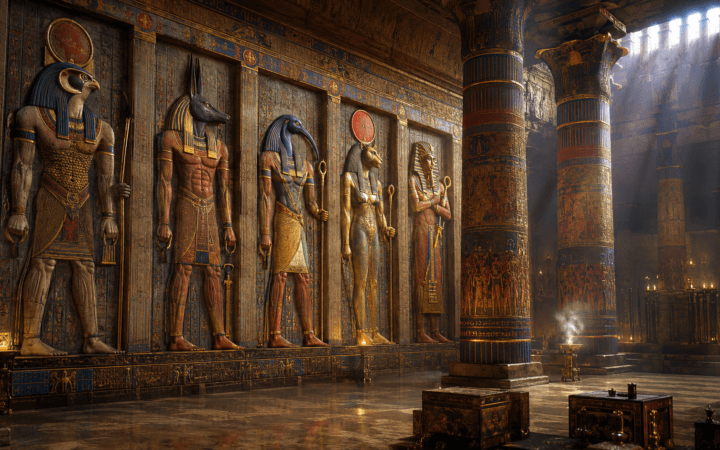
In art and architecture, falcon imagery is everywhere in Egyptian temples and tombs. Falcon-headed statues served protective functions. Falcon imagery on amulets was believed to convey protection to the wearer.
The sacred falcon of ancient Egypt wasn’t just a bird. It was a link to the divine. It was protection. It was power. It was the embodiment of kingly authority and spiritual strength.
The Ibis: Sacred to Thoth, God of Wisdom and Writing

If the falcon represented divine power, the ibis represented wisdom, knowledge, and intellectual achievement.
The ibis is a wading bird with a long curved beak. It’s common in the Nile Delta, near water. Egyptians observed ibis birds walking along the Nile, using their long beaks to probe the mud, hunting for food. The ibis seemed wise, deliberate, purposeful in its movements.
The ibis became sacred to Thoth, one of the most important gods in Egyptian religion. Thoth was the god of wisdom, knowledge, writing, mathematics, and scientific understanding. Thoth was depicted as ibis-headed, or sometimes as a full ibis, or sometimes as a baboon (ibis and baboons were both sacred to Thoth). Thoth and the other major deities are covered in our guide to the ancient Egyptian gods.
Thoth was credited with inventing writing. He was the keeper of sacred knowledge. He was associated with the moon and with calculation. He represented intellectual capability and the power of understanding.
The ibis, as Thoth‘s sacred animal, represented all of this. The ibis embodied wisdom. To be sacred to Thoth’s bird was to be connected to knowledge, to writing, to the intellectual pursuits that Egyptians valued.
Egyptian scribes—those who could read and write, who were learned and educated—held the ibis sacred. The bird represented their profession, their knowledge, their value to society.
Ibis amulets were worn for wisdom and protection. Images of ibis adorned temples dedicated to Thoth. When Egyptians wanted to connect to knowledge or intellectual capability, they looked to the ibis.
The sacred ibis of ancient Egypt was essentially the symbol of knowledge itself—the bird that represented humanity’s intellectual achievement.
The Vulture: Protector and Mother Goddess
Vultures might seem like an odd choice for a sacred bird. They eat carrion. They’re scavengers. But Egyptians saw something different in vultures. They saw protection and motherhood.
Vultures are incredibly devoted parents. They fiercely protect their young. They have excellent vision (vultures can see from incredibly far away). They mate for life. Despite being associated with death through carrion-eating, vultures embody protection and nurturing.
The vulture became sacred to Mut, a major goddess in Egyptian religion. Mut was the mother goddess. She was protective, nurturing, fierce in defending her children. She was often depicted as a woman with vulture wings, representing her protective power and her role as mother to the gods and to humanity.
Mut was also associated with motherhood, fertility, and protection—all qualities embodied by the attentive vulture mother.
Images of vultures with spread wings appear throughout Egyptian temples and tombs. The symbol represented maternal protection, divine care, the fierce love of a mother protecting her children.
Amulets showing vultures were worn for protection, particularly by women. The sacred vulture meant: you are protected, you are cared for, a divine mother watches over you.
The sacredness of vultures in ancient Egypt is a powerful example of how Egyptians found spiritual meaning by observing animal behavior. They noticed the vulture’s devotion to young. They connected this to the concept of motherhood and divine protection. And they built an entire religious association around this observation.
Also Read :- Ancient Egyptian Kohl: How Daily Eyeliner Was Really Preventive Medicine, Not Vanity
The Raven: Mystery, Magic, and the Otherworldly
Ravens appear less frequently in mainstream Egyptian religious iconography than falcons, ibis, or vultures. But they held spiritual significance, particularly in magical practices.
Ravens are intelligent. They seem mysterious and otherworldly. In many cultures, ravens are associated with magic, mystery, and the unknown. Ancient Egyptians seem to have felt something similar.
Ravens were associated with magic practices, with the mysterious forces beyond everyday understanding. They were connected to spiritual realms and supernatural knowledge.
In Egyptian art, ravens appear in magical contexts, in funerary settings, in spaces associated with spiritual transformation and otherworldly knowledge.
The sacred raven represented mystery. It represented the unknown. It represented the spiritual forces that Egyptians knew existed but couldn’t directly control.
The Eagle: Cosmic Vision and Divine Perspective
Eagles appear occasionally in Egyptian sacred symbolism, though less frequently than falcons. Like falcons, eagles were birds of prey, hunters, symbols of power and vision.
Eagles were sometimes associated with spiritual ascension and cosmic vision. The eagle’s ability to fly so high and see so far represented the connection between earthly and divine realms, the ability to perceive from a cosmic perspective.
Sacred eagle imagery was less common than falcon imagery, but when present, it conveyed similar themes of power, vision, and divine authority.
The Owl: Hidden Knowledge and Nocturnal Wisdom
Owls appear in Egyptian artistic representations and seem to have carried associations with hidden knowledge, nocturnal wisdom, and secret understanding.
Unlike daytime birds (falcons, eagles, ibis), owls represent knowledge that comes in darkness, understanding that comes through observation of hidden things, wisdom that requires looking beyond the obvious.
Owl symbolism in Egyptian culture reflects the bird’s nocturnal nature and association with insight and perception in circumstances where others see nothing.
Sacred Birds in Temples and Tombs: Practical Reverence
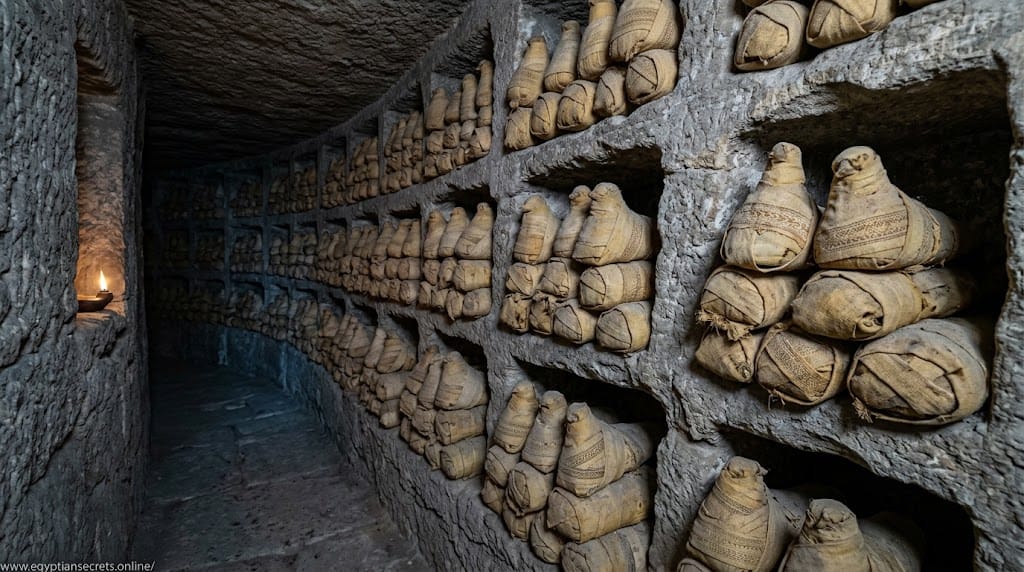
Beyond symbolic meaning, sacred birds had practical roles in Egyptian religious sites and burial practices.
Protection and Presence: Images of sacred birds adorned temples and tombs to provide spiritual protection. A statue of Horus-the-falcon was believed to actively protect the sacred space. Images of Mut-the-vulture protected tombs and temples from spiritual harm.
Spiritual Connection: Sacred bird imagery created connections to the divine. By surrounding themselves with representations of sacred birds, Egyptians believed they maintained spiritual connection to the gods those birds represented.
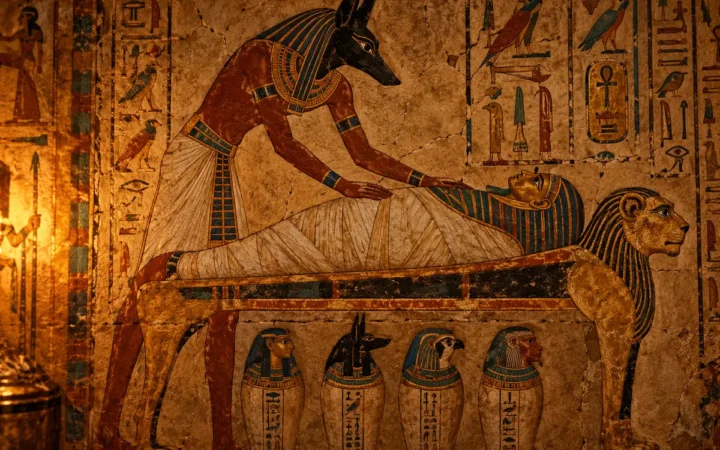
Funeral Practices: Birds sometimes played roles in funeral rituals. Mummified birds were placed in tombs. Birds were depicted on coffins and tomb walls to guide the deceased’s journey to the afterlife. Animal mummies were prepared using techniques described in our article on ancient Egyptian mummification.
Religious Texts: Sacred birds appear throughout Egyptian religious texts—the Book of the Dead, temple inscriptions, religious papyri—as guides, protectors, and representations of divine forces.
The Protection of Sacred Birds: Religious Law and Reverence
Here’s something remarkable: ancient Egypt had religious laws protecting sacred birds. Harming certain birds could result in severe punishment, including death.
This wasn’t theoretical. Archaeological evidence and historical accounts confirm that Egyptians took this seriously. The killing of a sacred bird was considered blasphemy—an affront to the divine itself.
This level of protection reflects how deeply Egyptians valued their sacred birds. These weren’t just symbols or artistic elements. They were sacred beings worthy of protection, embodiments of divine presence.
The protection of sacred birds was such a strong cultural value that sometimes it contributed to Egyptian military vulnerabilities. There are historical accounts of enemies of Egypt deliberately desecrating sacred bird temples to demoralize the population.
Sacred Bird Amulets and Spiritual Practice
Egyptians wore amulets shaped like sacred birds or incorporating sacred bird imagery. These amulets served several purposes:
- Protection: A falcon amulet provided protection and connected the wearer to Horus’s power
- Wisdom: An ibis amulet invited wisdom and intellectual capability
- Maternal Protection: A vulture amulet conveyed divine maternal care
- Spiritual Connection: Any sacred bird amulet created a bridge to the divine forces the bird represented
These amulets weren’t just jewelry. They were spiritual tools. They were ways of invoking divine power and protection in daily life.
Sacred Birds in Egyptian Art and Architecture
Sacred bird symbolism appears throughout Egyptian art:
Painted Ceilings: Temple ceilings often featured painted sacred birds, particularly vultures with spread wings, creating a protective covering.
Reliefs and Carvings: Sacred birds appear in carved reliefs on temple walls, depicting them in contexts of divine power, protection, or spiritual guidance.
Statuary: Sculptures of sacred birds or falcon-headed gods (like Horus) served both artistic and spiritual functions.
Hieroglyphics: Sacred bird symbols were incorporated into hieroglyphic writing itself, becoming part of the written language.
This integration of sacred birds throughout artistic and architectural spaces meant that Egyptians lived surrounded by these symbols. Daily exposure reinforced their spiritual significance.
Frequently Asked Questions (FAQ)
Q: What was the most important sacred bird in ancient Egypt?
A: The falcon (Horus) was probably most important for overall religious practice, as falcons represented divine power and protected pharaohs. But the ibis (Thoth) was equally important for intellectual/spiritual pursuits, and the vulture (Mut) for maternal protection.
Q: Why were birds considered sacred?
A: Egyptians observed birds’ behavior and connected their characteristics to spiritual concepts. Falcon’s power → divine authority. Ibis’s wisdom → intellectual achievement. Vulture’s motherhood → protection.
Q: Could you keep sacred birds as pets in ancient Egypt?
A: Harming sacred birds was often illegal. Keeping them as pets would be complicated and generally not permitted. Some birds might be kept in temples under controlled conditions.
Q: Were all birds considered sacred?
A: No, only specific birds held religious significance. Falcons, ibis, vultures, ravens, owls, and some others were sacred. Most birds didn’t carry special religious meaning.
Q: How did Egyptians know which gods sacred birds represented?
A: This knowledge was part of religious training and cultural transmission. Religious specialists (priests, scribes) learned the associations and taught them. Over time, the connections became traditional and widely known.
Q: Do sacred bird symbols mean the same thing today?
A: Modern interpretations of ancient Egyptian symbolism are educated guesses based on historical evidence. The original meanings were understood differently then. But the basic associations (falcon = power, ibis = wisdom) hold.
Q: Can you see sacred bird imagery in Egyptian museums today?
A: Yes, extensively. Major museums with Egyptian collections display statues, carvings, paintings, and amulets featuring sacred birds. The Cairo Egyptian Museum has extensive collections.
Q: Did other ancient civilizations have sacred birds?
A: Yes, many cultures held birds sacred. But the specific associations (which gods, which meanings) were particular to Egyptian culture.
Conclusion: Sacred Birds as Windows to Egyptian Spirituality
Sacred birds of ancient Egypt reveal something profound about how this civilization understood the world. They took what they observed in nature—the falcon’s hunting prowess, the ibis’s deliberate wisdom, the vulture’s protective care of young—and transformed these observations into spiritual meaning.
The sacred birds weren’t randomly chosen. They were chosen because Egyptians saw in them qualities they valued spiritually. By making birds sacred, by surrounding themselves with bird symbolism, by building birds into their religious practices, Egyptians created a spiritual worldview rooted in nature itself.
That connection between observation of nature and spiritual understanding—that’s powerful. And it’s one of the most beautiful aspects of ancient Egyptian spirituality that survives today.
1 Comment