
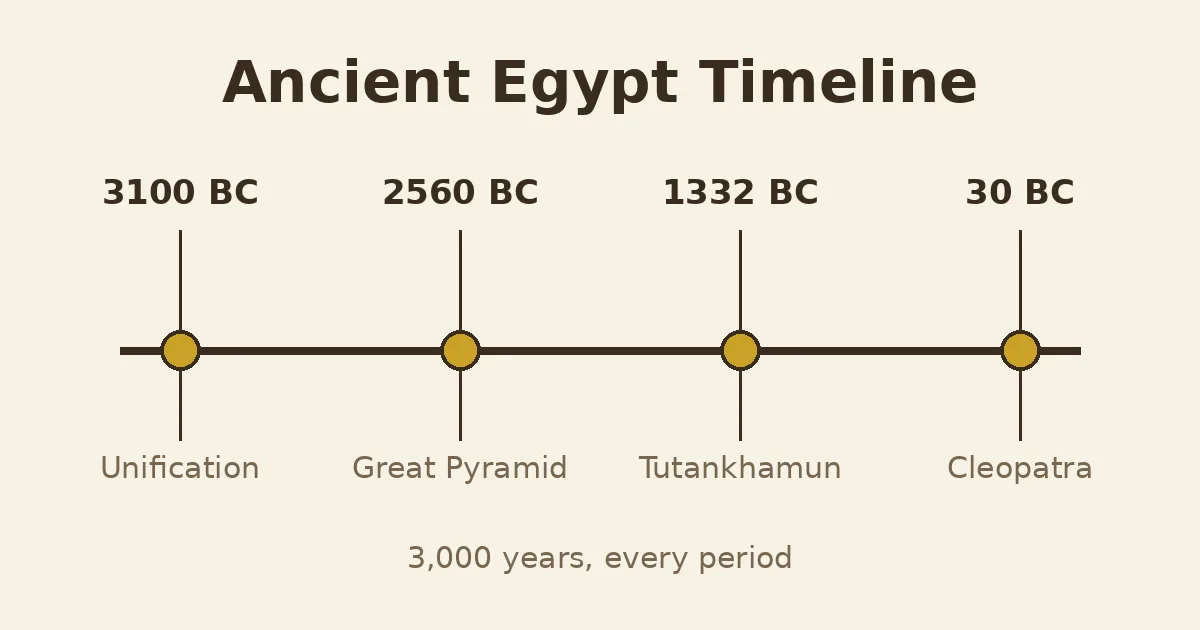
Ancient Egypt lasted about three thousand years. Cleopatra lived closer in time to the first Moon landing than to the building of the Great Pyramid — a gap of roughly 2,500 years separated her from Khufu.
That span is the hardest thing to hold in your head about Egypt, and it is why the periods below matter. The pyramid builders and the pharaohs of the Valley of the Kings were not contemporaries. They were separated by more time than divides us from the Roman Empire.
Predynastic Egypt
Farming villages spread along the Nile. Two separate cultures develop in the north and south, and the toolkit of Egyptian civilisation — pottery, copper, burial customs, early writing — takes shape before there is a state to use it.
- c. 5000 BCSettled farming established along the Nile floodplain
- c. 3500 BCLarge towns at Naqada and Hierakonpolis; social hierarchy visible in burials
- c. 3250 BCEarliest known hieroglyphic signs, on labels from a tomb at Abydos
- c. 3100 BCRock inscriptions at Elkab, some of the oldest monumental writing found anywhere
Early Dynastic Period
Upper and Lower Egypt are unified under a single king. The institutions that will run the country for three thousand years — kingship, a scribal bureaucracy, a tax system — are built from scratch.
- c. 3100 BCNarmer unifies Egypt. The Narmer Palette shows him wearing both crowns
- c. 3000 BCMemphis founded near the point where the valley meets the Delta
- c. 2970 BCDen is the first king titled ruler of Upper and Lower Egypt
- c. 2690 BCKhasekhemwy ends a period of internal conflict
Old Kingdom
The pyramid age. A centralised state with enormous surplus labour builds in stone on a scale never attempted before, then exhausts itself doing it.
- c. 2670 BCDjoser builds the Step Pyramid at Saqqara, the first monumental stone building
- c. 2600 BCSneferu builds three pyramids and works out the true pyramid form
- c. 2560 BCKhufu builds the Great Pyramid, taking roughly twenty years
- c. 2530 BCKhafre builds the second pyramid and, most likely, the Great Sphinx
- c. 2345 BCThe Pyramid Texts appear in the pyramid of Unas
- c. 2200 BCA prolonged drought and weakening central authority bring the period to an end
First Intermediate Period
Central authority collapses. Rival dynasties rule simultaneously from different cities, and provincial governors act as independent rulers. Tomb robbery becomes widespread.
- c. 2181 BCThe Old Kingdom state fragments after the long reign of Pepi II
- c. 2160 BCCompeting dynasties at Herakleopolis and Thebes
- c. 2100 BCFunerary spells once reserved for kings appear on the coffins of officials
Middle Kingdom
Egypt is reunified from Thebes. This is the classical age of Egyptian literature, and the state turns outward — fortresses in Nubia, trade with the Levant, large irrigation works in the Faiyum.
- c. 2055 BCMentuhotep II reunifies the country
- c. 1985 BCAmenemhat I founds the 12th dynasty and moves the capital north
- c. 1870 BCSenusret III campaigns in Nubia and reorganises provincial government
- c. 1831 BCAmenemhat III undertakes major irrigation work in the Faiyum
- c. 1806 BCSobekneferu rules as pharaoh, the first woman securely attested in the role
Second Intermediate Period
Foreign rulers known as the Hyksos take the Delta while Egyptian kings hold the south from Thebes. Egypt is divided for a century — and acquires the horse, the chariot and the composite bow.
- c. 1650 BCHyksos rulers establish themselves at Avaris in the eastern Delta
- c. 1560 BCSeqenenre Tao dies in battle; his mummy shows axe wounds to the skull
- c. 1555 BCKamose begins the campaign to drive the Hyksos out
New Kingdom
Egypt at its height, and an empire for the first time. This is the age of the Valley of the Kings, of Hatshepsut and Ramesses II, and of the only religious revolution in Egyptian history.
- c. 1550 BCAhmose I expels the Hyksos and founds the New Kingdom
- c. 1504 BCThutmose I is probably the first king buried in the Valley of the Kings
- c. 1473 BCHatshepsut takes the throne and rules for twenty years
- c. 1457 BCThutmose III wins at Megiddo, the earliest battle recorded in detail
- c. 1352 BCAkhenaten abolishes the traditional gods for the Aten and builds Amarna
- c. 1332 BCTutankhamun reverses the reform and restores the old religion
- c. 1274 BCRamesses II fights the Hittites at Kadesh; the resulting treaty is the earliest known
- c. 1155 BCRamesses III is assassinated in a harem conspiracy
- c. 1070 BCPriests abandon the Valley of the Kings and hide the royal mummies in caches
Third Intermediate Period
Egypt fragments again. Libyan dynasties rule the Delta, priests rule the south, and for a century Egypt is governed by Nubian kings from Kush who restore its temples and revive its old art.
- c. 1069 BCThe country splits between Tanis in the north and Thebes in the south
- c. 943 BCShoshenq I, of Libyan descent, founds the 22nd dynasty
- c. 747 BCPiye conquers Egypt from Nubia and founds the Kushite dynasty
- 671 BCAssyrian invasion. Taharqa is driven from Memphis
Late Period
A last native revival, then conquest. Egyptian culture turns deliberately backward-looking, copying Old Kingdom art, while Persian rule interrupts independence twice.
- 664 BCPsamtik I reunifies Egypt and ends Assyrian control
- c. 610 BCNecho II commissions a canal towards the Red Sea
- 525 BCCambyses II conquers Egypt for Persia
- 404 BCEgypt regains independence for sixty years
- 343 BCNectanebo II, the last native Egyptian pharaoh, flees the second Persian conquest
Ptolemaic Period
Alexander takes Egypt, and his general Ptolemy founds a Greek-speaking dynasty that rules for three centuries. Egyptian religion continues, now sharing space with Greek gods.
- 332 BCAlexander the Great takes Egypt and founds Alexandria
- 305 BCPtolemy I founds the dynasty
- 196 BCThe decree later carved on the Rosetta Stone is issued
- 51 BCCleopatra VII becomes co-ruler
- 30 BCCleopatra dies. Egypt becomes a Roman province and the line of pharaohs ends
Roman and Christian Egypt
Egypt becomes Rome’s grain supply. Temple funding dries up, the priesthoods fade, and Christianity replaces the old religion — gradually, with both coexisting for generations.
- AD 30Egypt is governed as a personal possession of the Roman emperor
- c. AD 200Christianity spreading widely along the Nile
- AD 394The last dated hieroglyphic inscription is carved at Philae
- c. AD 400Churches built inside temple precincts
- AD 641The Arab conquest. Egyptian Christianity continues as the Coptic Church
How the Periods Work
Egyptologists divide Egyptian history into three Kingdoms separated by two Intermediate Periods. The naming can mislead, so it is worth being clear about what it means.
| Term | What it actually describes |
|---|---|
| Kingdom | A period of unified rule from a single centre, with a functioning bureaucracy and large-scale building |
| Intermediate Period | Not a dark age. Central authority fragments and rival dynasties rule simultaneously — but art, writing and trade continue |
| Dynasty | A sequence of rulers grouped by the historian Manetho in the 3rd century BC. The groupings are not always by family |
The full list of rulers within each period is set out in our list of Egyptian pharaohs.
Why the dates are approximate
Every date above carries a margin, and the margin widens the further back you go. Egyptians dated events by regnal year, and for much of the Old Kingdom by counting periodic cattle censuses whose interval is uncertain.
Late Period and Ptolemaic dates are firm because they can be cross-checked against Greek and Persian records. Predynastic dates rest on radiocarbon and are estimates.
Frequently Asked Questions
How long did ancient Egypt last?
About three thousand years, from unification around 3100 BC to the death of Cleopatra in 30 BC. Egyptian religion and writing continued for several centuries after that under Roman rule.
What are the three Kingdoms of ancient Egypt?
The Old Kingdom (c. 2686–2181 BC), the age of pyramid building; the Middle Kingdom (c. 2055–1650 BC), a literary and administrative high point; and the New Kingdom (c. 1550–1069 BC), when Egypt held an empire.
What is an Intermediate Period?
A stretch when central authority broke down and rival dynasties ruled different parts of Egypt at the same time. They are not dark ages — writing, art and trade continued — but the unified state did not function.
When were the pyramids built?
The great pyramids belong to the Old Kingdom, roughly 2670 to 2500 BC. The Great Pyramid of Khufu dates to about 2560 BC, some 2,500 years before Cleopatra.
When did ancient Egypt end?
Politically in 30 BC, when Cleopatra died and Egypt became a Roman province. Culturally it faded more slowly — the last dated hieroglyphic inscription was carved in AD 394.
What came before the pharaohs?
The Predynastic period, from around 5000 BC. Farming villages along the Nile developed into two distinct cultures in the north and south, with pottery, copper working, early writing and elaborate burials all appearing before unification.