

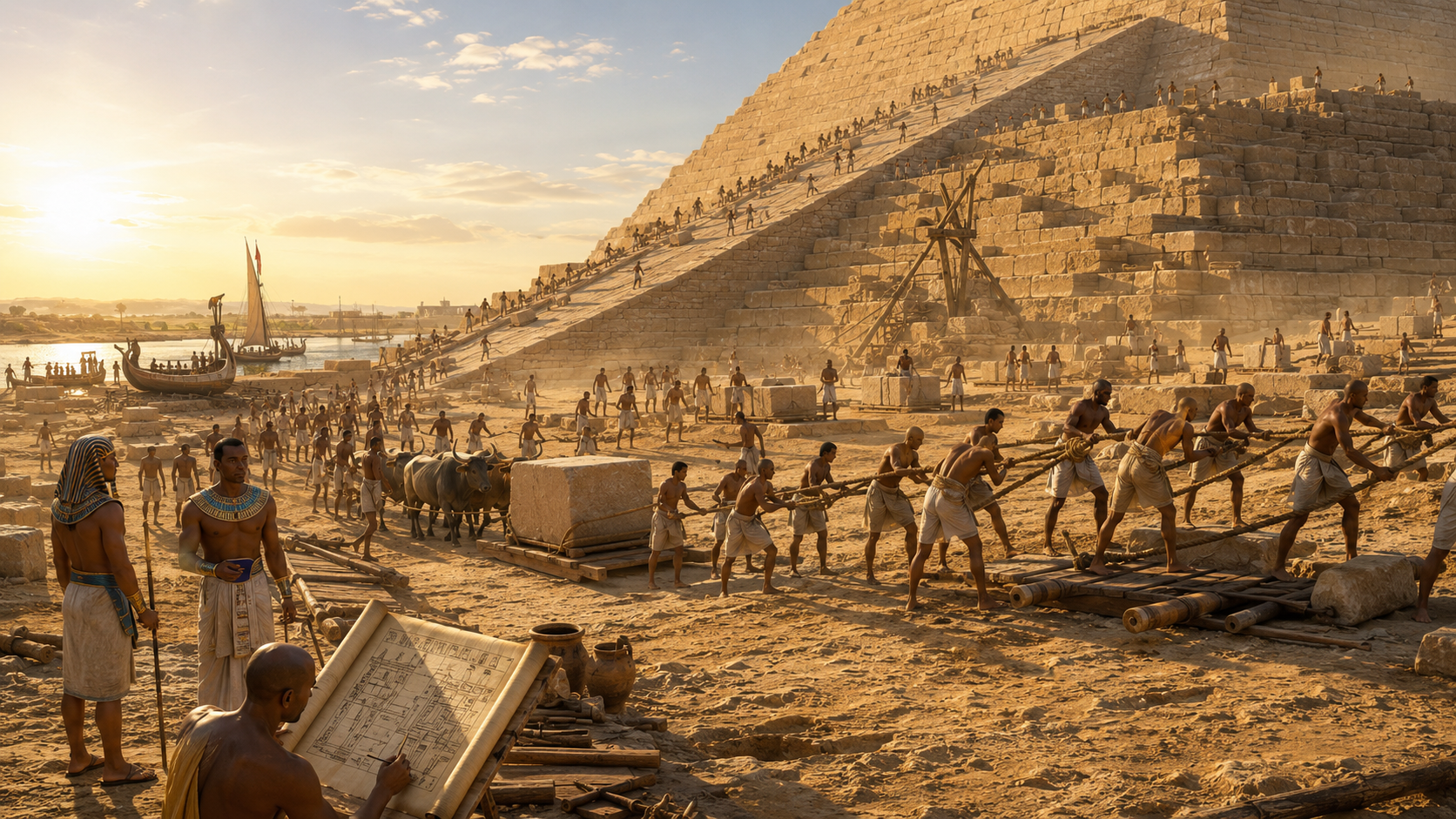
The Great Pyramid of Giza took approximately 20 years to build, according to most Egyptological estimates. That figure comes from a single historical source, a Greek historian writing over 2,000 years after the fact, cross-checked against physical evidence at the site itself and the two don’t always agree as neatly as popular articles suggest.
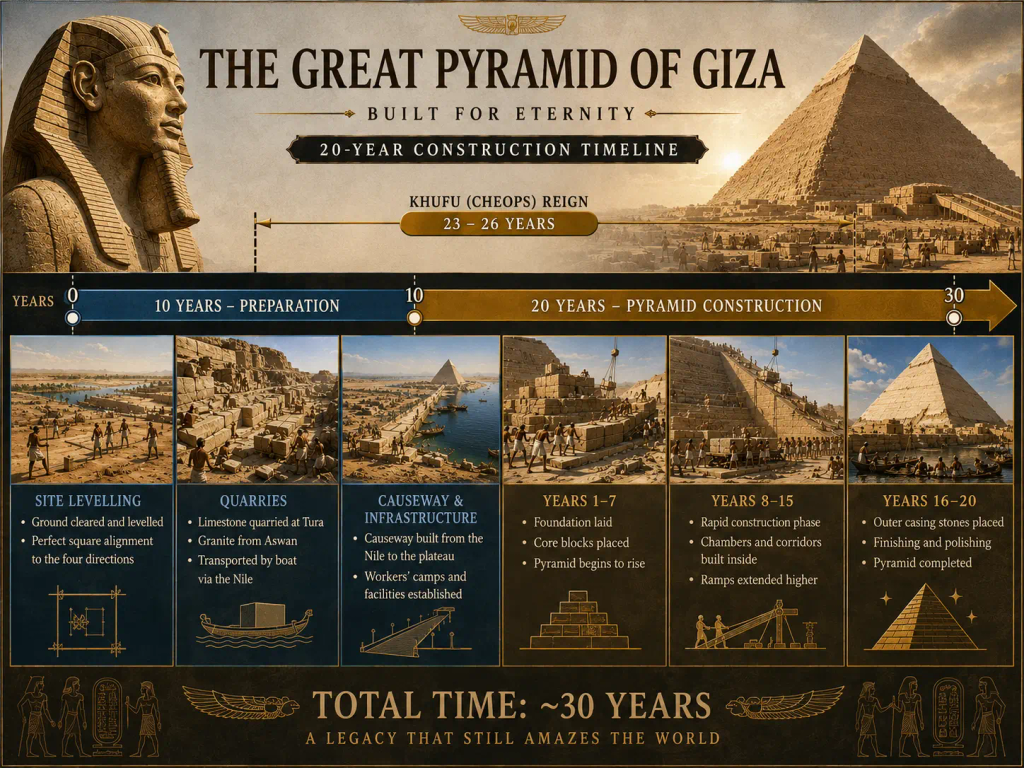
Short answer: roughly 20 years for the pyramid itself, during the reign of Khufu (about 2560 BC). Adding the preparatory work — levelling the site, opening quarries and cutting the causeway — pushes the total closer to 30 years. The 20-year figure comes from Herodotus, and holds up against three independent checks: construction arithmetic, Khufu’s reign length, and a work diary kept during the build.
Here’s where the number actually comes from, and why “about 20 years” is more solid than it might sound for something built 4,500 years ago.
The Original Source: Herodotus
The 20-year figure traces back to the Greek historian Herodotus, who visited Egypt around 450 BCE roughly 2,000 years after the Great Pyramid was completed. In his account, Herodotus wrote that the pyramid took 20 years to build, following a separate 10-year project to construct the causeway and underground chambers.
The problem: Herodotus was writing two millennia after the fact, based on stories told to him by Egyptian priests and guides. He wasn’t an eyewitness, and some of his other claims about Egypt including a widely repeated claim about slave labor have since been contradicted by archaeological evidence. So Egyptologists don’t take his number on faith. They test it.
Testing the Number Against the Pyramid Itself
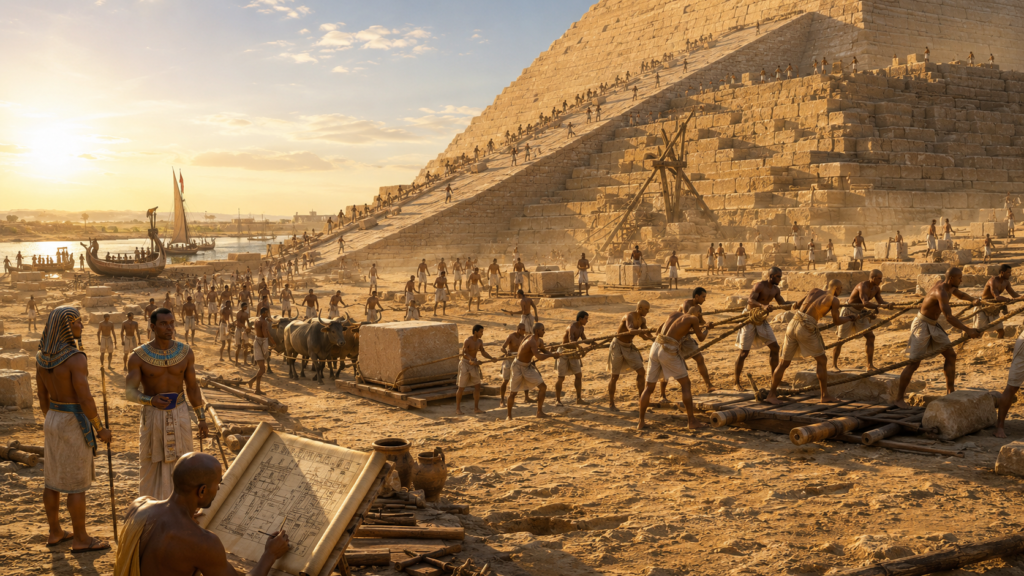
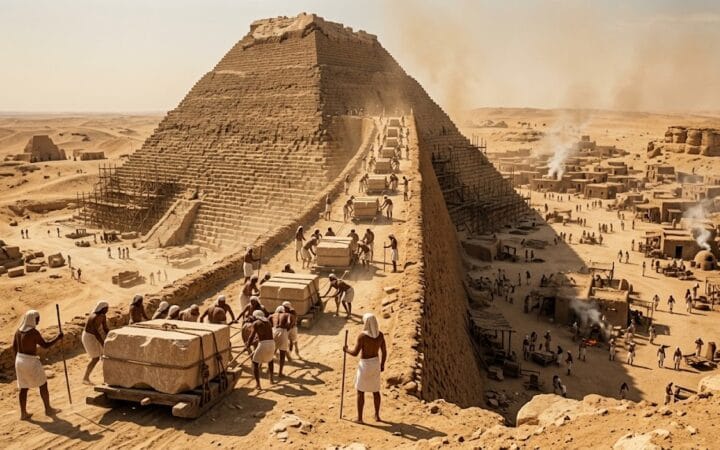
Modern estimates work backward from construction math. The Great Pyramid contains roughly 2.3 million blocks, with an average weight around 2.5 tons. If construction spanned 20 years, that works out to placing a block roughly every two to three minutes, assuming a 10-hour workday a demanding but physically plausible pace for a well-organized crew, especially once you account for the fact that different sections of the pyramid required different amounts of precision and labor.
This math is one of the stronger pieces of evidence supporting Herodotus’s number. If the real build time had been dramatically shorter, say five years, the placement rate required would push into implausible territory even for a highly skilled workforce. If it had taken far longer, say 50 years, the pace would be almost leisurely compared to what we know about ancient Egyptian labor organization from other massive building projects of the era.
What the Pharaoh’s Reign Tells Us
There’s a second independent check: the reign of Pharaoh Khufu, who commissioned the pyramid as his tomb. Historical king lists and inscriptions suggest Khufu ruled for somewhere between 23 and 26 years. Since the pyramid needed to be functionally ready by the time of his death a pharaoh’s tomb wasn’t something you could finish late a build time in the low-to-mid 20s fits neatly within a realistic portion of his reign, leaving time for the temple complex and other associated structures.
This is the kind of cross-referencing Egyptologists rely on constantly: no single source is treated as gospel, but when a 2,000-year-old historical account, physical construction math, and reign-length records all point to roughly the same window, confidence in the estimate goes up considerably.
Did the Timeline Include Off-Seasons?
Almost certainly, yes — and this matters for understanding how 20 years were used, not just how many. Evidence from the nearby workers’ village suggests labor was organized around the Nile’s annual flood season, when farming became impossible and a large seasonal workforce became available for state building projects. Skilled quarrymen, stonemasons, and engineers likely worked the site year-round, while the general labor pool swelled during flood months.
That means the 20-year timeline wasn’t 20 years of uniform, constant effort it was a sustained, multi-decade project with a permanent core team and a much larger seasonal surge workforce, which is part of why the logistics of the build are considered as impressive as the engineering itself.
Also Read How Were the Great Pyramids Actually Built?
How This Compares to Other Pyramids
Not every pyramid took two decades. The Bent Pyramid and Red Pyramid, both built earlier under Pharaoh Sneferu (Khufu’s father), show evidence of construction problems and design changes mid-build, suggesting variable and sometimes troubled timelines. The Great Pyramid, by contrast, shows remarkably few signs of major design revision once construction began — another indirect clue that its builders had learned from earlier projects and executed this one with unusual efficiency.
The Diary That Confirmed the Timeline
For most of the twentieth century, every estimate rested on Herodotus plus arithmetic. Then in 2013 a French mission excavating at Wadi al-Jarf on the Red Sea coast found something nobody expected: a stack of papyri from Khufu’s own reign.
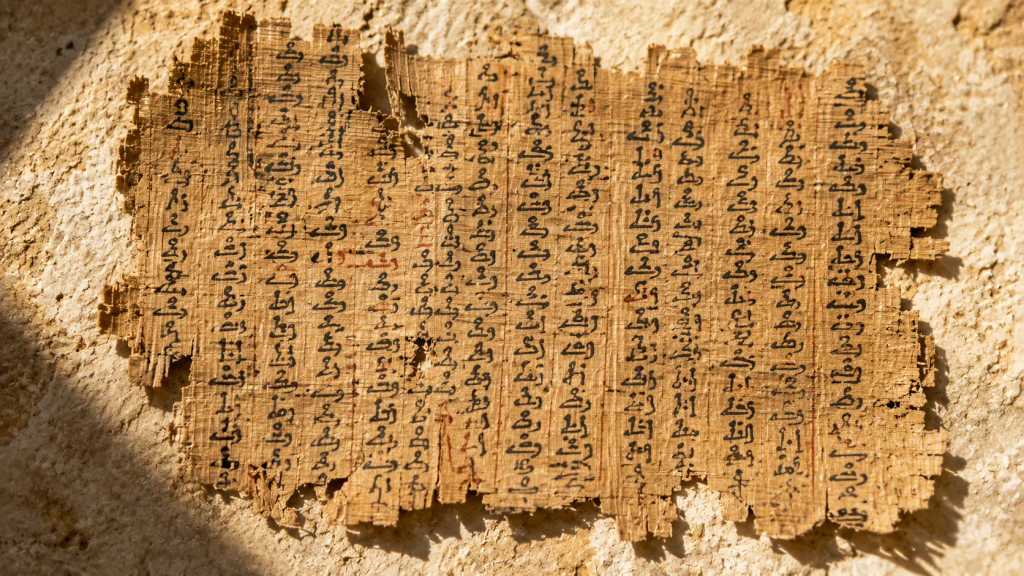
They are the oldest inscribed papyri ever recovered in Egypt, and one of them is a work log kept by an inspector named Merer, who supervised a crew of around two hundred men.
Merer’s diary records his team ferrying fine white limestone from the quarries at Tura across the Nile to the Giza construction site. It logs trips, timings and stops, in the flat administrative language of a man filling in a form.
Two things about it matter for the timeline.
First, it is dated to year 27 of Khufu’s reign — and the work Merer describes is casing stone, the smooth outer limestone that goes on last. If the outer casing was still being delivered in year 27, the project was still running deep into Khufu’s reign, exactly as a roughly two-decade build would predict.
Second, it shows the logistics running smoothly by that point — a routine supply operation, not a crisis rush. That fits a long, planned schedule far better than a compressed one.
Who Was Actually Doing the Work
Any build-time estimate depends on how many people you assume were working, and that number has been revised sharply downward over the past few decades.
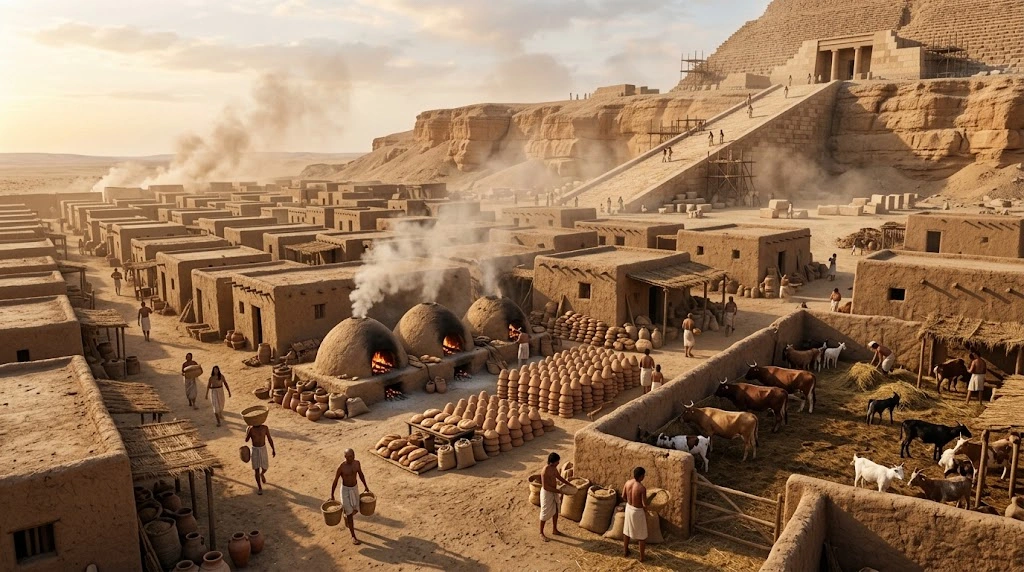
Herodotus claimed 100,000 men. Modern estimates based on the excavated workers’ settlement at Giza put the figure closer to 20,000–30,000, split between a permanent skilled core and rotating conscripted crews.
That settlement matters. Excavations uncovered bakeries and breweries operating at industrial scale, enormous quantities of cattle, sheep and goat bone, and workers’ cemeteries where skeletons show healed fractures and evidence of medical treatment. These were fed, housed and cared-for workers, not slaves — a point covered in more detail in our article on how the pyramids were built.
The rotating labour obligation that supplied those crews is exactly what the state’s record-keeping existed to track. Our piece on the ancient Egypt census covers how households were registered and who owed service.
Why the Estimate Still Has Uncertainty
Twenty years is the working figure, not a proven fact. Three things keep it approximate.
Khufu’s reign length is itself disputed
Old Kingdom dates were recorded by counting periodic cattle censuses rather than regnal years, and whether those counts happened annually or every second year varies by reign. Merer’s diary references year 27, which pushed some earlier estimates upward. If Khufu ruled longer than assumed, the pyramid could have been built at a more relaxed pace.
Nobody knows exactly how blocks were raised
Ramps were certainly used, but no substantial ramp survives at Giza and the models proposed — straight, spiral, internal, staged — imply quite different labour requirements. A 2018 discovery at the Hatnub quarry revealed a rope-and-post haulage system capable of far steeper slopes than previously assumed, which would change the arithmetic if it was used at Giza.
Preparation time is often left out
Herodotus described ten years of preparatory work before the pyramid itself — levelling the site, cutting the causeway, opening quarries. Whether you count that depends on where you draw the line. Including it gives roughly thirty years from first survey to finished monument.
What We Have Learned Since
The pyramid is still producing new information. In 2017 the ScanPyramids team imaged it using muon tomography — cosmic-ray particles that pass through stone and reveal density differences without anyone drilling anything. They reported a large void above the Grand Gallery in Nature, at least 30 metres long. Follow-up work confirmed a separate corridor-shaped space behind the chevron blocks on the north face.
Nobody yet knows what either space was for. Candidates include construction relief chambers to redistribute load, or features connected to the building process itself.
If they turn out to be construction features, they may eventually tell us something about the sequence and pace of the build — which is to say the twenty-year figure is not a closed question.
Frequently Asked Questions
Is the 20-year figure definitely accurate? It’s the best-supported estimate, corroborated by construction math and reign-length records, but it ultimately traces back to a historical account written 2,000 years after the pyramid was completed. Egyptologists treat it as a strong estimate rather than a certainty.
How many blocks were placed per day? Based on a 20-year timeline and roughly 2.3 million blocks, workers placed blocks at a rate of several hundred per day when the site was at full operation.
Did construction happen year-round? Skilled workers likely operated year-round, while the general labor force expanded significantly during the Nile’s flood season, when farming was on hold.
Why did the pyramid need to be finished within Khufu’s reign? The pyramid served as Khufu’s tomb. Ancient Egyptian royal burial practices required the tomb to be ready at the time of the pharaoh’s death, which set a hard, if flexible, deadline on the project.
1 Comment