

Introduction
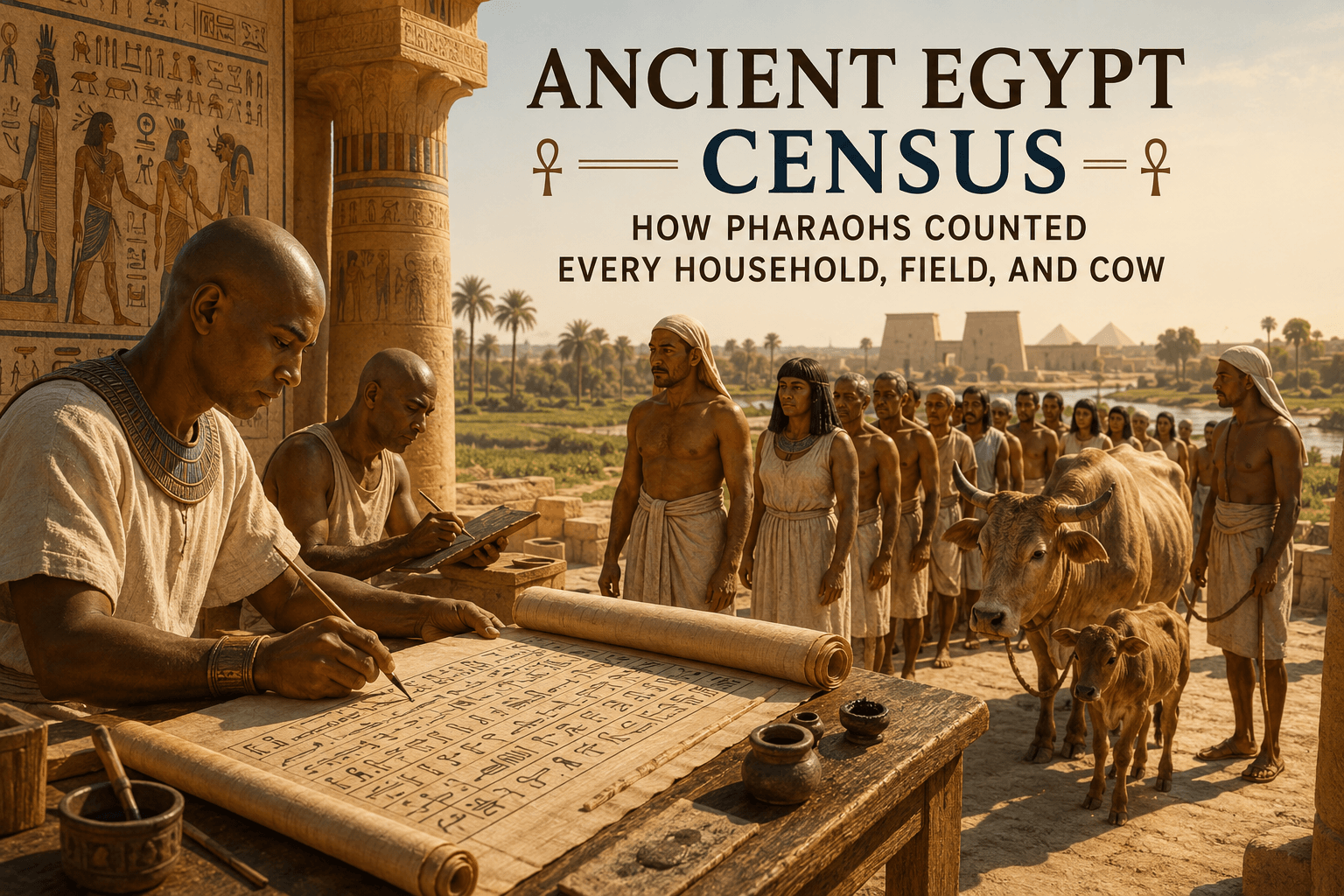
Imagine you’re standing in a limestone courtyard just after sunrise. Two hundred families are already there, lined up in rows that stretch toward the temple gate. Nobody is working today. The fields are empty, the workshops are shut, and the market stalls are closed.
At the front of the courtyard, three shaven-headed men sit at a low wooden table. One of them unrolls a papyrus scroll longer than a man is tall. Another dips a reed brush into black ink.
Then a name is called. A father steps forward and raises his hand.
The brush moves. And with a few strokes of hieratic script, that family’s taxes, labor obligations, and legal standing are set for the coming year.
This was the ancient Egypt census — one of the oldest and most sophisticated administrative systems in human history. Long before Rome, long before any modern government figured out how to track its own population, Egyptian officials were counting people, cattle, grain, and land with a precision that still surprises historians today.
Here’s how it actually worked.
What Was the Ancient Egypt Census?
The ancient Egypt census wasn’t one single event. It was a family of overlapping counting practices that changed shape over three thousand years of Egyptian history.
At its core, the census answered three questions the state needed answered:
- What do we own? Land, cattle, gold, grain reserves.
- Who lives here? Households, their members, their dependents.
- What can we collect? Taxes in grain and goods, plus labor owed to the state.
Unlike a modern census, which is mostly a statistical exercise, the Egyptian version had immediate teeth. The numbers written down became the assessment. If a scribe recorded that your plot produced a certain volume of grain, that was what you owed — regardless of what actually came out of the ground.
Counting, in Egypt, was power.
The Cattle Count: Egypt’s Oldest Counting System

The earliest form of the census has a slightly odd name: the cattle count.
During the Old Kingdom, Egyptian officials conducted a periodic survey of the country’s livestock and other movable wealth. In the earliest periods this appears to have happened every second year, which is why Old Kingdom dates are often recorded in a strange way — not “year 12 of the king,” but “the year of the sixth occurrence of the count.”
This dating system is one of the great headaches of Egyptian chronology. When a monument says “year after the seventh count,” Egyptologists have to work out whether counts were happening every two years, every year, or somewhere in between during that particular reign. The evidence points in different directions for different periods.
The Palermo Stone, a fragmentary set of royal annals carved during the Fifth Dynasty, records these counts alongside Nile flood heights and major royal events. It’s one of the oldest administrative records surviving from anywhere on Earth.
By the Middle and New Kingdoms, counting had become more frequent and more detailed. What began as a livestock tally had grown into something far closer to a full fiscal survey of the country.
What the Census Actually Recorded
Egyptian record-keeping was granular in a way that feels almost modern.
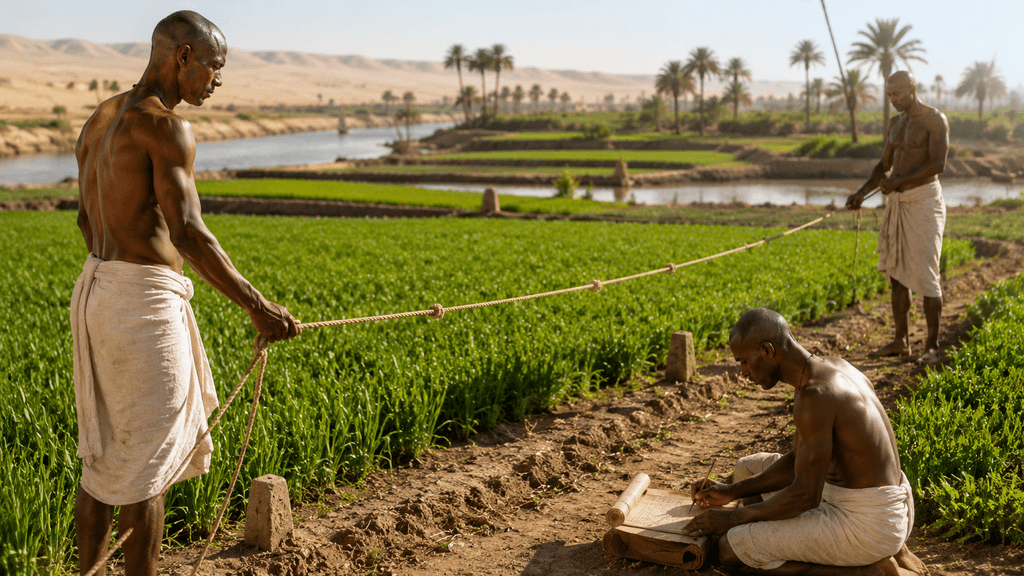
Land. Surveyors measured field boundaries with knotted cords after each annual flood, because the inundation regularly erased property markers. Every plot was assigned a size, an owner or institutional holder, and an expected yield.
Grain. Harvest assessments determined how much a plot owed to the state or temple granary. Officials then tracked what was actually delivered.
Cattle and livestock. Counted, branded, and recorded — tomb paintings from all periods show scenes of herds being driven past seated scribes who tally them on writing boards.
People. Household lists recorded the head of the household, his wife, children, and any dependents, servants, or attached laborers living under the same roof.
Obligations. Perhaps most importantly, the census recorded who owed what to the state — in grain, in goods, and in labor.
If you want the wider picture of how these records fed into the machinery of the state, our guide to ancient Egypt’s government covers the full administrative chain from village official up to the vizier.
The Scribes Who Made It All Possible
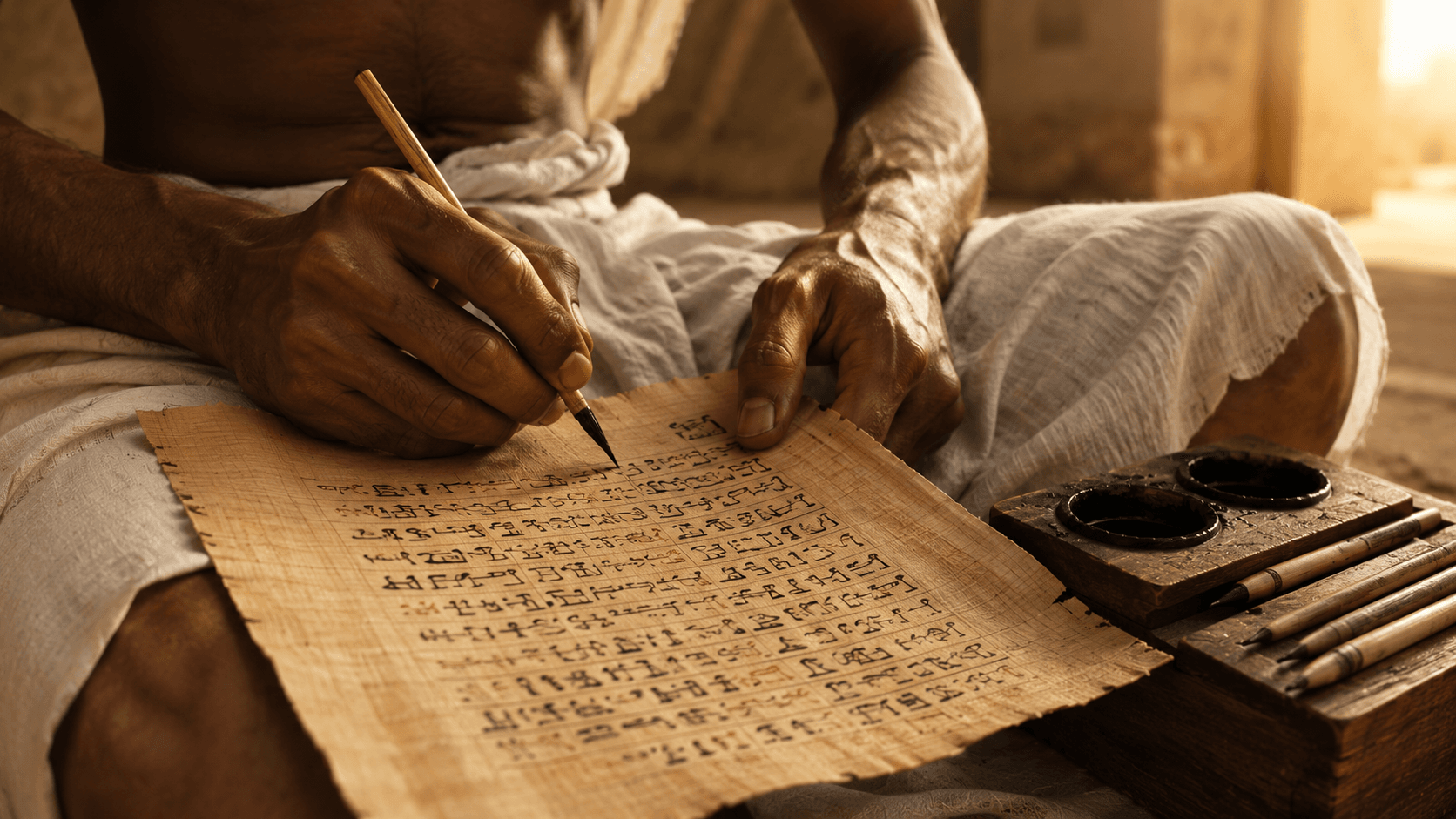
None of this works without scribes.
Literacy in ancient Egypt was rare — most estimates put it at a small single-digit percentage of the population. That scarcity made scribes extraordinarily valuable. A trained scribe didn’t farm, didn’t quarry stone, and didn’t serve in labor gangs. He sat in the shade with a reed brush and recorded other people’s obligations.
Egyptian wisdom texts are almost comically direct about this advantage. The famous Satire of the Trades runs through the misery of every other profession — the potter caked in clay, the fisherman working among crocodiles, the metalworker with fingers like crocodile hide — and concludes that the scribe’s life is better than all of them.
Scribal training was long. Students copied classic texts onto pottery shards and limestone flakes for years, learning hieratic (the cursive script used for administration) before ever touching an official document. They learned arithmetic, fractions, area calculation, and grain volume conversion — the practical mathematics of assessment. University College London’s survey of Egyptian accountancy sources traces this documentary trail period by period, from Old Kingdom temple accounts down to the thousands of ostraca left by New Kingdom workmen.
The tool that made their work possible was papyrus, one of Egypt’s genuinely transformative inventions. You can read about it alongside fourteen others in our piece on ancient Egyptian inventions.
The Wilbour Papyrus: Egypt’s Great Land Survey
If you want to see the Egyptian census in its raw form, the single best surviving document is the Wilbour Papyrus, held at the Brooklyn Museum.
Dated to the reign of Ramesses V in the twelfth century BCE, it’s a land assessment covering a long stretch of Middle Egypt. The main text runs to roughly 4,500 lines across more than a hundred columns, recording thousands of individual plots: the size of each, the institution or person holding it, the cultivator working it, and the grain assessment attached to it. A second text on the reverse lists royal lands organized under the officials responsible for administering them.
What makes it remarkable isn’t drama — there’s none. It’s a tax document. That’s exactly why it matters. It shows a functioning bureaucracy grinding through routine work, plot after plot, with a consistency that implies decades or centuries of institutional practice behind it.
The Wilbour Papyrus also reveals how tangled Egyptian land tenure had become by the late New Kingdom. Temples held enormous holdings. Soldiers, priests, herdsmen, and ordinary women appear as cultivators. The state wasn’t simply taxing farmers — it was managing a complex web of institutional and private claims.
The Nile Set the Numbers
There’s one factor that hovered over every Egyptian assessment: the flood.
Egypt’s agriculture depended entirely on the annual Nile inundation. Too little water and the fields went dry. Too much and villages were destroyed. The height of the flood directly predicted the size of the harvest.
So Egyptians measured it. Nilometers — staircases, wells, or marked columns built into riverbanks at key points — recorded the water level as the flood rose. Officials read the marks and passed the numbers up the chain.
Those readings weren’t a curiosity. They fed into the tax assessment for the year. A strong flood meant a good harvest, which meant higher expected yields and heavier obligations. A weak flood meant reduced assessments — and, in bad years, real famine.
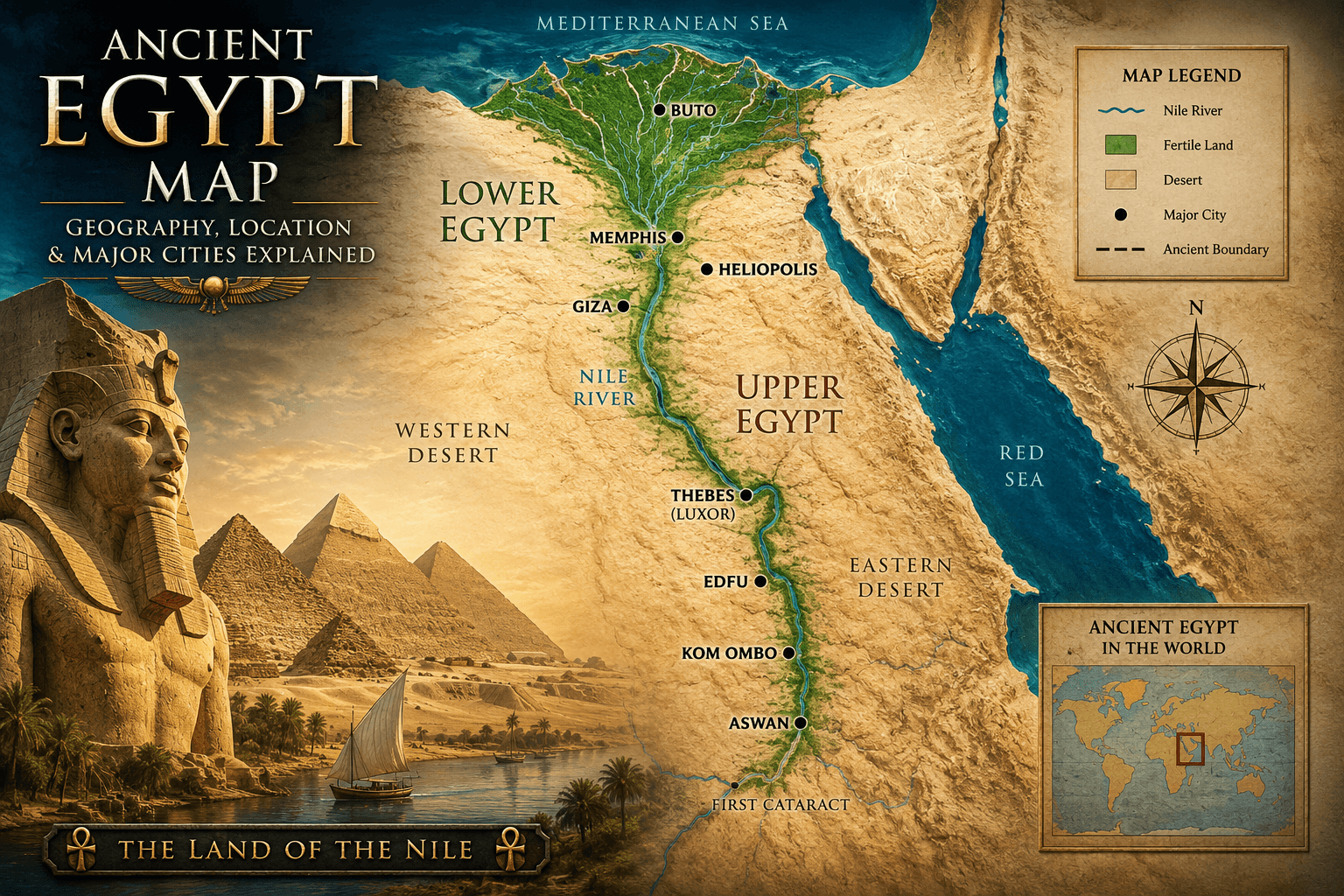
This tied Egyptian administration to the geography of the river in a way no other ancient state quite matched. If you want to see how the Nile shaped everything from settlement patterns to political division, our ancient Egypt map guide lays out Upper and Lower Egypt in detail.
Why Being Counted Actually Mattered
It’s tempting to read the census as pure extraction — the state taking what it wanted. That’s part of the story, but not all of it.
Being on the record gave you standing. Egyptian legal disputes over land, inheritance, and property routinely turned on documentation. Court records show parties producing older survey records to support their claims. A family with no entry in the registers had a much harder time defending what it held.
It defined your labor obligation. Egyptians owed the state periods of work — the system scholars often call corvée labor. Canal maintenance, quarrying, construction, agricultural work on state land. The registers determined who was liable and who was exempt. Certain roles, particularly priestly and scribal positions, carried exemptions that were genuinely valuable.
It connected you to redistribution. Egypt’s granary system was a form of insurance. Grain collected in good years buffered against bad ones. Workers on state projects were paid in rations drawn from those stores. Being inside the system meant access to it.
There was, of course, a darker side. Documents from the New Kingdom record men fleeing to escape labor obligations, and describe punishments for those caught. The famous Papyrus Lansing, a scribal training text, includes a grim account of a tax official arriving in a village with attendants who beat a farmer unable to pay. The text is propaganda for the scribal career, so it lays the cruelty on thick — but it wasn’t describing something unimaginable to its readers.
Household Lists: The Closest Thing to a Modern Census
The documents that look most like a census in the modern sense come from the Middle Kingdom town of Lahun (also called Kahun), a planned settlement built for the workforce attached to a royal pyramid complex and excavated by Flinders Petrie in 1889.
Papyri from the site preserve household declarations that list the head of the household by name and title, then enumerate the people living with him: wife, children, mother, sisters, and attached dependents. Some households are small. Others include long lists of servants.
These are recognizable documents. A modern census official would understand exactly what they’re looking at. They record who lives where, in what relationship, under whose responsibility.
Similar material survives from other sites, including lists of household servants from the Middle Kingdom that record names, origins, and occupations. Together they give us something rare in ancient history: ordinary people, named, in ordinary households.
The Roman Census in Egypt
The story doesn’t end with the pharaohs.
When Egypt became a Roman province, the Romans layered their own census system onto Egypt’s existing administrative infrastructure — and because Egypt’s dry climate preserves papyrus, the result is the best-documented census in the entire ancient world.
Roman Egypt ran a household-by-household census on a fourteen-year cycle, securely attested from the 30s CE through the middle of the third century. An earlier and shorter cycle appears to have operated before that. Every household head was required to file a written declaration listing everyone resident in the property, along with their ages and relationships, and details of the property itself.
Hundreds of these declarations survive. Demographic historians — most influentially Roger Bagnall and Bruce Frier in their study of Roman Egyptian demography — have used them to reconstruct life expectancy, household size, marriage patterns, and family structure with a level of statistical confidence that’s simply impossible for most of the ancient world.
The Roman census was built for taxation — specifically the poll tax levied on adult males. But its survival gives modern scholars an unmatched window into how ordinary people actually lived.
What Egypt’s Census Tells Us
Step back and the picture is striking.
For three thousand years, a state without printing, without mechanical calculation, and with a literate population in the low single digits managed to survey its land, count its herds, register its households, forecast its harvests, and collect from all of it — year after year, dynasty after dynasty, through collapses and reunifications.
That’s not a footnote to Egyptian civilization. It’s the foundation underneath it. The pyramids, the temples, the great building programs — none of them happen without a system capable of identifying resources and moving them where the state wanted them.
The scribe at his table with a reed brush was, in his own way, as important to Egypt as the pharaoh on the throne.
Frequently Asked Questions
Did ancient Egypt have a census? Yes. Egypt conducted systematic counts of cattle, land, grain, and households from the Early Dynastic Period onward. The earliest form, the cattle count, was so central that Old Kingdom years were dated by it. Later periods produced detailed land surveys and household registers.
How often was the ancient Egypt census taken? It varied by period. The Old Kingdom cattle count appears to have been biennial at first, though it became more frequent in some reigns. Land and harvest assessments were tied to the annual Nile flood cycle. Under Roman rule, Egypt ran a household census on a fourteen-year cycle.
What did the ancient Egyptians count in their census? Cattle and livestock, agricultural land and its expected yield, grain deliveries, gold and other valuables, and — in household registers — people, including wives, children, dependents, and servants.
Who carried out the census in ancient Egypt? Scribes, working under officials who reported upward through the provincial administration to the vizier and ultimately the pharaoh. Field surveyors measured land with knotted cords, while scribes recorded assessments on papyrus.
What was the Wilbour Papyrus? A land survey document from the reign of Ramesses V, roughly the twelfth century BCE. It records thousands of individual plots across Middle Egypt with their sizes, holders, cultivators, and grain assessments. It’s the most detailed surviving Egyptian land register.
Why was being counted important in ancient Egypt? Registration established legal standing in property and inheritance disputes, defined a household’s tax and labor obligations, and connected families to the state’s grain redistribution system. Being outside the records meant being outside the system’s protections.
Conclusion
The ancient Egypt census wasn’t a single ceremony. It was a habit — an unbroken institutional reflex that ran for three millennia, adapting through the Old, Middle, and New Kingdoms and surviving into Roman rule.
Its logic was simple and merciless: what can be measured can be taxed, and what can be taxed can build a civilization.
Every pyramid block that moved, every temple that rose, every granary that fed a village through a bad year traces back to a man sitting cross-legged at a low table, unrolling a scroll and writing down a name.
To be counted was to belong.
Explore more: Ancient Egypt Government · Ancient Egypt Map · Ancient Egypt Inventions
6 Comments