
Most Egyptian children worked. They helped in the fields, minded animals, fetched water, carried things in workshops and learned their parents’ trade by doing it. Childhood as a long protected stretch of life is a modern idea.
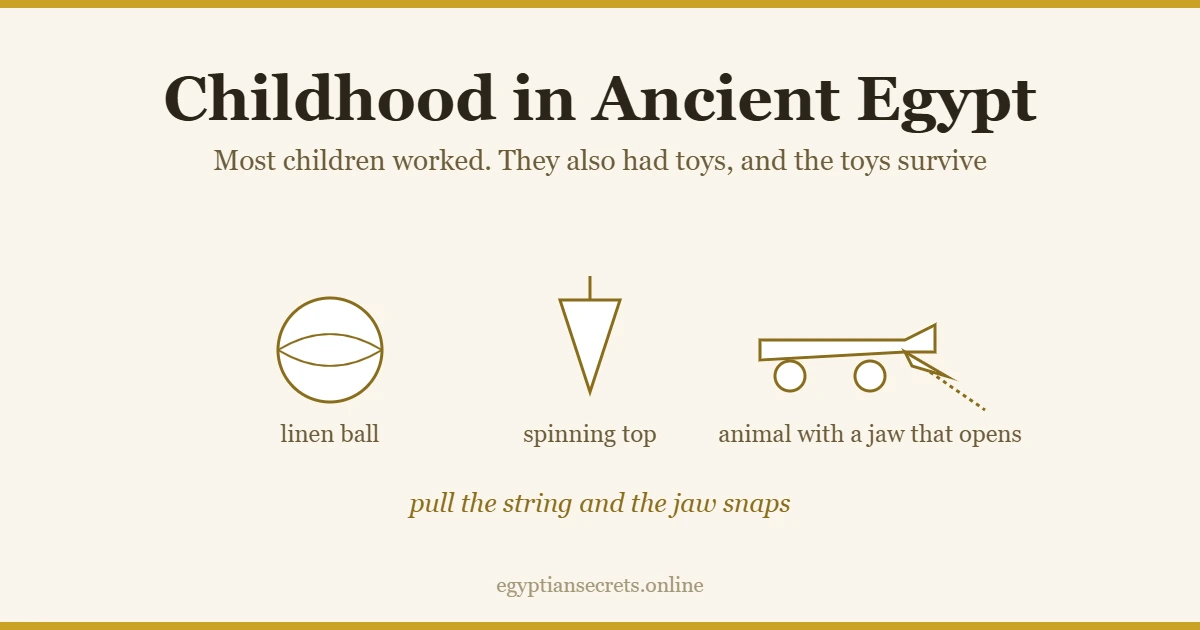
They also played, and we know what with, because the toys survive: wooden animals with jaws that open, balls wound from linen rag, spinning tops, and dolls.
How you can tell a child in Egyptian art
Two signs, and once you know them you see them everywhere.
The side-lock. Children are shown with the head shaved except for a single thick braid hanging over one ear. Adults do not wear it. When a figure has the side-lock, that figure is a child — including gods drawn as children, which is how you recognise the infant Horus.
No clothes. Young children are usually shown naked, whatever the family’s status. In Egypt’s climate that was practical rather than poor. Clothing appears in the images around the age when the side-lock is cut off.
The toys
| Toy | What survives |
|---|---|
| Wooden animals | Cats and crocodiles with hinged lower jaws worked by a string |
| Balls | Wound from strips of linen, or made of leather stuffed with straw |
| Dolls | Flat wooden “paddle dolls” with hair of clay beads; also cloth figures |
| Spinning tops | Turned wood and stone |
| Model boats and tools | Miniatures of adult objects — part toy, part training |
| Board games | Senet and mehen, played by children and adults alike |
Some of these come from tombs, which raises a question worth being careful about: a toy in a grave may have belonged to the child, or may have been made for the burial. Both happened, and it is not always possible to tell which.
The part that is hard to read about
Child mortality was very high. Estimates vary and none are firm, but a large share of children did not reach five. Families were correspondingly large.
This is the context for two things that otherwise look odd. First, the household gods: Bes, the dwarf with the lion’s face, and Taweret, the pregnant hippopotamus, were the most widely worshipped figures in Egypt and had almost no temples. They were for the house, for pregnancy, for childbirth, for the cot — exactly where the danger was.
Second, the amulets. Children were hung with protective charms, and mothers recited spells over them. These were not decoration. They were a response to a real and constant risk.
Growing up, and when
There was no single age of adulthood written into law. The markers were practical: the side-lock cut, work becoming full-time, and marriage, which for girls could come in the early teens and for boys somewhat later.
Marriage itself left almost no ceremony in the record. A couple appear to have become married by setting up a household together. What survives instead are the property arrangements — and those show Egyptian women holding property in their own names, before marriage and after it.
Frequently Asked Questions
Did ancient Egyptian children go to school?
A small minority did. Most children learned their parents’ work by doing it. Formal schooling meant scribal training, which was expensive, mostly for boys, and led to a specific career in the administration or the temples.
What toys did Egyptian children play with?
Wooden animals with moving jaws, linen balls, spinning tops, dolls, and miniature models of adult objects. Board games such as senet were played by children and adults together.
Why are Egyptian children shown with a braid on one side?
It is the side-lock of youth: the head shaved except for one braided lock. It marks the figure as a child, and it is cut off at the approach of adulthood. Gods shown as children wear it too.
Did Egyptian children work?
Yes, most of them, from an early age. They gleaned in the fields after harvest, watched animals, carried and fetched, and learned crafts in family workshops.
Who protected children in Egyptian religion?
Bes and Taweret, above all. Neither had significant temples; both were worshipped at home, in the room where children were born and slept. Amulets of them are among the commonest objects found in Egyptian houses.
At what age did Egyptians become adults?
There was no fixed legal age. Adulthood arrived through practical steps: the side-lock was cut, work became full-time, and a household was set up with a partner.
Related
What was school like in ancient Egypt?
What were ancient Egyptian houses like?
The gods of ancient Egypt
What did ancient Egyptians eat?
Sources
Further reading from museums and academic publishers:
- World History Encyclopedia — “Daily Life in Ancient Egypt“
- Penn Museum — “Egypt” educator guide (PDF)