
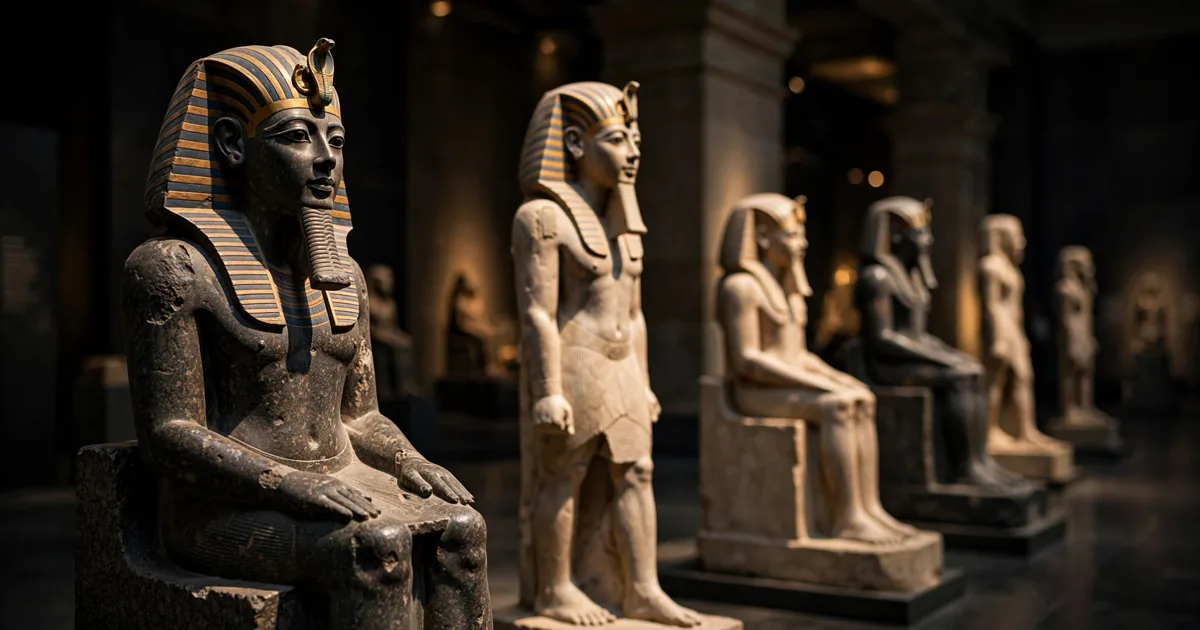
Egypt was ruled by pharaohs for roughly three thousand years — longer than the gap between Cleopatra and the present day. Over 170 rulers are known by name, and many more only from broken king lists.
This is a filterable list of the rulers who matter most: the ones whose reigns are securely attested and whose decisions are still visible in the archaeology. Search by name, dynasty or achievement, or filter by period.
| Pharaoh | Dynasty | Approx. dates BC | Remembered for |
|---|---|---|---|
| EARLY DYNASTIC PERIOD — c. 3100–2686 BC | |||
| Narmer | 1st | c. 3100 | Credited with unifying Upper and Lower Egypt. The Narmer Palette shows him wearing both crowns |
| Hor-Aha | 1st | c. 3080 | Possibly the same figure as Narmer, or his immediate successor |
| Den | 1st | c. 2970 | First ruler shown wearing the double crown and titled King of Upper and Lower Egypt |
| Khasekhemwy | 2nd | c. 2690 | Ended a period of internal conflict. Father of Djoser |
| OLD KINGDOM — c. 2686–2181 BC | |||
| Djoser | 3rd | c. 2670 | Built the Step Pyramid at Saqqara, the first monumental stone structure in Egypt |
| Sneferu | 4th | c. 2613–2589 | Built three pyramids, including the Bent and Red pyramids. Perfected the true pyramid form |
| Khufu | 4th | c. 2589–2566 | Built the Great Pyramid of Giza, the largest ever constructed |
| Djedefre | 4th | c. 2566–2558 | Khufu’s successor. Sometimes proposed as the builder of the Sphinx |
| Khafre | 4th | c. 2558–2532 | Second Giza pyramid. Usually credited with the Great Sphinx |
| Menkaure | 4th | c. 2532–2503 | Third and smallest Giza pyramid. The great age of pyramid building was ending |
| Userkaf | 5th | c. 2494–2487 | Founded the 5th dynasty and the first sun temple |
| Unas | 5th | c. 2375–2345 | First pyramid inscribed with the Pyramid Texts, ancestor of the Book of the Dead |
| Teti | 6th | c. 2345–2333 | Founded the 6th dynasty |
| Pepi I | 6th | c. 2321–2287 | Extensive building and Nubian campaigns |
| Pepi II | 6th | c. 2278–2184 | Traditionally credited with the longest reign in history, though the figure is disputed |
| MIDDLE KINGDOM — c. 2055–1650 BC | |||
| Mentuhotep II | 11th | c. 2055–2004 | Reunified Egypt after the First Intermediate Period |
| Amenemhat I | 12th | c. 1985–1956 | Founded the 12th dynasty. Assassinated, according to a surviving text |
| Senusret I | 12th | c. 1956–1911 | Major temple building at Karnak |
| Senusret III | 12th | c. 1870–1831 | Nubian campaigns and a centralised reform of provincial government |
| Amenemhat III | 12th | c. 1831–1786 | Large-scale irrigation work in the Faiyum |
| Sobekneferu | 12th | c. 1806–1802 | First woman securely attested as pharaoh. Brief reign, ending the dynasty |
| SECOND INTERMEDIATE PERIOD — c. 1650–1550 BC | |||
| Apepi | 15th (Hyksos) | c. 1590–1550 | Hyksos ruler of the Delta during the division of Egypt |
| Seqenenre Tao | 17th | c. 1560 | Died violently. His mummy shows axe and dagger wounds to the skull |
| Kamose | 17th | c. 1555–1550 | Began the campaign to expel the Hyksos |
| NEW KINGDOM — c. 1550–1069 BC | |||
| Ahmose I | 18th | c. 1550–1525 | Expelled the Hyksos and founded the New Kingdom |
| Thutmose I | 18th | c. 1504–1492 | Probably the first king buried in the Valley of the Kings |
| Hatshepsut | 18th | c. 1473–1458 | Ruled as pharaoh for twenty years. Her name was later erased from monuments |
| Thutmose III | 18th | c. 1479–1425 | Egypt’s most successful military campaigner. Ordered Hatshepsut’s erasure |
| Thutmose IV | 18th | c. 1400–1390 | Erected the Dream Stele between the paws of the Sphinx |
| Amenhotep III | 18th | c. 1390–1352 | Reign of exceptional wealth and monumental building |
| Akhenaten | 18th | c. 1352–1336 | Abandoned the traditional gods for the Aten and built a new capital at Amarna |
| Neferneferuaten | 18th | c. 1335 | Ruled as pharaoh. Possibly Nefertiti under a throne name |
| Tutankhamun | 18th | c. 1332–1323 | Reversed Akhenaten’s religion. Famous for his near-intact tomb |
| Horemheb | 18th | c. 1319–1292 | Army general who took the throne and systematically erased the Amarna kings |
| Seti I | 19th | c. 1290–1279 | Built the longest and most finely decorated tomb in the Valley of the Kings |
| Ramesses II | 19th | c. 1279–1213 | Reigned 66 years. Abu Simbel, Kadesh, and more monuments than any other pharaoh |
| Merneptah | 19th | c. 1213–1203 | His victory stele carries the earliest known mention of Israel |
| Tausret | 19th | c. 1191–1189 | Took the throne outright after her stepson’s death |
| Ramesses III | 20th | c. 1186–1155 | Last pharaoh of the great era. Assassinated in a harem conspiracy |
| THIRD INTERMEDIATE PERIOD — c. 1069–664 BC | |||
| Psusennes I | 21st | c. 1047–1001 | Buried at Tanis in a silver coffin, found intact in 1940 |
| Shoshenq I | 22nd | c. 943–922 | Libyan origin. Campaigned in the Levant |
| Piye | 25th | c. 747–714 | Nubian king who conquered Egypt and founded the Kushite dynasty |
| Taharqa | 25th | c. 690–664 | Major builder. Fought Assyrian invasions |
| LATE PERIOD — 664–332 BC | |||
| Psamtik I | 26th | 664–610 | Reunified Egypt and ended Assyrian control |
| Necho II | 26th | 610–595 | Commissioned a canal towards the Red Sea and a reported circumnavigation of Africa |
| Amasis | 26th | 570–526 | Long, prosperous reign. Close trading ties with the Greeks |
| Cambyses II | 27th (Persian) | 525–522 | Persian conquest of Egypt |
| Nectanebo II | 30th | 360–343 | The last native Egyptian pharaoh. Fled the second Persian conquest |
| PTOLEMAIC PERIOD — 332–30 BC | |||
| Alexander the Great | Macedonian | 332–323 | Took Egypt from Persia. Founded Alexandria |
| Ptolemy I Soter | Ptolemaic | 305–282 | One of Alexander’s generals. Founded the dynasty that ruled for three centuries |
| Ptolemy II | Ptolemaic | 284–246 | Expanded the Library of Alexandria |
| Ptolemy V | Ptolemaic | 204–181 | The Rosetta Stone records a decree issued in his reign |
| Cleopatra VII | Ptolemaic | 51–30 | The last pharaoh of Egypt. Macedonian Greek by descent |
A Note on the Dates
Every date above is approximate, and you will find different figures in other sources. That is not carelessness — Egyptian chronology genuinely is uncertain, and the further back you go the wider the margin becomes.
The reason is how Egyptians recorded time. For much of the Old Kingdom they dated events by counting periodic cattle censuses rather than regnal years, and whether those counts happened annually or every second year varies by reign. That single ambiguity can shift a king’s dates by decades, as our article on the ancient Egypt census explains.
For the New Kingdom onward the margins narrow considerably, because astronomical observations and better-preserved records allow cross-checking. Dates for Cleopatra are firm to the year; dates for Narmer are an educated estimate.
Which rulers are included
This list covers securely attested rulers with a meaningful historical footprint. It leaves out the many short-lived or disputed kings of the Intermediate Periods, where rival dynasties ruled simultaneously and the king lists contradict each other.
Four women appear: Sobekneferu, Hatshepsut, Tausret and Cleopatra VII, plus Neferneferuaten, whose identity is disputed. Only Hatshepsut ruled long enough to leave a substantial building record.
Frequently Asked Questions
How many pharaohs ruled ancient Egypt?
Over 170 are known by name across roughly thirty dynasties and three thousand years, though the exact count depends on how you treat rival rulers during the Intermediate Periods, when more than one dynasty held power at the same time.
Who was the first pharaoh of Egypt?
Narmer is usually named as the first, around 3100 BC, credited with uniting Upper and Lower Egypt. Some scholars identify him with Hor-Aha, and the unification was probably a process rather than a single event.
Who was the last pharaoh of Egypt?
Cleopatra VII, who died in 30 BC. The last native Egyptian pharaoh was Nectanebo II, who fled the Persian conquest in 343 BC — Cleopatra’s family was Macedonian Greek.
Which pharaoh ruled the longest?
Pepi II is traditionally credited with 94 years, but that figure is disputed and may be a misreading. The longest reign that is firmly documented is Ramesses II, at 66 years.
Were there female pharaohs?
Yes, though very few. Sobekneferu, Hatshepsut, Tausret and Cleopatra VII all held the title outright, and Neferneferuaten did too, though her identity is debated. Hatshepsut’s twenty-year reign was by far the most substantial.
Why are the dates different in other sources?
Because Egyptian chronology is reconstructed rather than recorded. Old Kingdom dates rest on cattle-count records whose interval is uncertain, so estimates vary by decades. Later periods can be cross-checked against astronomical records and are much firmer.