
In 1378, a Sufi named Muhammad Sa’im al-Dahr came to Giza and found local farmers leaving offerings at the Sphinx in the hope of a better harvest. He considered this idolatry. According to the fifteenth-century historian al-Maqrizi, he damaged the monument’s face — and was executed for it.
That is the earliest surviving account of how the Great Sphinx of Giza lost its nose. It has nothing to do with Napoleon, whose troops did not reach Egypt until 1798 — four centuries later, and sixty years after European travellers had already drawn the Sphinx noseless.
The nose is a small thing. But it is a useful warning about this monument: almost everything widely repeated about the Sphinx deserves checking.
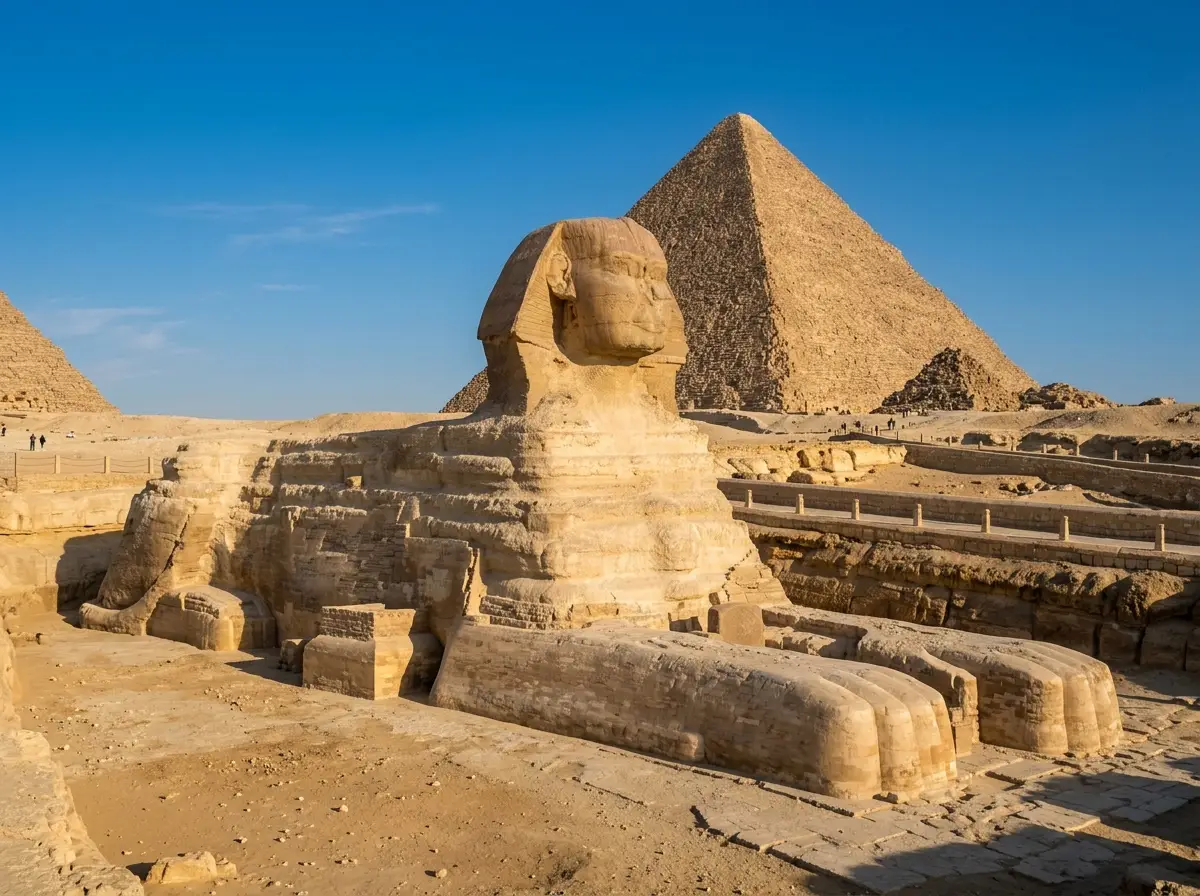
In brief: The Great Sphinx of Giza is a limestone statue roughly 73 metres long and 20 metres high, carved from bedrock on the Giza plateau. Most Egyptologists attribute it to the pharaoh Khafre, around 2500 BC. Its face was damaged in the fourteenth century, not by Napoleon’s army.
What the Sphinx Actually Is
The Great Sphinx of Giza is not built. That distinction matters more than it sounds.
The pyramids beside it were assembled from millions of quarried blocks. The Sphinx was carved down into the plateau — Egyptian workers cut a horseshoe-shaped trench around a mass of natural limestone and shaped what was left standing. The body is largely a single piece of bedrock. Only the paws and some later repairs use added masonry.
It measures roughly 73 metres from paw to tail and stands about 20 metres high, which makes it one of the largest single-stone sculptures anywhere in the world.
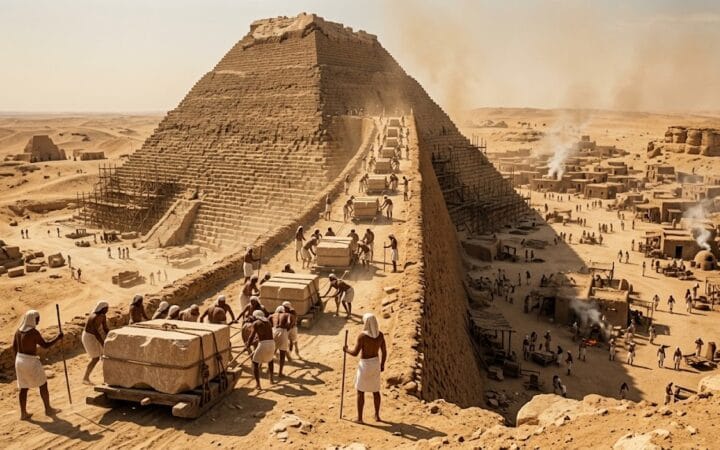
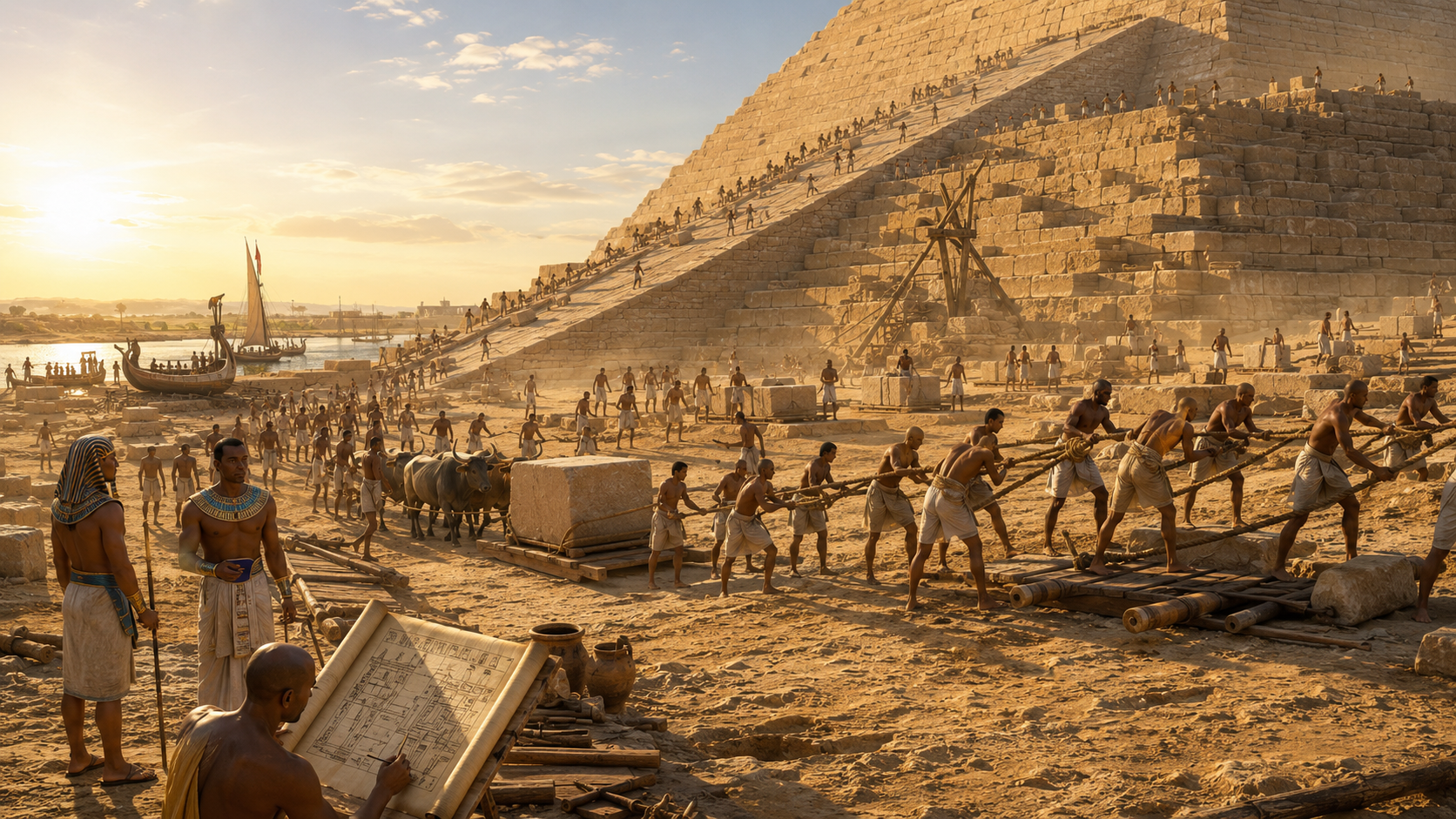
The form is a recumbent lion with a human head wearing the royal nemes headdress. That combination is not decorative. A lion signalled power and guardianship; a royal head signalled who was doing the guarding. The Sphinx faces due east, toward the sunrise, and sits at the eastern edge of the plateau where the pyramid complexes were built — a placement discussed further in our article on how the pyramids were built.
The limestone is not uniform
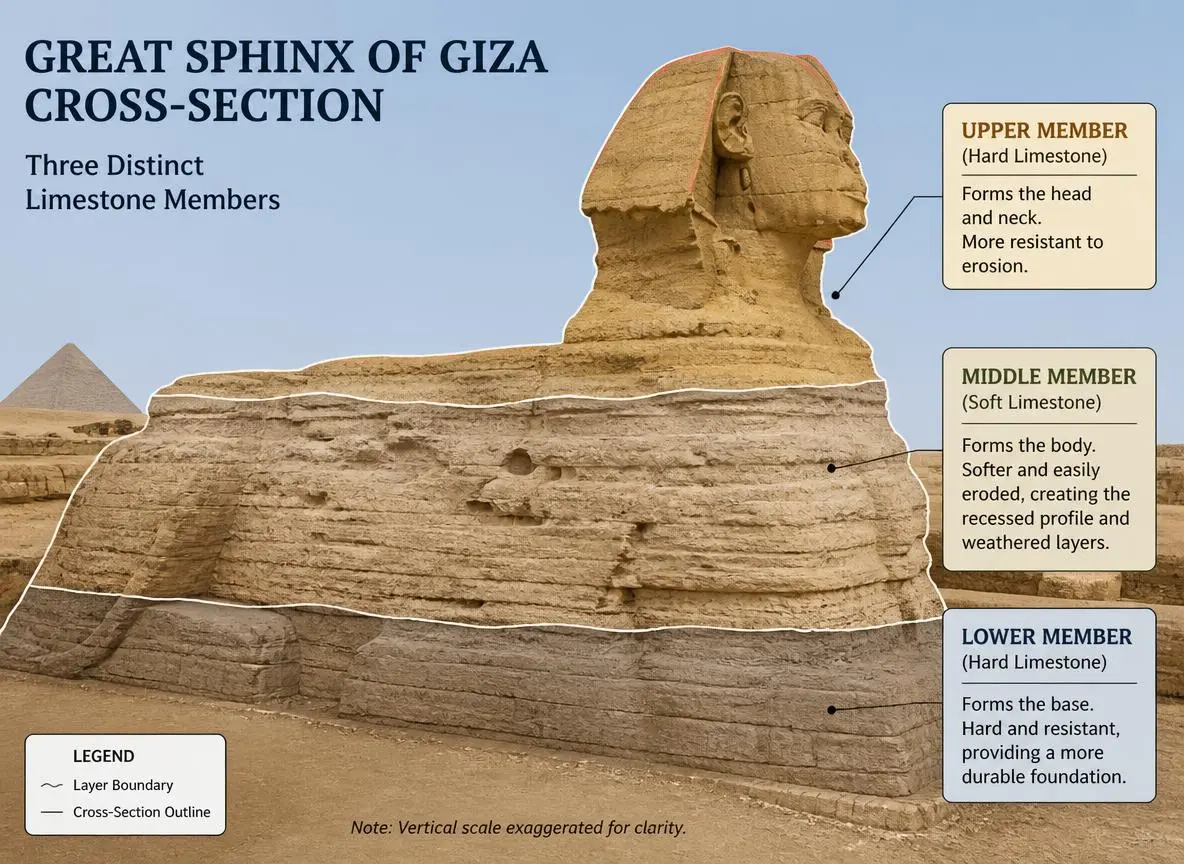
The rock the Sphinx was cut from consists of layers of very different hardness. The lowest layer is hard. The middle layers, which form most of the body, are soft and crumble readily. The topmost layer, which forms the head, is harder again.
This single geological fact explains a great deal — why the head survives in far better condition than the body, why the body has needed repair since antiquity, and, as we will see, why one recent study argues the shape may not have started as a human idea at all.
Who Built the Great Sphinx of Giza?
Here is something most articles skip: no ancient inscription identifies who commissioned the Sphinx. Not one.
The attribution to Khafre, fourth-dynasty pharaoh and builder of the second Giza pyramid, rests entirely on circumstantial evidence. It is good circumstantial evidence, and most Egyptologists accept it, but it is not a signature.
The case for Khafre
Several strands point the same way. The Sphinx sits directly beside Khafre’s causeway, and the two are architecturally integrated rather than merely adjacent. The Sphinx Temple immediately in front of it was built from blocks apparently quarried out of the very trench that freed the statue, tying the two operations together. The face wears royal regalia consistent with fourth-dynasty style.
Taken together this places the monument at roughly 2500 BC — the same window as the pyramids beside it, whose construction timeline is examined separately.
The dissenting views
Two other candidates have serious academic backing. The German Egyptologist Rainer Stadelmann argued the face more closely resembles Khufu, Khafre’s father, and that the Sphinx therefore belongs to the earlier reign. Others have proposed Djedefre, Khafre’s half-brother, as a monument to their father.
Separately, the British geologist Colin Reader has argued from weathering patterns that the excavation of the Sphinx enclosure predates the fourth-dynasty pyramids — placing it earlier in the Pharaonic period, though still firmly within it. Mark Lehner and Zahi Hawass, the two archaeologists who have worked most extensively at the site, reject that reading.
These are genuine scholarly disagreements about a few decades or centuries. They are a different category from claims that the Sphinx is ten thousand years old, which we return to below.
Did the Wind Start the Job?
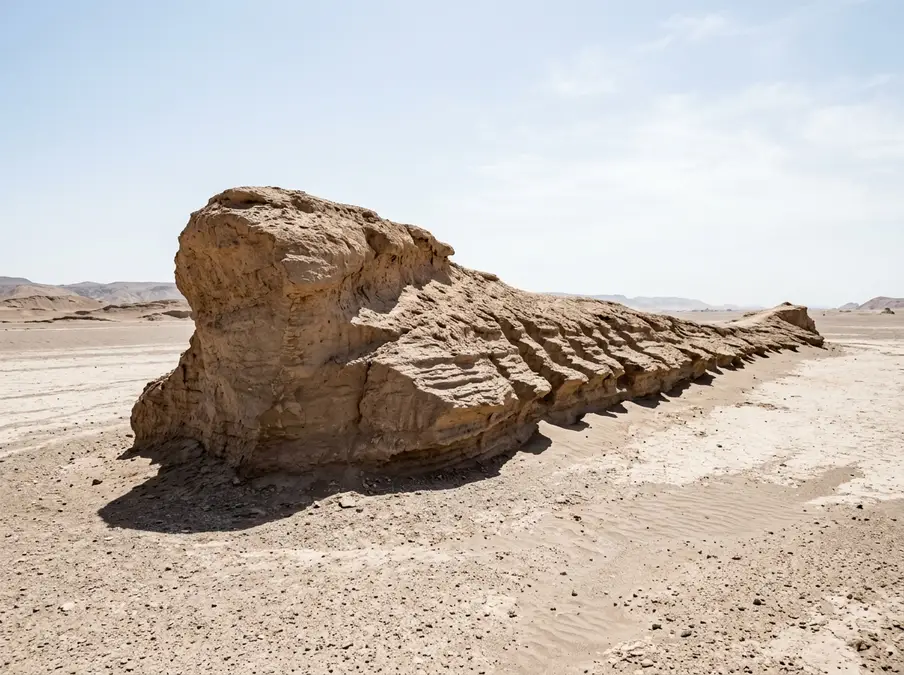
In October 2023, a team at New York University’s Applied Mathematics Laboratory published a result that got reported almost everywhere — and misreported in most places.
Leif Ristroph, Samuel Boury and Scott Weady were not studying the Sphinx. They were studying yardangs — elongated ridges that desert winds carve out of rock, which sometimes end up looking uncannily like crouching animals.
Their experiment was simple. They took mounds of soft clay, embedded a harder cylinder near the top, and ran fast-flowing water over them to stand in for decades of wind. A 3D scanner tracked the changes.
What emerged surprised them. Once erosion exposed the hard cylinder, it acted as a wind shadow, shielding the material behind it. The flow carved a neck, an arched back and forward-projecting paws from the clay around it. The cylinder became a head.
The shape was recognisably sphinx-like. The study was published in Physical Review Fluids.
What the study does and does not claim
This is where the reporting went astray, so it is worth being precise.
The finding is that a lion-shaped landform can arise naturally from erosion, given uneven rock and a steady prevailing wind. Giza has both. The Sphinx also faces into the prevailing wind direction, which is consistent with the idea.
Ristroph has been explicit that the detailed work is human. In his words there is no doubt the facial features were carved by people. The archaeologist Kathryn Bard has pointed out that the front paws are added masonry regardless — nature did not supply those.
The Cambridge geoarchaeologist Judith Bunbury described the experiment as a useful model for how such a landform could come to resemble a sphinx, rather than proof that this one did.
The idea itself is older than the experiment. The geologist Farouk El-Baz proposed in 1981 that the Sphinx began as a natural yardang, and fieldwork by Émile Baraize in the 1930s had already suggested the monument sits on more than one such formation. The NYU work gives that hypothesis a physical mechanism it previously lacked.
My own reading is that this is the most interesting Sphinx research in years precisely because it is modest. It does not claim to solve anything. It shows that a step everyone assumed was human might not have been.
The Great Sphinx of Giza Spent Most of History Buried
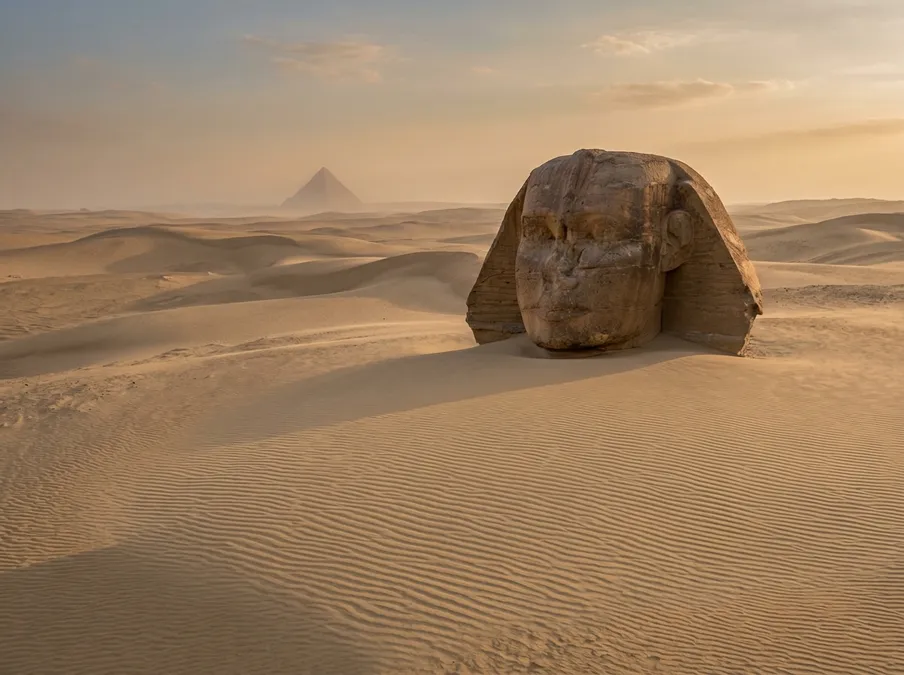
The image everyone carries — a lion sitting proud above the sand — is historically unusual. For most of the past 4,500 years the Great Sphinx of Giza was buried to the neck.
The enclosure it sits in acts as a sand trap. Left alone, it fills within a few decades. Every era that wanted to see the Sphinx had to dig it out again.
Between its paws stands a granite slab known as the Dream Stele, erected by Thutmose IV around 1400 BC — a thousand years after the monument was carved. Its inscription describes the young prince falling asleep in the Sphinx’s shadow and dreaming that the god spoke to him, promising the throne if he cleared away the sand. The stele is carved in Egyptian hieroglyphs, and remains readable today.
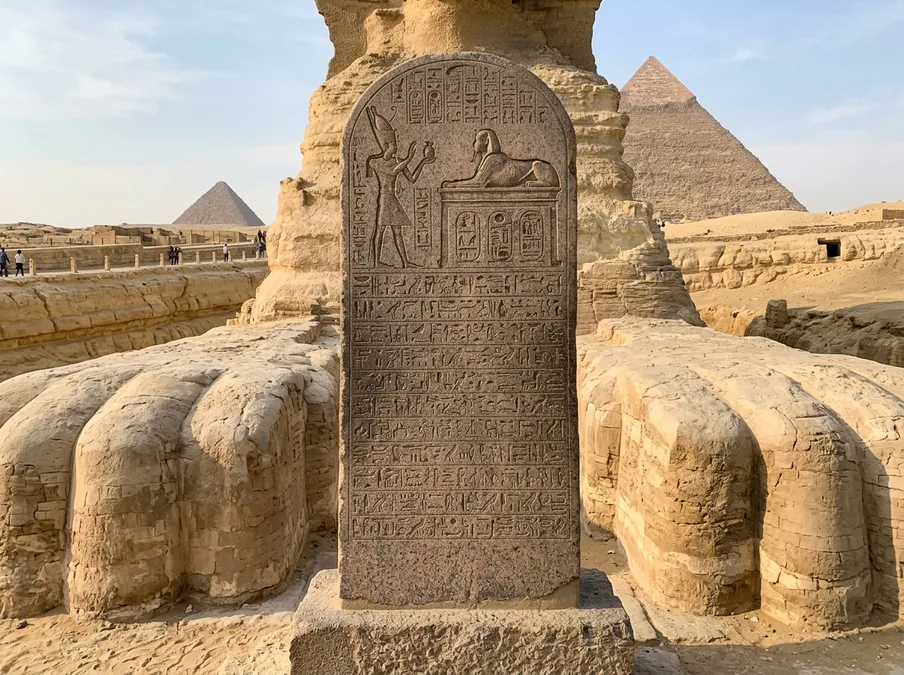
Whether the dream happened is beside the point. What the stele records is that by 1400 BC the Sphinx was already ancient, already buried, and already understood as divine rather than merely royal.
The New Kingdom knew it as Horemakhet, “Horus in the Horizon” — a god in its own right, with its own priesthood and offerings. Our guide to the ancient Egyptian gods covers how a monument could be absorbed into the pantheon this way.
Full excavation did not happen until the twentieth century.
The Missing Nose and the Missing Beard
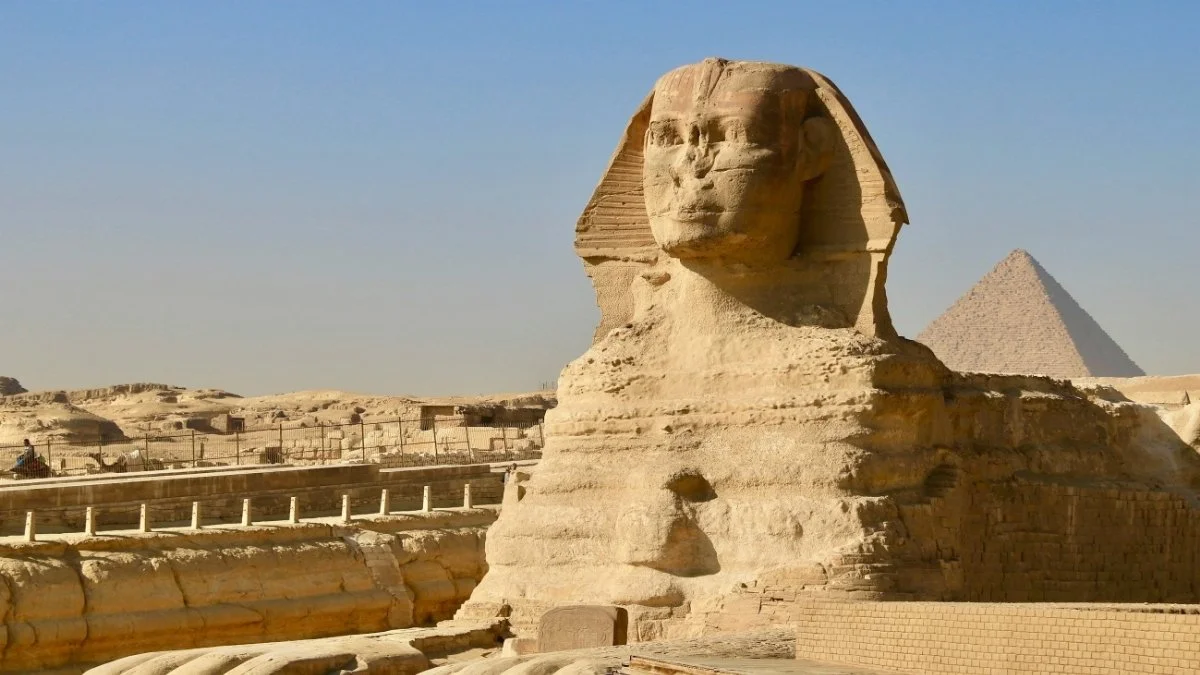
The Napoleon story is the most persistent myth attached to the Great Sphinx of Giza, and it is straightforwardly false.
The Danish traveller Frederic Louis Norden sketched the Sphinx in 1737 and drew it without a nose. Those drawings were published before Napoleon was born. Al-Maqrizi’s account of the fourteenth-century destruction predates them by centuries.
Examination of the face supports deliberate damage rather than erosion or cannon fire: chisel marks are visible where rods appear to have been driven in to lever the nose off.
The beard is a separate matter and a more interesting one. Fragments of a plaited royal beard were recovered near the Sphinx and are now split between the British Museum and the Egyptian Museum in Cairo. Most specialists think the beard was a later addition — probably New Kingdom, not original to the carving — which would make its absence historically correct rather than damage.
The Ten-Thousand-Year Claim
Search for the Sphinx online and you will meet the argument that vertical weathering on the enclosure walls was caused by heavy rainfall, that such rainfall last occurred thousands of years before the pharaohs, and that the monument must therefore date to roughly 10,500 BC.
This is worth addressing directly rather than ignoring.
Mainstream Egyptology and geology reject it, for reasons that are practical rather than dogmatic. The middle limestone layers weather severely from salt crystallisation and wind alone — the same process that has required repeated repair since antiquity. Weathering rates in that rock are not uniform enough to work as a clock.
The larger problem is archaeological. A society capable of carving a 73-metre monument would have left settlements, tools, pottery, burials and waste. At Giza, that material record exists in quantity — and it belongs to the fourth dynasty. For the earlier date, it is absent entirely.
Colin Reader’s geological argument, mentioned earlier, is a different thing and should not be lumped in with this. He proposes a shift of centuries within the Pharaonic period, based on published fieldwork, and he engages directly with his critics. Disagreeing with Lehner and Hawass is not the same as proposing a lost civilisation.
What We Know and What We Don’t
Established by evidence
- The body is carved from bedrock in place, not assembled from blocks
- It measures roughly 73 metres long and 20 metres high
- The Sphinx Temple in front of it uses blocks from the same excavation
- The monument was buried in sand for most of its history and cleared repeatedly
- Thutmose IV erected the Dream Stele between its paws around 1400 BC
- By the New Kingdom it was worshipped as the god Horemakhet
- The nose was deliberately removed, and before 1737
Still unresolved
- Which pharaoh commissioned it — no inscription names one
- Whether the face portrays Khafre, Khufu, or an idealised king
- Whether the shape began as a natural yardang
- The monument’s original name; Egyptians did not call it a sphinx
- Whether any chambers exist beneath it — surveys have found anomalies, none confirmed as constructed
Frequently Asked Questions
Who built the Great Sphinx of Giza?
Most Egyptologists attribute it to Khafre, around 2500 BC, based on its integration with his causeway and the shared quarrying of the Sphinx Temple. No inscription names a builder, so the attribution is circumstantial. Rainer Stadelmann argued for Khufu instead, and Djedefre has also been proposed.
How old is the Great Sphinx?
Roughly 4,500 years, placing it in Egypt’s fourth dynasty. Claims that it dates to 10,500 BC rest on weathering interpretation and are rejected by mainstream Egyptology, mainly because no archaeological material of that age exists at Giza.
Did Napoleon’s soldiers shoot off the Sphinx’s nose?
No. Frederic Louis Norden drew the Sphinx without a nose in 1737, sixty years before Napoleon reached Egypt. The historian al-Maqrizi recorded that a man named Muhammad Sa’im al-Dahr damaged the face in 1378 and was executed for it.
Was the Sphinx shaped by wind before humans carved it?
Possibly. A 2023 study at New York University showed that lion-shaped landforms called yardangs can form naturally from wind erosion where hard and soft rock sit together. The researchers stress that the face and detail work were carved by people, and that the front paws are added masonry.
How big is the Great Sphinx of Giza?
About 73 metres long from paw to tail and roughly 20 metres high, which makes it one of the largest sculptures ever carved from a single mass of stone.
Are there hidden chambers under the Sphinx?
Surveys have detected subsurface anomalies, but none has been confirmed as a constructed chamber. Natural cavities are common in this limestone. No excavation has produced a hidden room.
Conclusion
The Great Sphinx of Giza is unusual among famous monuments in how little it tells us directly. No builder’s name. No original name. No foundation text.
What it has instead is context — a causeway, a temple, a quarry trench, a plateau full of fourth-dynasty evidence, and a thousand years later a young king who thought it was worth digging out of the sand.
That is usually how ancient history works. The certainty people expect from a monument this famous is rarely what the evidence provides.
Sources and Further Reading
- Ristroph, L., Boury, S. and Weady, S. — study on yardang formation, Physical Review Fluids, October 2023. Summarised by Scientific American and Physics World.
- Smithsonian Magazine — coverage of the NYU experiment, including researcher comment on which features were human-carved.
- Lehner, M. and Hawass, Z., Giza and the Pyramids (2017) — the standard archaeological account of the plateau.
- Reader, C. — published geological work arguing for an earlier excavation date, and the responses to it.