
A New Crocodile Was Just Found Inside the Great Pyramid’s Stone
Here is a sentence I never expected to type: scientists have named a brand-new species of extinct crocodile after an Egyptian god — because the very rock that built the Great Sphinx and the pyramids of Giza preserved it.
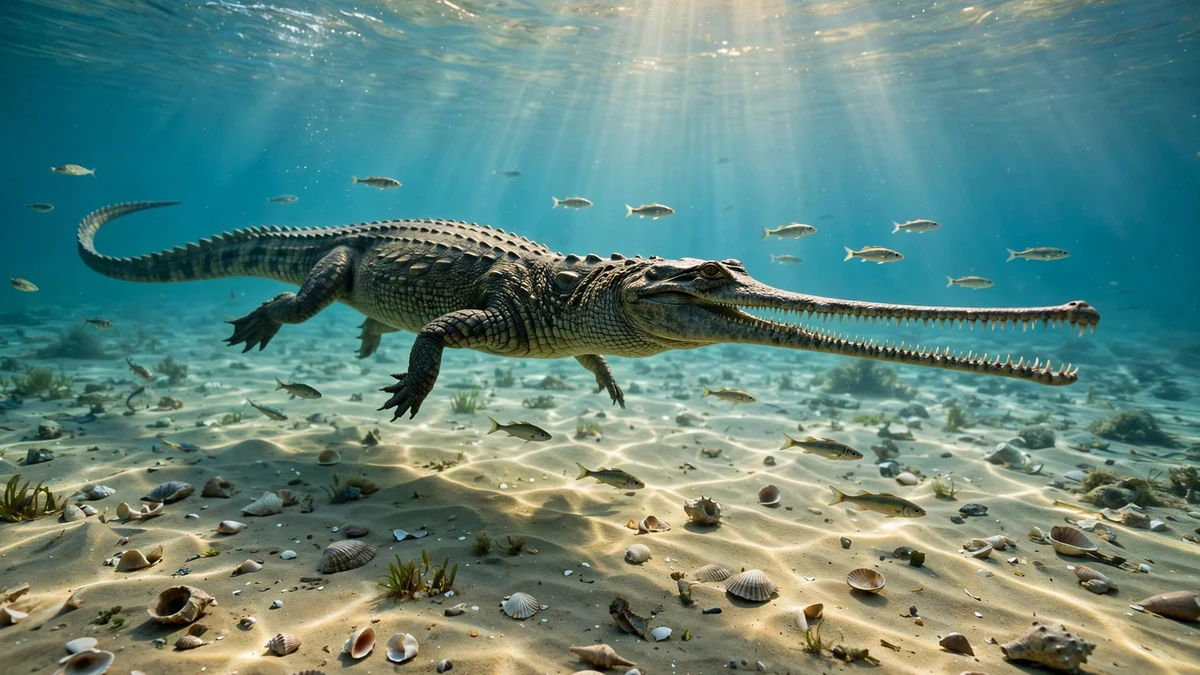
The study landed this week (October 7, 2026) in Royal Society Open Science. Workers dug up a nearly complete skull near Cairo in the 1920s, and it sat mislabeled for a century. Then re-examination showed it was an unknown species of gavial, a long-snouted croc. They named it Herugavialis cairensis after Heru (Horus), the Egyptian god.
And the detail that made me grin: the fossil skull lost the tip of its snout. Just like the Sphinx lost its nose.
But here’s the bigger story — the one this fossil forces you to notice. The rock of Giza is about 45 million years old. It formed as the floor of an ancient sea, and it still holds the fossils of creatures that swam there long before Egypt existed. So what is the Great Pyramid made of, exactly? In the most literal sense: fossils. Millions of them. The most famous building on Earth rises from the bones of an ocean.
✍️ Write YOUR Name in Real Hieroglyphics
See how the ancient Egyptians would have written your name — free hands-on tool.
Try It Now →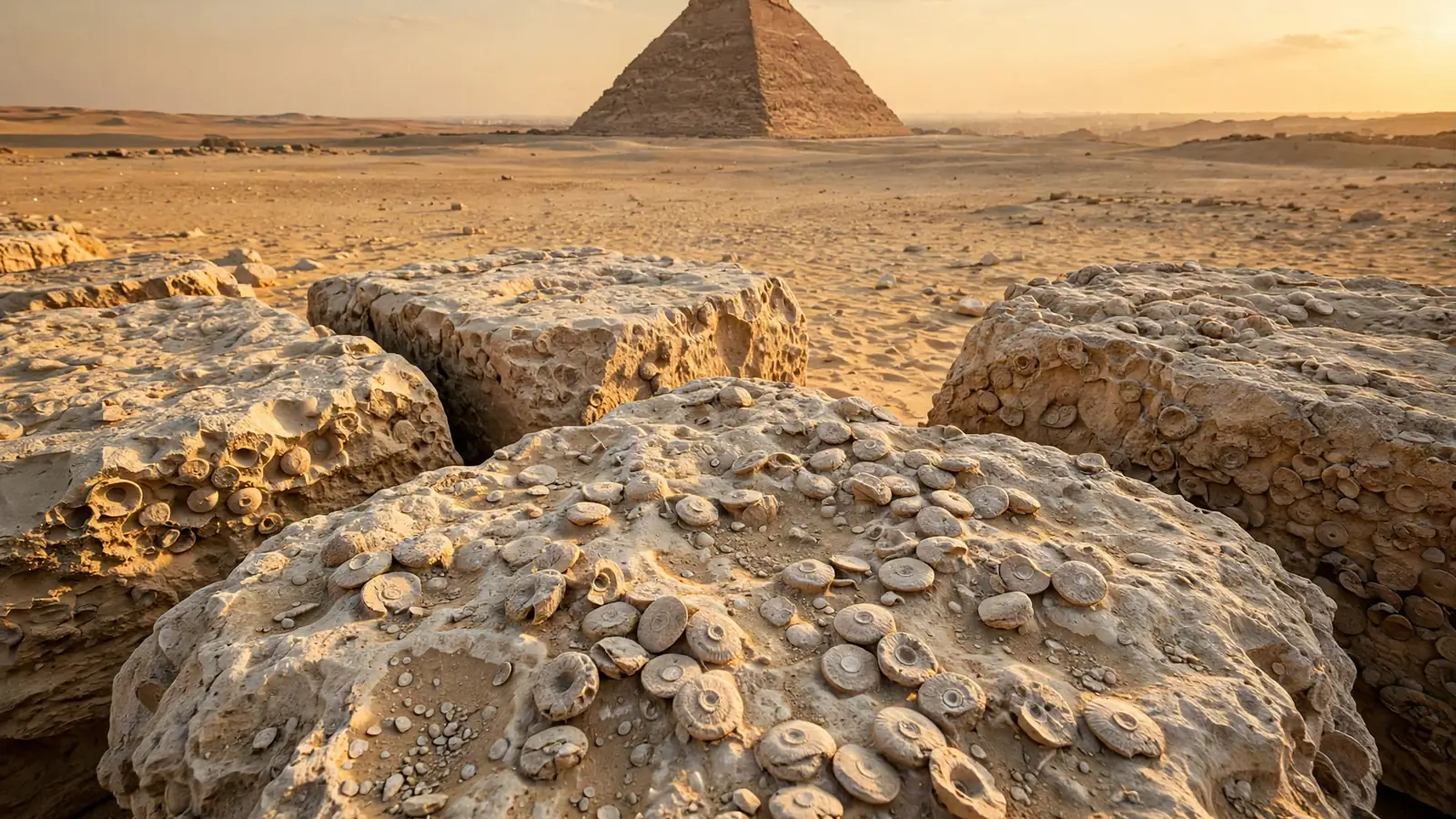
Quick Facts: What Is the Great Pyramid Made Of?
- Core blocks: Locally quarried nummulitic limestone from the Giza plateau (~2.3 million blocks)
- Stone’s age: ~45 million years — Eocene Mokattam Formation, laid down as an ancient seabed
- Casing: Fine white Tura limestone (mostly stripped away centuries ago)
- Burial chambers: Red granite hauled from Aswan, ~800 km south
- Hidden in the rock: Fossil shells, shark teeth — and, as of this week, a brand-new extinct crocodile species
- Still being discovered: Cosmic-ray scans found unknown voids in 2017 and 2023
The Stone Is Older Than Egypt — Older Than Humanity
Let’s get the timeline right. The Great Pyramid is about 4,500 years old, but its stone is about 45 million years old. That’s ten thousand times older. When that rock formed, no pyramids, pharaohs, or humans had appeared yet. A warm, shallow sea covered what is now northern Egypt, and fish, sharks, early whales, and crocs swam in it.
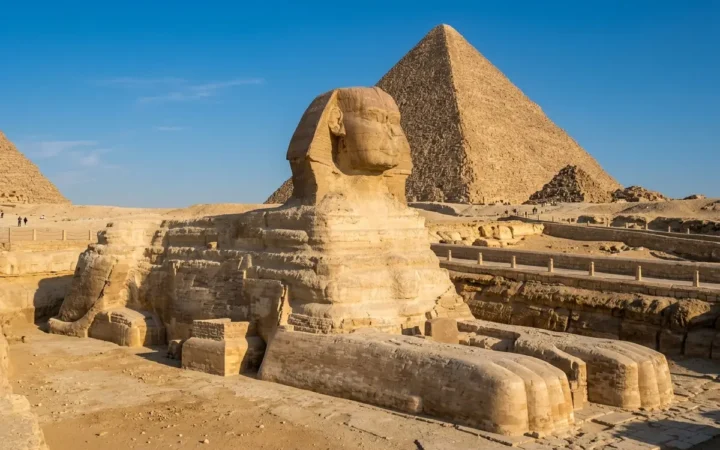
Geologists call this rock the Mokattam Formation, and it doesn’t just lie under Giza — it is Giza. Workers carved the Sphinx directly out of it, and the pyramid builders quarried their core blocks from the plateau right around the pyramid. The monument and its mountain are the same stuff.
That rock is still giving up secrets. Herugavialis cairensis lived about 45 million years ago in those waters. It belonged to one of six gavial species that lived in the Mediterranean between roughly 66 and 23 million years ago, when the region hosted a remarkable variety of crocodiles. Then, around 6 million years ago, the Mediterranean dried up, and its crocodiles vanished.
Then fast-forward 40-odd million years: Egyptians quarry the same limestone, haul it into the desert, and stack it into the tallest building on Earth for the next 3,800 years. The crocodile’s rock becomes the pharaoh’s pyramid. If that doesn’t give you goosebumps, check your pulse.
What Is the Great Pyramid Made Of? Fossils — Millions of Them
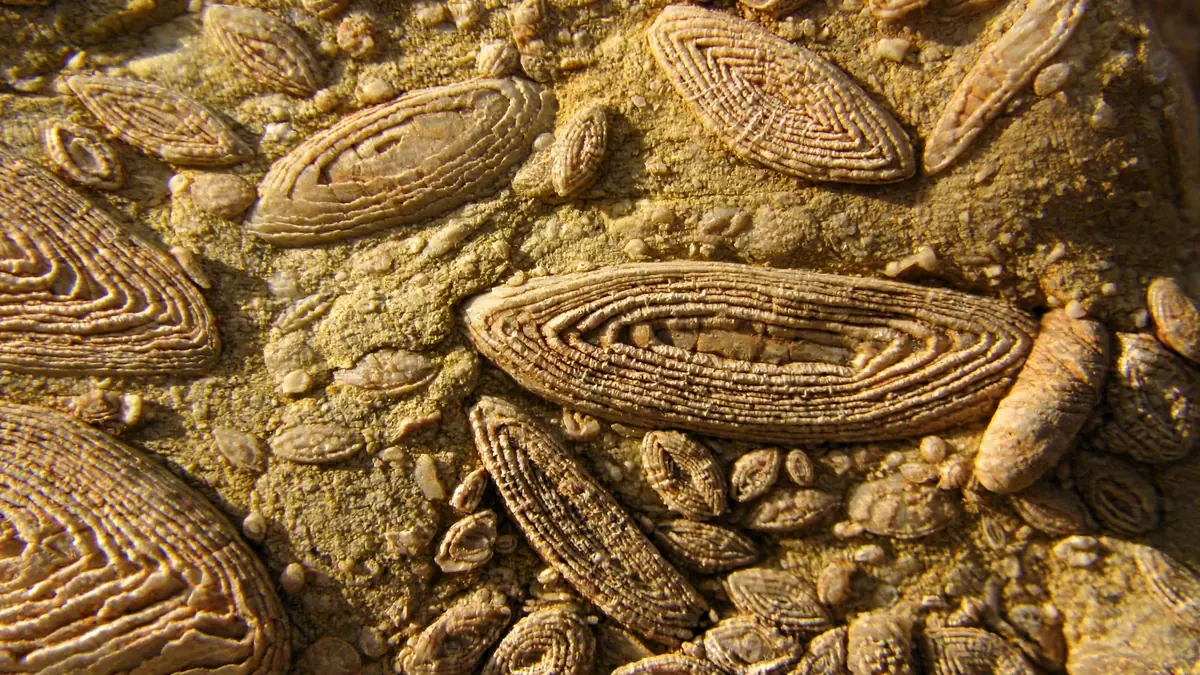
The textbook answer to what the Great Pyramid is made of is “limestone.” True, but boring. The interesting answer: nummulitic limestone — rock so stuffed with fossils of a tiny coin-shaped sea creature, Nummulites, that you can spot them with the naked eye. These little shells — some the size of lentils, some as big as coins — are 45-million-year-old marine life preserved in building stone.
The Giza species even has its own name: Nummulites gizehensis — literally “the Giza nummulite.” It got that name for this locale back in 1775, before anyone knew most of the pyramid’s human history.
What’s more, around the pyramid you can still find loose nummulites crumbling out of the rock, plus the odd shark’s tooth. Once upon a time, the sea rolled over the desert of Giza — and builders mortared the proof into the most famous tomb on the planet.
Strabo and the “Petrified Lentils” of Giza
The Greek writer Strabo visited the pyramids around 25 BCE and noticed something odd: stone chips scattered in front of them that looked “like lentils in both form and size.” The locals had a wonderful story — the lentil-shaped chips were the workmen’s leftover food, turned to stone over the ages.
Strabo wasn’t buying it. He’d seen lentil-shaped stones elsewhere and knew they were a natural puzzle, not stone lunches. What he was looking at was Nummulites gizehensis crumbling out of the pyramid limestone — quite possibly the first written account of this kind of fossil in history.
Fun footnote for curious readers: people often credit this story to Herodotus. That’s a myth, however — recent research pins the first clear account squarely on Strabo. Even the anecdotes about the pyramid’s stones have their own history.
What Is the Great Pyramid Made Of? Quarried Limestone, White Casing, and Aswan Granite
So let’s break the pyramid down layer by layer, because it wasn’t one material — it was a supply chain stretching hundreds of kilometers.
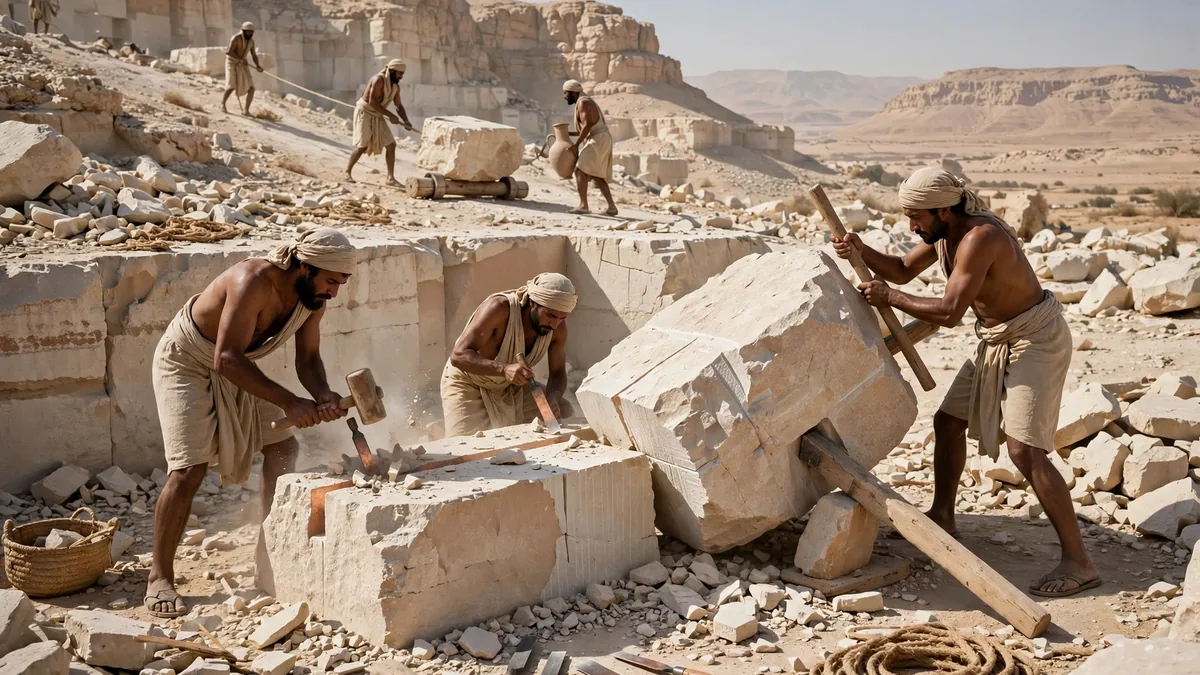
The core — the bulk of those ~2.3 million blocks — came from quarries on the Giza plateau itself, almost next door. Workers cut the rough, yellowish nummulitic limestone with copper tools and dolerite pounders and hauled it into place. This is the fossil-packed stone we’ve been talking about, and it’s what you see today: the stepped, weathered frame of the pyramid.
The casing was a different beast. For the smooth outer skin, builders used fine white limestone from Tura, on the Nile’s east bank south of modern Cairo. As a result, this denser, paler stone — almost like marble — made the finished pyramid blaze white in the desert sun. Builders may have capped it with a gilded capstone. In the Middle Ages, people stripped most of it away for Cairo’s mosques and walls. What remains clings to the pyramid’s base in a few places.
The King’s Chamber uses red Aswan granite. Workers quarried it some 800 km south and shipped it down the Nile. Nine enormous slabs, some weighing up to 80 tons, form the burial chamber and the five stress-relieving chambers above it. Think about what that took: dragging 80-ton granite beams the length of Egypt, then lifting them 50 meters into the air, 4,500 years ago. “Ancient” does not mean “primitive.”
What the Finished Pyramid Looked Like
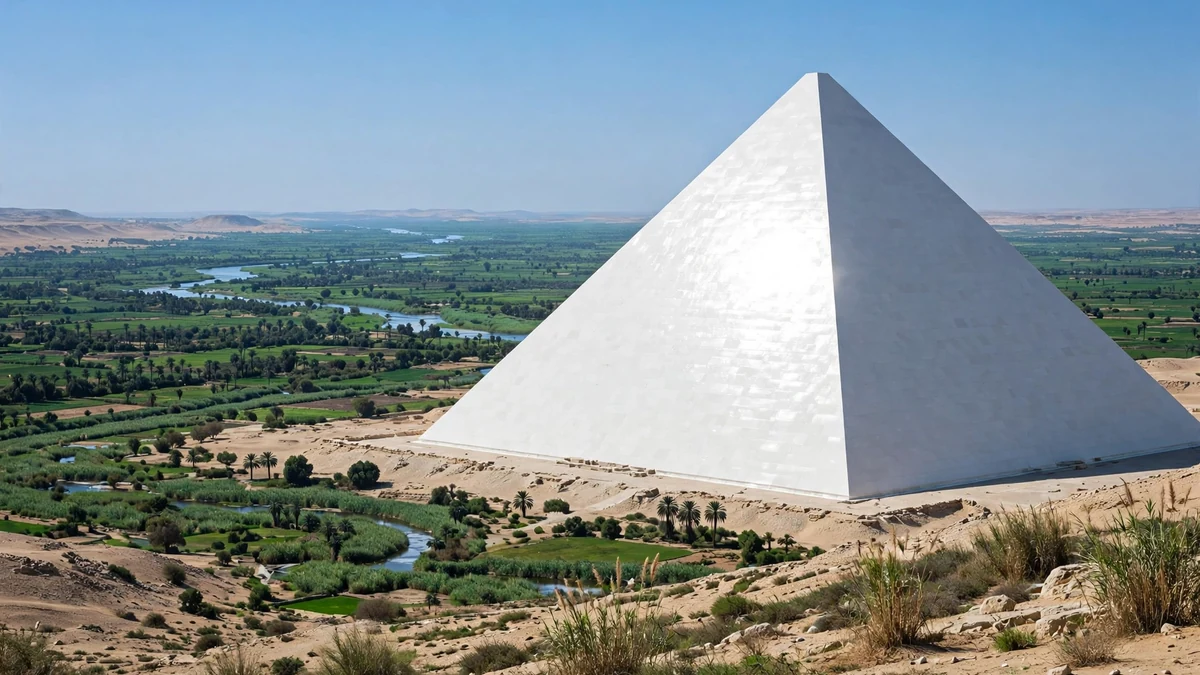
Picture the finished product: fresh out of the 26th century BCE, the Great Pyramid was a smooth, white, mirror-flashing mountain 146.6 meters tall — the tallest human-made structure in the world, a record it held for more than 3,800 years.
Workers cut the Tura casing stones to fit with joints so tight they say you couldn’t slide a knife blade between them. To an Egyptian farmer on the Nile, it must have looked less like a tomb and more like a second sun had landed in the desert.
Then came centuries of quakes and later stone-robbers, and the white skin came off. What’s left is the fossil-rich core — which might be the more interesting part. The casing was beautiful. The core is a 45-million-year-old seabed.
Hidden Voids: What Cosmic Rays Found Inside the Great Pyramid
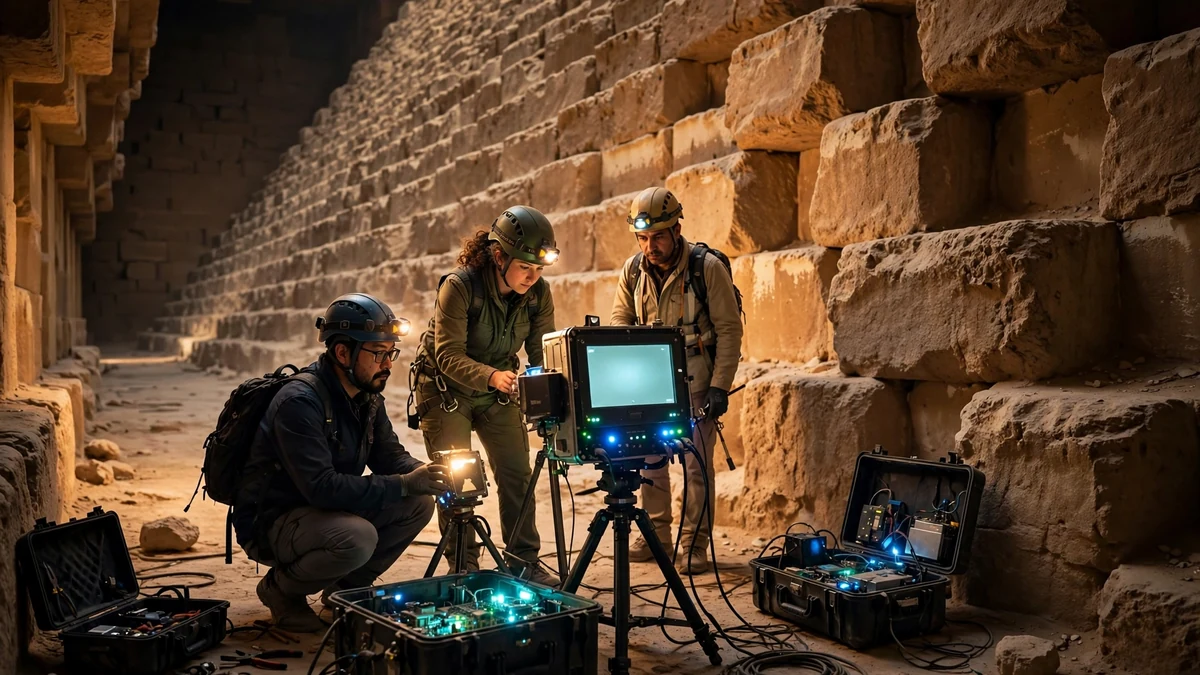
As if fossils weren’t enough, the pyramid is still hiding things. Since 2015, the global ScanPyramids team has peered through millions of tons of solid limestone without moving a single stone. It uses cosmic-ray muons — the same cosmic rays raining down on you right now — to X-ray the pyramid from the inside out.
In 2017 came the bombshell: three detector setups each found a void at least 30 meters long above the Grand Gallery. The team refused to call it a chamber — just the Big Void — and its purpose remains unknown.
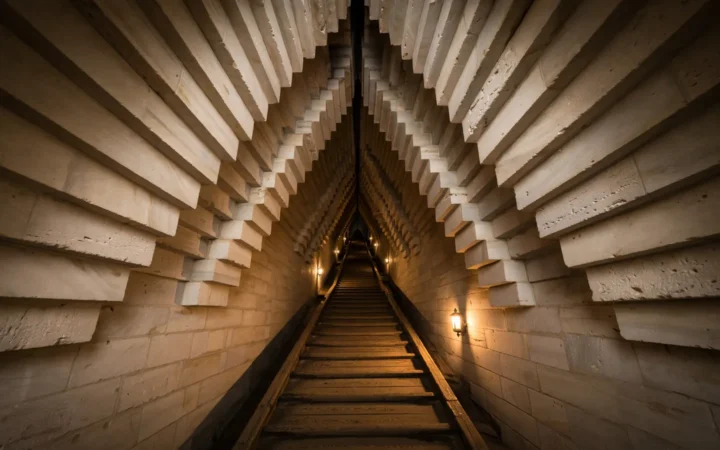
Then, in March 2023, came the payoff. Using muon scans, radar, and sound scans, the team found a tiny joint between the chevron blocks above the pyramid’s original entrance. They fed a 6-millimeter probe through it. For the first time in 4,500 years, human eyes saw inside: a 9-meter passage with a chevron ceiling, empty and silent. Egypt’s then heritage chief, Mostafa Waziri, said builders probably designed it to relieve the crushing weight above the entrance — the same logic as the stress-relieving chambers above the King’s Chamber.
No one has explored the Big Void yet, and no human eye has seen its far end. So the next time someone tells you everything about the pyramids is known — it isn’t.
A Crocodile God Buried in the Stone
Back to this week’s crocodile: the team named Herugavialis after Horus — Heru — the falcon god, possibly the divine model for the Sphinx itself. In fact, a 45-million-year-old croc — named for a god — lies entombed in the rock of a monument to another god.
The Egyptians themselves were crocodile people. They worshipped Sobek, the crocodile god of the Nile — strength, new life, and protection. Artists showed him as a man with a crocodile’s head, or as the animal itself. For example, at Crocodilopolis in the Faiyum, priests kept a living sacred crocodile. They adorned it with gold and hand-fed it cake, roast meat, and honeyed wine. At Kom Ombo, the double temple of Sobek and Horus still stands, and its Crocodile Museum displays hundreds of preserved crocodiles — some over four meters long.
They never knew about the fossils in their pyramid stones. But the stone remembers.
Questions People Actually Ask
What is the Great Pyramid made of?
Quarry workers cut nummulitic limestone on the Giza plateau (~2.3 million blocks). Builders used fine white Tura limestone for the original casing and red Aswan granite for the burial chambers. The limestone itself is ~45-million-year-old fossil-rich seabed rock.
Are there really fossils in the Great Pyramid?
Yes — millions. The limestone holds Nummulites — coin-shaped fossil shells — plus the odd shark tooth. The species took its name from Giza itself.
What was the new 2026 crocodile discovery?
In October 2026, scientists identified Herugavialis cairensis, a previously unknown extinct gavial. They studied a 1920s skull from the Mokattam Formation — the same limestone that forms the Sphinx and Giza pyramids. The team named it after the Egyptian god Horus.
Did the ancient Egyptians know about the fossils?
There’s no record of fossil science in ancient Egypt. But Strabo reported that locals in the 1st century BCE had noticed the lentil-shaped nummulites and spun a folk tale about workmen’s lentils turned to stone. Quarry workers must have seen them all the time.
What is the Big Void in the Great Pyramid?
The ScanPyramids team found a large empty space — at least 30 meters long — above the Grand Gallery in 2017 using cosmic-ray muon scans. Its purpose is still unknown. They confirmed another 9-meter passage behind the entrance chevrons with a probe in 2023.
What did the Great Pyramid originally look like?
Picture a smooth, gleaming white pyramid 146.6 meters tall, cased in polished Tura limestone — possibly with a gilded capstone. In the Middle Ages, builders removed most of the casing for building stone in Cairo.
The Mountain Remembers
The Great Pyramid consists of stone — but “stone” sells it short. It holds a 45-million-year-old sea: plankton shells, shark teeth, extinct crocodiles. Copper tools quarried it; human muscle stacked it. It held the world height record for nearly four thousand years, and it’s still giving up secrets: new species in its bedrock this week, unknown voids in its heart still waiting.
Want to go deeper? Step inside the Great Pyramid to explore its chambers and halls, read how the pyramids were built for the full story, or meet the monument carved from the same ancient seabed — the Great Sphinx of Giza. And if Sobek’s sacred crocodiles intrigue you, our guide to the gods of ancient Egypt is where their story lives on.