
Here’s a fact that resets everything you think you know about Egyptian history.
Cleopatra lived closer in time to the first Moon landing than to the building of the Great Pyramid.
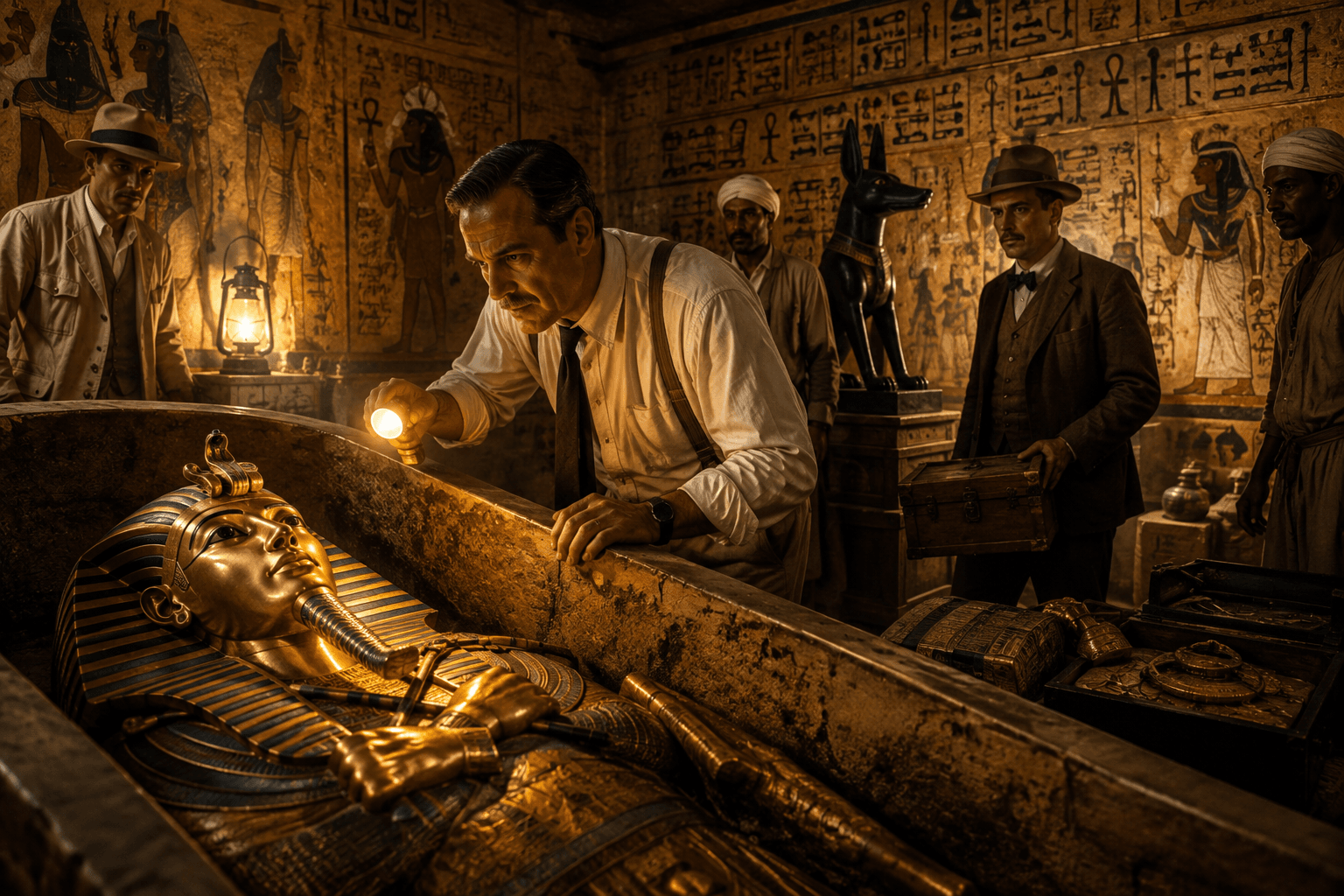
The pyramid was already older to her than she is to us. When she walked through Alexandria, Khufu had been dead for two and a half thousand years. She was not an ancient Egyptian in the way the pyramid builders were. She was the last ruler of a Greek dynasty governing a country whose own golden age was already deep history.
That gap matters, because most of what people believe about Cleopatra is wrong in ways that make her smaller than she was.
She Wasn’t Egyptian by Descent

Cleopatra VII Philopator was born around 69 BCE into the Ptolemaic dynasty, which had ruled Egypt since the death of Alexander the Great.
When Alexander died in 323 BCE, his generals carved up his empire. One of them, Ptolemy I Soter, took Egypt. His descendants ruled it for nearly three centuries from the Greek city of Alexandria, speaking Greek, worshipping in a Greek-Egyptian hybrid, and marrying largely within the family.
Cleopatra was therefore Macedonian Greek by ancestry — her father was Ptolemy XII Auletes. Her mother’s identity is not firmly established, which leaves genuine uncertainty in the record and is why arguments about her ancestry persist.
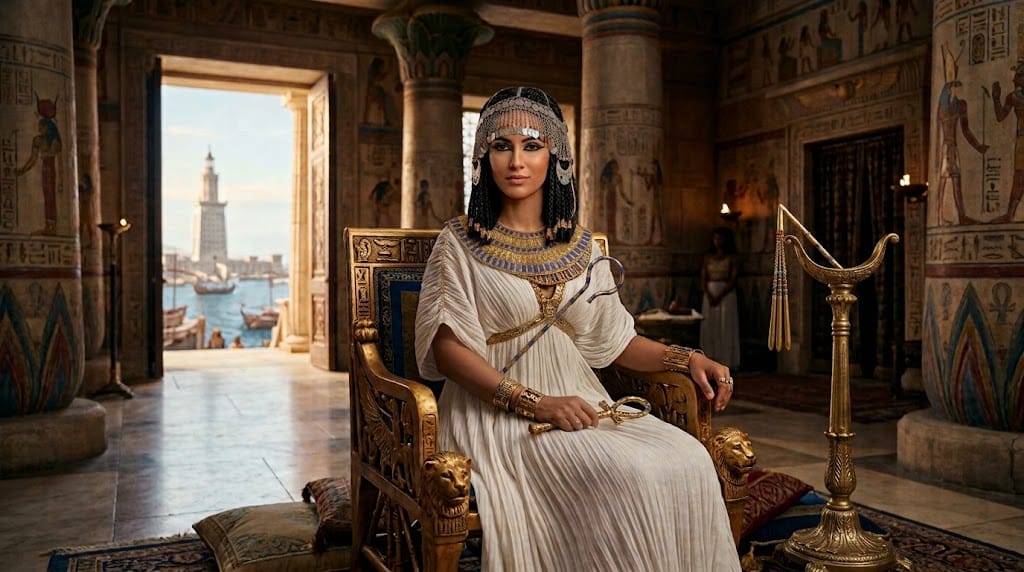
But descent isn’t the same as identity. Plutarch records that Cleopatra was the only member of her house who bothered to learn the Egyptian language. She presented herself publicly as the living embodiment of the goddess Isis, participated in Egyptian religious life, and ruled as an Egyptian queen rather than as a Greek administrator sitting on top of Egypt.
She was, culturally, something her ancestors had never tried to be. Our overview of the religion of ancient Egypt explains the divine framework she was stepping into.
The Language Point
Ancient sources describe Cleopatra as fluent in many languages, able to negotiate with foreign delegations without interpreters.
This gets repeated as a piece of trivia. It wasn’t trivia. It was statecraft.
Ptolemaic Egypt sat at the centre of a tangle of client kingdoms, trading partners, and rival powers. A ruler who could speak directly to an envoy — without a translator in the room shaping the exchange — had a real advantage in negotiation. Cleopatra used it.
A Family Business Built on Violence
Understanding Cleopatra requires understanding what the Ptolemaic court was.
By her time, the dynasty had a long record of siblings murdering siblings, mothers deposing sons, and children executing their parents’ allies. Royal marriage between brother and sister was standard practice. Alliances shifted constantly. Rome loomed over everything, increasingly willing to intervene.
Her father died in 51 BCE, leaving the throne to Cleopatra, then around eighteen, and her younger brother Ptolemy XIII, then about ten, as co-rulers and nominal spouses.
It didn’t hold. Ptolemy XIII’s advisers moved against her, and by 48 BCE Cleopatra had been forced out of Alexandria and was raising forces to fight her way back.
She was, at that point, a deposed teenager with a claim and no throne.
Caesar
Rome’s civil war arrived in Egypt at exactly the right moment.
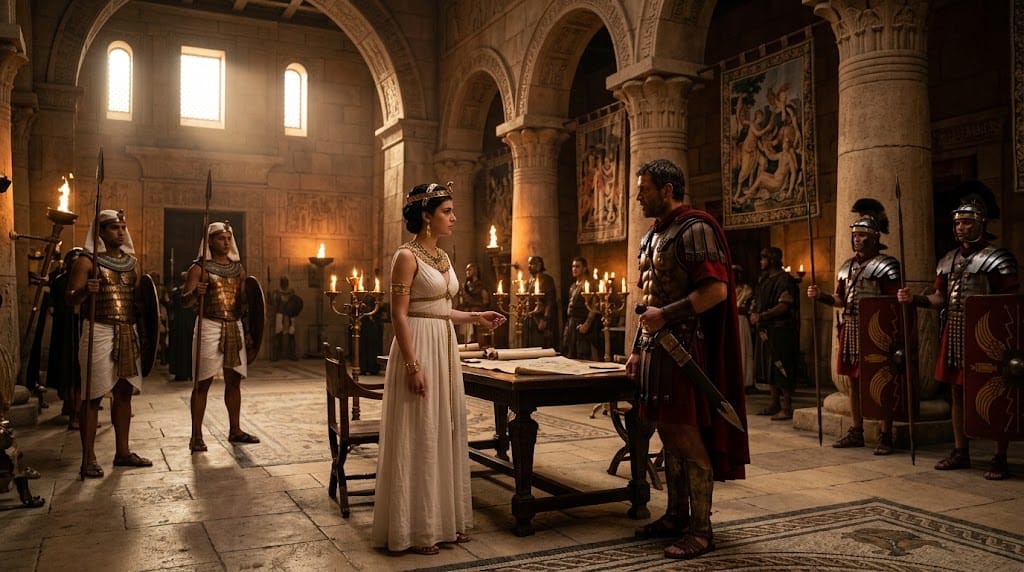
Pompey, fleeing Julius Caesar after defeat at Pharsalus, sought refuge in Egypt. Ptolemy XIII’s court had him killed, calculating that Caesar would be grateful.
Caesar was not grateful. He was appalled, and he stayed in Alexandria.
Cleopatra needed to reach him before her brother’s faction could shape his view. Plutarch describes her being carried into the palace concealed inside a bed-sack — the famous rolled-carpet image is a later embellishment, but the substance of the story, a smuggled entrance, comes from the ancient source.
Whatever happened in that room, Caesar backed her. The resulting war ended with Ptolemy XIII dead and Cleopatra restored, now ruling alongside another younger brother, Ptolemy XIV.
She later had a son, Caesarion, whom she presented as Caesar’s child.
Antony
Caesar’s assassination in 44 BCE left Cleopatra exposed. She needed a new arrangement with whoever came out on top in Rome.
That turned out to be Mark Antony, who controlled the eastern half of Roman territory. Their alliance was political before it was anything else — Antony needed Egypt’s grain and money for his eastern campaigns; Cleopatra needed Roman protection for her throne and a future for her children.
They had three children together: twins, Alexander Helios and Cleopatra Selene, and later Ptolemy Philadelphus.
In 34 BCE, in a public ceremony in Alexandria, Antony distributed eastern territories among Cleopatra and her children and affirmed Caesarion as Caesar’s legitimate son.
That last part was the fatal move. Caesar’s adopted heir was Octavian, and a rival claimant with actual Caesar blood was a direct threat. Octavian used the ceremony to frame Antony as a man who had abandoned Rome for a foreign queen.
War followed.
Actium and the End

The decisive battle came at Actium, off the Greek coast, in 31 BCE. Octavian’s fleet defeated the combined forces of Antony and Cleopatra, and the two withdrew to Egypt.
Octavian invaded the following year. Antony died by suicide. Cleopatra, held under guard and facing the certainty of being paraded through Rome as a trophy, took her own life in August 30 BCE, at thirty-nine.
The snake is probably legend. The popular image of an asp comes from later tradition, but Roman-era writers including Strabo, Plutarch, and Cassius Dio recorded alternative accounts involving poison — an ointment, or poison introduced with a sharp implement. Modern historians generally regard poison as more plausible than a snake, which is an unreliable way to die quickly.
Caesarion was killed on Octavian’s orders. Egypt became a Roman province. Octavian became Augustus.
Three thousand years of pharaonic Egypt ended with her.
Why the Beauty Story Won’t Die
Roman propaganda invented the seductress, and it stuck for two thousand years.
Octavian needed a way to attack Antony without admitting he was fighting a civil war against a fellow Roman. Casting Cleopatra as a foreign temptress who had bewitched a good Roman general solved that problem neatly. The blame fell on her, and the war became a defence of Rome rather than a fight for power.
The ancient sources themselves are more measured. Plutarch’s account suggests her appearance was not extraordinary, and that what people found compelling was her presence in conversation — her voice, her intelligence, her ability to hold a room. As historians have long noted, she was a formidable ruler in her own right before either relationship.
Renaissance painters, Shakespeare, and Hollywood each preferred the temptress, and the propaganda won.
She ruled Egypt for twenty-one years, through famine, currency collapse, court conspiracy, and the most dangerous period in Rome’s history. She kept her country independent longer than anyone had a right to expect. The administrative machine she inherited is described in our guide to ancient Egypt’s government.
That’s the story. The rest is marketing — Octavian’s, and then everyone else’s.
Frequently Asked Questions
Was Cleopatra Egyptian?
By ancestry she was Macedonian Greek, descended from Ptolemy I, one of Alexander the Great’s generals. Culturally she identified as Egyptian — she learned the Egyptian language, which no other Ptolemaic ruler had done, and presented herself as an embodiment of the goddess Isis.
How did Cleopatra die?
She died by suicide in Alexandria in August 30 BCE, aged thirty-nine, after Octavian’s invasion. The asp story is popular tradition; Roman writers including Strabo, Plutarch, and Cassius Dio recorded accounts involving poison instead.
How long did Cleopatra rule Egypt?
About twenty-one years, from 51 BCE until her death in 30 BCE, ruling at various points alongside two brothers and then her son Caesarion.
Was Cleopatra actually beautiful?
Ancient accounts suggest her appearance was not exceptional and that her charm, voice, and conversational skill were what people found compelling. The seductress image largely originates in Roman propaganda used against Mark Antony.
Who were Cleopatra’s children?
Caesarion, presented as Julius Caesar’s son, and three children with Mark Antony: the twins Alexander Helios and Cleopatra Selene, and Ptolemy Philadelphus.
What happened to Egypt after Cleopatra?
Egypt was annexed as a Roman province. Caesarion was killed, ending the Ptolemaic dynasty and pharaonic rule.
Conclusion
Cleopatra inherited a bankrupt kingdom, a hostile court, and a superpower next door that had already decided Egypt would eventually be its property.
She held it off for twenty-one years by out-manoeuvring, out-negotiating, and out-thinking almost everyone she dealt with. She lost in the end, but she was playing against Rome at the height of Rome.
The version of her we inherited was written by the man who beat her. It’s worth remembering that.