
Explore religion of ancient Egypt: polytheistic gods, spiritual beliefs, rituals, and how Egyptians understood the divine and the afterlife for over 3,000 years. Our full guide to the ancient Egyptian gods covers the major deities individually.
Introduction
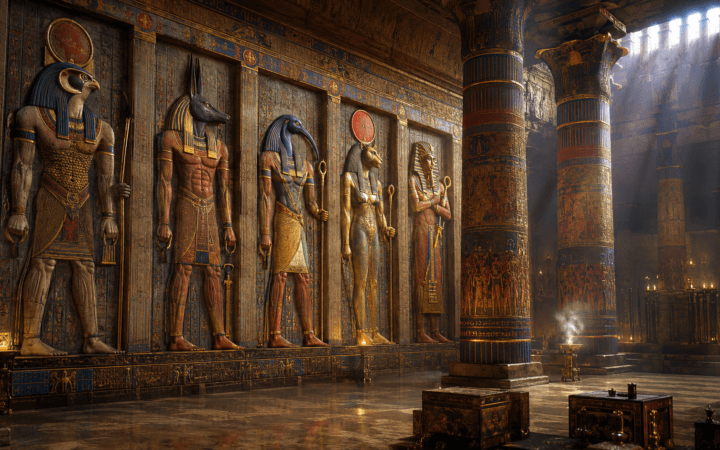
Imagine walking into an ancient Egyptian temple at dawn. The air smells of incense. Priests are chanting in a language that sounds like music. The walls are covered with images of gods—human-headed, animal-headed, hybrid creatures you’ve never seen. Statues stand in niches, their eyes painted so realistically they seem to follow you. Temple wealth and priestly power are covered in our guide to Egypt’s government.
This is religion of ancient Egypt. Not a single god, not abstract theology, but a rich, layered, constantly evolving system of spiritual beliefs that shaped how Egyptians understood existence itself.
What’s remarkable about Egyptian religion is its complexity. Egyptians had hundreds of gods. These gods had intricate relationships, contradictions, regional variations. Gods could merge into combined entities. New gods appeared over time. Old gods evolved in meaning.
And underlying it all was a fundamental question that Egyptian religion answers: what happens after you die? How do you achieve eternal life? What does it mean to exist in the next world?
Understanding religion of ancient Egypt means understanding how Egyptians made meaning of existence, how they prepared for death, and how they built a spiritual worldview complex enough to sustain a civilization for over 3,000 years.
Let me walk you through the gods, the beliefs, and the practices that formed the heart of Egyptian spirituality.
The Basics: Polytheism and Multiple Layers of Belief
Ancient Egypt was polytheistic—Egyptians worshipped many gods, not one god. But “many gods” doesn’t capture the complexity. Egyptians had hundreds of deities, ranging from major gods worshipped throughout Egypt to local gods known only in specific regions.
What’s interesting is that Egyptian religious belief seems to have had multiple layers:
The Official Religion:
Priests, temples, and the pharaoh maintained official religious practices. Gods had temples, rituals were performed, religious services were conducted. This is what we know most about, because temples lasted and provided documentation.
Popular Religion:
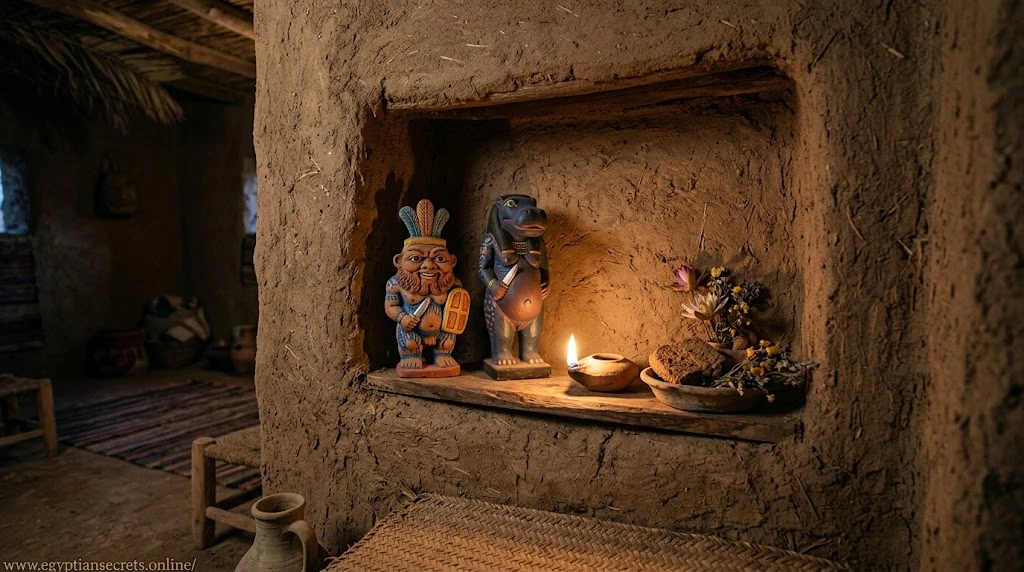
Common people had their own spiritual practices. They had household gods, personal amulets, local deities, and folk beliefs that might differ from official temple religion.
Mystical Religion:
There were mysterious religious practices, magical knowledge, secret initiations—all part of spiritual practice but less documented.
Regional Variation:
Different regions had different god preferences. Upper Egypt emphasized certain gods; Lower Egypt had different emphases. When Upper and Lower Egypt unified, both sets of gods were incorporated into the religious system.
This multiplicity—hundreds of gods, multiple layers of belief, regional variation—created a religious system flexible enough to adapt over 3,000 years while maintaining continuity.
The Major Gods: The Pantheon You Need to Know
Egyptian gods number in the hundreds, but certain gods were particularly important:
Ra (or Re) – The Sun God:
Ra was the sun itself—the daily journey of the sun across the sky represented Ra’s journey through the world. Ra was the creator god who brought light and life. Every dawn, Ra was reborn. Every night, Ra journeyed through the underworld before emerging again at dawn.
Ra represented life, creation, energy, and renewal. By the New Kingdom, Ra had merged with Amun to become Amun-Ra, combining Ra’s solar power with Amun’s cosmic significance.
Osiris – The God of the Afterlife:
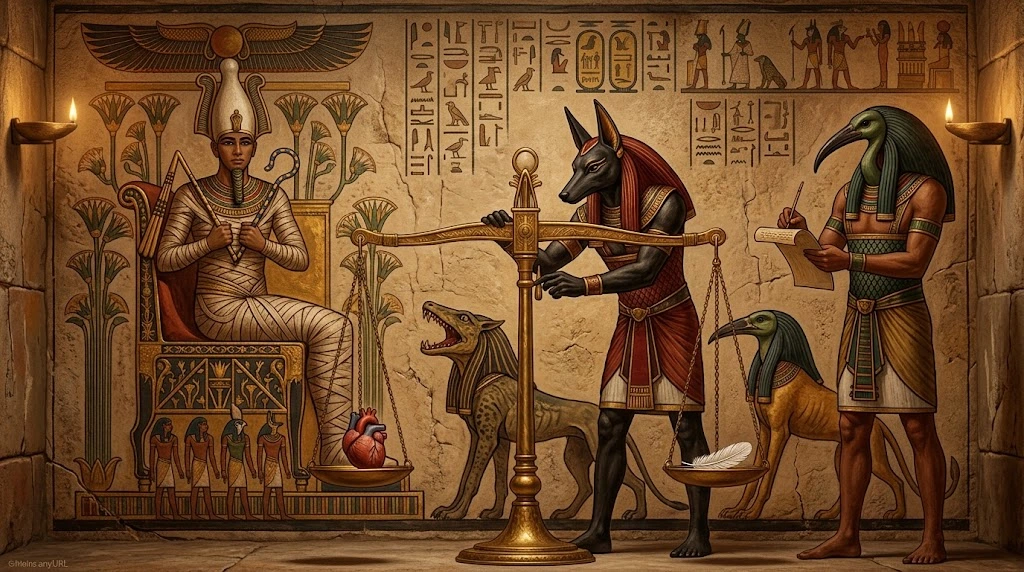
Osiris was the god of death, resurrection, and the afterlife. According to mythology, Osiris was murdered by his brother Set but was resurrected by his wife Isis. Because of his resurrection, Osiris became the god who promised resurrection and eternal life to all Egyptians.
Understanding Osiris is crucial to understanding Egyptian religion, because Osiris represented the possibility of eternal life—the fundamental hope of Egyptian spirituality.
Isis – The Goddess of Magic and Protection:
Isis was the wife of Osiris and mother of Horus. She was a protector goddess, associated with magic (not spells, but the spiritual force that organized the universe), fertility, and maternal care.
Isis was incredibly popular in ancient Egypt and remained popular even after Egypt’s conquest by Rome. Her cult spread throughout the Mediterranean world.
Horus – The Falcon God:
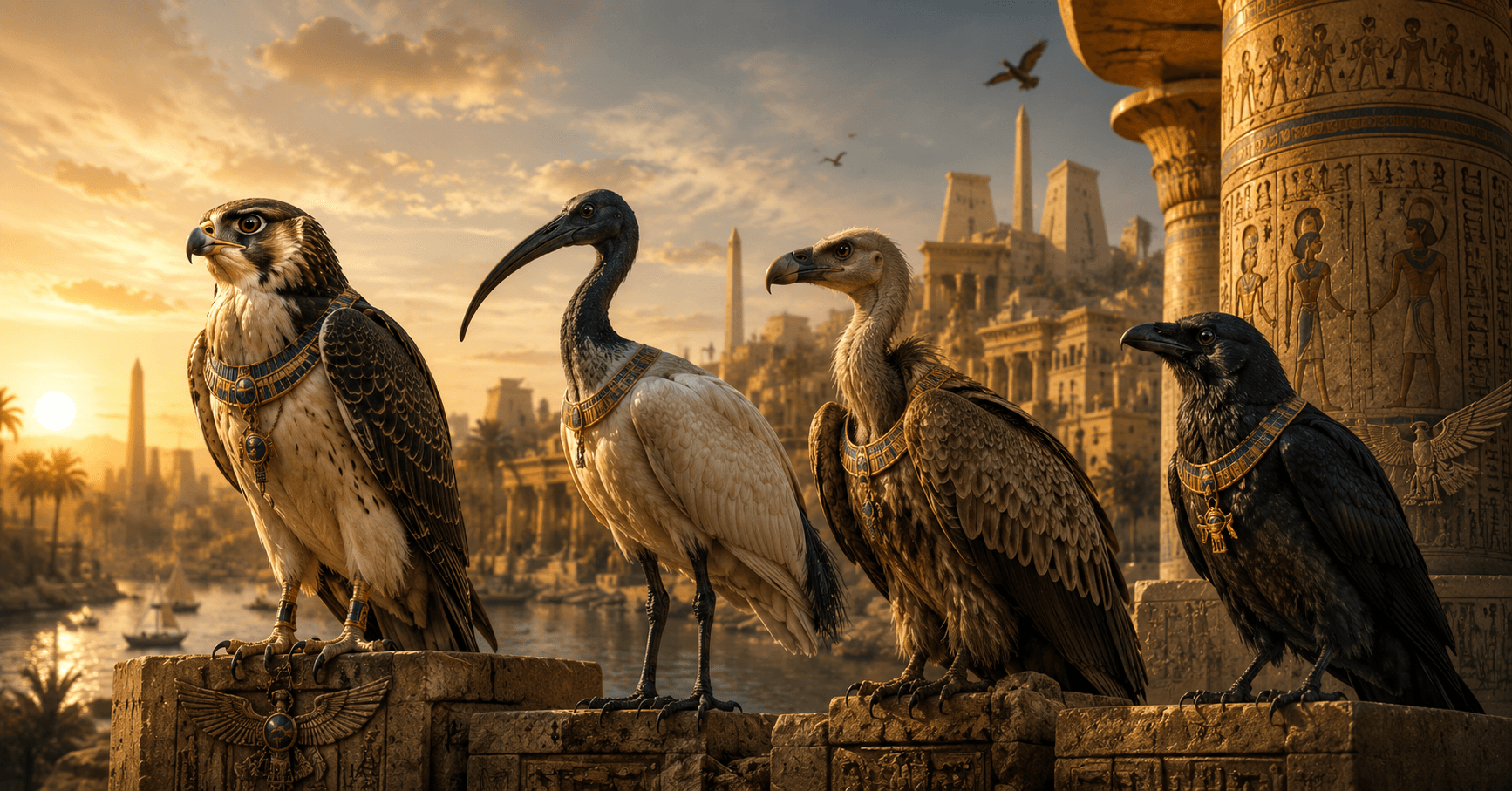
Horus was the son of Osiris and Isis. He was associated with the sky, with the pharaoh (who was considered to be Horus incarnate), and with protection. Horus was depicted as a falcon or as a man with a falcon head.
The mythology surrounding Horus—his struggle with his uncle Set for control of Egypt—represented fundamental conflicts and resolutions important to Egyptian understanding of power and justice.
Set – The Chaos God:
Set was Osiris’s brother, depicted as having an animal head unlike any known species (possibly a stylized hippopotamus or aardvark). Set represented chaos, disorder, and destruction.
Importantly, Set wasn’t entirely evil in Egyptian thought. Set represented necessary chaos—the force that created tension and conflict. Without Set’s chaos, there would be no development, no growth. Set was dangerous but necessary.
Thoth – The God of Wisdom:
Thoth was depicted as ibis-headed or baboon-headed. He was the god of wisdom, writing, mathematics, and scientific knowledge. Thoth was associated with the moon and with intellectual capability.
As discussed in our previous article on sacred birds, Thoth represented knowledge and rational thought.
Amun – The Hidden God:
Amun represented the invisible, creative force of the universe. Amun wasn’t typically depicted directly but rather as hidden power. Over time, Amun became increasingly important and merged with Ra to become Amun-Ra.
Ptah – The Creator God:
Ptah was the creator god associated with craftsmanship and creation. He created the world through thought and speech—a profoundly abstract concept for Egyptian theology.
Ma’at – The Goddess of Truth and Order:
Ma’at (sometimes spelled Maat) represented universal order, truth, and justice. Ma’at was the principle that organized the universe. Maintaining Ma’at was the fundamental goal of Egyptian religious and social order.
Also Read :- Ancient Egypt Government
Mythology: The Stories That Explained the World
Egyptian religion included a rich mythology—stories explaining how the world came to be, how gods related to each other, and how humans should behave.
The Creation Myth:
Multiple creation myths existed, varying by region and period. One version: Atum, the creator god, created himself and then created other gods. Another version: Ptah created the world through thought. Another: Ra created the world as he traveled across the sky.
These weren’t understood as contradictory. Rather, different aspects of creation could be explained through different myths. Creation was mysterious and multi-layered.
The Osiris-Isis-Horus Cycle:
The most important Egyptian myth involved Osiris, who was murdered by his brother Set but resurrected by his wife Isis. From Isis, the resurrected Osiris had a son, Horus. Horus eventually defeated Set and restored order.
This myth answered fundamental questions: What happens after death? Can you be resurrected? What is justice? The myth provided a template for death, resurrection, and justice that shaped all Egyptian religion.
The Daily Battle Between Ra and Apophis:
Each night, Ra journeyed through the underworld, where he battled the chaos serpent Apophis. If Ra lost, the sun wouldn’t rise. Every night, Ra had to fight to ensure the dawn came. This myth explained natural cycles and emphasized that order (Ma’at) requires constant effort against chaos.
The Afterlife: What Ancient Egyptians Believed Happened After Death
Religion of ancient Egypt was fundamentally about the afterlife. Egyptians didn’t see death as an ending. They saw it as a transition.
The Soul and Its Components:
Egyptians believed humans had multiple spiritual components:
- The ka: a life force present in all living things
- The ba: personality, consciousness, the aspect of self that survived death
- The akh: the transformed spirit after successful transition to the afterlife
After death, the ba and akh would continue existing (if all went properly), while the ka remained connected to the body.
The Journey Through the Duat:
The afterlife wasn’t a single location but rather a journey through the Duat (the underworld). The dead had to navigate this dangerous space, avoiding demons and obstacles, guided by spells and knowledge.
The Book of the Dead provided maps and spells—essentially a guidebook for the afterlife journey.
Upon reaching the final judgment, the dead person’s heart was weighed against Ma’at (truth and justice). If the heart was light (good, truthful), the person could enter the eternal afterlife. If the heart was heavy (burdened by sin), the person couldn’t enter the eternal afterlife and would face destruction or eternal suffering.
This concept of judgment based on moral behavior was revolutionary for its time—the afterlife wasn’t guaranteed; you had to earn it through living rightly.
Eternal Life in the Field of Reeds:
If you successfully navigated the Duat and passed judgment, you entered the Field of Reeds (or similar concepts of the afterlife), a place where you continued existing, ideally enjoying eternity surrounded by loved ones and abundance.
Religious Practices: How Egyptians Expressed Their Beliefs
Temple Worship:
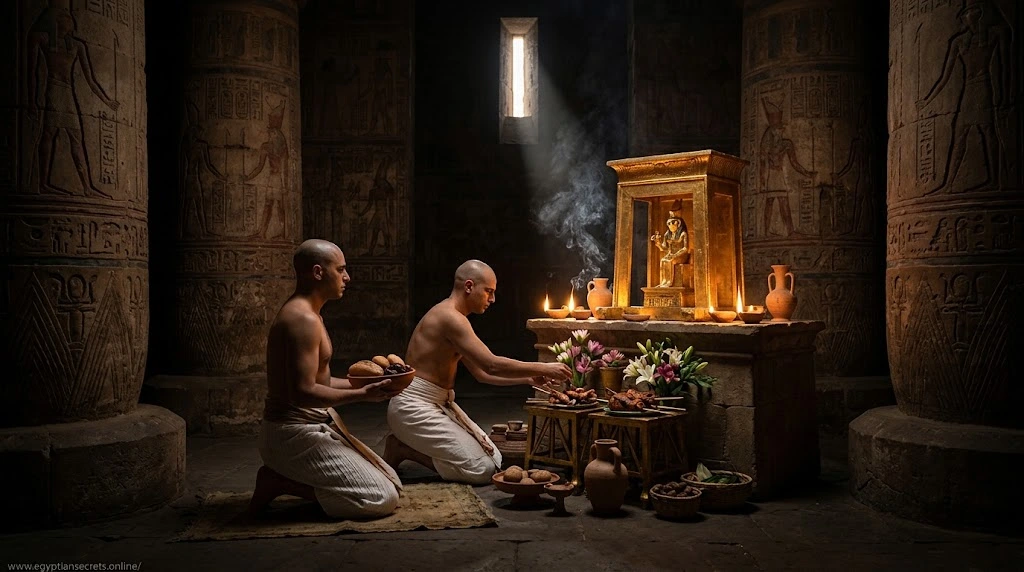
Temples were the centers of official religion. Priests conducted daily rituals, maintaining the gods’ statues, making offerings, chanting prayers. Temples were not open to the general public (except on festival days). Most religious life happened in temples, not accessible to common people.
Personal Devotion:
Individual Egyptians maintained personal religious practice. They wore amulets for protection. They said prayers. They maintained household gods. They participated in local religious festivals.
Festivals and Celebrations:
Major religious festivals brought the community together. During festivals, divine statues were carried through streets, communities gathered for celebrations, and religious knowledge was shared.
Magic and Amulets:
Egyptians used amulets and magical practices to protect themselves and achieve spiritual goals. This wasn’t considered separate from religion—magic was part of spiritual practice, a way of invoking divine power.
Mummification and Funeral Rites: The funerary side of this belief system is described in our article on mummification.
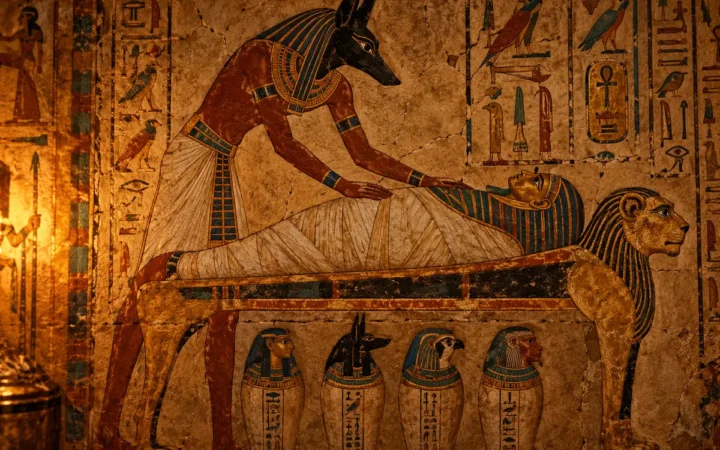
Funeral practices embodied religious belief. The entire mummification process was designed to preserve the body for the afterlife. Funeral rituals were meant to ease the dead person’s journey through the Duat.
Religious Change Over Time
Egyptian religion wasn’t static. It evolved over 3,000 years:
The Old Kingdom:
Religion was relatively straightforward. Ra and Osiris were important. The pharaoh’s connection to the gods was emphasized.
The Middle Kingdom:
Religious complexity increased. More gods became important. Democratization of religion occurred—ordinary people could now have legitimate access to afterlife (not just pharaohs).
The New Kingdom:
Amun became increasingly dominant. Amun merged with Ra. Religious complexity expanded further. The priesthood became more powerful and wealthy.
Late Period:
Foreign conquest challenged Egyptian religion. Traditional practices persisted but changed. Eventually, Christianity and Islam replaced traditional Egyptian religion entirely.
Religious Tolerance and Religious Innovation
An interesting aspect of Egyptian religion was its tolerance for religious variation and innovation.
When Upper and Lower Egypt unified, rather than suppressing one region’s gods, both sets of gods were incorporated. Gods could merge (like Amun and Ra becoming Amun-Ra). New gods could arise.
This flexibility allowed Egyptian religion to adapt and persist. Rather than rigid orthodoxy, Egyptian religion was inclusive, accommodating new beliefs while maintaining traditional practices.
Frequently Asked Questions (FAQ)
Q: Did ancient Egyptians worship only one god?
A: No. Egyptians were polytheistic, worshipping hundreds of gods. However, some gods were more important than others, and some were more widely worshipped than others.
Q: What was the most important Egyptian god?
A: Difficult to say—it changed over time and varied by region. Ra was crucial for creation and solar theology. Osiris was crucial for afterlife beliefs. Amun became increasingly dominant over time.
Q: Did Egyptian religion have priests like modern religions?
A: Yes. Priests maintained temples, conducted rituals, and preserved religious knowledge. The high priest of a major temple held significant power. Becoming a priest required education and training.
Q: Could ordinary Egyptians access the afterlife?
A: Originally, afterlife was restricted to pharaohs. Over time (particularly by the Middle Kingdom), religious democratization meant ordinary people could also access afterlife if they lived rightly.
Q: What was the Book of the Dead?
A: A collection of spells, prayers, and instructions meant to guide the dead through the afterlife. Different versions existed. It’s called the “Book of Coming Forth by Day” in Egyptian.
Q: Did Egyptians believe in one afterlife or multiple afterlife options?
A: Conceptions varied and evolved. Generally, successful passage led to eternal life in the Field of Reeds. Failed passage led to various undesirable fates (destruction, torment, nonexistence).
Q: How did Egyptian religion influence later religions?
A: Egyptian concepts influenced Greek religion, which influenced later Western religions. Isis worship spread throughout the Mediterranean. Some scholars suggest Egyptian concepts influenced early Christianity, though this is debated.
Q: Why did Egyptian religion eventually disappear?
A: Foreign conquest (particularly the Islamic conquest in the 7th century CE) gradually replaced Egyptian religion with Islam. Traditional practices faded as the culture transformed.
Conclusion: Religion as the Foundation of Egyptian Civilization
Religion of ancient Egypt wasn’t separate from everyday life. It was foundational to how Egyptians understood existence, made decisions, organized society, and prepared for death.
The pharaoh’s authority derived from being god-incarnate. Government decisions were framed as divine will. Building projects were religious acts. Social hierarchy reflected cosmic order. Personal amulets connected individuals to divine power.
By understanding Egyptian religion—the gods, the myths, the beliefs, the practices—you understand how Egyptians made sense of their world. You understand what they valued (truth/Ma’at, order, eternal life), what they feared (chaos, destruction, failure in the afterlife), and how they imagined existence continuing beyond death.
That’s why religion of ancient Egypt remains fascinating thousands of years later. It reveals how humans grapple with ultimate questions—what happens after death, how should we live, what is divine—using the understanding and imagination available to them.
Sources & References
- Hart, G. (2005). The Routledge Dictionary of Egyptian Gods and Goddesses. Routledge.
- Quirke, S. (2001). The Cult of Ra: Religion and Mythology of Ancient Egypt. Thames and Hudson.
- David, R. (2002). Religion and Magic in Ancient Egypt. Routledge.
- Taylor, J. H. (2001). Death and the Afterlife in Ancient Egypt. University of Chicago Press.
- Allen, J. P. (2000). The Ancient Egyptian Pyramid Texts. Society of Biblical Literature.
- Kemp, B. J. (2006). Ancient Egypt: Anatomy of a Civilization. Routledge.
- Faulkner, R. O. (1985). The Egyptian Book of the Dead. Chronicle Books.
6 Comments