
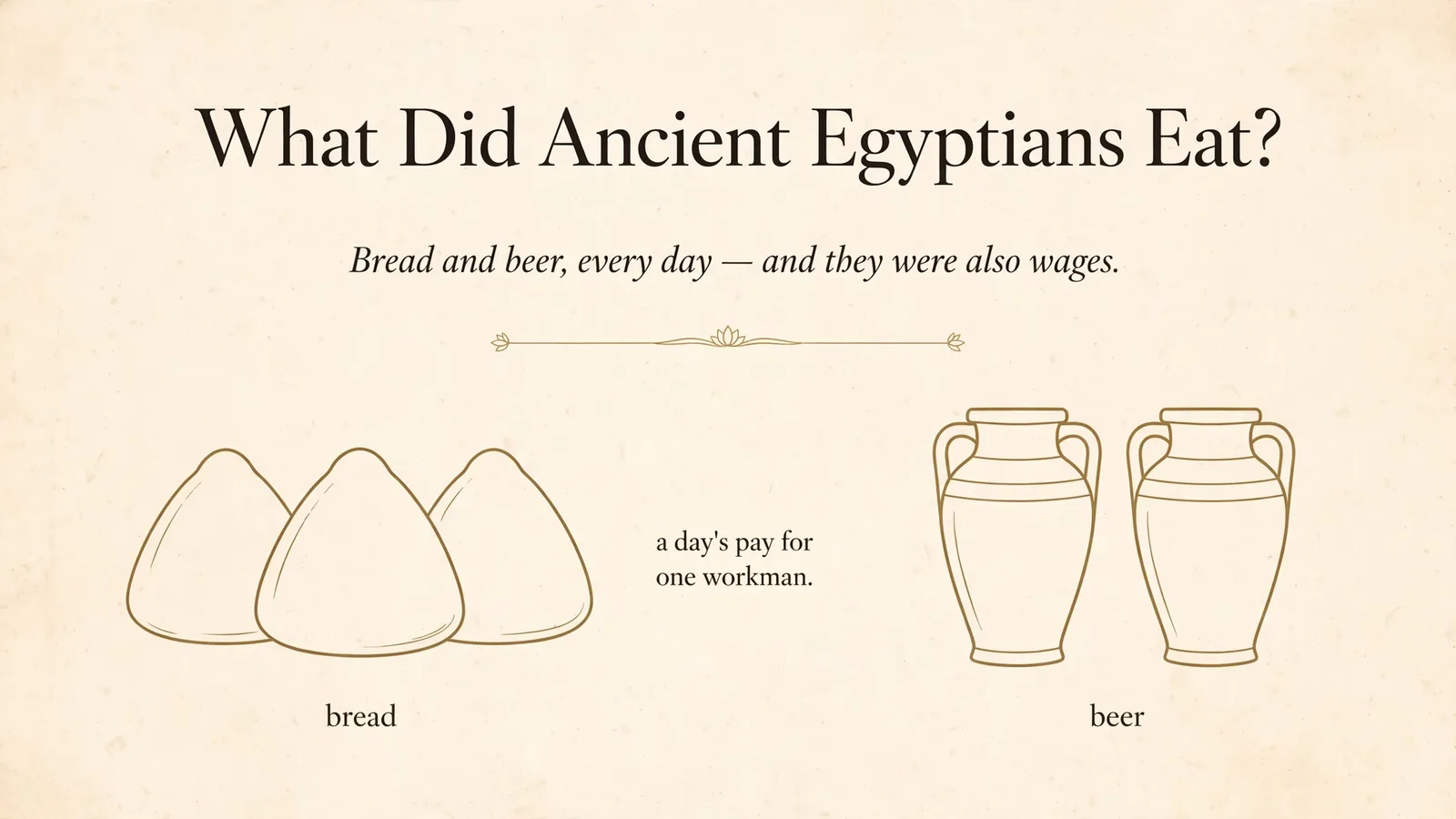
Most ancient Egyptians ate bread and beer, every day, for their whole lives. Onions, and whatever vegetables were in season. Fish out of the Nile. Dates and figs when they ripened. Meat rarely, unless you were rich or a festival was on.
That sounds thin, and it was not. Egyptian bread and beer were both made from the same two grains and between them they carried most of the calories, most of the protein and a good share of the vitamins in the diet. They were also money.
Bread and beer were wages
Egypt had no coinage until very late in its history. Workers were paid in goods, and the two constants were loaves and jugs of beer. Ration lists survive with exactly that accounting: so many loaves and so many jugs per man per day, with more for the foreman.
So “bread and beer” was not only what you ate. It was what you were owed. When the tomb-builders at Deir el-Medina went on strike in the reign of Ramesses III — the first recorded strike anywhere — it was because the rations had not arrived.
The beer was not what the word suggests now. It was thick, cloudy, only lightly alcoholic, and closer to a thin porridge than to a modern pint. Children drank it. It was safer than river water and it was food.
What was actually on the table
| Food | Who ate it | Notes |
|---|---|---|
| Bread (emmer wheat) | Everyone, daily | Dozens of shapes; the basic unit of pay |
| Beer (barley) | Everyone, daily, including children | Thick and nutritious, weakly alcoholic |
| Onions, garlic, leeks | Everyone | Onions especially — eaten raw with bread |
| Lentils, chickpeas, beans | Everyone | The main plant protein |
| Lettuce, cucumber, melon | Common | Lettuce was linked to the god Min and fertility |
| Fish | Common for ordinary people | Dried and salted to keep; avoided by some priests |
| Dates, figs, grapes | Seasonal | Dates were the everyday sweet |
| Honey | Rare, expensive | The only real sweetener — there was no sugar |
| Duck, goose | Sometimes | Trapped in the marshes; also salted |
| Beef | Mostly the rich, and festivals | Temple offerings were redistributed afterwards |
| Pork | More common than usually said | Pig bones are frequent in settlement rubbish |
| Wine | The wealthy | Jars were labelled with vineyard, year and quality |
The bread wrecked their teeth
This is not a guess. It is written on the mummies.
Grain was ground between stones, and the grinding shed grit into the flour — fragments of the quern itself, plus windblown sand, which in Egypt gets into everything. The bread came out gritty, and eating gritty bread twice a day for forty years grinds the enamel off your molars.
Egyptian mummies, rich and poor alike, show teeth worn flat, often down to the pulp, with the abscesses that follow. Pharaohs were not spared: several royal mummies have severe dental disease. It is one of the clearest pictures we have of ordinary Egyptian life, and it comes from the food.
Did they really eat that much meat?
It depends who. For most people meat was occasional — a festival, an offering redistributed from a temple, a bird caught in the marshes.
But the excavations at Giza complicate the picture. The settlement that housed the pyramid workers has produced animal bone in quantity: cattle, sheep and goat, enough to suggest the workforce was supplied with meat regularly. Whoever organised the pyramid project was feeding its people properly, which fits the other evidence that these were paid workers rather than slaves.
What they did not have
No sugar, no chicken until late, no rice, and none of the foods that came from the Americas — no potatoes, tomatoes, maize, chillies or chocolate. No citrus for most of Egyptian history.
Modern “ancient Egyptian” menus often include things that arrived thousands of years later. If a recipe calls for lemon and sugar, it is not Egyptian.
Frequently Asked Questions
What was the main food in ancient Egypt?
Bread, made from emmer wheat, eaten at every meal by everybody. Beer made from barley came close behind. Together they supplied most of the calories in the Egyptian diet and were also used as wages.
Did ancient Egyptians drink beer every day?
Yes, including children. It was thick, low in alcohol and nutritious — treated as food rather than as a luxury, and safer to drink than untreated river water.
Did ancient Egyptians eat meat?
Some. Beef was expensive and mostly reached ordinary people through temple offerings that were redistributed after the ritual. Fish, ducks and geese were far more common, and pork was eaten more widely than older books suggest.
What did ancient Egyptians eat for breakfast?
There is no Egyptian word for a breakfast menu, but the everyday answer is bread, beer and onions. Field workers took the same food with them and ate it through the day.
Did ancient Egyptians have sugar?
No. Sugar cane reached Egypt long after the pharaohs. Sweetness came from dates, figs and honey, and honey was expensive enough to be a luxury and an offering.
Why were their teeth so worn down?
Because of grit in the bread. Grinding grain on stone shed particles into the flour, and blown sand added more. Decades of eating it wore the chewing surfaces flat, which is visible in mummies at every level of society.
Related
The Nile: why the flood set the calendar
Counting ancient Egypt
The honey from Tutankhamun’s tomb
How were the pyramids built?
Sources
Further reading from museums and academic publishers:
- Google Arts & Culture — “What Did Ancient Egyptians Eat?“
- Journal of Ethnic Foods (Springer Nature, peer-reviewed) — “Influence of the traditional food culture of Ancient Egypt on the transition of cuisine and food culture of contemporary Egypt“