
Egyptian school meant one thing: learning to write. There was no general education. A boy sent to school was being trained for a job in the administration, the army or a temple, and the training was years of copying.
We know what it was like in unusual detail, because the homework survives — thousands of pieces of it, with the teacher’s corrections still on them in red ink.
They wrote on rubbish
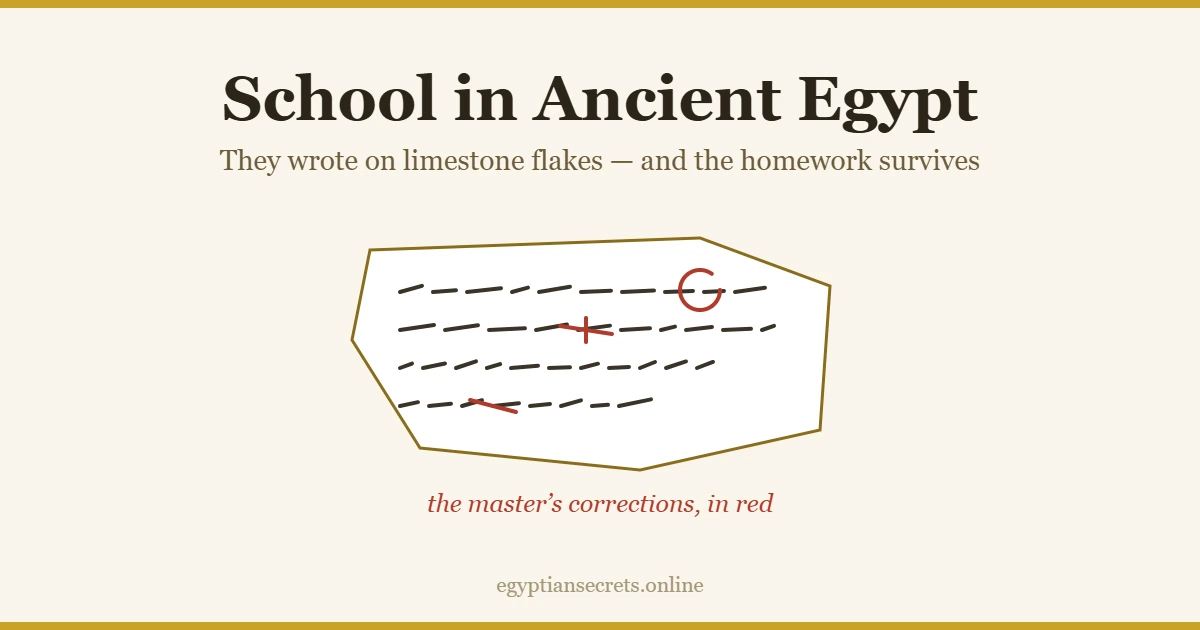
Papyrus was expensive and not wasted on beginners. Students wrote instead on ostraca: flakes of limestone and broken pottery, free and everywhere, and on whitewashed wooden boards that could be washed clean and used again.
Limestone flakes do not rot. That is why a schoolboy’s exercise from three thousand years ago can sit in a museum case today while the fine papyrus it was practising for has long since crumbled.
The corrections are the striking part. A student copies out a passage; the master goes over it and marks the errors in red. On some pieces you can see the same passage attempted again underneath, better.
What they copied
Not stories for pleasure. Model texts, chosen for handwriting and for the attitudes they taught.
The most copied of all is the Satire of the Trades, in which a father takes his son to scribal school and explains, at length, why every other job is worse. The metalworker’s fingers are like crocodile skin. The barber shaves until late at night. The fisherman works among crocodiles. The message is repeated until it sticks: be a scribe, and you will not have to do any of this.
It is propaganda, written by scribes for future scribes, and it is also one of the best descriptions of ordinary Egyptian working life that survives — precisely because it is describing the jobs it wants you to avoid.
Discipline
Beating was normal and openly discussed in the teaching texts. One line, copied by students themselves, runs: a boy’s ear is on his back — he listens when he is beaten.
Another instruction tells the student that he was in school every day while his mother brought him three loaves and two jugs of beer, and asks what he intends to do about it. Guilt and the stick, in the same curriculum.
What else was taught
Mathematics, for the same reason as writing: the state ran on measurement. Students learned to work out the area of a field, the volume of a granary, how to divide rations among a gang of workmen, and how to calculate the slope of a pyramid face.
The surviving mathematical papyri are problem books of exactly this kind. They are not abstract. Every question is a task someone actually had to do.
How many people could read?
The figure usually quoted is one per cent. It should be treated with more caution than it usually gets.
Estimates of one to five per cent rest on very limited evidence. Work on the Middle Kingdom town of Lahun has suggested the figure for an urban population there may need revising upwards, possibly towards fifteen per cent. The low numbers may also reflect the assumptions of nineteenth and twentieth-century scholarship as much as the Egyptian evidence.
There is a further complication. Egypt used more than one script — formal hieroglyphs and the cursive hands used for everyday documents — so “literate” is not one category. A person might read a business letter without being able to read a temple wall, and reading, writing and composing are different skills.
The honest answer is that writing was a minority skill concentrated in towns and in particular families, and that anyone quoting a precise percentage is quoting an estimate built on thin ground.
Frequently Asked Questions
Did all Egyptian children go to school?
No. School meant scribal training, which was limited and mostly for boys from families already connected to the administration or a temple. Most children learned their parents’ work instead.
What did Egyptian students write on?
Ostraca — flakes of limestone and broken pottery — and whitewashed wooden boards that could be wiped and reused. Papyrus was too expensive for practice.
Could girls go to school in ancient Egypt?
Rarely. A small number of women could certainly write, and women held property and went to court in their own names, but scribal schooling was overwhelmingly male and the evidence for female students is thin.
What was the Satire of the Trades?
A teaching text copied endlessly by students, in which a father lists the miseries of every trade to persuade his son to become a scribe. It doubles as a vivid description of Egyptian working life.
How long did it take to train as a scribe?
Years. Students began in childhood and worked through model texts, handwriting and practical mathematics before taking a junior post and continuing to learn on the job.
What percentage of Egyptians could read?
Commonly given as around one per cent, but that figure is an estimate from limited evidence. Some studies of individual towns suggest considerably higher rates, and the question is complicated by Egypt using more than one script.
Related
The hieroglyphic alphabet
Egyptian hieroglyphs explained
What was childhood like in ancient Egypt?
How ancient Egypt was governed
Sources
Further reading from museums and academic publishers:
- Austrian National Library, Papyrus Museum — exhibition “Hieroglyphs and alphabets: 2500 years of education in Ancient Egypt“
- World History Encyclopedia — “Daily Life in Ancient Egypt“