

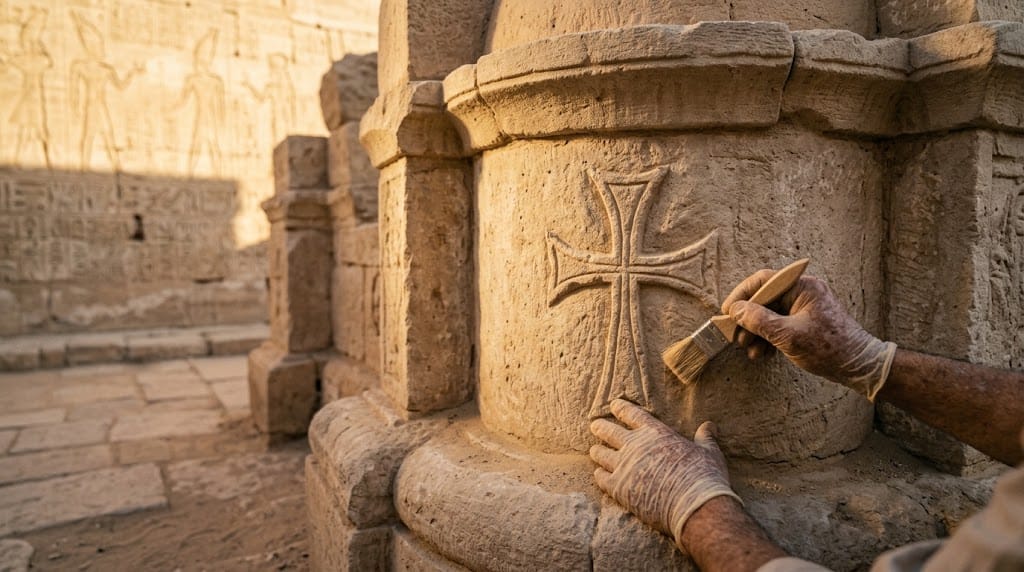
Archaeologists are discovering something incredible beneath Egypt’s sand: thousands-year-old churches. Here’s what these hidden structures reveal about Egypt’s forgotten faith.
Introduction
Imagine standing at an excavation site in Luxor, watching workers carefully brush away centuries of sand. And then—right there, adjacent to the Temple of Karnak, one of ancient Egypt’s most magnificent pharaonic structures—they find the foundation stones of a church. Not just any church. A church built when Christianity was still new. A church where early believers gathered to worship in a language and tradition that would directly shape the faith practiced by Egyptian Christians today. The older belief system these churches replaced is described in our overview of the religion of ancient Egypt.
For a long time, we told Egypt’s story in this neat, clean way: pharaonic civilization, golden age, decline, and then… silence. As if Egypt’s real story ended when the pyramids stopped being built. As if after the pharaohs, there wasn’t much worth paying attention to.
But that’s not what happened. Not even close.
Over the past fifteen years—and especially in the last five—archaeologists have been uncovering something that completely rewrites this narrative. Beneath the sand, beneath the layers of Islamic-era construction, beneath streets built on top of older streets, they’re finding churches. Dozens of them. Hundreds, probably. Structures that reveal an ancient Egypt most of us never learned about in school: Christian Egypt. An Egypt where believers built basilicas and gathered for worship centuries before Islam arrived. An Egypt where faith transformed the landscape in ways we’re only now beginning to understand.
These discoveries matter. Not just for archaeologists in dusty excavation sites. They matter because they’re changing how we understand an entire civilization. They’re revealing stories of religious transformation, cultural adaptation, and human resilience that are genuinely profound. And honestly? They’re kind of fascinating.
Let me walk you through what’s actually being discovered out there.
Churches in Places We Never Thought to Look
Here’s the thing about archaeological discoveries—they rarely happen the way Hollywood portrays them. There’s rarely a dramatic moment of a shovel breaking through a sealed door. Usually, it’s more subtle. It’s teams of researchers noticing patterns. Using new technology. Asking questions that previous generations didn’t think to ask.
That’s what’s been happening across Egypt over the past couple decades.
Archaeologists started asking: “If Christianity was spreading through the Mediterranean, it definitely reached Egypt. So where did they worship? Where are their churches?” They started looking not at remote sites or obviously Christian locations, but at the archaeological layers beneath major cities and established settlements. And they started finding them.
In Cairo’s suburbs. In Luxor’s temple complexes. In the harbor areas of Alexandria. In the river valleys south of Aswan. Basically, everywhere they looked carefully. Our ancient Egypt map guide shows how these sites sit along the Nile.
What’s particularly mind-blowing is where these churches were built. They weren’t constructed in isolation, away from established communities. They were built right where people were already living—sometimes overlapping with sites that had been sacred for centuries under different religious traditions. A Christian basilica goes up adjacent to a pharaonic temple. Another one gets built partially within Greco-Roman structures that were already centuries old. It’s like watching one civilization literally build on top of another in real time. The transition began under the last of the pharaohs — see our article on Cleopatra.
This proximity matters. It tells us something real about how religious change actually happens. It’s not usually clean or separate. It’s messy and integrated and deeply human.
What Archaeologists Are Actually Finding
Let me tell you about some of these discoveries, because they’re genuinely remarkable.
Cairo: A Hidden Basilica Right Under Our Noses
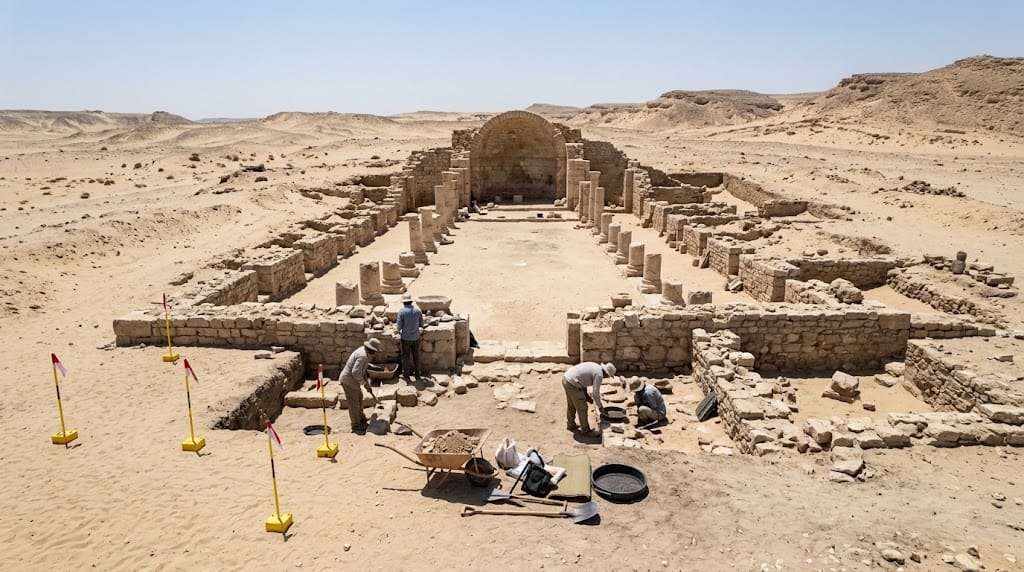
In 2024, archaeologists working in Ain Shams near Cairo uncovered a substantial early Christian basilica. This wasn’t some tiny structure—it was a real basilica, with multiple chambers, sophisticated architectural planning, and evidence that considerable resources went into building it. We’re talking 4th-5th century CE, when Christianity was still establishing itself.
What got people excited wasn’t just the structure itself. It was the context. This basilica had been built on top of a Greco-Roman settlement. That means the Christian community didn’t pick a random empty lot. They chose a place that was already established as a gathering point, already had infrastructure, already mattered to the community. That’s strategic. That’s showing you understand the human landscape you’re moving into.
The artifacts found around this church were incredible—pottery that helped date the structure, Greek and Coptic inscriptions that tell us who used this space and what they believed, liturgical vessels that show exactly how they practiced their faith. Real objects that real people touched. You can hold those and think about the hands that held them centuries ago.
Also Read :- Ancient Egyptian Kohl: How Daily Eyeliner Was Really Preventive Medicine, Not Vanity
Luxor: Churches Next to the Gods
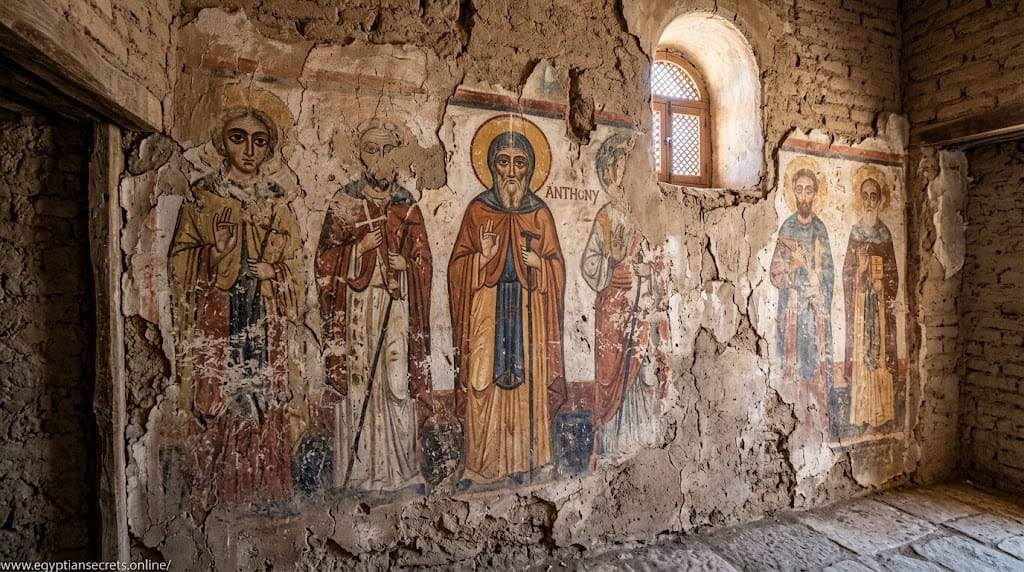
The Luxor discoveries hit different for me, honestly. In one of the world’s most iconic archaeological sites—the Temple of Karnak, one of the grandest pharaonic temples ever constructed—archaeologists found churches. Multiple churches. Built centuries after the pharaohs, when Christianity had become the dominant religion.
But here’s what’s wild: some of these churches weren’t built far away from the temple. They were built literally adjacent to it. In some cases, they partially incorporated existing structures into their design.
Think about what that means. A Christian community, centuries after pharaonic Egypt had faded into history, didn’t see the massive Temple of Karnak and think “we should build elsewhere.” They looked at that monumental space and thought “this is the center of our city. This is where people gather. We’ll build our church here.” They were reclaiming the spiritual center of their community.
Excavations found altar stones, inscribed crosses, liturgical vessels, and Coptic inscriptions. Concrete evidence that people were worshipping here, that this mattered to them, that they were passing their faith to their children in these spaces.
Alexandria: Churches Beneath the Sea
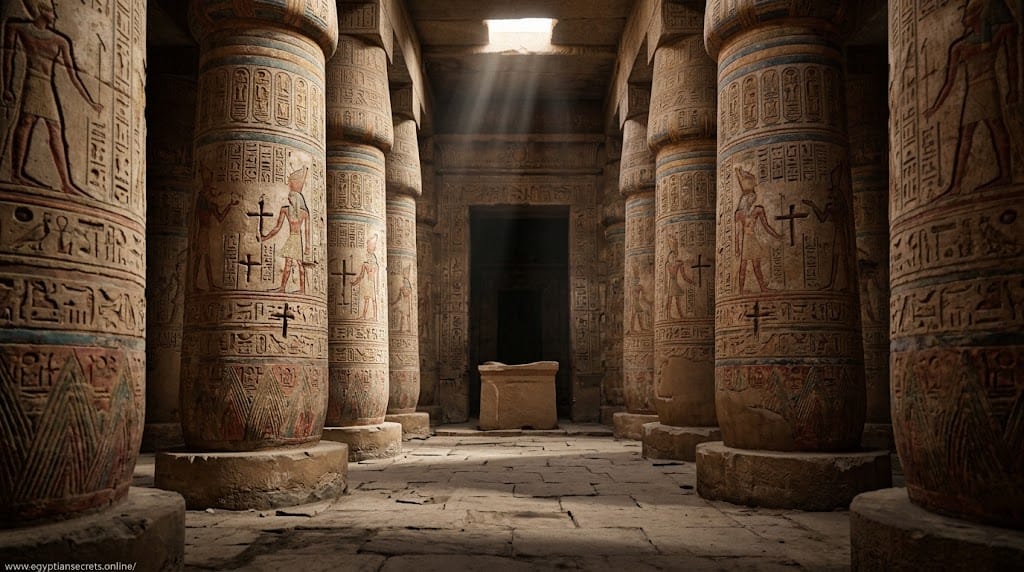
Some of the most mysterious discoveries are happening underwater in Alexandria’s harbor. As archaeologists have explored submerged structures, they’ve found what appear to be substantial basilicas beneath the water—victims of the subsidence that’s slowly claiming Alexandria.
This is significant because Alexandria was a major Christian center. Theologically important, culturally influential. The evidence of substantial architecture in the harbor suggests that Alexandria’s Christian heritage was just as architecturally impressive as its Greco-Roman and Islamic-era heritage. This is a city with layers upon layers of faith.
Aswan and Beyond: Christianity Spreading South
South of Aswan, in Nubian territory, excavations reveal churches with different architectural styles than those in Egypt proper. These discoveries are crucial for understanding how Christianity spread not just within Egypt but southward along the Nile into African territories.
It’s like watching Christianity move geographically, adapting to different landscapes, different cultures. Each region putting its own stamp on the religion.
So When Did All This Happen? The Timeline Question
Here’s where it gets complicated—in a really interesting way.
For years, the standard scholarly answer was something like: “Christianity reached Egypt gradually, starting late 2nd century, really picked up in the 3rd century, and by the 4th century it was the dominant religion.” This was based mainly on written sources—historical accounts, theological writings, that kind of thing.
But archaeology has this annoying habit of complicating neat timelines.
Some churches being discovered are older than we expected. Others suggest Christian communities were more established and geographically dispersed earlier than the written sources suggest. The presence of elaborate basilicas indicates resources, organization, and population—suggesting Christianity wasn’t a small minority religion but rather something with real institutional power.
And here’s something fascinating: some inscriptions in these churches are in Greek, while later churches use Coptic (the native Egyptian language). This shift in language tells you about how the religion was transforming. Initially, maybe brought by Greek-speaking Mediterranean traders and settlers. Over time, becoming more Egyptian, using the local language, becoming truly embedded in Egyptian culture.
It’s like watching a foreign religion become native before your eyes.
By the 5th-6th centuries, when we find elaborate churches with Byzantine architectural influences, Christianity is clearly the dominant religion in Egypt. But the path to get there? That’s way more interesting and complex than any simple timeline can capture.
The Architecture Tells Its Own Story
I love what you can learn just by looking at how these churches were built. It’s like reading a history book written in stone.
The earliest churches—those from the 3rd-4th centuries—they’re pretty simple. Sometimes they’re literally just one room that might have originally served a different purpose before being converted to church use. No elaborate features. No fancy decorations. Just a space for a community to gather.
Then gradually, over time, you start seeing sophistication increase. Basilica-style churches with apses (those semicircular chambers where altars go), multiple rooms, decorated entrances. These churches required planning. They required money. They required a community with resources and commitment.
By the 5th-6th centuries, especially in major cities, churches show Byzantine influences—domed structures, intricate mosaics, sophisticated interior divisions. These look like they were built by architects who’d studied how to make impressive spaces. They look confident.
And then there’s the adaptive reuse thing, which is genuinely clever. Sometimes a team would look at an existing structure—maybe an old Greco-Roman building or even a repurposed pharaonic temple—and think “we can work with this.” They’d modify it, orient it correctly (Christians traditionally faced east for prayer), create an apse where an altar could go, subdivide it into usable spaces.
It’s pragmatic. It’s resourceful. It shows communities working with what they had.
Multiple Faiths, One Landscape: How Religious Change Actually Happened
One of my favorite things about these discoveries is what they tell us about religious coexistence and change.
Because here’s the reality: religious transformation in the ancient world wasn’t usually a dramatic event. It wasn’t one day everyone was worshipping pharaonic gods and the next day everyone was Christian. It was gradual. It involved compromise. It involved new communities building alongside old ones. It involved adaptation.
The archaeological evidence shows this playing out in space. You have a pharaonic temple, still standing. You have Greco-Roman structures. You have Christian churches. Sometimes in the same settlement, sometimes in the same building complex, at different periods.
Were these communities living peacefully together? Sometimes, probably. Were there conflicts? Probably, at certain points. Did some churches deliberately replace temples as a statement that Christianity had won? Possibly. Did some communities just pragmatically reuse existing structures because they were available? Almost certainly.
The truth is probably all of these things at different times and places. Religious change in real history is messier than any single narrative can capture.
What’s remarkable is that the archaeological evidence shows this—not as abstract history, but as the actual lived experience of people making choices about where to worship, how to coexist, what traditions to maintain.
How We Know All This: The Technology That Made It Possible
Honestly, a lot of these discoveries wouldn’t have happened without advances in how archaeologists work.
Ground-penetrating radar is genuinely cool. You basically point it at the ground, and it uses waves to detect changes in soil density. Structures have different densities than surrounding soil. So walls, floors, architectural elements show up. You can map out a site before you ever dig into it. This saves massive amounts of time and reduces damage to sensitive sites.
Satellite imagery and LiDAR (light detection and ranging) let you see settlement patterns across huge areas. You can identify potential sites without even being there in person.
Then the dating technology—thermoluminescence dating of pottery is really accurate. Carbon-14 dating of organic materials is more precise than it used to be. Inscription analysis helps establish chronology. Artifact style analysis connects objects to specific periods.
All of this together means archaeologists can be way more targeted. Instead of conducting massive general excavations hoping to stumble onto something, they can use remote sensing to identify likely areas, then carefully excavate exactly what they need to document and understand.
The result? We’re discovering more in five years than we might have discovered in fifty years with older methods.
Coptic Christianity: Egypt’s Own Kind of Faith
Understanding these churches means understanding Coptic Christianity, which is genuinely fascinating.
Coptic Christianity isn’t just “Christianity that exists in Egypt.” It’s a distinct Christian tradition with its own theology, its own liturgical practices, its own language. The word “Coptic” itself comes from the Greek word for “Egyptian”—these are literally Egyptian Christians, with a tradition shaped by Egyptian culture and history.
The Coptic Church developed theological positions that sometimes differed from Byzantine or Western Christianity. The liturgical language was Coptic, not Greek or Latin, which created a separate spiritual and cultural world.
These churches being unearthed? They’re the physical foundation of that tradition. Structures where Coptic Christianity literally developed and took root. Which means these aren’t just archaeological artifacts. For the Coptic Christian communities that exist in Egypt today—and they do exist, and they’re thriving in some areas—these discoveries are deeply personal. They’re connecting to ancestors. They’re claiming heritage. They’re saying “we’ve been here, we’ve been practicing our faith here, continuously, for nearly two thousand years.”
That’s powerful.
Why This Changes How We Understand Egypt
Here’s what I think is really significant about these discoveries, beyond just the cool factor of finding old churches.
They force us to question this narrative we’ve inherited about Egypt. The story went: ancient Egypt was incredibly advanced and magnificent, then it declined, then… nothing much happened worth paying attention to. Christian Egypt disrupts that story. It says: “actually, while pharaonic civilization was fading, something new and just as significant was emerging.”
These discoveries show that Egypt wasn’t a civilization that peaked and then faded into irrelevance. It transformed. It adapted. It became something different while maintaining continuity with its own past.
That’s a more interesting story than just “rise and fall.”
Additionally, these discoveries illuminate something scholars really care about: how religious and cultural change actually happens in human societies. Not through sudden conquest or instant conversion, but through gradual adaptation, coexistence, building on existing infrastructure, communities making pragmatic choices about their spiritual lives.
And finally, these discoveries connect Egypt not to isolation but to broader networks. The Greek inscriptions, the Byzantine architectural influences, the theological positions connected to larger Christian debates—all of this shows Egypt engaged with the wider Mediterranean and Christian worlds. Egypt was part of a bigger story, not separate from it.
The Challenge of Preservation: Keeping These Churches Alive
Here’s the tricky part: finding these churches is only half the work. Keeping them intact is harder.
Many sites are threatened. Urban development can destroy them. Water damage is constant in Egypt’s climate, especially for structures built from mudbrick (which was common). Agricultural use of land can disturb sites. Even tourism, if not carefully managed, can damage fragile structures.
Egyptian authorities have been working on preservation, and international organizations have helped. Digital modeling and photogrammetry create detailed 3D records of sites before they deteriorate further. Some structures have been carefully moved to museums or protected archaeological zones.
But honestly? Resources are limited. Many sites are still partially buried or inadequately protected. Some structures we know existed are now in worse condition than they were ten years ago.
This is where it gets real. These aren’t just historical curiosities. They’re fragile human artifacts that could be lost. There’s an urgency to documenting, preserving, and understanding them while they still exist.
Living Faith, Ancient Churches: Egypt’s Coptic Christians Today
This is something important to recognize: these churches aren’t just ancient history. They’re connected to living communities.
Coptic Christianity persists in Egypt today. There are Coptic Orthodox churches in Cairo, Alexandria, and other cities. There are Coptic Christian communities that trace their spiritual lineage directly back to these ancient churches being unearthed. This is a living faith tradition with nearly two thousand years of history.
When these ancient churches are discovered, it matters to these communities. It’s not just academic. It’s personal. It’s heritage. It’s identity.
Some Coptic communities have participated in archaeological work on these sites. They’ve supported preservation efforts. For them, rediscovering these churches is reclaiming a part of their own history that had been buried—literally and figuratively.
This is something I think gets overlooked when we talk about archaeology as pure academic pursuit. But the most meaningful archaeology connects past to present, connects to people whose heritage is being studied.
Frequently Asked Questions (FAQ)
Q: How many churches have actually been discovered?
A: Dozens have been substantially excavated and documented in the past twenty years. Many more have been partially identified. New discoveries are happening regularly. It’s honestly hard to give an exact number because the work is ongoing.
Q: Were these discoveries recent?
A: The accelerated pace of discoveries is recent—really the last ten to fifteen years. But archaeologists have been finding evidence of Christian Egypt for much longer. It’s just that recent technology and more focused research attention have revealed the scale of what’s there.
Q: Did Christians deliberately build on top of pharaonic temples?
A: Sometimes probably yes, sometimes probably no. In some cases, it seems intentional religious replacement. In others, it seems more like pragmatic reuse of existing structures. Different sites probably have different stories.
Q: Do these churches still have religious services?
A: Some are in museums or inaccessible because of their depth. A few have been restored and are used occasionally for prayer or services, especially in areas with Coptic Christian communities. But most are archaeological sites now, not active places of worship.
Q: How accurate are the dating methods?
A: Pretty accurate, honestly. Multiple dating methods cross-check each other. Pottery analysis, carbon-14 dating, inscriptional evidence, stratigraphic analysis (the layer sequence of excavation)—when they all point to the same period, archaeologists can be confident about dates.
Q: What was the biggest surprise these discoveries revealed?
A: Probably how early and how extensive Christian architecture was in Egypt. The sophistication and scale of some churches suggests Christianity was more established and institutionally powerful than traditional historical narratives suggested.
Q: Are these churches being preserved?
A: Preservation efforts are ongoing but resource-limited. Some sites are better protected than others. There’s a genuine urgency to document and preserve what we can.
Conclusion: A Story We Almost Missed
Standing at these excavation sites, brushing sand away from stones that haven’t seen daylight in fifteen hundred years—that’s genuinely moving. You’re reconnecting with human history. With people who gathered in these spaces, who believed things, who built things to last.
These churches being unearthed across Egypt are reshaping our understanding of Egypt itself. They’re saying that Egypt’s story didn’t end with the pharaohs. It transformed. It became something new while maintaining connection to its own past. It produced a unique Christian tradition that survives to this day.
And they’re reminding us that history is stranger and more interesting than the clean narratives we inherit. It’s messier. It involves real people making choices. It involves faith and pragmatism and coexistence and transformation. It involves sacred spaces being repurposed and reimagined. It involves civilizations building on top of each other.
As excavations continue, as technology reveals more, as more churches are carefully unearthed and preserved, Egypt’s story gets richer and more complex. These are discoveries that matter—not just for scholars in academic journals, but for anyone curious about how human civilizations actually work, how faith shapes societies, how the past connects to the present.
Beneath the sand of Egypt, the churches are still waiting to tell their stories. And archaeologists are finally listening.
1 Comment