

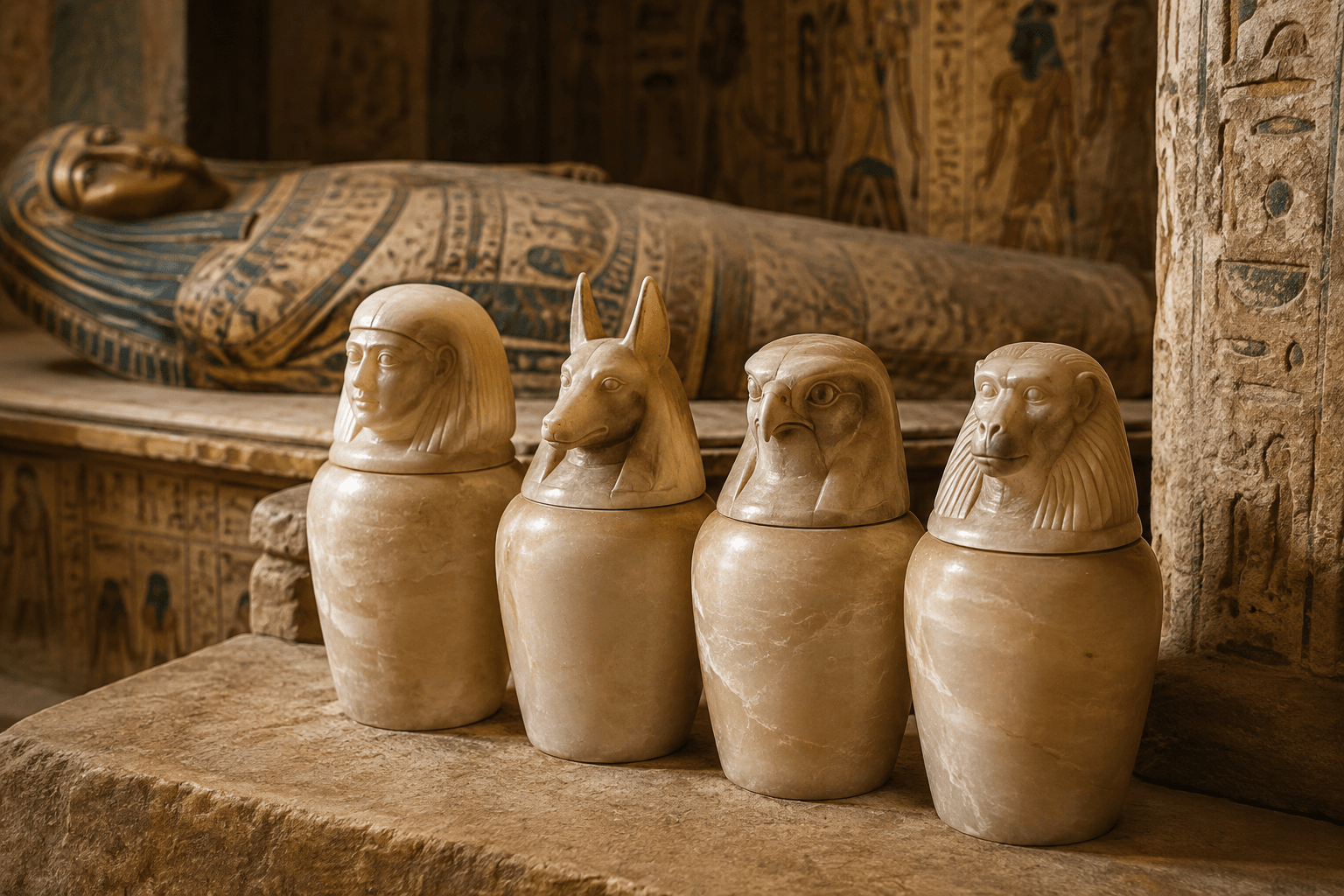
Ancient Egypt funerary jars protected organs for the afterlife. Discover what was inside these sacred vessels, why Egyptians valued them, and what archaeologists found. Egyptian beliefs about the afterlife are set out in our overview of the religion of ancient Egypt.
Introduction
Imagine you’re an ancient Egyptian preparing for death. You believe—truly believe—that you’ll need your body intact in the afterlife. But there’s a problem: the mummification process requires removing your internal organs. So what do you do with them? The wider process is covered in our guide to ancient Egyptian mummification.
You place them in beautiful stone jars. These protective deities are covered in our guide to the ancient Egyptian gods.
Specifically, you place them in what we call ancient Egypt funerary jars. These weren’t decorative pieces you’d display in your living room. They were sacred vessels holding the most vital parts of you—your organs, your essence, your connection to the eternal life you believed awaited.
For centuries, these jars sat in Egyptian tombs, preserved in darkness, protected by ritual and stone. And when archaeologists finally opened them thousands of years later, they found something remarkable: evidence of a civilization’s most profound beliefs about death, the body, and what happens after we die.
Funerary jars are one of those artifacts that seem small until you understand what they meant. Then suddenly, they become windows into how an entire civilization understood existence itself.
Let me walk you through what these jars actually were, why they mattered so much, and what they’re still teaching us about ancient Egypt.
What Exactly Is an Ancient Egypt Funerary Jar?
Okay, let’s start with the basics, because the terminology can get confusing.
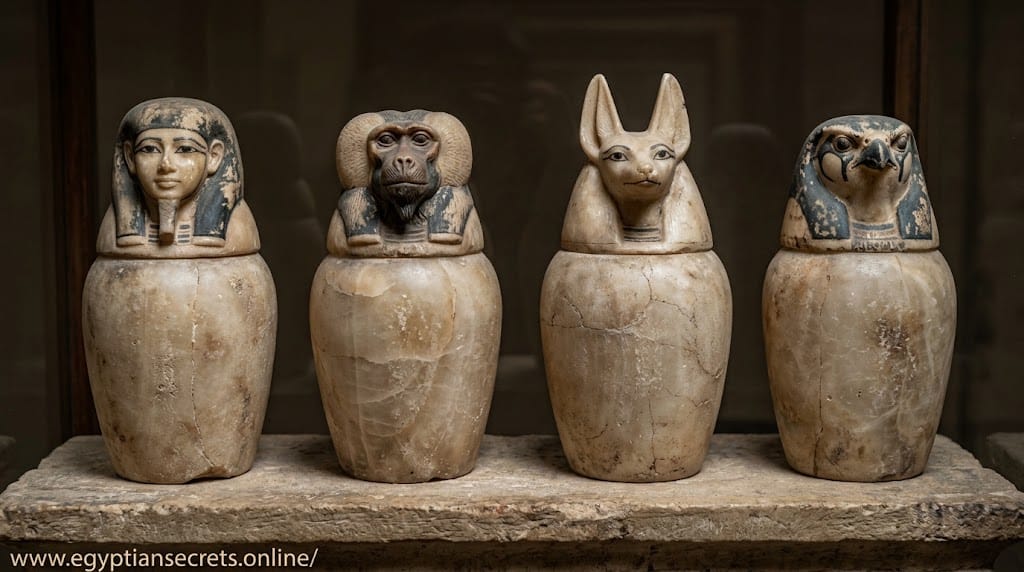
An ancient Egypt funerary jar is a container—usually made of stone, though sometimes ceramic—that was used specifically for storing organs during the mummification and burial process. The most common name you’ll hear is “canopic jar,” which comes from the Greek city of Canopus. But that name is actually kind of misleading, because it’s based on a myth rather than historical accuracy. Egyptians themselves called these vessels by different names depending on their purpose and the period in history.
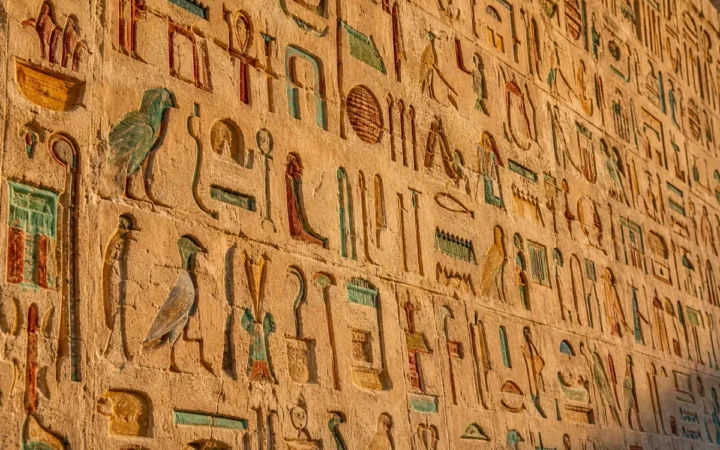
Here’s what makes these jars distinctive: they’re not just any container. They’re specifically designed for burial, decorated with religious symbols, often inscribed with hieroglyphics that identify whose organs are inside and what deity protects them. They’re functional, yes—but they’re also deeply spiritual objects.
A typical funerary jar stood maybe 6-12 inches tall, though some were larger. They were usually made from limestone, alabaster, travertine, or faience (a glazed ceramic). The lids were carefully fitted and sometimes sealed. Many had stoppers carved to represent specific gods or goddesses.
What’s fascinating is that these jars were mass-produced in some periods. That might sound odd—you’d think something this sacred would be individually crafted. But archaeological evidence shows that potters and stone workers had established patterns and forms they repeated, suggesting these were created with some standardization while still maintaining individual touches.
Why Egyptians Actually Needed Funerary Jars: The Afterlife Belief
This is where it gets really interesting, because you can’t understand funerary jars without understanding Egyptian beliefs about death and the afterlife.
Ancient Egyptians didn’t see death as an ending. They saw it as a transition. The body would die, yes, but the person—the spiritual essence—would continue on. To make that transition successfully, to function in the afterlife, you needed your body intact. This wasn’t metaphorical. It was literal. Egyptians believed that the physical body was essential for eternal existence.
But here’s the problem that creates the need for funerary jars: mummification requires removing internal organs. The process of preserving the body—removing moisture, treating the skin, wrapping in linen—it works better without the organs decomposing inside. So the organs had to come out.
But they couldn’t just be thrown away. That would compromise your ability to function in the afterlife. Your organs needed to be preserved, protected, and kept close to your body. So they were placed in funerary jars.
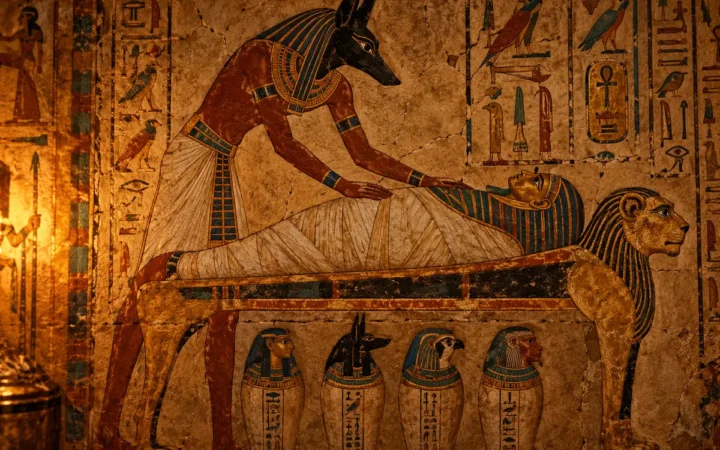
Each jar protected a specific set of organs, and each was watched over by a specific deity. Your lungs went into one jar, protected by one god. Your stomach went into another, protected by another god. Your intestines and liver had their own jars.
This wasn’t random. It was systematic. It was theology expressed through objects. Every jar, every deity, every protection spell hieroglyphically inscribed on the jar—it all came together to ensure that when you reached the afterlife, you’d be complete. Protected. Ready to continue existing.
This is why funerary jars weren’t luxury items. They were essential. You couldn’t afford to not have them, if you wanted to function in the afterlife. If you were wealthy, your jars might be made of alabaster and elaborately decorated. If you were ordinary, they might be simpler, made of limestone. But everyone who could afford any kind of decent burial had funerary jars.
Inside the Jar: What Actually Was Stored
Let’s talk about what was actually inside these jars, because it’s both practical and deeply spiritual.
The primary contents were organs—specifically, the organs that Egyptians believed were most important for the afterlife. Different periods had different conventions, but generally:
The lungs went into one jar, typically protected by the god Imsety (or sometimes shown as Shu). In some representations, this deity had a human head.
The liver and gall bladder went into another jar, typically protected by Duamutef, often represented with a jackal head. The liver was considered the seat of emotions and will—incredibly important for functioning in the afterlife.
The stomach and intestines went into a third jar, protected by Kebehsenuef, often shown with a falcon head. The digestive system was thought to be central to sustaining life.
The small intestines sometimes had their own jar, or might be combined with the stomach.
Now, here’s something important: the brain and heart were NOT placed in jars. The heart was left in the body because Egyptians believed it was the seat of intelligence and memory. The brain was often extracted during mummification but basically discarded—they thought it was useless. I mean, they were wrong about that particular detail, but their reasoning made sense given what they could actually observe.
Beyond organs, jars sometimes contained other materials. Natron (the salt used in mummification) might be placed in jars. Sometimes herbs or spices were added, possibly for preservation, possibly for spiritual protection. Some jars contained rolls of papyrus with spells and protective incantations. The exact contents varied by period, by wealth, by regional customs.
What’s remarkable is that when archaeologists open these jars today—carefully, respectfully, scientifically—they find that preservation is astonishing. Wrapped in natron, sealed in stone, protected from moisture and decomposition, organs can remain recognizable after thousands of years. Organic material that should have disintegrated centuries ago is still there, still analyzable.
This tells us something: the ancient Egyptians understood preservation deeply. They understood how to protect things from decay. Whether their understanding was scientific or magical, it worked.
The Artistic Side: How Funerary Jars Were Made and Decorated
Beyond function, funerary jars were objects of beauty and artistry.
The craftsmanship was genuinely impressive. A funerary jar made from alabaster required careful stone selection and precise carving. The stone had to be dense enough to hold contents, sculptable enough to form into the jar shape, and aesthetically pleasing—because these objects were meant to be seen. They weren’t hidden. They were displayed in tombs where family members and priests would see them during burial rituals.
The lids were particularly significant. Many jar lids were carved to represent the heads of protecting deities. A jackal head for Duamutef, a falcon for Kebehsenuef, a human head for Imsety. These weren’t just decorative—they visually communicated spiritual protection. You’d open the jar and see a god’s face protecting your organs.
The inscriptions carved into jars were equally important. Hieroglyphic texts would typically include:
- The name of the deceased
- The name of the protecting deity
- Protective spells and incantations
- Sometimes the name of the person who made the jar
- Dates and titles
These inscriptions weren’t just informational. They were protective magic. The Egyptians believed that writing something made it real, made it functional in the spiritual realm. So the inscriptions were as important as the physical contents.
Decoration varied by period and wealth. Royal funerary jars were more elaborate—sometimes made from precious stones, covered in gold leaf, intricately carved. Commoner jars were simpler—basic stone, functional decoration, simpler inscriptions.
But whether simple or elaborate, every funerary jar served the same purpose. Every jar communicated the same message: these organs are protected, this person is prepared for the afterlife, these divine forces will ensure continuity of existence.
Also Read :- Ancient Egypt Churches Unearthed: The Hidden Christian Story Nobody’s Talking About
Types of Funerary Jars: How They Evolved Over Time
Here’s something interesting: funerary jars weren’t always exactly the same. They evolved over Egypt’s long history.
Early Period (around 1300-1100 BCE): Jars were often simpler, sometimes just functional containers without elaborate deity representations. They might have been made of ceramic rather than stone.
New Kingdom (1550-1070 BCE): This is when we see the most elaborate funerary jars. Limestone and alabaster jars with distinctive deity heads on the lids. Careful inscriptions. Sophisticated decoration. This period represents peak sophistication in funerary jar design.
Late Period and Ptolemaic Era (664-30 BCE): Jars became more standardized but sometimes less elaborate. Mass production increased. Some jars had more generic decorations rather than specific deity representations.
The evolution tells a story about how Egyptian religious practices changed, how wealth and resources affected burial practices, how craftspeople refined their techniques over time.
There were also regional variations. Jars from Upper Egypt (southern) sometimes had different styles than those from Lower Egypt (northern). Jars from Memphis looked different than those from Thebes. These regional variations actually help archaeologists date and place artifacts—they can look at a jar and say, “This came from Luxor, this period, this workshop probably.”
Archaeological Discoveries: What Unopened Jars Tell Us
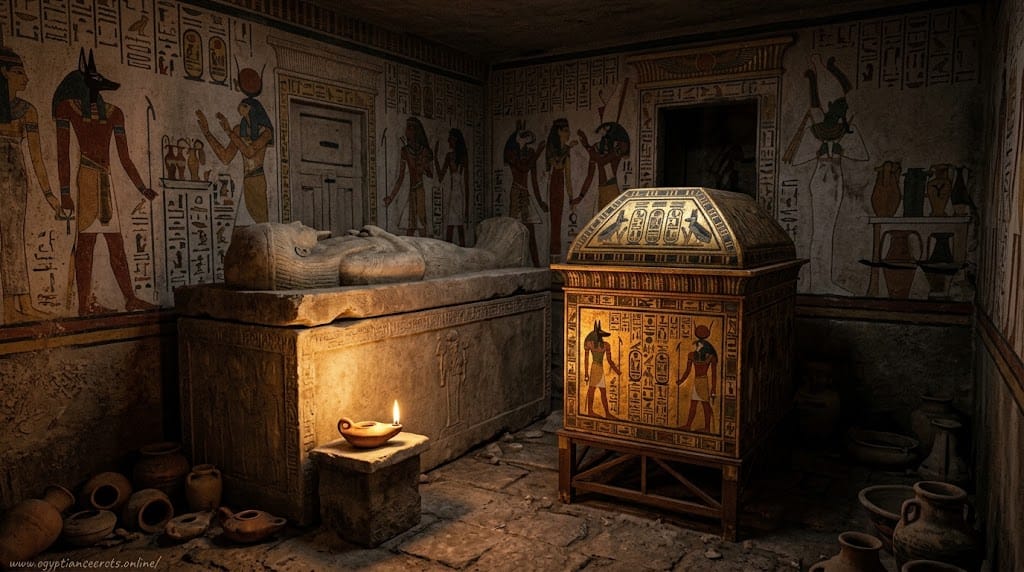
Here’s where it gets really dramatic. Because some funerary jars were never opened in antiquity. They were sealed when placed in tombs and remained sealed for thousands of years.
When archaeologists carefully open these jars today, they’re literally looking at the last moment the jar was closed. They’re seeing what the Egyptians placed inside and then sealed forever. It’s like opening a time capsule.
Some of the most significant discoveries:
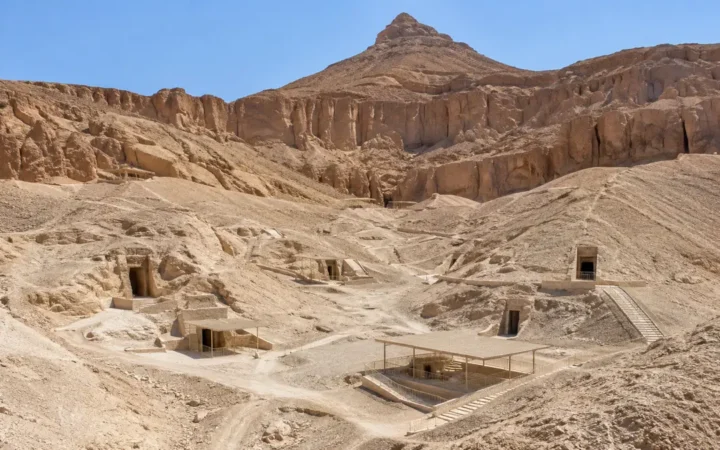
Tutankhamun’s Funerary Jars: When Howard Carter opened Tutankhamun’s tomb in 1922, he found four beautiful canopic jars containing the young pharaoh’s preserved organs. These jars were elegant—carved of calcite (Egyptian alabaster), with lids carved as heads of the protecting deities. They were among the most celebrated artifacts from that tomb.
Tomb KV62 Analysis: Modern analysis of organs from Tutankhamun’s jars revealed information about the young pharaoh’s health, his family relationships (through DNA analysis), even details of his mummification process. The jars, 3,300 years old, still held recognizable organ tissue.
Worker Community Jars: Archaeologists have also found funerary jars from ordinary people—not pharaohs, just workers. These simpler jars reveal that the practice was widespread. It wasn’t just royal. It was cultural.
Egyptian Museum Collections: Cairo’s Egyptian Museum holds hundreds of funerary jars. When scholars examine these collections, they gain insights into regional practices, economic status, religious beliefs across different periods and locations.
What Funerary Jars Reveal About Egyptian Society
Beyond their immediate spiritual function, funerary jars tell us massive amounts about how ancient Egyptians thought and lived.
Social Hierarchy: Wealthy people had elaborate jars. Ordinary people had simpler ones. This reflects wealth distribution and social status. But the fact that even ordinary people had funerary jars suggests that the belief in the afterlife and the need for protection wasn’t limited to elites. It was cultural. It was widespread.
Craft and Commerce: The production of funerary jars was an actual profession. People made them professionally. Workshops produced them. This suggests a real economy around death and burial—which makes sense, given that death was universal and elaborate burial was a cultural value.
Religious Belief: The specific choices about which organs went to which deities tells us about Egyptian theology. The Egyptians had detailed beliefs about which gods protected which bodily functions. These weren’t random associations. They reflected sophisticated religious thinking.
Practical Knowledge: The fact that seal techniques were so effective, that preservation worked so well, tells us Egyptians understood chemistry and preservation at a practical level. Whether they understood the theory, they understood the practice.
Continuity and Change: By tracking funerary jar styles across centuries, archaeologists can see how religious practices evolved, how artistic styles changed, how economic conditions affected burial practices. Jars are durable, plentiful, and well-documented. They’re perfect artifacts for tracking long-term cultural change.
The Connection to Mummification and Burial Rituals
You can’t really understand funerary jars without understanding the entire burial process they were part of.
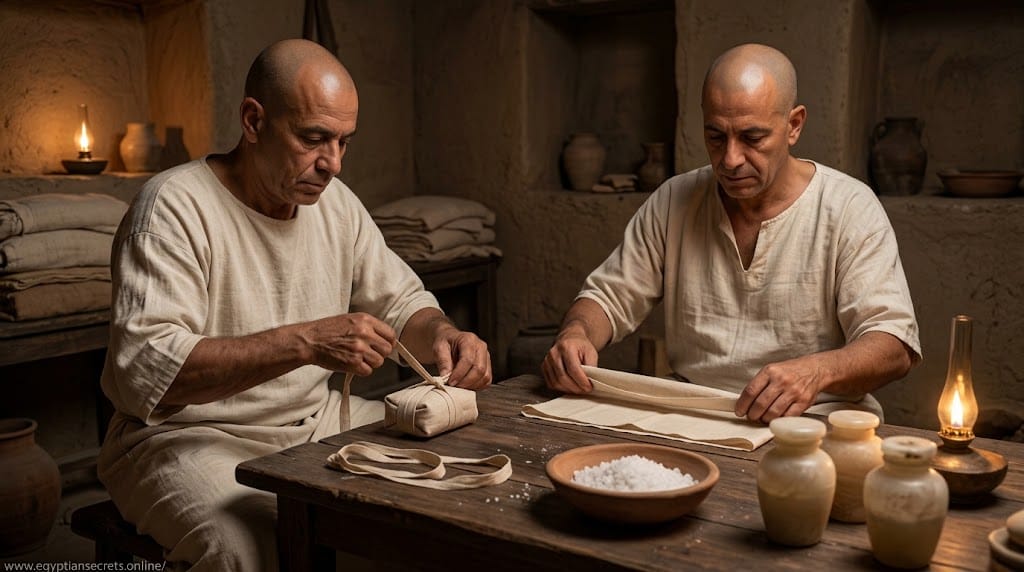
The ancient Egyptian burial process was incredibly elaborate. When someone died, their body was taken to the ibu (the place of purification). There, specialists would begin the mummification process. The body would be washed. The brain would be extracted through the nose. Internal organs would be carefully removed through an incision in the side.
As organs were removed, they were treated with natron and placed in funerary jars. Each organ would be prepared specifically—dried, sometimes treated with oils or spices, wrapped in linen strips.
The jars would then be sealed. Sometimes they were placed in a canopic chest along with the mummified body. Sometimes they were stored separately in the tomb but kept in proximity to the mummy.
The placement of these jars was ritualistic. They weren’t just thrown into tombs randomly. They were arranged with purpose. They were oriented toward specific directions. Prayers were said over them. They were positioned so they’d be accessible and visible during the burial ceremony.
This entire process—the removal, the preservation, the placement of organs in jars, the careful arrangement—it was religious ritual enacted through practical action. It was theology expressed through the care of the body.
Frequently Asked Questions (FAQ)
Q: Are funerary jars the same as canopic jars?
A: Essentially, yes, though the terminology is a bit complicated. “Canopic jar” is the Greek-derived term most commonly used in English. Egyptians used different names depending on the period and the deity protecting the jar. But they’re all funerary jars—containers used for storing organs during burial.
Q: How many funerary jars were in a typical tomb?
A: Usually four—one for each set of organs. Though some tombs had more, and some had fewer depending on period and wealth. Royal tombs were often more elaborate.
Q: What was the most important organ that went into funerary jars?
A: Egyptians valued different organs differently. The liver was considered the seat of emotion and will. The lungs were associated with breath and life. All were considered necessary for the afterlife, but if pressed, Egyptians would probably emphasize the liver as most crucial.
Q: Why didn’t the heart go into a jar?
A: Egyptians believed the heart, not the brain, was the seat of intelligence and memory. They thought the heart was essential for the afterlife self, so it was left in the body during mummification.
Q: How long do funerary jars last? Will they preserve forever?
A: Stone jars essentially last indefinitely if kept in dry conditions. That’s why so many have survived thousands of years. But the contents can deteriorate if exposed to moisture, temperature fluctuations, or oxygen after being sealed. Sealed jars in tombs preserve remarkably well. Once opened, preservation becomes more challenging.
Q: Can archaeologists identify whose organs are in a jar?
A: Often yes! Hieroglyphic inscriptions name the deceased. DNA analysis can sometimes confirm identity. The style and period of the jar provides context. Sometimes the placement in the tomb alongside other artifacts confirms identity.
Q: Were funerary jars used by all ancient Egyptians?
A: Not by everyone. Poorer people might have had simpler burials without jars. But anyone who could afford it had them. The practice spanned from at least the New Kingdom (1550 BCE) through the Ptolemaic period (ended 30 BCE).
Q: What’s the difference between Egyptian funerary jars and similar practices in other cultures?
A: The Egyptian approach was uniquely elaborate and systematized. While other cultures preserved remains, the Egyptian system of specific deities protecting specific organs, the ritualization, the artistic sophistication—that was distinctive to Egypt.
Q: Have archaeologists found jars that were never opened since burial?
A: Yes! Some jars were sealed in antiquity and not disturbed until modern archaeological excavation. These provide the most intact evidence of what Egyptians actually placed inside and how well preservation worked.
Q: Can you see funerary jars in museums today?
A: Absolutely. Major museums with Egyptian collections have them. The Cairo Egyptian Museum, the British Museum, the Louvre, the Metropolitan Museum in New York—they all have excellent collections of funerary jars you can see in person.
Conclusion: Why Ancient Egypt Funerary Jars Still Matter
Standing in a museum, looking at a limestone jar carved three thousand years ago, something shifts. You’re not just looking at an artifact. You’re looking at evidence of how humans confront mortality, how we prepare for what comes after, how we honor our understanding of what continues beyond death.
Ancient Egypt funerary jars are profound because they’re personal. They held the organs of real people. They were created by craftspeople who believed they were participating in something sacred. They were placed in tombs by families who believed they were ensuring their loved ones’ continuation into the afterlife.
The fact that we can still see these jars, still open some of them, still analyze what’s inside—it creates a connection across millennia. It’s a conversation between dead Egyptians and living archaeologists. It’s evidence that human beings have always grappled with the same questions: What happens after we die? How do we prepare? What’s worth preserving?
The ancient Egyptians answered those questions with beautiful stone jars, careful ritual, and profound faith. And thousands of years later, those answers are still here. Still visible. Still revealing what a civilization believed mattered most.
That’s why ancient Egypt funerary jars matter. They’re not just historical artifacts. They’re windows into how humans understand existence itself.
3 Comments