
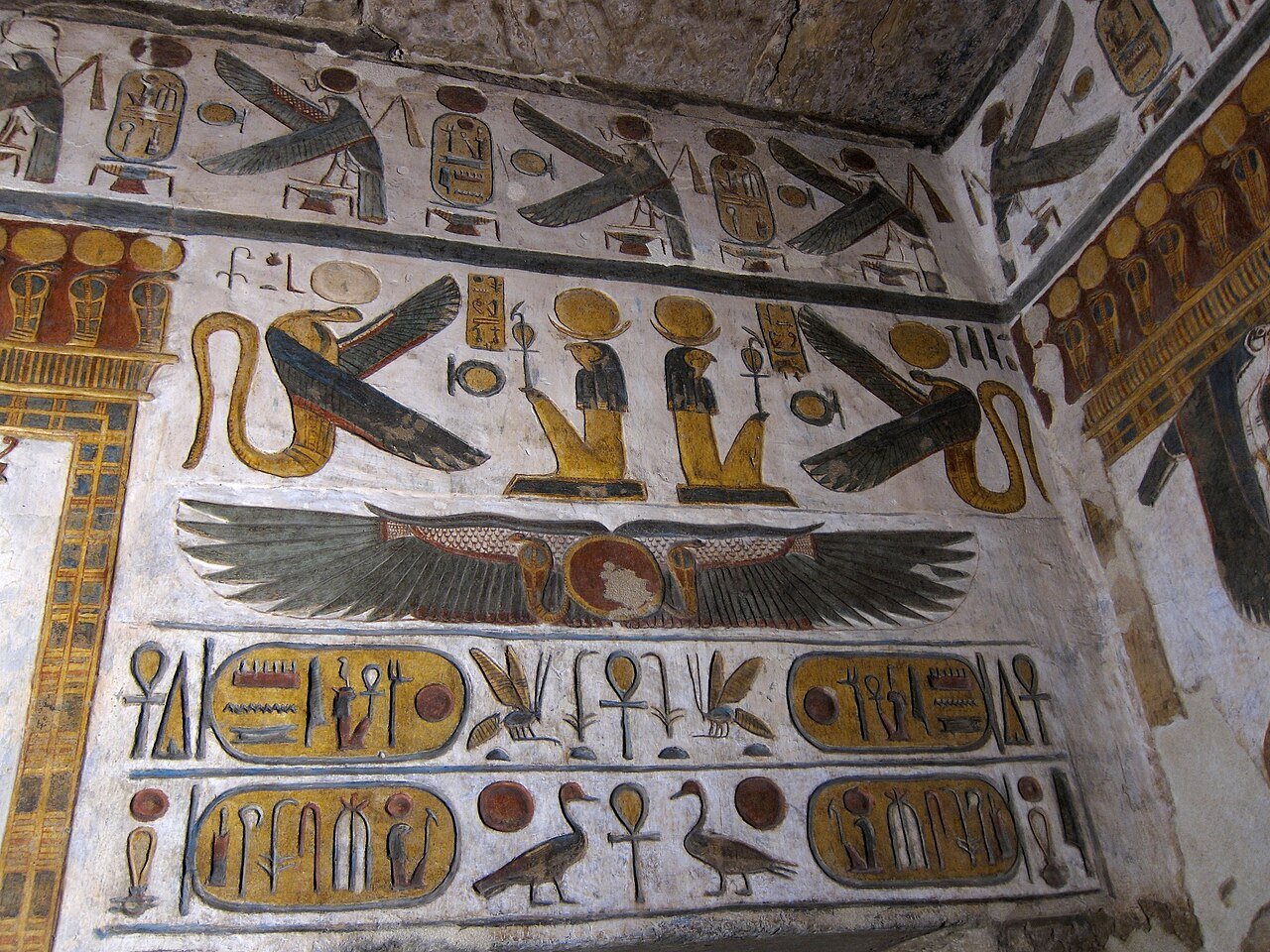
Today we picture Egyptian temples as vast, sunlit ruins full of tourists. In ancient times they were nothing like that. A temple was the house of a god, closed to almost everyone, and the deeper you went inside, the darker, quieter and more sacred it became. In the very center, in a small dark room, lived the god himself, in the form of a statue that priests woke, washed, dressed and fed every single day.
Temples were also some of the richest institutions in Egypt, with their own farms, herds, workshops and thousands of workers. Here is how an ancient Egyptian temple worked, what happened inside, who was allowed in and the best temples you can still visit today.
Egyptian Temples at a Glance
- Egyptian name: hut-netjer, “house of the god.”
- Purpose: a home for a god’s statue, where priests performed rituals to keep the god happy and the world in order.
- Two main types: cult temples for the gods (such as Karnak) and mortuary temples for dead kings (such as Medinet Habu).
- Basic layout: avenue of sphinxes, pylon gateway, open courtyard, hall of columns, and a dark inner sanctuary.
- Who could enter: priests and the king. Ordinary people usually stayed in the outer areas.
- Largest temple: Karnak in Luxor, built and expanded over about 2,000 years.
- Best preserved: the Temple of Horus at Edfu, finished in 57 BC.
What Was an Egyptian Temple For?
An Egyptian temple was not a place where a community gathered to pray, like a church or mosque. It was the earthly home of a god. Egyptians believed that the god’s spirit could live in its cult statue, and that if the god was properly housed, fed and honored, it would protect Egypt, bring the Nile flood and keep chaos away.
In theory, the pharaoh was the high priest of every temple in the land and performed all the rituals himself. In practice, priests acted on his behalf, and temple walls show the king making offerings to the gods again and again, a promise that the relationship between Egypt and its gods was being kept.
The Layout: A Journey Toward the Gods
Egyptian temples followed a remarkably consistent plan for more than 2,000 years. Walking through one was like walking back to the moment of creation.
- The avenue of sphinxes. Many temples were approached by a processional road lined with sphinxes or ram-headed statues. The avenue linking Karnak and Luxor temples runs for nearly 3 km.
- The pylon. A huge gateway of two sloping towers, decorated with giant scenes of the king smiting his enemies. Its shape echoed the hieroglyph for “horizon,” where the sun rises between two hills.
- The open courtyard. A large, sunlit court surrounded by columns, where offerings were collected and where some festival crowds could gather.
- The hypostyle hall. A forest of massive columns shaped like papyrus and lotus plants, representing the marsh that grew around the first mound of land at creation. At Karnak the hall has 134 columns.
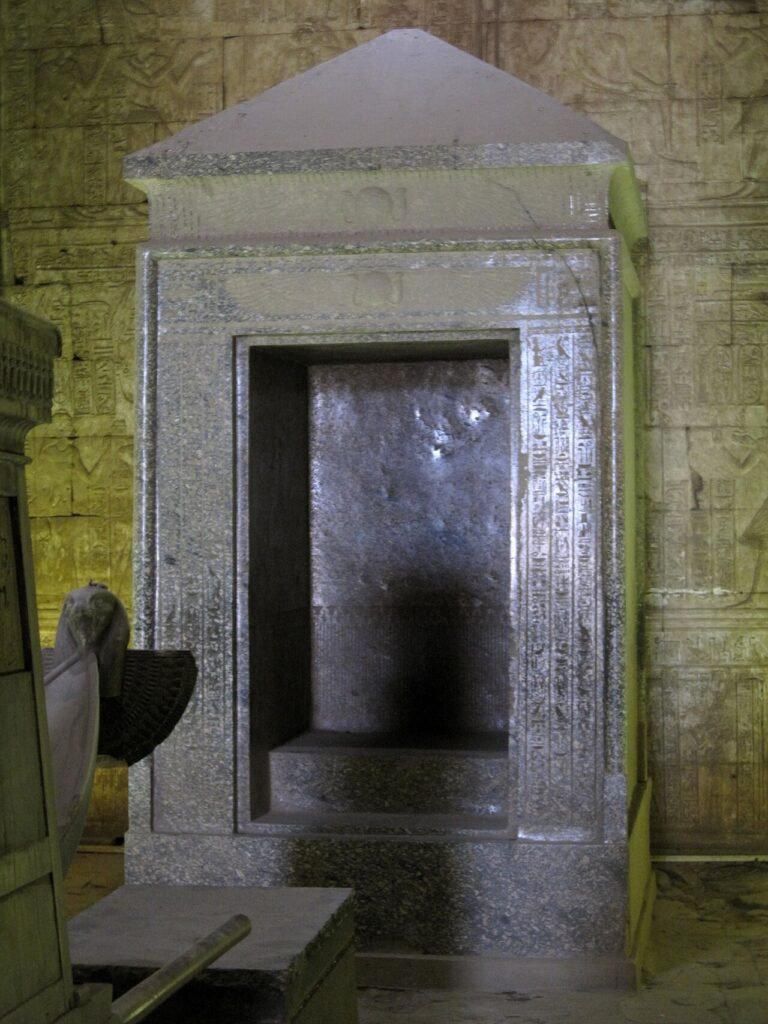
- The sanctuary. At the very back, in darkness, a small room held a stone shrine (the naos) containing the god’s statue.
As you moved inward, the floor rose and the ceiling dropped, the light faded and the doors became narrower. The sanctuary stood on the highest point, a symbol of the primeval mound that rose from the waters of chaos when the world began.
What Happened Inside: The God’s Daily Routine
Every morning at dawn, a priest approached the sanctuary, broke the clay seal on the shrine doors and opened them to “wake” the god with hymns. He then cared for the statue as if it were a living person:
- Purification: the statue was cleansed with water and incense.
- Dressing: it was clothed in fresh linen, adorned with jewelry and anointed with oils and eye paint.
- The meal: bread, beer, meat, fruit, vegetables and flowers were laid before it.
- Closing: the priest withdrew, walking backward and sweeping away his footprints, and the shrine was sealed again.
Smaller services were held at midday and in the evening. Nothing was wasted. Once the god had “eaten” the spiritual essence of the food, the offerings were taken away and shared among the priests and temple staff as their wages. Egyptologists call this the “reversion of offerings.”
Who Were the Priests?
Temple priests were called hem-netjer, “servants of the god.” Below the high priests were many lower-ranking priests known as wab, “the pure ones.” To be ritually clean, they shaved their whole bodies, washed several times a day in the temple’s sacred lake, wore only linen and white sandals, and avoided certain foods.
Most priests were not full-time. They were organized into groups called phyles, which took turns serving in the temple for one month at a time and then returned to ordinary jobs as scribes, officials or landowners. Women also served, especially as singers and musicians, and in some periods royal women held the powerful title “God’s Wife of Amun.”
Could Ordinary People Go Inside?
Mostly no. The inner parts of a temple were reserved for priests and the king. Ordinary Egyptians could visit the outer areas, leave offerings at the gates, and pray at small shrines built on the back walls of temples, sometimes carved with ears so the god would “hear” them.
Their best chance to see their god came during festivals. On these days, priests carried the god’s statue out of the temple in a small boat-shaped shrine on poles. In the great Opet Festival at Thebes, Amun of Karnak traveled to Luxor Temple along the avenue of sphinxes or by river, while crowds lined the route, music played and food and beer were handed out. People could also ask the god questions, and the movement of the shrine, dipping forward or back, was read as the god’s answer.
Temples as Businesses
Temples were among the biggest landowners and employers in Egypt. They owned farmland, cattle, boats, workshops, granaries and even mines, and employed farmers, bakers, brewers, weavers, sculptors and scribes. Kings donated land and captured treasure to the temples to win the gods’ favor.
A famous document called the Great Harris Papyrus lists the gifts Ramesses III gave to the temples during his reign, including vast herds of cattle, more than a hundred thousand workers and huge areas of farmland. By the end of the New Kingdom, the temple of Amun at Karnak controlled so much wealth that its high priests became the real rulers of southern Egypt. Learn more about how this fit into Egypt’s wider society in our guide to the social structure of ancient Egypt.
Cult Temples and Mortuary Temples
Egyptologists divide temples into two main types:
- Cult temples were homes for gods, such as Karnak (Amun), Edfu (Horus), Dendera (Hathor) and Philae (Isis).
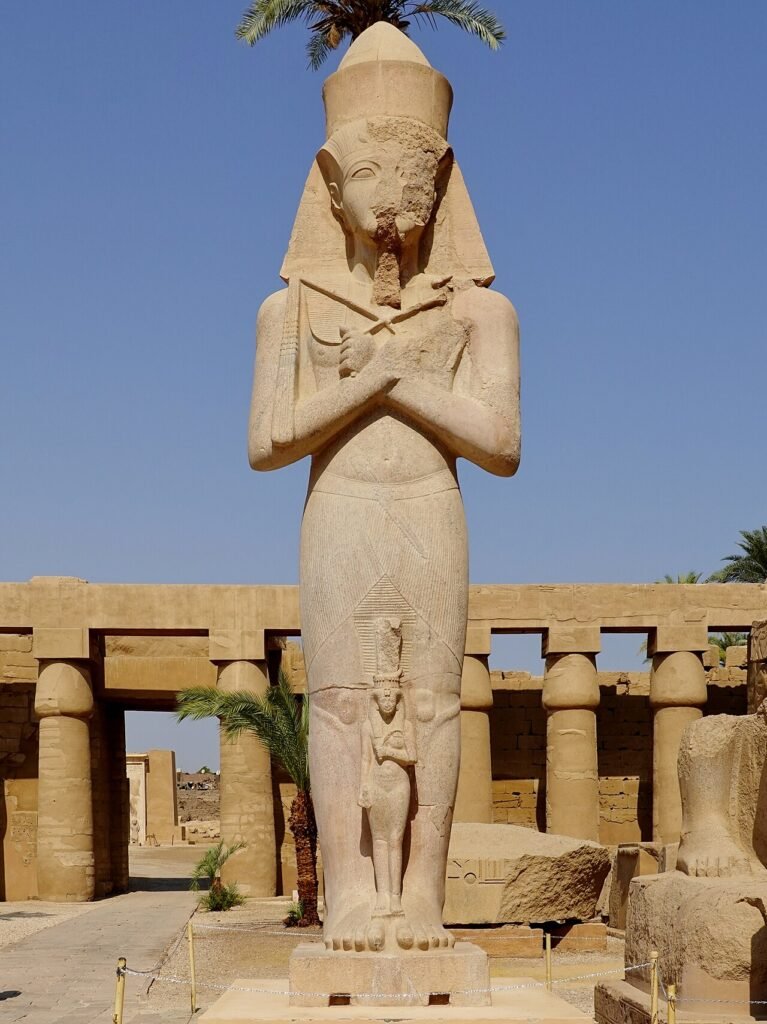
- Mortuary temples were built to keep a dead king’s memory and spirit alive with daily offerings. Kings buried in the Valley of the Kings built their mortuary temples on the edge of the farmland at Thebes, such as Hatshepsut’s terraced temple at Deir el-Bahari, the Ramesseum of Ramesses II and Medinet Habu of Ramesses III.
Famous Egyptian Temples You Can Visit
| Temple | Location | Dedicated to | Why visit |
|---|---|---|---|
| Karnak | Luxor | Amun, Mut and Khonsu | The largest religious complex ever built, with the 134-column Great Hypostyle Hall |
| Luxor Temple | Luxor | Amun | Linked to Karnak by the Avenue of Sphinxes; spectacular at night |
| Abu Simbel | Near the Sudan border | Ramesses II and the gods | Four colossal statues cut into a cliff, moved to save them from Lake Nasser |
| Edfu | Between Luxor and Aswan | Horus | The most complete temple in Egypt |
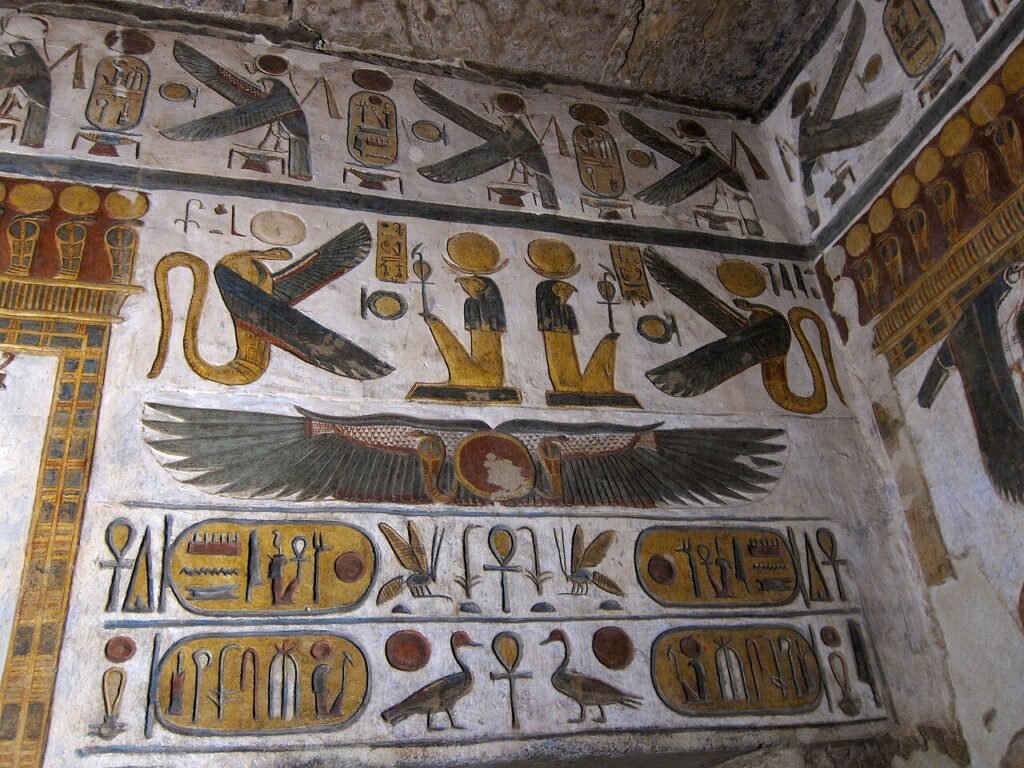
| Dendera | North of Luxor | Hathor | Brightly painted ceilings and the Dendera Zodiac chapel |
| Philae | Aswan | Isis | The last temple of the old gods, rebuilt on an island |
| Kom Ombo | North of Aswan | Sobek and Horus the Elder | A rare double temple |
| Deir el-Bahari | West Bank, Luxor | Hatshepsut and Amun | The terraced temple of Egypt’s famous female pharaoh |
Frequently Asked Questions
What was the purpose of temples in ancient Egypt?
Egyptian temples were homes for the gods, where priests cared for a god’s statue with daily rituals and offerings. Egyptians believed this kept the gods content and the world in order. Temples were also major landowners and centers of the economy.
What were the parts of an Egyptian temple?
A typical temple had an avenue of sphinxes, a pylon gateway, an open courtyard, a hypostyle hall full of columns and a dark inner sanctuary that held the god’s statue.
Could ordinary people enter Egyptian temples?
Usually only the outer areas. The inner halls and sanctuary were reserved for priests and the king. Ordinary people saw the god during festivals, when the statue was carried out in procession.
What is the largest temple in Egypt?
The Karnak Temple Complex in Luxor, dedicated mainly to the god Amun. It was expanded by pharaohs for about 2,000 years and covers more than 200 acres.
Who worked in Egyptian temples?
Priests, temple singers and musicians, scribes, farmers, bakers, brewers, craftsmen and guards. Many priests served part-time, working one month in the temple and then returning to their regular jobs.
The Bottom Line
An Egyptian temple was a model of the universe and a house where a god lived, ate and slept, cared for by priests in a daily routine that lasted for thousands of years. Its massive walls also hid one of the biggest businesses in the ancient world. To understand the beliefs behind it, read our guide to the religion of ancient Egypt, or meet the gods themselves in our guide to the ancient Egyptian gods.
Sources
- World History Encyclopedia: Ancient Egyptian Religion
- Encyclopaedia Britannica: Egyptian religion
- World History Encyclopedia: Ancient Egyptian Architecture
- UNESCO: Ancient Thebes with its Necropolis
- Richard H. Wilkinson, The Complete Temples of Ancient Egypt (Thames & Hudson, 2000)