
In a country where fewer than one person in a hundred could read and write, the scribe was one of the most important people in the room. Scribes counted the harvest, collected the taxes, recorded court cases, wrote the king’s letters, kept the temple accounts and copied the sacred texts. Without them, the government of ancient Egypt simply could not have worked.
It was also one of the best jobs a young Egyptian could hope for. Scribes did not dig canals or haul stone, they were paid well, and the cleverest among them rose to the highest offices in the land. Here is what scribes did, how they trained, what tools they used and why the Egyptians honored them for 3,000 years.
Egyptian Scribes at a Glance
- Egyptian word: sesh, “scribe” or “one who writes.”
- Job: recording taxes, harvests and censuses, writing letters and legal documents, keeping accounts and copying religious texts.
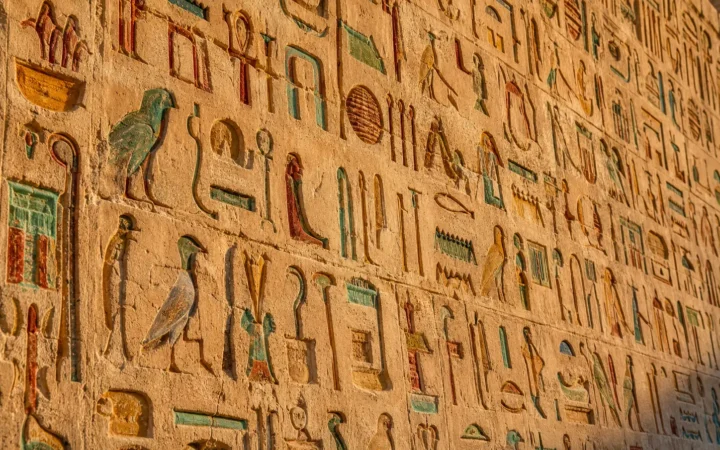
- Scripts: hieroglyphs for monuments, hieratic (a fast, joined-up script) for everyday writing, and later Demotic.
- Training: began in childhood and lasted several years of copying and memorizing texts.
- Tools: a palette with red and black ink, reed brushes, a water pot and papyrus.
- Patron gods: Thoth, god of writing, and Seshat, goddess of writing and measurement.
- Literacy: probably around 1% of the population, mostly men.
What Did Scribes Do in Ancient Egypt?
Almost every part of Egyptian life left a written record, and scribes produced it. Their work included:
- Taxes and harvests. Scribes measured fields, estimated the crop before harvest and recorded how much grain each farmer owed. Tomb paintings often show a scribe sitting with his palette while farmers bring in sacks of grain.
- Counting. They counted cattle, workers, rations and building materials. Egypt’s regular cattle counts and household lists were the closest thing to a census in the ancient world.
- Law and government. They wrote down court cases, wills, contracts and royal decrees, and kept the archives of government offices.
- The army. Military scribes recorded soldiers, supplies and the spoils of war.
- Temples. Temple scribes managed estates and workshops and copied religious and magical texts, including copies of the Book of the Dead.
- Building projects. At Deir el-Medina, the village of the royal tomb builders, scribes kept daily records of who worked, who was absent and why. One note explains a worker was off because he was “brewing beer,” another because he had been stung by a scorpion.
Some scribes specialized further, becoming doctors, architects, astronomers or accountants. Many senior officials, including viziers, began their careers as scribes.
How Did Scribes Train?
Training usually began when a boy was around 5 to 10 years old. Many were sons of scribes, but bright boys from ordinary families could also be sent to study. Lessons took place in schools attached to temples or government offices, or at home with a father or a senior official as teacher.
Students first learned hieratic, the cursive script used for everyday documents, and only later the more formal hieroglyphs carved on monuments. They learned by copying: old school exercises survive on thousands of ostraca, flakes of limestone and pieces of pottery that were cheaper than papyrus. Students copied model letters, lists of words and classic texts again and again, often with spelling mistakes still visible.
Discipline was strict. One Egyptian lesson book warns that “a boy’s ear is on his back: he listens when he is beaten.” Students also copied texts designed to keep them motivated, such as the “Satire of the Trades,” which mocks every other occupation, from the tired farmer to the smelly fisherman, to prove that being a scribe is the best life of all. You can read more about lessons and classrooms in our article on what school was like in ancient Egypt.
The Scribe’s Tools
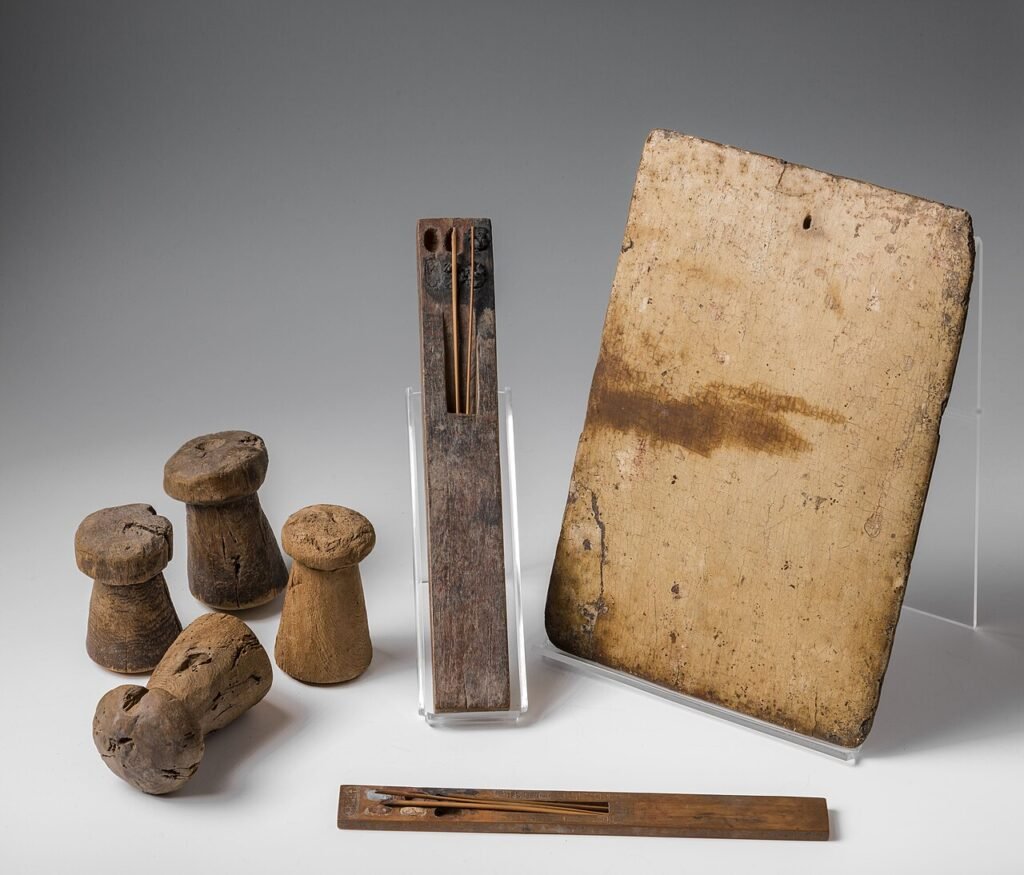
A scribe’s kit was so recognizable that the hieroglyph for “scribe” is a picture of it: a palette, a water pot and a pen case tied together.
- The palette: a long, flat piece of wood, ivory or stone with two hollows for cakes of ink and a slot for pens.
- Ink: black ink was made from soot, and red ink from red ochre. Black was used for most text; red marked headings, dates, totals and corrections, which is where our word “rubric” comes from (from Latin rubrica, “red ochre”).
- Pens: thin reeds or rushes, chewed or cut at one end to make a brush. Later, in Greek times, scribes adopted sharpened reed pens.
- Papyrus: paper made from strips of the papyrus plant, pressed together and dried. It was expensive, so it was often scraped and reused.
Before starting work, some scribes poured out a drop of water from their water pot as an offering to Imhotep, the great architect and sage who was honored as the patron of scribes.
Were Scribes Rich and Respected?
Yes. Scribes were part of Egypt’s educated elite, just below the nobles and high officials in the social pyramid. They were exempt from the heavy labor that farmers and workers were called up to do, and they were paid in generous rations of grain, bread and beer, sometimes with land as well.
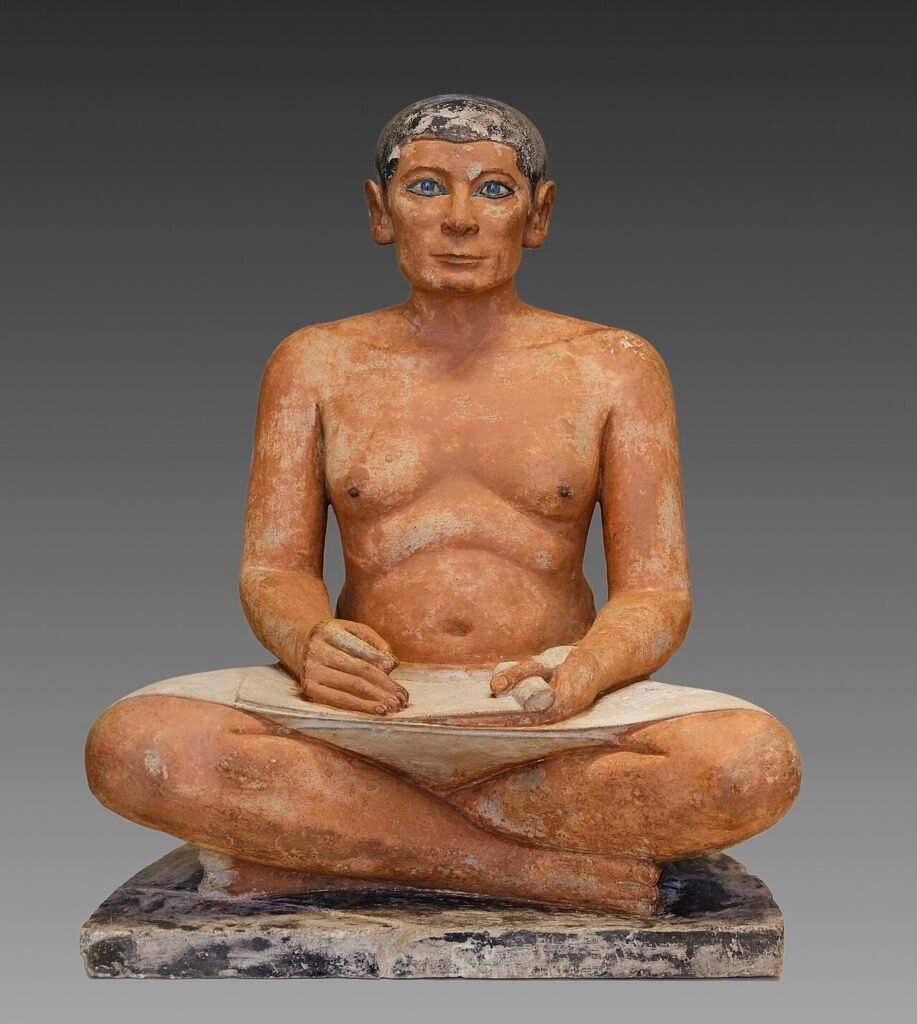
Wealthy men proudly had themselves shown as scribes. The famous Seated Scribe in the Louvre, carved around 2500 BC, shows an official sitting cross-legged with a papyrus roll on his lap, alert and ready to write. Statues like this were a way of saying: this man was educated, trusted and important.
Some scribes became famous in their own right. Amenhotep son of Hapu, a royal scribe under Amenhotep III, was later worshipped as a god of wisdom. At Deir el-Medina, the scribe Qenherkhepeshef owned a private library of papyri, including a dream book and poems, much of which survives today.
Could Women Be Scribes?
It was rare, but not impossible. A small number of women held the title “female scribe,” and some letters from Deir el-Medina may have been written by women. Royal women and priestesses were sometimes educated, and princesses are occasionally shown with scribal palettes. But almost all professional scribes were men.
The Language and Scripts Scribes Used
Egyptian scribes used several scripts over the centuries:
| Script | Used for | When |
|---|---|---|
| Hieroglyphs | Monuments, temple walls, tombs and sacred objects | About 3200 BC to AD 394 |
| Hieratic | Everyday documents, letters, accounts and literature | About 3000 BC to the Roman period |
| Demotic | Business, legal and daily writing in later Egypt | About 650 BC to AD 452 |
If you want to see how these signs worked, read our guide to Egyptian hieroglyphs and the hieroglyphic alphabet.
Frequently Asked Questions
What did scribes do in ancient Egypt?
Scribes were the record-keepers of ancient Egypt. They tracked taxes and harvests, counted cattle and workers, wrote letters and legal documents, kept temple and government accounts and copied religious texts.
How long did it take to become a scribe?
Training began in childhood and usually lasted several years. Students spent years copying texts and learning hundreds of signs before they could work as professional scribes.
Why were scribes important in ancient Egypt?
Because so few people could read and write, scribes were essential to running the government, collecting taxes, managing temples and keeping the law. Without them the Egyptian state could not function.
What tools did Egyptian scribes use?
A wooden palette with cakes of red and black ink, reed brushes, a small water pot and papyrus. For practice and rough notes they used flakes of limestone and pottery, called ostraca.
Who was the god of scribes?
Thoth, the ibis-headed god of writing and wisdom, was the patron of scribes. The goddess Seshat was also linked with writing, and the sage Imhotep was honored by scribes in later times.
The Bottom Line
Scribes were the quiet engine of ancient Egypt. Their palettes and reed brushes ran the economy, kept the law and preserved the stories and prayers we can still read today. Becoming one was the best way for an Egyptian boy to escape hard labor and rise in the world. To see their world through their own writing, start with our guide to Egyptian hieroglyphs, or write your own name with our hieroglyphics translator.
Sources
- World History Encyclopedia: The Satire of the Trades
- The Metropolitan Museum of Art: scribal palettes and writing equipment
- World History Encyclopedia: Jobs in Ancient Egypt
- Encyclopaedia Britannica: Hieratic script
- Andrea G. McDowell, Village Life in Ancient Egypt: Laundry Lists and Love Songs (Oxford University Press, 1999)