

Introduction
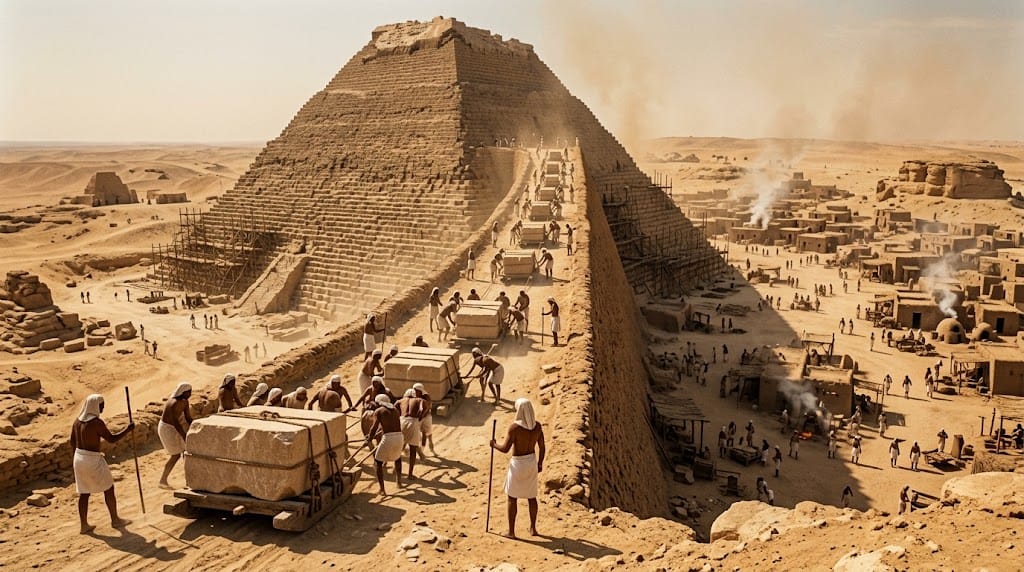
Imagine you’re standing at the base of the Great Pyramid in the year 2560 BCE. It isn’t ancient yet. It’s a construction site.
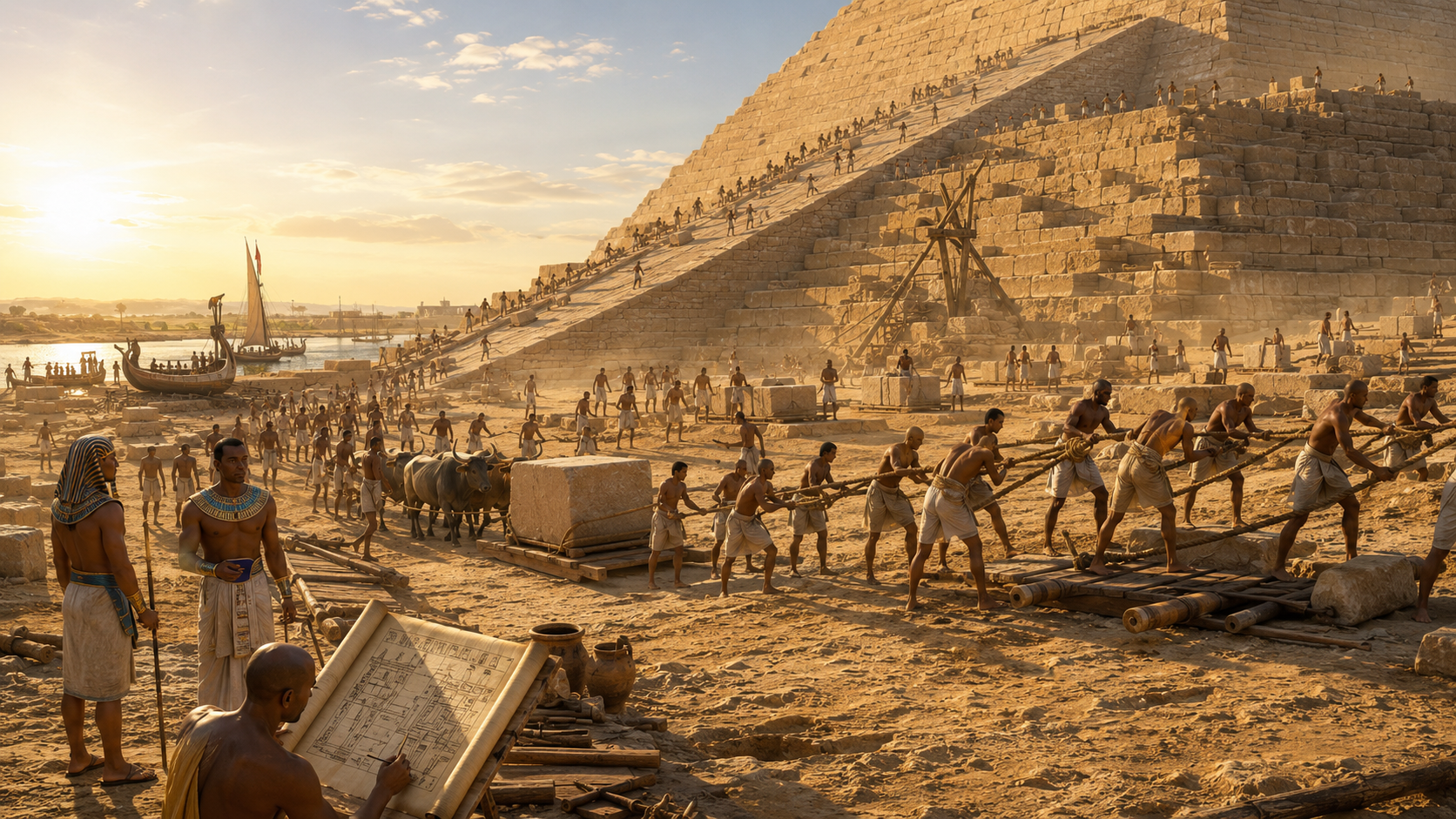
There’s dust everywhere. Ramps of mudbrick and rubble climb the sides. Teams of men haul limestone blocks on wooden sledges while others pour water on the sand ahead of them. Somewhere on the plateau there’s a bakery producing bread at industrial scale, a brewery, a cattle yard, and a settlement housing thousands of workers who need feeding every single day. The households that supplied those rotating crews were registered by the system described in our article on the ancient Egypt census.
There are no aliens. There are no lost technologies. There is a very large number of organised people, a functioning state, and about twenty years.
Here’s what the evidence actually shows — including the parts nobody has solved.
Quick Answer: How Were the Pyramids Built?
The pyramids were built by paid and conscripted Egyptian workers using copper tools, wooden sledges, ramps, and river transport. Limestone was quarried on site and across the Nile, granite was floated from Aswan, and blocks were dragged on sledges over sand that was wetted to reduce friction. The Great Pyramid took roughly twenty years.
(Isko Gutenberg mein “Quote block” ya highlighted box banao — featured snippet ke liye ideal format hai.)
The Process, Step by Step
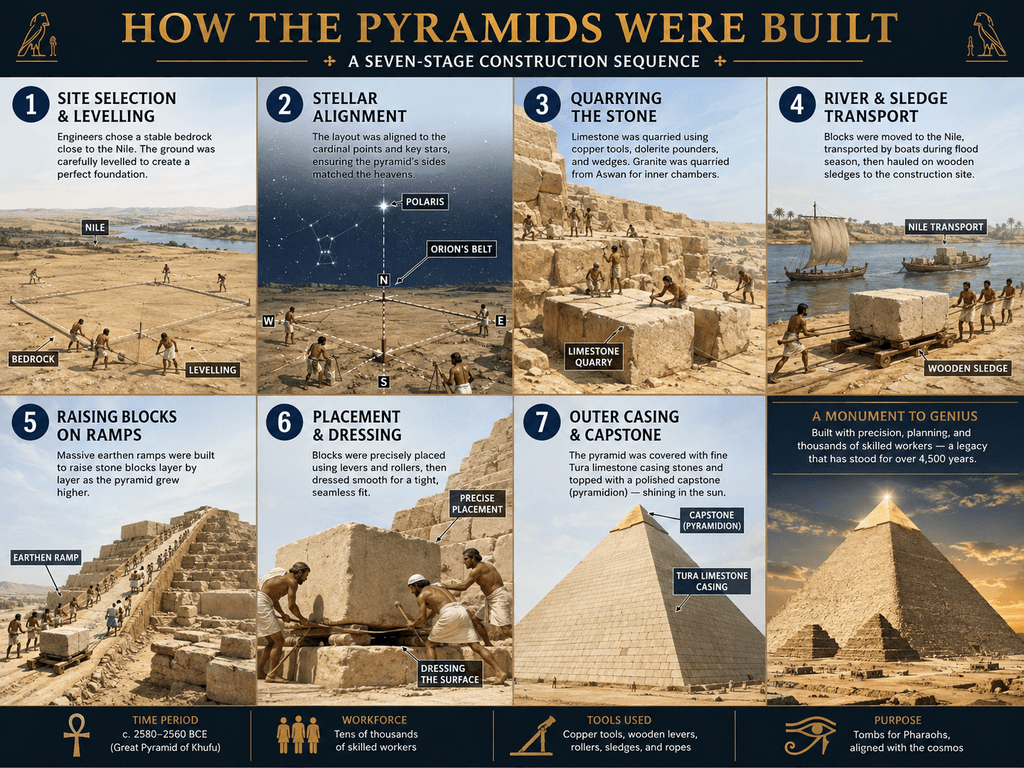
- Site selection and levelling. The Giza plateau was chosen partly because it had its own limestone quarry. The base was levelled to within a few centimetres, possibly using water-filled channels as a reference plane.
- Alignment. The sides were oriented to true north using stellar observation, achieving an error of a small fraction of a degree.
- Quarrying. Core limestone came from the plateau itself. Fine casing limestone came from Tura across the river. Granite came from Aswan, around 800 kilometres south.
- Transport. Stone travelled by barge along the Nile and by wooden sledge overland, dragged across sand that workers wetted to cut friction.
- Raising the blocks. Ramps, in some configuration still debated, carried blocks up the rising structure.
- Placement and dressing. Blocks were manoeuvred with levers and ropes, then the outer casing was smoothed to a finished surface.
- Casing and capstone. The polished white Tura limestone went on last, working downward from the top.
First, Two Myths Worth Clearing Up
Slaves did not build the pyramids
The idea comes from a much later religious narrative, not from Egyptian evidence, and the chronology doesn’t fit — the Giza pyramids predate the period in question by roughly a thousand years.
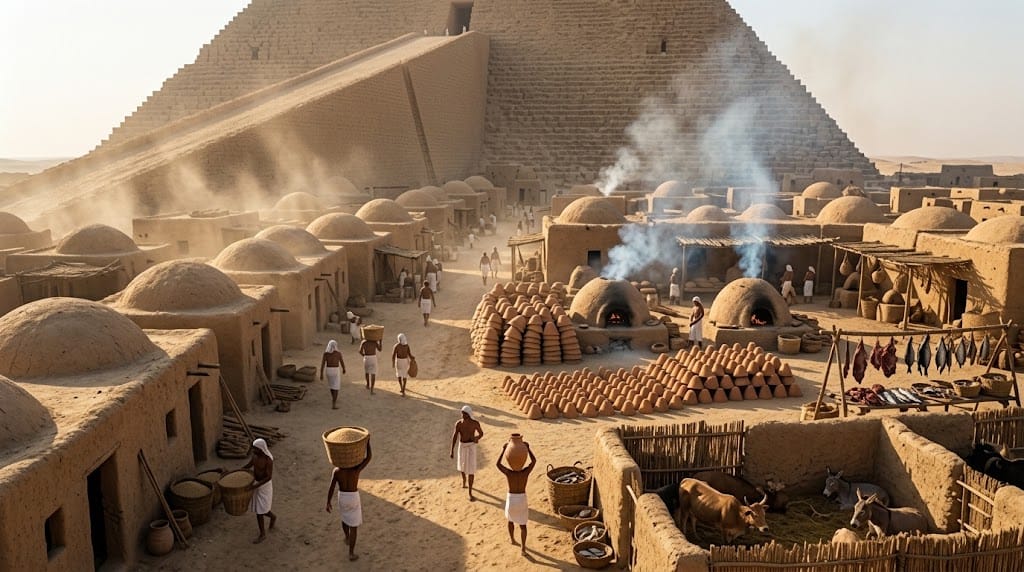
Excavations at Giza uncovered a substantial settlement for pyramid workers, and the finds reshaped the whole discussion. The site included large-scale bakeries, breweries, and enormous quantities of cattle, sheep, and goat bone. Workers were fed meat, regularly.
Skeletal remains from workers’ cemeteries show healed fractures and evidence of medical treatment. Bones were set. Injuries were cared for. Some workers were buried in tombs near the pyramid they built, with grave goods and inscriptions naming their work gangs — names that survive as graffiti inside the monuments, reading as boastful and competitive.
The current picture is a permanent skilled workforce of masons, surveyors, and engineers, supplemented by rotating conscripted labour drawn from villages serving fixed terms. That obligation is exactly what the ancient Egypt census existed to track.
There is no evidence of anything other than human construction
Egypt has produced quarries with tool marks, abandoned half-cut blocks still attached to bedrock, unfinished pyramids showing the internal stages, worker settlements, administrative papyri, and a two-thousand-year record of the technique evolving from mudbrick mastabas to step pyramids to true pyramids.
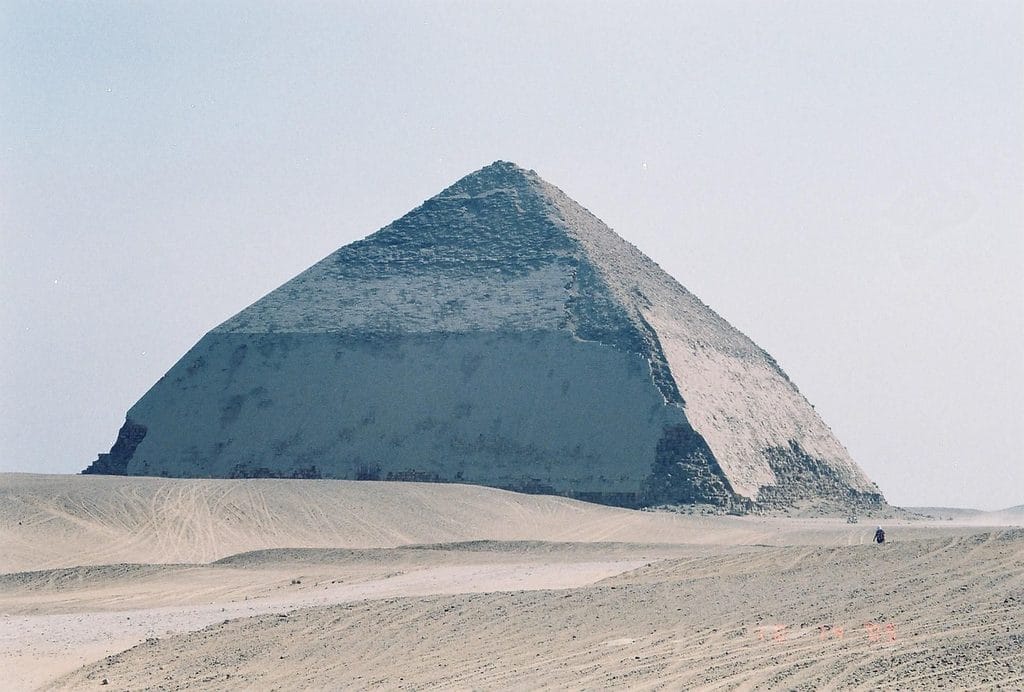
That evolution is the strongest argument of all. The Great Pyramid did not appear from nowhere. It sits at the end of a long chain of experiments, including failures — the Meidum pyramid partially collapsed, and the Bent Pyramid at Dahshur changes angle partway up, apparently because the original slope proved unstable.
Those are the mistakes of people learning a craft.
The Scale of the Problem
The Great Pyramid of Khufu stood roughly 146 metres tall when finished, and about 138 metres today after the loss of its casing and capstone. Our companion article looks in detail at how long the Great Pyramid took to build.
It contains an estimated 2.3 million blocks. Most weigh around 2.5 tonnes. The granite beams roofing the King’s Chamber are far heavier — estimates run from 25 to as much as 80 tonnes.
The base covers roughly 5.3 hectares and is level to within a few centimetres across that entire footprint.
Across a twenty-year build, that averages to placing a block every few minutes of daylight, continuously — while also quarrying, transporting, dressing, and surveying.
A Logbook From the Job Site
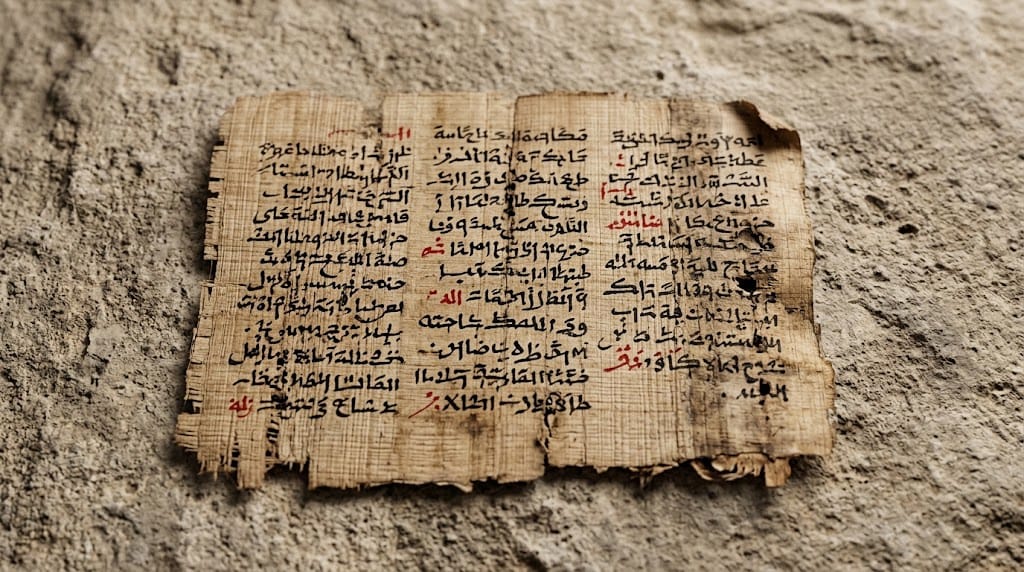
In 2013, a French mission led by Pierre Tallet and Gregory Marouard excavated a Red Sea site called Wadi al-Jarf. In storage caves there they found around thirty papyri — the oldest inscribed papyri ever recovered in Egypt.
They date to the reign of Khufu. One of them is a work diary.
It belonged to a middle-ranking inspector named Merer, who supervised a crew of around two hundred men. His logbook records their daily activities over a period of months. The best-preserved sections describe exactly what his team did: transport fine white limestone by boat from the quarries at Tura, across the river, to the construction site at Giza.
The papyrus records trips, timings, and stops. It is dry and repetitive.
It is also the closest thing we will ever have to an eyewitness account of the Great Pyramid going up, written by someone who was there doing the work.
Quarrying and Transport
Three stones, three sources.
Core limestone came from the Giza plateau itself, from quarries identified only a few hundred metres from the pyramids. This is the bulk of the mass, and it explains the choice of site.
Fine white casing limestone came from Tura, across the Nile. This is what Merer was hauling. Almost all of it was later stripped for medieval building work in Cairo.
Granite for the King’s Chamber came from Aswan, floated downriver on barges.
Limestone was cut with copper chisels and wooden wedges, following natural bedding planes. Granite is far too hard for copper — for that, Egyptians used dolerite pounders, hand-held balls of harder stone, to gradually bruise the surface into shape, with sand as an abrasive under saws and drills.
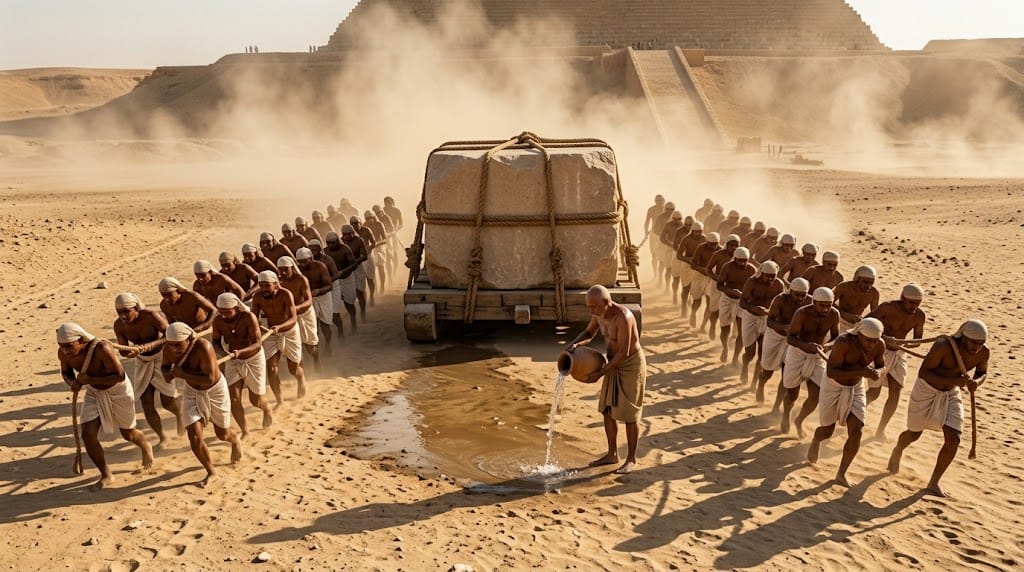
For overland movement there’s good evidence for a specific trick. A wall painting from the tomb of Djehutihotep shows a colossal statue on a sledge, with a man standing at the front pouring liquid onto the sand ahead of it. This was long read as a ritual act.
A physics team at the University of Amsterdam, led by Daniel Bonn, tested it directly and published the results in Physical Review Letters in 2014. Wetting sand to the right degree substantially reduces sliding friction — enough to roughly halve the force needed to pull a loaded sledge. Too little water and nothing changes; too much and it gets worse. There’s an optimum, and the tomb painting appears to show it in use.
The Egyptians were doing applied physics without the vocabulary for it.
The Ramp Problem
Here is where honest uncertainty begins.
Everyone agrees ramps were used. Ramp remains survive at other Egyptian sites. What nobody has established is what kind of ramp was used at Giza, because no substantial ramp survives there.
A single straight ramp is the simplest model, but to keep a workable gradient it would need to be enormous — potentially requiring a volume of material comparable to the pyramid itself.
A spiral ramp wrapping the exterior uses far less material, but makes it difficult to sight the corners during construction, and the corners are exactly what must stay precise.
An internal spiral ramp, proposed by architect Jean-Pierre Houdin, would run inside the outer casing. There are structural anomalies some read as supporting it, but it remains unproven.
Multiple ramps used in stages, with different techniques at different heights, is probably the most realistic answer.
A discovery announced in 2018 added something concrete. At the Hatnub alabaster quarry, a joint team from the University of Liverpool and the French Institute for Oriental Archaeology excavated a ramp flanked by two staircases lined with post holes.
The reconstruction is elegant. A block sits on a sledge. Ropes run from the sledge around wooden posts set into the holes. Workers on the staircases either side pull — and because the rope wraps a post, the system acts as a force multiplier, with some teams able to pull downward while others haul from above.
The excavators reported that this allowed blocks to be pulled up slopes of twenty percent or more, against earlier assumptions that Egyptian ramps wouldn’t have exceeded around ten percent. Inscriptions at the site date the system to Khufu’s reign.
Two caveats matter. Hatnub is an alabaster quarry, not Giza, and the system has not been found at a pyramid site. Some specialists have also questioned whether ropes and posts could handle multi-tonne limestone blocks without fouling on the edges.
So it widens what was possible. It does not close the case. Researchers working on the question are open about the fact that no single ramp model is confirmed.
Precision Without Instruments
The Great Pyramid’s alignment to true north is accurate to within roughly a fifteenth of a degree.
They had no compass. The leading explanation is stellar: Egyptian surveyors watched circumpolar stars and used the moment two specific stars aligned vertically to fix true north. Egyptologist Kate Spence proposed a version using the stars Kochab and Mizar, and it has a useful property — it predicts a small drift in accuracy across successive pyramids that roughly matches what we observe.
For levelling the base, one proposal is that shallow channels were cut into the bedrock and flooded, using the water surface as a reference plane. Water is perfectly level by definition and needs no instrument.
Both explanations are plausible reconstructions rather than proven methods. No Egyptian text describes either.
What We Still Don’t Know
In 2017, the ScanPyramids team imaged the Great Pyramid using muon tomography — cosmic-ray particles that pass through stone and reveal density differences without anyone touching the structure.
They reported a large void above the Grand Gallery in Nature, at least 30 metres long, the first major internal structure identified since the nineteenth century. Follow-up work confirmed a separate corridor-shaped space behind the chevron blocks on the north face.
Nobody knows what either is for. Candidates include relief chambers to redistribute load, features connected to the construction process, or something not yet guessed.
Four and a half thousand years on, the building still has secrets. They just aren’t the ones television usually sells.
Frequently Asked Questions
How were the pyramids built?
Using quarried limestone and granite, copper and stone tools, wooden sledges, ramps, and river barges, worked by an organised labour force over roughly two decades. Blocks were dragged on sledges across wetted sand to reduce friction, then raised on ramps whose exact configuration is still debated.
Who built the pyramids of Egypt?
Paid and conscripted Egyptian workers, not slaves. Excavations at Giza uncovered a workers’ settlement with bakeries, breweries, substantial quantities of meat bone, evidence of medical care, and worker tombs beside the pyramid.
How long did the Great Pyramid take to build?
Roughly twenty years, based on ancient accounts and modern estimates of Khufu’s reign.
How heavy are the pyramid blocks?
Most average around 2.5 tonnes. The granite beams over the King’s Chamber are far heavier, with estimates ranging from 25 to 80 tonnes.
What tools did the Egyptians use?
Copper chisels and wooden wedges for limestone, dolerite pounders and sand abrasive for granite, plus sledges, ropes, levers, and surveying cords.
Do we know how the ramps worked?
No. Ramps were certainly used, but none survives at Giza. Straight, spiral, internal, and staged models have all been proposed. A 2018 find at the Hatnub quarry showed a rope-and-post system capable of far steeper slopes than previously assumed, but it has not been found at a pyramid site.
Is there evidence aliens built the pyramids?
None. There are quarries with tool marks, unfinished blocks, worker settlements, administrative papyri, and a long developmental sequence including structural failures — the record of people learning a craft.
Conclusion
The pyramids don’t need a mystery to be impressive.
What they required was a state capable of feeding thousands of workers for two decades, an administration that could track labour and supply, engineers who understood friction and stellar alignment well enough to use both, and a workforce with enough pride in the job to write their team names inside the stone.
Merer’s logbook is the perfect artefact for it. No drama, no revelation. Just a man recording that his crew moved limestone from Tura to Giza again today.
That’s how the pyramids were built.
This article reflects current archaeological consensus where one exists, and states clearly where it does not. Interpretations of pyramid construction continue to develop as new evidence emerges.
4 Comments