

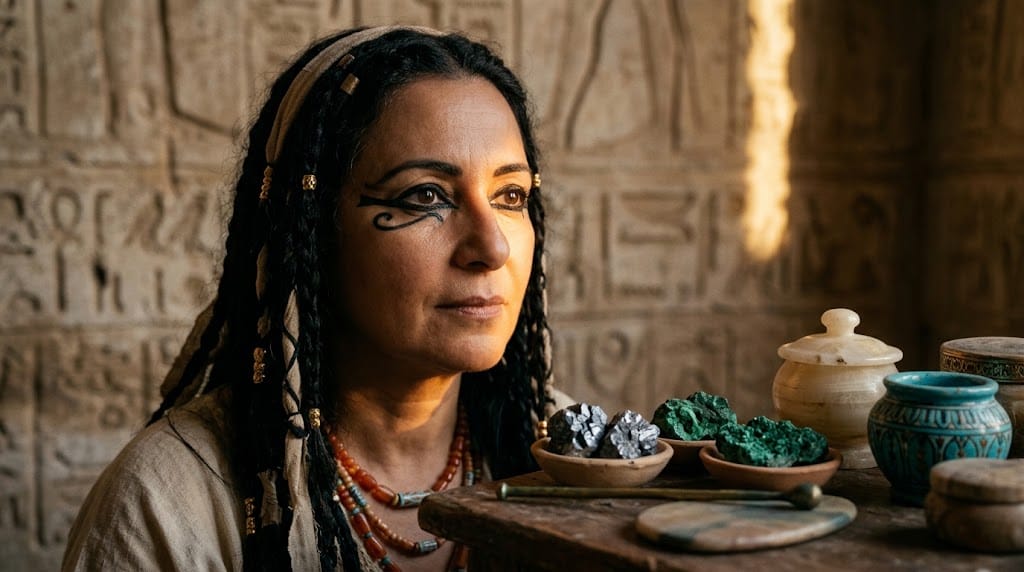
Ancient Egyptian kohl eyeliner was more than cosmetics. Scientists reveal how lead-based makeup actually protected against eye infections through immune stimulation.
Introduction
For thousands of years, ancient Egyptians applied thick, dark eyeliner every single day without exception. Men, women, children—regardless of social class or occupation—incorporated kohl application into their daily grooming ritual. Archaeological evidence shows that this practice was so deeply embedded in Egyptian culture that even pharaohs were buried with containers of kohl, suggesting its importance extended beyond daily life into the spiritual realm.
For centuries, historians and archaeologists interpreted this practice as primarily aesthetic and religious. The dramatic black lines around the eyes, they reasoned, enhanced beauty and served symbolic purposes connected to the sun god Ra and the goddess Hathor. The practice seemed to fit neatly into our understanding of ancient vanity—a civilization investing in appearance much as we do today.
But this interpretation missed something crucial. Recent scientific research has revealed that ancient Egyptian kohl was far more sophisticated than decoration. The formula these ancient peoples developed—through observation, trial, and accumulated wisdom—actually provided measurable health benefits. The daily application of kohl may have functioned as one of humanity’s earliest recorded forms of preventive medicine, embedded so seamlessly into cultural practice that its true purpose was nearly lost to history.
Understanding this shift in scientific perspective reveals something profound about how ancient civilizations solved problems. The Egyptians did not understand bacterial infection or immune response. Yet they discovered a compound that stimulated immune function and protected against eye disease. They encoded this solution into daily practice. They passed the knowledge down through generations. And they did this thousands of years before modern science could explain why it worked.
Note: This article describes a historical practice and the modern research
into it. Lead-based cosmetics are unsafe and are restricted or banned in
modern products for good reason. Nothing here is a health recommendation.
The Ancient Egyptian Practice: Kohl as Universal Daily Ritual
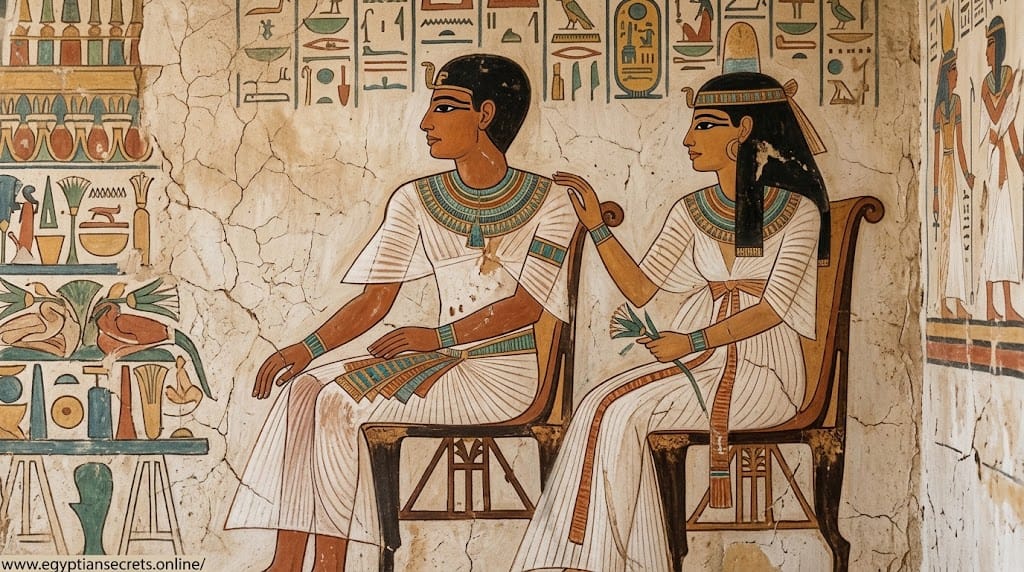
Archaeological evidence provides remarkably detailed documentation of kohl use in ancient Egypt. Cosmetic containers, applicator sticks, and residual deposits have been recovered from tombs across the Nile Valley, dating back to the Old Kingdom (circa 2686-2181 BCE) and continuing through the Ptolemaic period (305-30 BCE). The consistency and standardization of these artifacts across centuries and social classes suggests something far more significant than a passing fashion trend.
Kohl application was not casual or optional. It was ritualized. Historical records and artistic depictions suggest that daily application occurred in the morning, perhaps as part of a broader washing and grooming routine. The intensity and extent of application varied by social class—wealthier individuals and royalty had access to higher-quality formulations—but the practice itself crossed all social boundaries.
Both male and female mummies show evidence of habitual kohl use. Tomb paintings and sculptures from the New Kingdom (1550-1077 BCE) depict men in administrative and military roles wearing kohl, suggesting that far from being exclusively feminine, the practice was considered appropriate and necessary for all adults. Even children’s mummies show evidence of kohl application, indicating that the protection it provided was considered important for young people as well.
This universality is the first clue that kohl served a purpose beyond aesthetic preference. Fashion trends, by definition, are selective and often gender-specific. Practices that serve genuine health functions tend to be universal. The fact that ancient Egyptians across all demographics and social classes applied kohl daily suggests they recognized a benefit that transcended appearance.
The Chemical Composition: What Ancient Kohl Actually Contained
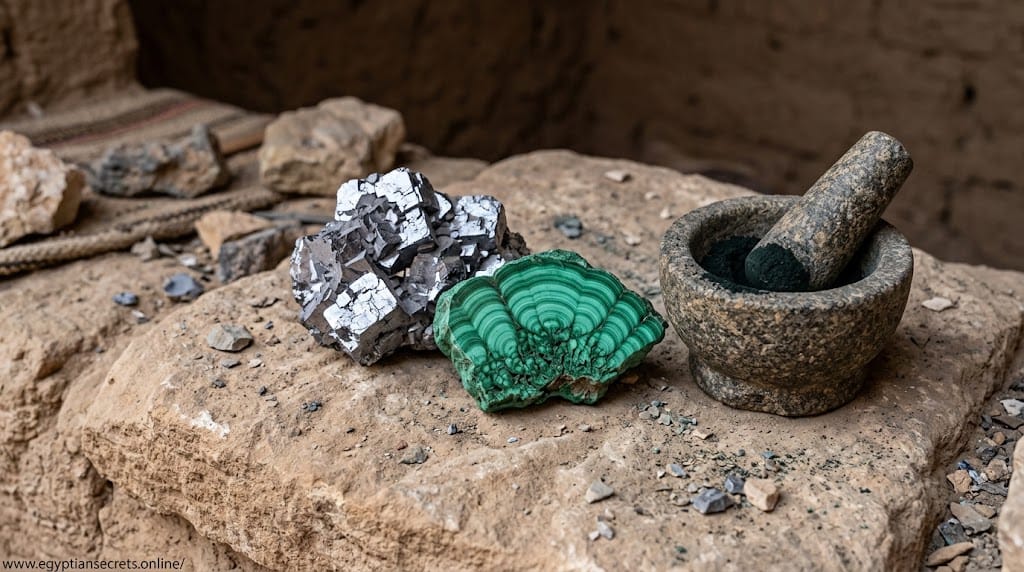
The kohl used in ancient Egypt was more chemically involved than the phrase
“ground mineral powder” suggests.
The most familiar ingredient was galena, a naturally occurring lead sulfide
(PbS). Egypt had accessible deposits in the Eastern Desert and along the Red
Sea coast. Galena was ground to a fine powder and formed the dark base of the
paste.
Egyptians also used malachite, a green copper carbonate mineral, and cerussite,
a lead carbonate. These were blended with oils or animal fats into a paste that
could be applied around the eyes with a stick or fingertip.
But the most interesting components were not natural at all.
When French researchers analyzed samples from 52 kohl containers held at the
Louvre, they identified four distinct lead species. Two of them — laurionite
(PbOHCl) and phosgenite (Pb₂Cl₂CO₃) — are lead chlorides that do not occur in
Egyptian mineral deposits in any meaningful quantity.
The only reasonable explanation is that Egyptians manufactured them.
Reconstructions of the process, supported by recipes recorded by later
Greco-Roman writers, suggest a wet-chemical procedure using lead oxide, rock
salt, natron, and water, worked over a period of weeks. That is not grinding a
rock. That is deliberate chemical synthesis, repeated at scale, to produce a
compound that could not simply be dug out of the ground. The same salt made mummification possible.
The study’s authors described this as the earliest known example of a
large-scale chemical process.
The 2010 Study: What the Chemistry Actually Showed
In January 2010, a team of French researchers — Issa Tapsoba, Stéphane Arbault,
Philippe Walter, and Christian Amatore, working through the CNRS and the École
Normale Supérieure in Paris — published a study in the American Chemical
Society journal Analytical Chemistry.
Their earlier work had established what was in the kohl. This study asked a
different question: what did those compounds do to living tissue?
To find out, the team used a technique called amperometry at single cells. In
practice, this means placing an ultramicroelectrode against an individual
cultured human skin cell and measuring, in real time, the chemical species it
releases. It allows researchers to observe a cell’s response directly rather
than inferring it from bulk samples.
They exposed cultured human keratinocytes — the dominant cell type in the outer
layer of skin — to the lead compounds found in ancient kohl, at the low
concentrations that skin contact would realistically produce.
The cells responded by producing significantly more nitric oxide. The reported
increase was up to 240 percent above baseline.
Nitric oxide matters here because it is one of the body’s key immune signalling
molecules. Among other roles, it helps recruit and activate macrophages, the
white blood cells that consume bacteria. A sustained local increase in nitric
oxide production around the eyes would, in principle, mean a more responsive
local immune environment in exactly the tissue most exposed to infection.
That is the finding. It is worth stating precisely, because it is often
reported more dramatically than the researchers themselves put it.
The Nile River Environment: Why Eye Protection Mattered

To understand why this development was so important, it’s essential to recognize the specific health challenges facing ancient Egyptians living along the Nile River.
The Nile’s ecology, particularly in the delta and the marshy margins of the
river, created conditions in which eye infections spread easily. Warm standing
water left behind after the annual flood, dense settlement along a narrow
habitable strip, shared water sources, and constant exposure to dust and flies
all contributed.
The most significant of these diseases was almost certainly trachoma, a
bacterial infection caused by Chlamydia trachomatis. Trachoma spreads readily
in crowded conditions with limited sanitation, and repeated infection scars the
eyelid, which can eventually lead to blindness. It remains a leading cause of
preventable blindness in similar environments today.
Bacterial conjunctivitis and other ocular infections would have been common
alongside it.
Eye disease was a serious public health concern throughout the ancient world, but particularly acute in Egypt. Historical medical documents, including the Ebers Papyrus (circa 1550 BCE) and the Edwin Smith Papyrus (circa 1600 BCE), contain numerous remedies and treatments for eye diseases. This documentation suggests that eye infections and vision problems were common enough to warrant detailed medical attention.
In this context, a daily preventive measure that reduced infection risk would have provided significant survival value. Children and elderly individuals, both groups particularly vulnerable to severe eye infections, would have benefited most from enhanced immune protection. The documented application of kohl to children and the elderly supports this interpretation—cultures tend to target preventive practices to vulnerable populations.
What the Researchers Did and Did Not Claim
The team was explicit about the limits of their conclusion.
They did not claim that Egyptians manufactured laurionite because they
understood it had antibacterial properties. They said the opposite — that such
a claim cannot be supported.
What they proposed instead is more modest and, arguably, more interesting.
Egyptian preparers may have noticed, over generations, that batches of kohl
containing a particular white precipitate were associated with better eye
health among the people using them. Having noticed the correlation, they then
worked out how to produce that precipitate deliberately and in quantity.
The researchers compared this to the histories of penicillin, aspirin, and
quinine — cases where a practical effect was observed and exploited long before
anyone could explain the mechanism.
This is empirical medicine: knowledge built from repeated observation rather
than theory. It does not require the Egyptians to have understood bacteria,
immune cells, or lead chemistry. It only requires them to have paid close
attention over a very long time.
Why a Small Amount of Lead Might Have Helped
The idea that a lead compound could be protective sits uncomfortably against
everything modern medicine says about lead. The distinction is dose and route.
Lead is unambiguously toxic in the quantities associated with poisoning —
ingested, inhaled, or accumulated over time in the bloodstream and bone. That
is not what is being described here.
What the 2010 study measured was a local response in skin cells to very low
concentrations. At that scale, the lead ions did not kill the cells. They
triggered them to release nitric oxide.
This kind of biphasic response, where a substance produces one effect at low
concentration and a very different one at high concentration, is common in
toxicology and pharmacology. A great many useful compounds are dangerous at the
wrong dose.
The copper in malachite may have contributed as well. Copper has genuine
antimicrobial activity, and copper surfaces are used in modern hospital settings
for that reason.
So the plausible picture is a dual effect at the site of application: local
immune signalling raised by the lead compounds, and some direct antimicrobial
action from the copper — concentrated precisely on the eyelids and the skin
around the eyes, which is where the exposure risk was highest.
It should be said clearly that this is a proposed mechanism supported by
laboratory work on cultured cells. It is not the same as a clinical trial
showing reduced infection rates in a population, which is not something that
can be run on a civilization that ended two thousand years ago.
From Vanity to Medicine: Reinterpreting Ancient Egyptian Cosmetics
This scientific revelation requires us to reconsider how we interpret ancient practices more broadly. The assumption that cosmetics are purely aesthetic is modern. In many ancient cultures, appearance and medicine were not separate domains.
Kohl application in ancient Egypt likely served multiple purposes simultaneously. It enhanced appearance—the dramatic dark lines were considered beautiful by Egyptian aesthetic standards. It held religious significance—the eye of Ra and Hathor symbolism connected beauty to divine power. And it provided health protection—the daily application prevented eye disease. Both are covered in our guide to the ancient Egyptian gods.
These purposes were not contradictory. They were integrated into a single practice that served physical, aesthetic, and spiritual needs simultaneously. This integration suggests a sophisticated understanding of how ritual, appearance, and health could be unified.
This reinterpretation also places Egyptian practices within a broader pattern of ancient medicine. The Egyptians developed surgical techniques documented in medical papyri. They used herbal remedies for various ailments. They practiced trepanation (skull surgery) with a success rate that suggests genuine medical knowledge. They bandaged wounds with honey (which, as modern science has confirmed, has antimicrobial properties).
Kohl, in this context, represents one more example of a civilization developing practical health solutions through observation and experimentation, thousands of years before the scientific theory behind those solutions was discovered.
The Broader Pattern
This pattern shows up repeatedly in Egyptian practice.
Honey was applied to wounds, and modern research confirms that honey does have
real antimicrobial properties — the same chemistry that explains why sealed
honey from Egyptian tombs has not spoiled. Willow bark appears in Egyptian medical texts as a treatment for pain. It contains salicin, the compound from which aspirin was eventually derived. Natron, the mineral salt that made mummification possible, works as a
preservative because it draws water out of tissue and inhibits bacterial growth
— a property Egyptians exploited for three thousand years without being able to
explain it. Our article on ancient Egyptian honey looks at another case where modern chemistry confirmed what Egyptians worked out by observation.
In each case the sequence is the same. Observe an effect. Refine the method.
Encode it in ritual or routine so that it survives across generations. The
theory arrives thousands of years later, if at all.
Why This Is Not an Endorsement of Kohl Today
None of this makes lead-based kohl safe.
By modern standards, daily application of a lead compound to the skin around
the eyes would exceed accepted exposure limits. Lead accumulates in the body
over time, and its effects on the nervous system, particularly in children, are
well established. Cosmetic regulators in most countries restrict or prohibit
lead in beauty products, and they are right to.
The reason the calculation looked different in ancient Egypt is that the
alternative was worse. In a society without antibiotics, clean water systems,
or eye surgery, a serious eye infection could mean permanent blindness. Against
that risk, a small chronic exposure to lead was a trade a population might make
without ever consciously framing it as a trade.
That situation no longer exists. Antibiotics, sanitation, and modern
ophthalmology have removed the threat kohl was addressing. The benefit side of
the equation has effectively gone to zero while the risk side has not moved.
Lead-based kohl is still sold in some markets and has been linked to elevated
blood lead levels, particularly in children. It should not be used.
Archaeological Evidence: Cosmetic Containers and Burial Practices
Physical archaeological evidence supports the importance of kohl in Egyptian society. Cosmetic containers—small vessels made of stone, ceramic, or faience—have been recovered from tombs across Egypt and across multiple time periods. The consistency of these objects across centuries and social classes indicates a continuous, important practice.
Applicators for kohl application, typically made from wood or bone with rounded ends, appear in tomb assemblages. These tools were often carefully crafted and decorated, suggesting they held significance beyond mere functional necessity.
The inclusion of kohl containers among burial goods is particularly telling. Egyptians buried their dead with objects they believed would be needed in the afterlife. The consistent inclusion of cosmetics and kohl alongside items like sandals, clothing, and tools suggests that Egyptians viewed appearance maintenance (and by extension, the health benefits of kohl) as relevant even in the spiritual realm.
Royal burials contain particularly elaborate cosmetic containers and kohl applicators, often made from precious materials like alabaster or faience. This suggests that kohl was valued as an important substance worthy of resources and artisanal attention.
Frequently Asked Questions (FAQ)
Q: Did ancient Egyptians understand that kohl was a medical treatment?
A: Not in the modern sense. The researchers behind the 2010 study were careful on
this point — they proposed that Egyptians noticed a correlation between certain
kohl batches and better eye health, and then deliberately reproduced the
compound responsible. That is empirical observation, not an understanding of
immunology.
Q: What did the 2010 study actually find?
A: Researchers exposed cultured human skin cells to the lead compounds present in
ancient kohl and measured the response using amperometry at single cells. The
cells increased their production of nitric oxide by up to 240 percent. Nitric
oxide is an immune signalling molecule that helps activate macrophages, the
cells that consume bacteria.
Q: Was the lead in kohl dangerous to ancient Egyptians?
A: By modern safety standards, yes. However, the benefit of preventing eye infections in an environment where such infections were endemic and potentially blinding may have outweighed the long-term toxicity risk. The cost-benefit calculation was different in ancient Egypt than it would be today.
Q: Did only women wear kohl in ancient Egypt?
A: No. Archaeological evidence and artistic depictions clearly show that men, women, children, and even some representations of divine figures wore kohl. It was a universal practice across gender and age.
Q: Are there other examples of ancient Egyptian health practices that science has since validated?
A: Yes. Honey for wound treatment, willow bark for pain relief, natron for antimicrobial preservation, and various herbal remedies have been validated by modern science. This suggests a pattern of empirical medicine development in ancient Egypt.
Q: Should modern people use lead-based kohl?
A: Absolutely not. Modern occupational health standards restrict lead exposure, and there is no medical need for lead-based cosmetics in modern contexts. This is a historical observation about ancient practice, not a health recommendation.
Q: How do historians know ancient kohl contained galena and malachite?
A: Chemical analysis of kohl residues from 52 containers in the Louvre collection
identified four lead species: galena, cerussite, phosgenite, and laurionite.
The last two are lead chlorides that don’t occur naturally in Egyptian deposits,
which indicates the Egyptians synthesised them deliberately.
Q: What are laurionite and phosgenite?
A: Two lead chloride compounds found in ancient Egyptian kohl that do not occur
naturally in Egypt. Their presence indicates deliberate manufacture, probably
using lead oxide, rock salt, natron, and water. Researchers have described this
as the earliest known example of a large-scale chemical process.
Conclusion: Ancient Wisdom and Modern Science
The story of ancient Egyptian kohl is not really about vanity, and it is not
quite about medicine either. It is about what a civilisation can work out
through sustained attention.
Egyptian preparers had no theory of infection and no concept of an immune
system. What they had was several thousand years of watching, comparing, and
adjusting — and a willingness to go to considerable trouble, synthesising a
compound over weeks, when the simpler version would have been to just grind up
a rock.
The fact that this solution was embedded in a cultural practice—daily grooming, aesthetic enhancement, and religious ritual—meant it persisted for thousands of years. Every generation inherited the practice. Every generation reinforced it. And it worked.
Modern science eventually provided the theoretical explanation for what the Egyptians knew empirically. Lead compounds did stimulate immune response. Copper compounds had direct antimicrobial effects. The Nile’s bacteria were indeed a health threat. The practice was protective.
Recognizing this pattern—of ancient peoples developing practical solutions before understanding their mechanism—reshapes how we view ancient medicine and ancient knowledge more broadly. It suggests that vanity and medicine, appearance and health, spirituality and pragmatism were not separate domains in ancient Egypt. They were integrated into practices that served multiple purposes simultaneously.
And it reminds us that some of humanity’s most sophisticated problem-solving is ancient. We are only now, with modern scientific tools, learning to read the solutions that previous generations developed and passed down.



2 Comments