
Discover why honey from Tutankhamun’s tomb sealed 3,000 years ago remains edible. Learn the three scientific defenses that make honey nature’s perfect food preservative.
Introduction
When archaeologist Howard Carter opened Tutankhamun’s tomb in 1922, his team discovered something that defied conventional wisdom about food preservation. Inside sealed alabaster jars sat thick, golden honey not crystallized remnants or oxidized residue, but substance that, by every chemical measure, was still honey. Three thousand years of being sealed in an Egyptian burial chamber, and it remained sweet. Remarkably, it remained edible.
The discovery raised an immediate question that still fascinates modern scientists, archaeologists, and history enthusiasts: How is this possible?
This question leads to an answer far more elegant than any preservation technique humans have engineered. The solution lies not in the Egyptian tomb itself, though the tomb played a crucial supporting role. Instead, the answer exists in the remarkable chemistry that honeybees encode into every drop of honey they produce. Understanding why ancient Egyptian honey survives millennia reveals something profound about nature’s problem-solving abilities and about how ancient civilizations understood preservation long before modern science could explain it.
The Tutankhamun Discovery: Ancient Honey That Survived the Ages
Tutankhamun, the Egyptian pharaoh who ruled approximately 1332-1323 BCE, died at roughly eighteen years old. His burial chamber, hidden in the Valley of the Kings, remained undisturbed for more than 3,200 years until Carter’s expedition broke the seal in November 1922. The discovery sent shockwaves through the archaeological world not only because of the tomb’s contents but because of what those contents revealed about ancient Egyptian culture, craftsmanship, and daily life.
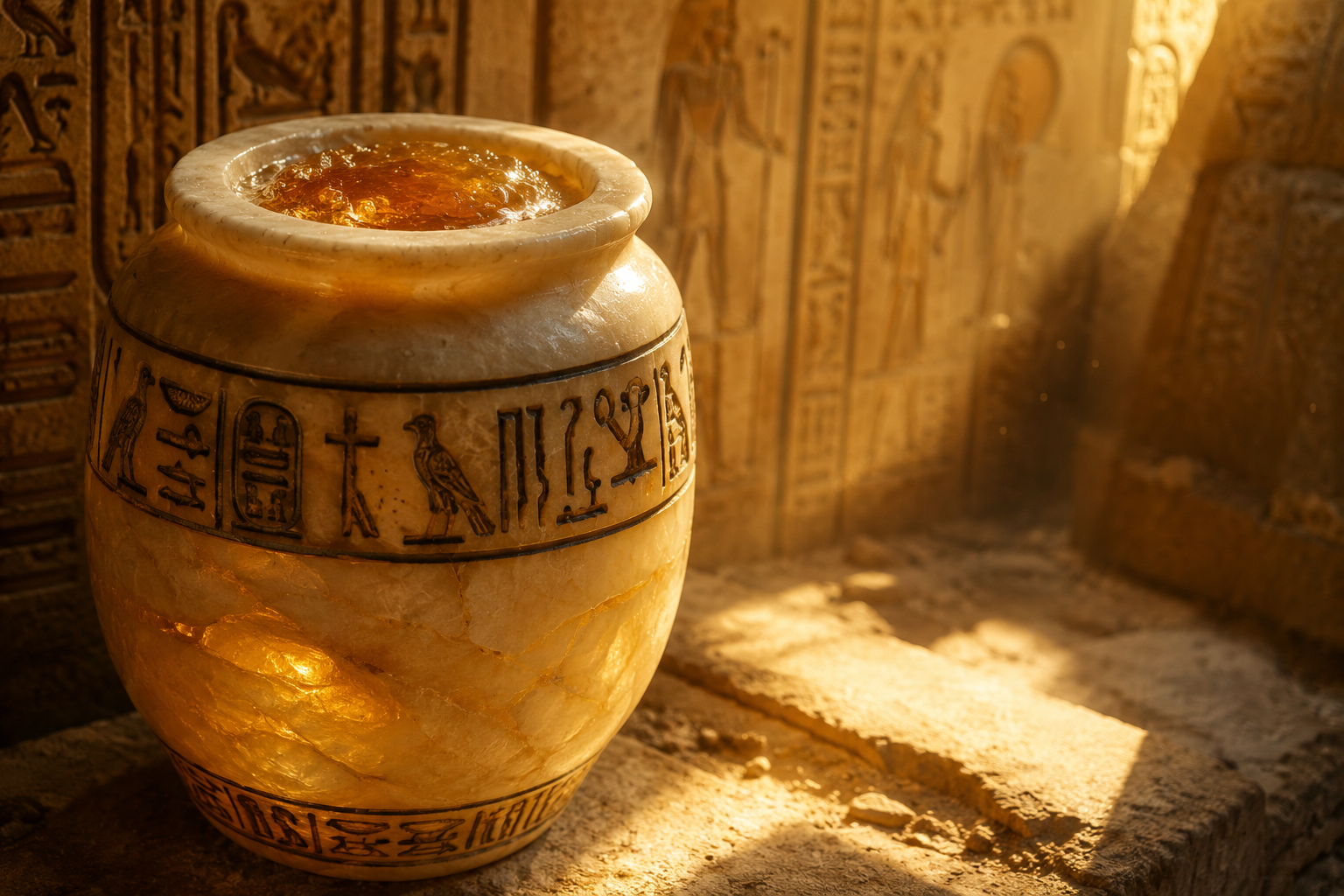
Among the thousands of artifacts catalogued were sealed containers holding honey. The jars themselves were crafted from alabaster, a soft, white stone prized by ancient Egyptians. The containers were stoppered with clay and sealed intentionally preserved as funerary offerings for the pharaoh’s journey into the afterlife.
Over a century later, chemical analysis of honey recovered from sealed Egyptian tombs confirms an astonishing fact: the honey remains chemically intact. The sugars have darkened slightly and crystallized, the volatile aromatic compounds have diminished, but the fundamental structure—the very thing that makes honey honey persists unchanged.
This isn’t a folk tale or an exaggeration passed down through generations. It’s documented scientific fact, verified by modern chemical analysis and peer-reviewed research.
How Honey Achieves Perfect Preservation: The Three-Defense System
Honey is, biochemically speaking, one of the few foods on Earth that does not spoil when sealed and kept dry. A single jar of honey, undisturbed in stable conditions, can outlast entire civilizations. The reason is not a single defense mechanism but rather a remarkable stack of three overlapping biological strategies that honeybees engineer into the substance during production. Any one of these defenses alone would be sufficient to prevent most bacterial and fungal growth. Together, they create an environment so hostile to microbial life that virtually nothing biological can survive.
The First Defense: Water Removal and Osmotic Pressure
When honeybees forage for nectar, they collect liquid that contains a high percentage of water—sometimes as much as 70% or more. Back inside the hive, worker bees pass this nectar from one bee to another through mouth-to-mouth contact, adding enzymes from specialized glands in their heads as they do. The nectar is regurgitated and ingested multiple times during this process.
Once the nectar reaches its final processing stage, bees fan it with their wings. This sustained fanning removes water through evaporation, concentrating the nectar until the water content drops to approximately 17-18% of the final honey’s composition. This specific water content level is critical.
At such low water content, honey becomes fundamentally inhospitable to microbial life. Bacteria and fungi require free water to grow specifically, water that exists independent of other chemical compounds. In honey, sugar molecules (primarily fructose and glucose) are packed at such high concentrations that they bind water molecules through osmotic pressure.
When a bacterial cell lands on honey’s surface, the osmotic gradient pulls water out of the microorganism’s cell membrane. The water moves out of the bacterial cell and into the sugar solution. This process is called freeze-drying, though no freezing is involved. The bacterial cell literally desiccates from the inside out, and the cell membrane collapses.
This is the same preservation principle that humans have used for centuries in curing meat with salt and preserving fruit in heavy syrup. Humans simply learned to copy what bees already understood. Honey executes this principle more efficiently than almost any food preservation method humans have engineered.
The Second Defense: Acidity That Stalls Microbial Metabolism
Beyond water content, honey possesses another formidable defense: acidity. The pH of honey typically ranges between 3.2 and 4.5, placing it somewhere between the acidity of orange juice (pH 3.3) and vinegar (pH 2.4). This acidic environment is hostile to most pathogens that threaten human food safety.
The acidity in honey comes primarily from gluconic acid, a compound produced when the enzyme glucose oxidase breaks down glucose in the original nectar. This enzyme is secreted by specific glands in the bee’s body and introduced during the nectar-to-honey conversion process.
Most bacterial pathogens that concern food safety specialists—Salmonella, E. coli, Listeria, and Clostridium species among them prefer neutral pH environments, ideally near pH 7. When these microorganisms are exposed to honey’s pH of 4, their metabolic processes stall. The acidic environment disrupts the ionic balance that these organisms need to function. Their enzyme systems, which evolved to work in neutral conditions, malfunction in acidic conditions.
When you combine this acidic environment with the osmotic stress from the high sugar concentration, the few microorganisms hardy enough to survive one defense get overwhelmed by the other. It’s a one-two punch of inhospitable conditions.
What’s particularly remarkable is that while acidity alone is not unusual—lemon juice is more acidic than honey—what makes honey exceptional is this acidity layered on top of near-zero free water and high sugar concentration. The combination creates a uniquely antimicrobial environment.
The Third Defense: Hydrogen Peroxide Production
The third and strangest defense is the hydrogen peroxide mechanism. The same glucose oxidase enzyme that produces gluconic acid as a byproduct also generates hydrogen peroxide—the very same compound sold in brown pharmacy bottles as a wound disinfectant.
In raw honey, hydrogen peroxide is produced slowly and continuously, especially when the honey comes into contact with a small amount of water. This is exactly what happens when honey is applied to a wound or when it contacts contaminated surfaces. The enzyme, dormant in dry honey, becomes activated in the presence of moisture, and begins producing hydrogen peroxide at low but lethal concentrations for most bacteria.
The concentrations are not high enough to harm human tissue, but they are sufficient to kill bacteria that might have survived the osmotic and acidic defenses. This is a targeted antimicrobial system that activates only when conditions suggest contamination.
Researchers writing in The Conversation have noted that this three-part defense system was likely unknown to ancient healers, yet they recognized honey’s remarkable healing properties long before modern chemistry could explain the mechanism.
Ancient Egyptian Medicine: The Empirical Knowledge That Preceded Modern Science
The ancient Egyptians did not understand glucose oxidase. They could not have known about osmotic pressure or the biochemistry of hydrogen peroxide generation. Yet they recognized something that modern science has since confirmed: honey healed wounds in ways that other treatments could not.
Historical evidence of this knowledge appears in one of archaeology’s most significant medical documents: the Edwin Smith papyrus, acquired by the Egyptologist Edwin Smith in Luxor in 1862. This papyrus dates to approximately 1600 BCE roughly 300 years after Tutankhamun’s reign and is widely considered the oldest known surgical manual in human history.
Throughout this medical text, honey appears repeatedly. It is recommended for treating burns, cuts, and infected wounds. The papyrus directs physicians to smear honey on bandages before applying them to injuries. The Egyptians had observed, through centuries of empirical medical practice, that wounds treated with honey did not fester. They healed better. They became infected less frequently.
This observation predates modern germ theory by more than 3,000 years. The Egyptians could not have articulated the concept of bacteria or understood why honey worked. They simply noted that it did work, and they incorporated it into their medical practice.
This pattern—empirical observation leading to effective practice before theoretical understanding catches up—appears repeatedly throughout human history. The ancient Egyptians possessed practical wisdom that modern science would later validate.
Why Egyptian Tombs Created the Perfect Preservation Environment
The chemical properties of honey explain why it can theoretically remain edible indefinitely if properly sealed. But why did Tutankhamun’s specific honey last three thousand years? The answer involves both the honey’s chemistry and the tomb’s architecture.
Honey will absorb water from humid air if left unsealed. If the water content rises sufficiently, dormant wild yeasts present in the honey can activate and begin fermenting the sugars. This fermentation process disrupts the very chemistry that made honey preservation-proof in the first place, and the honey begins to spoil.
Egyptian tomb builders, intentionally or not, created near-perfect preservation chambers. They used thick ceramic jars, often coated inside with beeswax or resin to prevent absorption. The jars were stoppered with clay and sealed. These jars were then placed in burial chambers cut deep into limestone bedrock.
These underground chambers possessed several characteristics that made them exceptional preservation environments: they were dark (preventing any photodegradation), cool relative to the Egyptian surface (slowing chemical reactions), and sealed against outside air. Critically, humidity inside a closed tomb maintains remarkable stability over long periods. The humidity doesn’t fluctuate wildly with seasons or weather changes.
Under these conditions, the honey had nothing to absorb and nothing to react with. The sugars slowly darkened and underwent a browning reaction called the Maillard reaction (the same process that browns bread crust or caramelizes sugar). Some volatile aromatic compounds—the components that give fresh honey its perfume—drifted off or underwent slow chemical changes. But the fundamental structure held: sugar bound to almost no water, acidic, mildly antiseptic.
Whether any particular archaeologist actually tasted any particular jar from Tutankhamun’s tomb is difficult to verify with historical certainty, and such anecdotes deserve skepticism. What is beyond doubt is that honey recovered from sealed Egyptian contexts has been subjected to modern chemical analysis and been found chemically intact. Modern honey stored in similar conditions would behave identically.
Also Read :- How Long Did It Take to Build the Great Pyramid of Giza?
The Broader Preservation Legacy: More Than Just Honey
The remarkable preservation conditions inside Egyptian tombs extended far beyond honey. Recent chemical analysis of mummies themselves has revealed another striking discovery.
In 2026, a research team analyzing nine mummies stored at the Egyptian Museum in Cairo conducted mass spectrometry analysis of the embalming materials and wrappings. They detected aromatic signatures—scent compounds from the original embalming oils, resins, and waxes—still present and measurable after more than two thousand years.
Researchers identified recognizable notes of pine resin, juniper, and animal fats at concentrations that permitted identification. The molecules had not degraded into unrecognizable compounds; they remained structurally intact.
This discovery reinforces an important principle: the sealed, dark, cool, stable-humidity conditions inside an Egyptian tomb constitute, essentially by accident, one of the most effective long-term archival environments humans have ever built. Industrial cold storage facilities, climate-controlled museum vaults, and sophisticated preservation laboratories all serve similar functions, but ancient Egyptians achieved comparable results through careful tomb construction and sealing practices.
Why This Preservation Doesn’t Work for Other Foods
Honey’s ability to remain edible indefinitely raises a natural question: Why can’t other foods be preserved this way?
The answer lies in honey’s unique chemical composition. Most foods contain sufficient water, fat, or protein to provide sustenance for something—bacteria, fungi, insects, or the chemical processes of oxidation and degradation.
Grain, for example, remains dry when stored, yet it develops insect infestations and mold because it contains enough nutrients and moisture to support these organisms’ growth. Dried meat oxidizes and turns rancid as the fats in the meat break down through exposure to oxygen, altering both flavor and nutritional quality. Wine, even when sealed in ideal conditions, slowly undergoes chemical reactions that change its composition over decades and centuries. The wine doesn’t spoil, but it transforms into something different.
Honey, by contrast, is almost pure sugar with only trace amounts of enzymes and acids. There is virtually nothing in honey that can oxidize meaningfully. There is almost no water for microbes to access. There is no fat to spoil. The sugars themselves can undergo browning reactions over many decades, gradually darkening color and shifting flavor toward caramel and molasses, but these chemical changes do not render the honey unsafe for consumption.
This is why honey is unique. Its composition is such that biological decay and chemical degradation have almost no substrate to work with. It is a food stripped to its essential component—stored energy in the form of sugar—without the supporting molecules that typically fuel spoilage.
Honey’s Antimicrobial Power: Diminishing with Age but Never Disappearing
It’s important to note that honey’s antimicrobial potency is not static over time. A 2024 study reviewed by News-Medical found that fresher honey tends to demonstrate stronger antibacterial activity than older honey. The reason relates to the third defense mechanism—hydrogen peroxide generation.
The glucose oxidase enzyme, which produces hydrogen peroxide, slowly degrades over centuries. The steady trickle of hydrogen peroxide produced in response to moisture weakens as the enzyme population diminishes. After three thousand years, three-thousand-year-old honey would not be as effective as fresh honey as a wound dressing or antimicrobial agent.
However, this does not mean old honey becomes dangerous. The osmotic defense—based on water content and sugar concentration—does not depend on a living enzyme and therefore does not degrade. The acidity, similarly, remains essentially stable. These two defenses continue to prevent microbial growth indefinitely.
Modern honey producers have discovered interesting variations in this principle. Manuka honey from New Zealand, prized in contemporary wound care applications, derives much of its antimicrobial potency from a different compound called methylglyoxal, which is produced as nectar from the manuka tree breaks down during honey production. This compound is more chemically stable than hydrogen peroxide and therefore maintains stronger antimicrobial activity over longer periods. Most floral honeys, by contrast, rely primarily on the hydrogen peroxide route and therefore lose some antimicrobial punch with age.
The Sensory Experience of Ancient Honey
What would ancient honey actually taste like if a sealed jar from Tutankhamun’s tomb were opened today?
Modern honey varies dramatically based on what plants the bees foraged on. Orange blossom honey is light and delicate. Buckwheat honey is dark and almost meaty. Eucalyptus honey carries mentholated notes. These flavor profiles are determined by the plants available during the nectar flow.
Ancient Egyptian bees foraged on flowers and plants that grew along the Nile River valley—lotus flowers, acacia trees, clover, and various wildflowers that bloomed along the irrigated edges of the river.
A jar of ancient Egyptian honey opened today would have undergone dramatic changes in appearance. The original amber color would have darkened to deep brown. The texture would be heavily crystallized—closer to wet sand than syrup. The bright top notes—the volatile aromatic compounds that give fresh honey its characteristic perfume—would largely be gone.
What would remain would be pure sugar, minimal water, gluconic acid, traces of pollen from the original flowers, and the slow Maillard-brown residue of three thousand years of quiet chemistry. It would still be sweet. It would still, by any reasonable definition, be food.
The bees that made this honey have been dust for longer than most written languages have existed. The civilization that stored it has fallen and risen again in different forms countless times over. Yet the work of their wings and their enzymes—the three defenses encoded into every molecule of glucose and fructose—still holds the line against time.
Key Takeaways: What Ancient Honey Teaches Us About Science and History
Understanding why ancient Egyptian honey remains edible after three thousand years teaches several important lessons:
First, it demonstrates the elegance of nature’s problem-solving. The three-part defense system is so effective that humans have struggled to engineer anything more efficient.
Second, it illustrates how ancient peoples understood practical solutions long before modern science could explain the underlying chemistry. The Egyptians knew honey healed wounds. Modern science has explained why.
Third, it shows the importance of environmental conditions in preservation. The chemistry of honey is crucial, but the sealed, cool, dark, stable conditions of the tomb were equally essential.
Fourth, it expands our understanding of archaeological evidence. Objects we recover from ancient sites preserve in ways we often take for granted. Understanding preservation mechanisms helps us interpret what we find.
Finally, it reminds us that some of nature’s most sophisticated solutions to the problem of preservation predate human civilization by millions of years. Honeybees have been producing this three-part defense system for tens of millions of years. We are simply beginning to understand what they have always known.
Frequently Asked Questions (FAQ)
Q: Is honey from Tutankhamun’s tomb actually edible today?
A: Honey recovered from sealed Egyptian contexts has been chemically analyzed and found intact. However, specific anecdotes about particular archaeologists tasting it should be treated with skepticism. What is certain is that the chemical composition remains that of honey, and modern honey stored in similar conditions would behave identically.
Q: Why doesn’t honey need to be refrigerated?
A: Honey’s low water content, acidic pH, and hydrogen peroxide production make it inhospitable to microbial growth at any temperature. Refrigeration is unnecessary for properly sealed honey.
Q: Can honey go bad?
A: Honey can absorb water from humid air if left unsealed, potentially allowing fermentation. If properly sealed in dry conditions, honey can remain edible indefinitely.
Q: Did ancient Egyptians understand the chemistry of honey preservation?
A: No, but they understood through empirical observation that honey healed wounds effectively. Modern science has since explained the biochemical mechanisms.
Q: How long does honey last?
A: Properly sealed honey can last indefinitely. Archaeological evidence demonstrates this fact.
Conclusion
Three thousand years ago, workers in an Egyptian hive produced honey. Beekeepers collected it. Administrators stored it in sealed jars. It was placed in a tomb as a funerary offering. The civilization that built the tomb rose to magnificence and fell. Empires rose and fell around it. Yet the honey remained—unchanged in its essential chemistry, still sweet, still edible.
This remarkable preservation is not magic. It is elegant, sophisticated chemistry developed over millions of years of evolution, refined by an insect that weighs less than a gram. Understanding why honey lasts—understanding the three defenses that make it nearly indestructible—is to understand something profound about how nature solves problems.
And it is a reminder that ancient peoples, lacking modern science, understood through careful observation how to work with nature’s solutions. Their honey remains, three thousand years later, as a testament to both their practical wisdom and the extraordinary achievements of the honeybee.